
BuddhistCatholicContemplativeEvangelicalGeneral ChristianHinduJewishLatter-day SaintMuslimNew VisionsProgressive Christian
Beliefs
- Buddhist
- Catholic
- Contemplative
- Evangelical
- General Christian
- Hindu
- Jewish
- Latter-day Saint
- More Voices
- Muslim
- New Visions
- Pagan
- Progressive Christian
Topics
- Religion News
- Food and Religion
- Sports and Religion
- Religious Art
- Religious Music and Entertainment
- Religious Events
- History and Religion
- Style and Religion
- Politics and Religion
- Women in Religion
- Recreation Outdoors and Religion
- Business Finance and Religion
- Careers Workplace and Religion
- Education and Religion
- Family Parenting and Religion
- Health Fitness and Religion
- Home and Religion
- Relationships and Religion
- Technology and Religion
- Travel and Religion
Columnists
- Buddhist Columnists
- Business Finance and Religion Columnists
- Careers Workplace and Religion Columnists
- Catholic Columnists
- Contemplative Columnists
- Education and Religion Columnists
- Evangelists Columnists
- Family Parenting and Religion Columnists
- General Christian Columnists
- Health Fitness and Religion Columnists
- Hindu Columnists
- History and Religion Columnists
- Home and Religion Columnists
- Jewish Columnists
- More Voices Columnists
- Latter Day Columnists
- Muslim Columnists
- New Visions Columnists
- Nonreligious Columnists
- Pagan Columnists
- Politics and Religion Columnists
- Progressive Columnists
- Recreation Outdoors and Religion Columnists
- Relationships and Religion Columnists
- Religion News Columnists
- Religious Art Columnists
- Religious Events Columnists
- Religious Music and Entertainment Columnists
- Sports and Religion Columnists
- Style and Religion Columnists
- Technology and Religion Columnists
- Travel and Religion Columnists
- Women in Religion Columnists
Resource Library
- 2026 Calendar
- Library of World Religions
- The 100 Most Holy Places on Earth
- Patheos Answers
- Podcasts
- Videos
- Faith Leaders Database
- Anglican Episcopalian
- Bahai
- Baptist
- Buddhism
- Christianity
- Confucianism
- Eastern Orthodoxy
- Hinduism
- Holiness and Pentecostal
- ISKCON
- Islam
- Judaism
- Lutheran
- Methodist
- The Church of Jesus Christ of Latter-day Saints
- New Age
- Paganism
- Presbytarian and Reformed
- Protestantism
- Religion Behind the Scenes
- Roman Catholic
- Scientology
- Shia Islam
- Sikhism
- Sufism
- Sunni Islam
- Taoism
- Zen
- See all religions
Research Tools
 Ad-Free & Subscriber Log-In Subscription Support
Ad-Free & Subscriber Log-In Subscription Support
Follow Patheos 

- Trending:
- Forgiveness
- |
- Marriage
- |
- Consciousness
- |
- Death Penalty
- |
- Election
- |
- Halloween
 Split the Moon
- Home
- Muslim
- “These Birds Walk” Soars
“These Birds Walk” Soars
Last updated on: January 20, 2014 at 10:53 am by Rabia Chaudry
“These Birds Walk” Soars 2014-01-20T10:53:56-05:00 Rabia Chaudry
Patheos Explore the world's faith through different perspectives on religion and spirituality! Patheos has the views of the prevalent religions and spiritualities of the world.
This film is not about Edhi. I was mistaken, going into the theater, that it would be. But I’m glad that it wasn’t.
“These Birds Walk” is a portrait of lives rooted in poverty, trapped by birth and circumstance, in some of the most dangerous and impoverished neighborhoods of Karachi, Pakistan. While the filmmakers originally set out to document the life and work of public servant Abdul Sattar Edhi, an octogenarian who has devoted the bulk of his adult life to caring for those discarded by society, they ended up creating something much more profound. Edhi himself is a source of great pride to Pakistanis, an immense irony given his foundation has brought international focus to the nonexistent social welfare infrastructure of that country.
Though there are half a dozen characters in the film, we’re brought most intimately into the lives of two of them – Omar and Asad. Omar, a boy of near 8 or 9 years, awaits at an Edhi center for boys who have either been abandoned or run away. Asad, a young man in his 20’s, drives one of the center’s ambulances.
Omar had my heart from the moment the camera captured him. Small for his big talk, Pathani pride swelling out of his pores, he lobbies witty one-liners, dispenses spiritual advice, cusses like a sailor, and breaks into impromptu but situationally-appropriate songs with the ease of a 45 year old who’s traveled the world and seen some things. He’s the life of the party, playing every card he’s got to be the center of attention. But his big personality is a mask, and we see glimpses of his real self in the attention he gives to some of the more depressed and outwardly sad boys. His story is hard to ascertain, we don’t know how long he’s been at the center or how he got there, but it’s telling that he’s content to be there. He talks other boys out of their despondency, questioning why they’d want to return to homes they aren’t wanted in. As the film moves on, his mask breaks further when he’s humiliated in a fight, his bravado crumbles, and for the first time a little boy emerges. His fear at being returned to his family is clear when he begs to be taken to pray at a shrine before returning home. His defeat is complete by the end, having been returned to his family, who clearly does not want him. He’s no longer Omar, the smart-talking street kid. The walls of Omar have fallen. He becomes Fuad, his real name, an unsure, quiet, scared child. He cannot look his parents in the eye, and they don’t come to greet him, to welcome him back. He stands apart from his intimidating father and abrasive mother, looking very close to bolting again. That’s the moment you understand why this child has the eyes and expression of a tired old man.
There there is Asad, who has delivered Omar to his parents, as he’s done with countless other boys. We learn in the film that Asad was raised in much the same way as the center’s children, without parents, on his own. He initially comes off as aloof, looking for reasons to avoid having to shuttle the children around, but we eventually see how deeply he connects with their fears. One child after another, he consoles them, counsels their families, gives reassurances for their safety and protection. He himself is alone in the world, and is baffled at parents who don’t want their children. Asad is our narrator, providing context for the lives of the children, the families they come from, the neighborhoods they live in, and the possibilities that await them. He is, by all measures, a success story. The kind of embittered, reactive cynicism we find in Omar has been tempered in Asad, who’s found purpose in his work with Edhi, who has made something of himself and wants that for others. He is what Omar and other of these children could be.
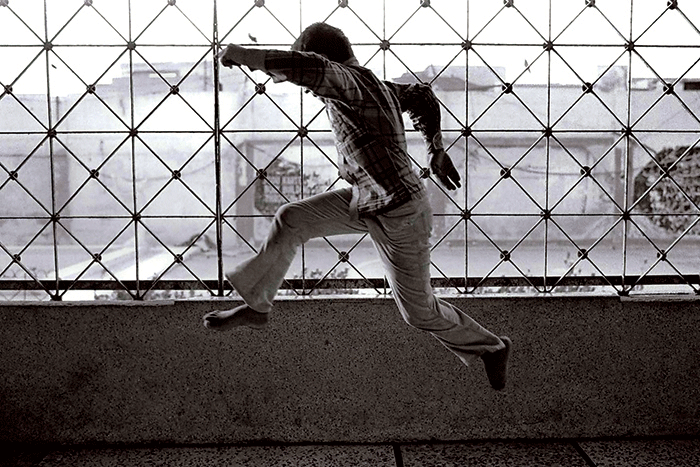
The most moving moments in the film show Omar running. The desperation of his life is found in his running. The first scene shows him bolting towards the ocean with an abandon that can only be described as unthinking. He moves at amazing speed, with no hesitation, almost propelled, directly into the water where he splashes, soaks, comes up panting, his momentary fire extinguished. Whatever he was running from, he escaped it when he hit the water. We then see him run in the most desperate way towards a shrine before Asad takes him home. Before then if my heart was cracking, it fully broke open when Omar reached the shrine. Only a child in tremendous pain and with tremendous fear prays like that.
Which brings me to religion. The children in the film repeatedly spoke of God, showing hope in Him and His divine will, expressing an ease with God that I’m no longer used to. You would expect children of privilege (as many are in the West) to be more God-conscious and thankful, with full bellies, warm homes, the latest gadgets. And I’d have expected these children, without families, sleeping on stone floors, forgotten by society and with no certain prospects, to be resentful, rejecting the very idea of a merciful God. But they held on to God, praying in disjointed congregations, led by a madrassah run-away. They were not yet so jaded to turn away from a God who hadn’t fulfilled their most basic human need – the love of parents. Their devotion was a testament to both their innocence and resilience. All was not lost. There was still hope for their lives.
When the film ended, there was silence in the packed auditorium for what seemed like a long time. We were not quite ready to let go of the characters, of their stories. We didn’t get the happy ending, we weren’t given the details to answer all the questions we had. But we felt connected to every character and invested in the potential of their lives. And this was ultimately the story the film aims to tell. Not one of despair, anger, or fear. But of rising above these elements. The dedication of an elderly man to give what he could, when he could, for as many as he could. The triumph of Asad, who may well be the future Edhi, in building a life and being a support to others. And the faith and hope of Fuad, who manifested the possibility of his life through his alter-ego Omar. The lesson for us, as we sit comfortably munching popcorn in temperature controlled auditoriums, is of humility at our privileged conditions and of remaining faithful in the face of severe challenges. But the question we are challenged with is this: what now? What will our personal call to action be, if any, after bearing witness to these lives? It’s a question I’ll be thinking about for a long time to come.
*I encourage you to donate generously to the Edhi Foundation. I also encourage you to bring this film to your city. The makers of the film can be contacted through their Facebook page.
Previous Post

January 17, 2014
In The Beginning: A Note to Myself
Next Post
January 31, 2014 All Hijabbed Out
Browse Our Archives
Select a Category Adnan Syed Muslim Women Uncategorized
Select a Month November 2014 October 2014 September 2014 August 2014 June 2014 May 2014 April 2014 March 2014 February 2014 January 2014
TAKE THE
Religious Wisdom Quiz
Who was cast into a fiery furnace but was unharmed?
Select your answer to see how you score.
Shadrach, Meshach, and Abednego Moses, Aaron, and Joshua Elijah and Elisha Daniel
Related posts from Split the Moon

Serial Episode 8: Confirmation Bias FTW

Serial Episode 7: In Which I Exhale

Serial Episode 6: The Worst of It

Let's Give Them Something To Talk About
TRENDING AT PATHEOS Muslim

25 Years Later: How Much Has Changed for...
As we approach the 25th anniversary of September 11th, I’ve found myself...

Podcast: Third Spaces & The Rise of Yemeni...
In the latest episode of The Artistic Foodies Podcast, hosts Abbas...

HalalFest Picks: Best 60 Halal Spots for Super...
Back in 2016, I came up with a list of 29...

Unity Is America’s Strength — Division Is Its...
by Hidayatullah Ahsan When Valentina Gomez, a Republican candidate for Congress in...

Zohran Mamdani and New York’s Fight Against Islamophobia
This past June, against all odds, Zohran Mamdani won the Democratic primary...

What the Fourth of July Means to a...
As we mark another Fourth of July, millions of Americans will celebrate...
view all Muslim blogs
Ad-Free & Subscriber Log-In Subscription Support
- About Us
- 2026 Calendar
- Videos
- Podcasts
- Library of World Religions
- Faith In Media Tracker
- Advertise With Us
- Write for Us
- Privacy Policy
- Terms of Service
- Do Not Sell My Data
- Contact Us
- Radiant Digital
- Manage Newsletter Subscriptions
- Unsubscribe From Notifications
- Sitemap
Copyright 2008-2026, Patheos. All rights reserved.
Subscription Support Ad-Free & Subscriber Log-In
Follow Patheos