
BuddhistCatholicContemplativeEvangelicalGeneral ChristianHinduJewishLatter-day SaintMuslimNew VisionsProgressive Christian
Beliefs
- Buddhist
- Catholic
- Contemplative
- Evangelical
- General Christian
- Hindu
- Jewish
- Latter-day Saint
- More Voices
- Muslim
- New Visions
- Pagan
- Progressive Christian
Topics
- Religion News
- Food and Religion
- Sports and Religion
- Religious Art
- Religious Music and Entertainment
- Religious Events
- History and Religion
- Style and Religion
- Politics and Religion
- Women in Religion
- Recreation Outdoors and Religion
- Business Finance and Religion
- Careers Workplace and Religion
- Education and Religion
- Family Parenting and Religion
- Health Fitness and Religion
- Home and Religion
- Relationships and Religion
- Technology and Religion
- Travel and Religion
Columnists
- Buddhist Columnists
- Business Finance and Religion Columnists
- Careers Workplace and Religion Columnists
- Catholic Columnists
- Contemplative Columnists
- Education and Religion Columnists
- Evangelists Columnists
- Family Parenting and Religion Columnists
- General Christian Columnists
- Health Fitness and Religion Columnists
- Hindu Columnists
- History and Religion Columnists
- Home and Religion Columnists
- Jewish Columnists
- More Voices Columnists
- Latter Day Columnists
- Muslim Columnists
- New Visions Columnists
- Nonreligious Columnists
- Pagan Columnists
- Politics and Religion Columnists
- Progressive Columnists
- Recreation Outdoors and Religion Columnists
- Relationships and Religion Columnists
- Religion News Columnists
- Religious Art Columnists
- Religious Events Columnists
- Religious Music and Entertainment Columnists
- Sports and Religion Columnists
- Style and Religion Columnists
- Technology and Religion Columnists
- Travel and Religion Columnists
- Women in Religion Columnists
Resource Library
- 2026 Calendar
- Library of World Religions
- The 100 Most Holy Places on Earth
- Patheos Answers
- Podcasts
- Videos
- Faith Leaders Database
- Anglican Episcopalian
- Bahai
- Baptist
- Buddhism
- Christianity
- Confucianism
- Eastern Orthodoxy
- Hinduism
- Holiness and Pentecostal
- ISKCON
- Islam
- Judaism
- Lutheran
- Methodist
- The Church of Jesus Christ of Latter-day Saints
- New Age
- Paganism
- Presbytarian and Reformed
- Protestantism
- Religion Behind the Scenes
- Roman Catholic
- Scientology
- Shia Islam
- Sikhism
- Sufism
- Sunni Islam
- Taoism
- Zen
- See all religions
Research Tools
 Ad-Free & Subscriber Log-In Subscription Support
Ad-Free & Subscriber Log-In Subscription Support
Follow Patheos 

- Trending:
- Forgiveness
- |
- Marriage
- |
- Consciousness
- |
- Death Penalty
- |
- Election
- |
- Halloween
 spiritchatter
- Home
- Progressive Christian
- Why Protestants Should Read Jon Sweeney’s Latest Book on Saint Francis of Assisi
Why Protestants Should Read Jon Sweeney’s Latest Book on Saint Francis of Assisi
Last updated on: October 25, 2014 at 4:46 pm by Jack Levison
Why Protestants Should Read Jon Sweeney’s Latest Book on Saint Francis of Assisi 2014-10-25T16:46:49-07:00 Jack Levison
Patheos Explore the world's faith through different perspectives on religion and spirituality! Patheos has the views of the prevalent religions and spiritualities of the world.
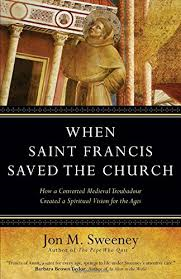 I spent a week recently in Assisi, reflecting upon the legacy of St. Francis, with Jon Sweeney, author of When Saint Francis Saved the Church, as my companionable guide. That book is written by a Catholic, published by a Catholic press (Ave Maria), and directed toward Catholics. Why, some of you might ask, should Protestants read this book? Good question. Let me tell you.
Embracing Silence
Many of us Protestants aren’t very good at silence, at meditation, at listening prayer. When I want to retreat into silence to spend 24 hours in God’s presence, I tend to visit St. Placid Priory, a Catholic retreat center run by Benedictine sisters.
Saint Francis embraced silence. In Assisi, I sensed that silence, particularly as I made the short trek outside the city walls, past the basilica of St. Chiara (Clare), through the Nuova Porta, down the hill past the bus parking lot, with its succession of trinket shops, through olive groves, to San Damiano. This is where St. Francis heard Jesus from the crucifix tell him to rebuild the church. Despite the swell of tourists, in and out, out and in, I sensed the quiet. As much as quiet, I sensed the slowness.

Later that same day, I hiked up Mount Subasio, to the hermitage where Saint Francis, in a bathtub-sized rock cave, prayed. Again, I sensed the silence. Deeply. I know that baseball games and committee meetings and commutes make it difficult for us to embrace silence. I know that intimately. I also know that many of us are starved for silence. We need St. Francis’ silence and the art of listening he developed over a lifetime of relinquishing–what Jon Sweeney calls Francis’ “new spirituality.”

Breaking Boundaries
Wendy Murray, in her review of Sweeney’s book, may be right to point out that Sweeney’s portrait of Francis is perhaps too liberal. In the throes of the Crusades, Francis went to convert the Muslim sultan of Egypt—not just to chat amiably or even to prevent another war. (The Crusades were in full swing.) Francis was not a universalist.
When a teenaged Clare came to him in the middle of the night, Saint Francis cut her hair, dressed her in a tunic, and let her remain with the friars for a while as a brother—but not permanently. Francis was not a feminist.
Still, the reality that Francis does not fit into modern categories should not diminish our appreciation for how profoundly he broke boundaries, as Sweeney is quick to point out, with respect to women and Muslims and birds, for that matter. He moved with uncharacteristic grace and unassuming charm—but with a tenacious impulse toward inclusion and acceptance. We Protestants, liberal and conservative alike, can garner a good deal from the life of Francis about how to respect others, especially those whom we may want to vilify.
Saint Francis and Pope Francis
Here and there throughout When Francis Saved the Church, Sweeney expresses hope for the pope, the first in 800 years to take the name of Francis. I was skeptical. Can Pope Francis really accomplish that much from the center of power the way Francis did from the margins? My experience says no. I thought Sweeney naïve.
Then I met a Catholic bishop from the Methodist-Catholic dialogue of which my wife Priscilla is a part. (The dialogue brought me to Assisi; I just went along for the ride.) Over dinner, we pried out of the bishop something startling. He is leaving his three bedroom, four bath home, which sits directly opposite a beach, to live in a two bedroom Knights of Columbus apartment. He puts it in terms of necessity: he can’t keep the house up; he doesn’t need the space; he is away so much, working 80-90 hours a week; the cathedral has guest rooms. But then he ceases to be practical and tells us he is moved by Pope Francis’ example: the Ford Focus instead of a limousine; a guesthouse rather than the papal apartment. That’s really why he is giving up a beautiful house for an apartment in an inexpensive and ethnically diverse part of the city.
I confessed to our bishop friend (over pasta rather than in a confessional) that it’s hard to think about being downwardly mobile without the sort of community Catholicism provides. Then the bishop said something that sounds, well, astonishingly Protestant. He said, “You have the Bible, and that is enough.”
We’re back to Saint Francis—or is it Pope Francis? We’re back to taking the Bible seriously on poverty, the way Francis did—the way Pope Francis does. We’re back to taking Jesus at his word about wealth, the way Francis did—the way Pope Francis does. We’re back, if you don’t mind my saying, to being distinctly Protestant when it comes to the Bible. Thank God for a Catholic bishop willing to tell me—and show me—what it means to be genuinely Protestant.
Previous Post

October 24, 2014
Double Vision, Saint Francis Style
Next Post

November 13, 2014 You're Welcome
Browse Our Archives
Select a Category Uncategorized
Select a Month August 2017 July 2017 June 2017 March 2017 February 2017 February 2016 December 2015 September 2015 August 2015 June 2015 May 2015 February 2015 January 2015 December 2014 November 2014 October 2014 September 2014 August 2014 July 2014 June 2014 May 2014 April 2014 March 2014 February 2014 January 2014 December 2013 November 2013 October 2013 September 2013 August 2013 July 2013 June 2013 May 2013
Follow Us!
TAKE THE
Religious Wisdom Quiz
In what parable does a father run to greet his lost son?
Select your answer to see how you score.
The Lost Sheep The Prodigal Son The Two Sons The Rich Man and Lazarus
Related posts from spiritchatter

Hurricane Heroes and the Book of Exodus
Beneath the Headlines: Another Presidential Committee Ups and...

The Summer of '17: Jacob's Ladder and Esau's...

Summer of '17: Sibling Rivalry on Steroids
TRENDING AT PATHEOS Progressive Christian

Why Christians Have a Sacred Duty to Vote:...
The Bible offers strong support for the sacred duty to vote. Here...

What Being a Modern-Day Apostle Means to Me
In my last column, I discussed the ins and outs of modern-day...

Did Ancient China Once Worship the God of...
Across human history, a common thread weaves through the origins of the...

Love Your Neighbor – Including Earth-Kin: Lev. 19,...
God’s command to love your neighbor means acting in an ethical and...

Lead a Church Study of “Jesus and Lao...
Guest writer Jack Thomas (The Irreverent Reverend) reflects on leading his church...

Principles for Understanding the Apostolic Ministry Today
Whenever people discover that my formal ministry title is "apostle," as in...
view all Progressive Christian blogs
Ad-Free & Subscriber Log-In Subscription Support
- About Us
- 2026 Calendar
- Videos
- Podcasts
- Library of World Religions
- Faith In Media Tracker
- Advertise With Us
- Write for Us
- Privacy Policy
- Terms of Service
- Do Not Sell My Data
- Contact Us
- Radiant Digital
- Manage Newsletter Subscriptions
- Unsubscribe From Notifications
- Sitemap
Copyright 2008-2026, Patheos. All rights reserved.
Subscription Support Ad-Free & Subscriber Log-In
Follow Patheos