
BuddhistCatholicContemplativeEvangelicalGeneral ChristianHinduJewishLatter-day SaintMuslimNew VisionsProgressive Christian
Beliefs
- Buddhist
- Catholic
- Contemplative
- Evangelical
- General Christian
- Hindu
- Jewish
- Latter-day Saint
- More Voices
- Muslim
- New Visions
- Pagan
- Progressive Christian
Topics
- Religion News
- Food and Religion
- Sports and Religion
- Religious Art
- Religious Music and Entertainment
- Religious Events
- History and Religion
- Style and Religion
- Politics and Religion
- Women in Religion
- Recreation Outdoors and Religion
- Business Finance and Religion
- Careers Workplace and Religion
- Education and Religion
- Family Parenting and Religion
- Health Fitness and Religion
- Home and Religion
- Relationships and Religion
- Technology and Religion
- Travel and Religion
Columnists
- Buddhist Columnists
- Business Finance and Religion Columnists
- Careers Workplace and Religion Columnists
- Catholic Columnists
- Contemplative Columnists
- Education and Religion Columnists
- Evangelists Columnists
- Family Parenting and Religion Columnists
- General Christian Columnists
- Health Fitness and Religion Columnists
- Hindu Columnists
- History and Religion Columnists
- Home and Religion Columnists
- Jewish Columnists
- More Voices Columnists
- Latter Day Columnists
- Muslim Columnists
- New Visions Columnists
- Nonreligious Columnists
- Pagan Columnists
- Politics and Religion Columnists
- Progressive Columnists
- Recreation Outdoors and Religion Columnists
- Relationships and Religion Columnists
- Religion News Columnists
- Religious Art Columnists
- Religious Events Columnists
- Religious Music and Entertainment Columnists
- Sports and Religion Columnists
- Style and Religion Columnists
- Technology and Religion Columnists
- Travel and Religion Columnists
- Women in Religion Columnists
Resource Library
- 2026 Calendar
- Library of World Religions
- The 100 Most Holy Places on Earth
- Patheos Answers
- Podcasts
- Videos
- Faith Leaders Database
- Anglican Episcopalian
- Bahai
- Baptist
- Buddhism
- Christianity
- Confucianism
- Eastern Orthodoxy
- Hinduism
- Holiness and Pentecostal
- ISKCON
- Islam
- Judaism
- Lutheran
- Methodist
- The Church of Jesus Christ of Latter-day Saints
- New Age
- Paganism
- Presbytarian and Reformed
- Protestantism
- Religion Behind the Scenes
- Roman Catholic
- Scientology
- Shia Islam
- Sikhism
- Sufism
- Sunni Islam
- Taoism
- Zen
- See all religions
Research Tools
 Ad-Free & Subscriber Log-In Subscription Support
Ad-Free & Subscriber Log-In Subscription Support
Follow Patheos 

- Trending:
- Forgiveness
- |
- Marriage
- |
- Consciousness
- |
- Death Penalty
- |
- Election
- |
- Halloween
 spiritchatter
- Home
- Progressive Christian
- Christian Prayer as Media Event
Christian Prayer as Media Event
Last updated on: June 11, 2014 at 12:50 pm by Jack Levison
Christian Prayer as Media Event 2014-06-11T12:50:31-07:00 Jack Levison
Patheos Explore the world's faith through different perspectives on religion and spirituality! Patheos has the views of the prevalent religions and spiritualities of the world.
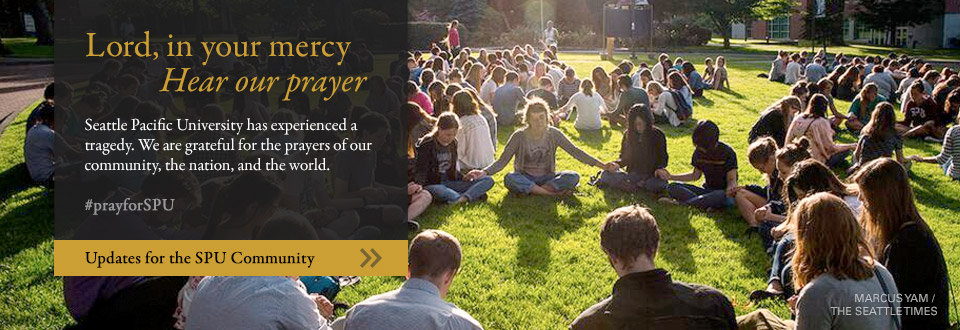 My colleague, Rick Steele, wrote this essay for TIME magazine online in the aftermath of the shooting at Seattle Pacific University. It is significant, so I reproduce it here in full.
___________________________________________________________________________________________
Last Thursday afternoon around 3:30 p.m., a senseless act of violence visited Seattle Pacific University, where I teach. Within minutes, squad cars, fire engines, ambulances, helicopters, and TV news trucks had converged on the scene of shooting that took the life of one of our students and injured two others. The campus was on lockdown for several hours. But by 7 p.m., the mayhem had subsided and the campus community did something that has seldom been seen in the aftermath of the many school shootings that have occurred lately. It prayed.
And it was the praying, almost as much as the shooting, which seemed to capture the attention of the media in the next couple days.
SPU is a church-related school. All employees are professing, practicing Christians, and so are the majority of students. It seemed to be the most natural and needful thing for us to do at that moment to gather in the campus church for corporate worship, and then to gather in small groups for prayer and lamentation till nightfall. Another service was held the next day. We were all grief-stricken: but as Christians we are required to bear up with hope. We were shocked and angry: but we are forbidden to be vengeful. We were broken: but we know that it is only by recognizing our own brokenness that we are able to extend mercy and compassion to others when their brokenness is unleashed upon ourselves. So we did what Christians do in the face of senseless evil: we looked to the Source of Goodness. We lamented the fallen and wounded. We gave thanks for the heroes and safety officers and medics. We interceded for the bereaved…and for the gunman.
As we prayed, two things happened: God heard our prayers, and the media watched us praying. The first of these was a mercy; the second was a fresh trial.
That God heard our prayers came as no surprise. For slowly…very slowly…we began to heal. Our anger remained—and had to remain, lest the evil we had experienced be trivialized. But nobody was heard to express vengefulness for the killer. Our grief persisted, and even grew in its intensity. But so did our resolution to trust the One whose ways we don’t understand. Our brokenness was more obvious to us than ever. But expressions of concern and support poured in from families and friends, from loyal alumni and perfect strangers, from sister schools and local churches, from neighbors across the street and neighbors across the world. Banners with words of encouragement sprouted all over campus. Floral bouquets ringed the crime scene.
The fact that the TV cameras were recording all this was another story. We Christians are forbidden to “practice [our] piety before others in order to be seen by them” (Mt. 6:1), but we are also required to “speak [God’s] word with all boldness” (Acts 4:29). We are told “to be prepared to make a defense to anyone who calls [us] to account for the hope that is in [us]”—but to do so “with gentleness and reverence,” abstaining from self-display (1 Pet. 3:15). On that awful evening, when we needed to huddle together in order to begin healing, we found ourselves the object of media attention. We are required to bear public witness to our faith—but this hardly felt like the proper occasion or setting for that. It was very awkward. We had to pray in a way that was emotionally real, lest we prove ourselves hypocrites before God. But we had to avoid turning our agonized devotions into the grotesque unreality of reality TV by displaying either exaggerated emotionalism or mock-heroic stoicism for theatrical effect. We had to act as if we weren’t being watched, but we also had to act as if we weren’t trying to act as if we weren’t being watched.
When I was a boy, I once complained to my parents that my sister had kept her eyes open during table grace. To which Mother smilingly responded, “And how do you know that?” I learned that day that when it comes to religion, cynical voyeurism is as wrong as sanctimonious exhibitionism. I am praying that the SPU community avoided the latter this week, and that the watching world avoided the former. I am hoping that God’s healing grace can be seen in our campus tragedy—either because of us, or in spite of us, or perhaps both.
Previous Post
June 10, 2014
Seattle Pacific University as Our Place and the Poetry of Wendell Berry
Next Post
June 12, 2014 A Memorial Service, Memory, and the Eventual Gifts of Suffering
Browse Our Archives
Select a Category Uncategorized
Select a Month August 2017 July 2017 June 2017 March 2017 February 2017 February 2016 December 2015 September 2015 August 2015 June 2015 May 2015 February 2015 January 2015 December 2014 November 2014 October 2014 September 2014 August 2014 July 2014 June 2014 May 2014 April 2014 March 2014 February 2014 January 2014 December 2013 November 2013 October 2013 September 2013 August 2013 July 2013 June 2013 May 2013
Follow Us!
TAKE THE
Religious Wisdom Quiz
Who was King Saul's father?
Select your answer to see how you score.
Rehoboam Methuselah Kish Job
Related posts from spiritchatter

Hurricane Heroes and the Book of Exodus
Beneath the Headlines: Another Presidential Committee Ups and...

The Summer of '17: Jacob's Ladder and Esau's...

Summer of '17: Sibling Rivalry on Steroids
TRENDING AT PATHEOS Progressive Christian

Why Christians Have a Sacred Duty to Vote:...
The Bible offers strong support for the sacred duty to vote. Here...

What Being a Modern-Day Apostle Means to Me
In my last column, I discussed the ins and outs of modern-day...

Did Ancient China Once Worship the God of...
Across human history, a common thread weaves through the origins of the...

Love Your Neighbor – Including Earth-Kin: Lev. 19,...
God’s command to love your neighbor means acting in an ethical and...

Lead a Church Study of “Jesus and Lao...
Guest writer Jack Thomas (The Irreverent Reverend) reflects on leading his church...

Principles for Understanding the Apostolic Ministry Today
Whenever people discover that my formal ministry title is "apostle," as in...
view all Progressive Christian blogs
Ad-Free & Subscriber Log-In Subscription Support
- About Us
- 2026 Calendar
- Videos
- Podcasts
- Library of World Religions
- Faith In Media Tracker
- Advertise With Us
- Write for Us
- Privacy Policy
- Terms of Service
- Do Not Sell My Data
- Contact Us
- Radiant Digital
- Manage Newsletter Subscriptions
- Unsubscribe From Notifications
- Sitemap
Copyright 2008-2026, Patheos. All rights reserved.
Subscription Support Ad-Free & Subscriber Log-In
Follow Patheos