
BuddhistCatholicContemplativeEvangelicalGeneral ChristianHinduJewishLatter-day SaintMuslimNew VisionsProgressive Christian
Beliefs
- Buddhist
- Catholic
- Contemplative
- Evangelical
- General Christian
- Hindu
- Jewish
- Latter-day Saint
- More Voices
- Muslim
- New Visions
- Pagan
- Progressive Christian
Topics
- Religion News
- Food and Religion
- Sports and Religion
- Religious Art
- Religious Music and Entertainment
- Religious Events
- History and Religion
- Style and Religion
- Politics and Religion
- Women in Religion
- Recreation Outdoors and Religion
- Business Finance and Religion
- Careers Workplace and Religion
- Education and Religion
- Family Parenting and Religion
- Health Fitness and Religion
- Home and Religion
- Relationships and Religion
- Technology and Religion
- Travel and Religion
Columnists
- Buddhist Columnists
- Business Finance and Religion Columnists
- Careers Workplace and Religion Columnists
- Catholic Columnists
- Contemplative Columnists
- Education and Religion Columnists
- Evangelists Columnists
- Family Parenting and Religion Columnists
- General Christian Columnists
- Health Fitness and Religion Columnists
- Hindu Columnists
- History and Religion Columnists
- Home and Religion Columnists
- Jewish Columnists
- More Voices Columnists
- Latter Day Columnists
- Muslim Columnists
- New Visions Columnists
- Nonreligious Columnists
- Pagan Columnists
- Politics and Religion Columnists
- Progressive Columnists
- Recreation Outdoors and Religion Columnists
- Relationships and Religion Columnists
- Religion News Columnists
- Religious Art Columnists
- Religious Events Columnists
- Religious Music and Entertainment Columnists
- Sports and Religion Columnists
- Style and Religion Columnists
- Technology and Religion Columnists
- Travel and Religion Columnists
- Women in Religion Columnists
Resource Library
- 2026 Calendar
- Library of World Religions
- The 100 Most Holy Places on Earth
- Patheos Answers
- Podcasts
- Videos
- Faith Leaders Database
- Anglican Episcopalian
- Bahai
- Baptist
- Buddhism
- Christianity
- Confucianism
- Eastern Orthodoxy
- Hinduism
- Holiness and Pentecostal
- ISKCON
- Islam
- Judaism
- Lutheran
- Methodist
- The Church of Jesus Christ of Latter-day Saints
- New Age
- Paganism
- Presbytarian and Reformed
- Protestantism
- Religion Behind the Scenes
- Roman Catholic
- Scientology
- Shia Islam
- Sikhism
- Sufism
- Sunni Islam
- Taoism
- Zen
- See all religions
Research Tools
 Ad-Free & Subscriber Log-In Subscription Support
Ad-Free & Subscriber Log-In Subscription Support
Follow Patheos 

- Trending:
- Forgiveness
- |
- Marriage
- |
- Consciousness
- |
- Death Penalty
- |
- Election
- |
- Halloween
 spiritchatter
- Home
- Progressive Christian
- Animals & Ambiguity: The Spirit & the Flood
Animals & Ambiguity: The Spirit & the Flood
Last updated on: October 12, 2013 at 11:25 am by Jack Levison
Animals & Ambiguity: The Spirit & the Flood 2013-10-12T11:25:30-07:00 Jack Levison
Patheos Explore the world's faith through different perspectives on religion and spirituality! Patheos has the views of the prevalent religions and spiritualities of the world.
 About a month ago, I paused with you to ponder humanity’s first breath, when God stooped and shadowed the face of adam, with knees planted in the mud, hands sinking in the soft, damp earth, lips to lips, mouth to mouth—and blew into Adam’s nostrils the breath of life. On the outskirts of Eden we glimpsed the ambiguity of creation, adam created as dust from the earth (adamah in Hebrew). We came to grips with
the unfortunate clash between energy and emptiness, life and death, breath and dust … where the giving of life is hemmed in by punctuations of death, like exclamation points in a Spanish sentence, where a single, shared intimate moment between God and adam is bordered by the inevitability of death: dust then life then dust. The opening scene of the human drama, though set in a garden of delight, echoes against the implacable cliffs of the valley of the shadow of death.
It’s not surprising that, just a story or two later—past Cain’s brutal murder of Abel, the birth of Seth, and sundry genealogies—we come to the flood, where we discover a mirror image of the creation story. The creation story read like this:
The LORD God breathed into his nostrils the breath of life; and adam became a living being.
The flood story reads like this:
And all flesh died—everything on dry land in whose nostrils was the spirit of life.
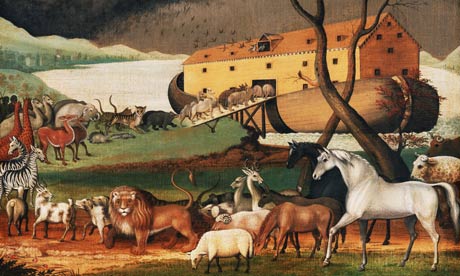
The chorus of life crescendoes if we recognize something astonishing: this spirit belongs, not to humankind alone, but to all flesh, all animals, clean and unclean, everything under heaven. This is an overture to life, all of life, living beings, human and animal, whose nostrils flare with the spirit of life. Animals breathe the spirit of the breath of life—just like human beings.
But there is something else, and this is what I want you to see. This story, a chorus of life, a crescendo of vitality, a cacophony of energetic squeals and barks and moos and howls, is, at the same time, a horrific denial of life. The presence of the spirit of life for all creatures crescendoes only on the cusp of a universal fatality, at the point of catastrophic death, when God destines to a watery destruction “all flesh in which is the spirit of life; everything that is on the earth shall die.” This is the sort of poignant, inescapable tension which lies, like it did in the mud on the day of creation, at the base of life and the heart of any spirituality—the work of the holy spirit—worth its salt.
I need to be honest with you. To come clean. I am suspicious of a sort of triumphalism that sees the work of the holy spirit exclusively in the spectacular—healings, prophecies, the promise of health and wealth, perennial joy and uninterrupted uplift. For instance, Joyce Meyer says this of the holy spirit: “His purpose is to come into us with His abiding presence and power and help us do things with ease that would otherwise be hard or even impossible” (page 8). Later she says, “After we receive the baptism of the Holy Spirit, we get filled with ‘can do.’” (page 44). This is partly true. Partly. But not the whole truth. And certainly not the whole of biblical truth because in the Bible, the spirit enters the story in the shadow of death, on the edge of destruction.
In my first spiritchatter post back in May, I wrote,
I am dumbstruck, dope-slapped by the ambiguity of it all.
I still am. The Bible doesn’t excise the ambiguity from life, not even when its stories are about the life-giving, energy-creating, vitality-infusing spirit of God. We learn first about the spirit only in the shadow of death, and we cling to that life still, floodwaters notwithstanding. We may be black and blue, but we’re black and blue because the blood still pulses in our veins, the breath still fills our lungs, the spirit still flares in our nostrils.
______________________________________________________________________________________
Painting by Edward Hicks (1780-1849), American folk painter and Quaker (Society of Friends) minister
Previous Post
September 28, 2013
Spiritchatter--in Hebrew!
Next Post

October 19, 2013 The Spirit & the Dreamer
Browse Our Archives
Select a Category Uncategorized
Select a Month August 2017 July 2017 June 2017 March 2017 February 2017 February 2016 December 2015 September 2015 August 2015 June 2015 May 2015 February 2015 January 2015 December 2014 November 2014 October 2014 September 2014 August 2014 July 2014 June 2014 May 2014 April 2014 March 2014 February 2014 January 2014 December 2013 November 2013 October 2013 September 2013 August 2013 July 2013 June 2013 May 2013
Follow Us!
TAKE THE
Religious Wisdom Quiz
Which Christian group is associated with the "Anabaptist" tradition?
Select your answer to see how you score.
Episcopalians Calvinists Lutherans Mennonites
Related posts from spiritchatter

Hurricane Heroes and the Book of Exodus

The Summer of '17: Jacob's Ladder and Esau's...

The Summer of '17: a Summer of Trysts...

TRENDING AT PATHEOS Progressive Christian

Why Christians Have a Sacred Duty to Vote:...
The Bible offers strong support for the sacred duty to vote. Here...

What Being a Modern-Day Apostle Means to Me
In my last column, I discussed the ins and outs of modern-day...

Did Ancient China Once Worship the God of...
Across human history, a common thread weaves through the origins of the...

Love Your Neighbor – Including Earth-Kin: Lev. 19,...
God’s command to love your neighbor means acting in an ethical and...

Lead a Church Study of “Jesus and Lao...
Guest writer Jack Thomas (The Irreverent Reverend) reflects on leading his church...

Principles for Understanding the Apostolic Ministry Today
Whenever people discover that my formal ministry title is "apostle," as in...
view all Progressive Christian blogs
Ad-Free & Subscriber Log-In Subscription Support
- About Us
- 2026 Calendar
- Videos
- Podcasts
- Library of World Religions
- Faith In Media Tracker
- Advertise With Us
- Write for Us
- Privacy Policy
- Terms of Service
- Do Not Sell My Data
- Contact Us
- Radiant Digital
- Manage Newsletter Subscriptions
- Unsubscribe From Notifications
- Sitemap
Copyright 2008-2026, Patheos. All rights reserved.
Subscription Support Ad-Free & Subscriber Log-In
Follow Patheos