
BuddhistCatholicContemplativeEvangelicalGeneral ChristianHinduJewishLatter-day SaintMuslimNew VisionsProgressive Christian
Beliefs
- Buddhist
- Catholic
- Contemplative
- Evangelical
- General Christian
- Hindu
- Jewish
- Latter-day Saint
- More Voices
- Muslim
- New Visions
- Pagan
- Progressive Christian
Topics
- Religion News
- Food and Religion
- Sports and Religion
- Religious Art
- Religious Music and Entertainment
- Religious Events
- History and Religion
- Style and Religion
- Politics and Religion
- Women in Religion
- Recreation Outdoors and Religion
- Business Finance and Religion
- Careers Workplace and Religion
- Education and Religion
- Family Parenting and Religion
- Health Fitness and Religion
- Home and Religion
- Relationships and Religion
- Technology and Religion
- Travel and Religion
Columnists
- Buddhist Columnists
- Business Finance and Religion Columnists
- Careers Workplace and Religion Columnists
- Catholic Columnists
- Contemplative Columnists
- Education and Religion Columnists
- Evangelists Columnists
- Family Parenting and Religion Columnists
- General Christian Columnists
- Health Fitness and Religion Columnists
- Hindu Columnists
- History and Religion Columnists
- Home and Religion Columnists
- Jewish Columnists
- More Voices Columnists
- Latter Day Columnists
- Muslim Columnists
- New Visions Columnists
- Nonreligious Columnists
- Pagan Columnists
- Politics and Religion Columnists
- Progressive Columnists
- Recreation Outdoors and Religion Columnists
- Relationships and Religion Columnists
- Religion News Columnists
- Religious Art Columnists
- Religious Events Columnists
- Religious Music and Entertainment Columnists
- Sports and Religion Columnists
- Style and Religion Columnists
- Technology and Religion Columnists
- Travel and Religion Columnists
- Women in Religion Columnists
Resource Library
- 2026 Calendar
- Library of World Religions
- The 100 Most Holy Places on Earth
- Patheos Answers
- Podcasts
- Videos
- Faith Leaders Database
- Anglican Episcopalian
- Bahai
- Baptist
- Buddhism
- Christianity
- Confucianism
- Eastern Orthodoxy
- Hinduism
- Holiness and Pentecostal
- ISKCON
- Islam
- Judaism
- Lutheran
- Methodist
- The Church of Jesus Christ of Latter-day Saints
- New Age
- Paganism
- Presbytarian and Reformed
- Protestantism
- Religion Behind the Scenes
- Roman Catholic
- Scientology
- Shia Islam
- Sikhism
- Sufism
- Sunni Islam
- Taoism
- Zen
- See all religions
Research Tools
 Ad-Free & Subscriber Log-In Subscription Support
Ad-Free & Subscriber Log-In Subscription Support
Follow Patheos 

- Trending:
- Forgiveness
- |
- Marriage
- |
- Consciousness
- |
- Death Penalty
- |
- Election
- |
- Halloween
 Word + Flesh
- Home
- Progressive Christian
- Loving Those People
Loving Those People
Last updated on: April 25, 2013 at 8:41 am by Ragan Sutterfield
Loving Those People 2013-04-25T08:41:37-06:00 Ragan Sutterfield
Patheos Explore the world's faith through different perspectives on religion and spirituality! Patheos has the views of the prevalent religions and spiritualities of the world.
 This Lectionary Reflection is cross-posted at the Ekklesia Project
Easter 5, Year C
She stood outside of the meeting room, a cigarette in hand–crying. This was a weekend spiritual retreat, a time of renewal, but for this woman it was clearly painful, even degrading. My wife approached the woman and asked what was wrong. “I’m Baptist,” she said, “and everyone is just saying such bad things about us.” The retreat was put on by the Episcopal Church and this being a southern Episcopal gathering “Baptist bashing” is bound to be the common sport. The Baptist are the dominant denomination in the region, often conservative brands. Many in the Episcopal Church grew up in Baptist churches or similar denominations and they consider their new status as Episcopalians to be an enlightened escape. So they take cheap shots, ridicule the Baptists and feel self-satisfied.
The flipside occurs of course. I migrated into the Episcopal Church from a world that found it unimaginable that either Episcopalians or Catholics were even followers of Jesus. The Episcopalians were clearly apostate sinners who didn’t read the Bible. The Roman Catholics were not really Christians since they didn’t believe in the Bible and they worshiped Mary. I think it is fair to say that every Christian group or denomination has its Christian “other” that can be made the object of exclusion.
And here in our Gospel reading we have Jesus telling us that we need to love these people: “I give you a new commandment, that you love one another. Just as I have loved you, you also should love one another. By this everyone will know that you are my disciples, if you have love for one another.” Of course when Jesus gives this commandment it is to a small group of disciples, no denominations have formed yet, no groups have split. That will come soon enough though, in our Acts reading we see a division being reconciled between Gentile and Jewish believers but we know from Paul that that division will be a major dividing point again. We also know that the early church will quickly differentiate around different leaders–Paul, Apollos, Peter, etc. Jesus we could say is working to head all of this off–if you follow me, you must “love one another.”
But Jesus, we could hear someone say, those people don’t really follow you. They don’t _______ (Episcopalians insert “work for social justice.” Mennonites insert “practice peaceableness.” Evangelicals insert “submit to the authority of scripture.” Etc.). Jesus however seems relatively uninterested in the inside or outside status of his followers. When the disciples complain about a person who was casting out demons in the name of Jesus and “was not following us,” Jesus tells them that anyone working for the good of the kingdom of God in his name is a disciple. “Whoever is not against us is for us,” he tells them (Mark 9:40). It is sometimes hard to see this in our many divisions and denominations, the history of serious and often important theological splits. But we must come to see that for all of the differences, we are seeking the same kingdom, we are trying to follow the same God made manifest in the world through the Christ whose name we bear.
Even the fiercest disagreements and differences within Christianity, the kind that produced interChristian martyrdoms, should be guided by that other command Jesus gave about love: “love your enemies and pay for those who persecute you so that you may be children of your Father in heaven…For if you greet only your brothers and sisters, what more are you doing than others?” (Matthew 5:44-48). This passage from the beatitudes states again what is to be the mark of the Christian–love of one another even when that other is an enemy. This love, even for enemies, even the enemies close to us is to be the thing that distinguishes Christians. It is to be our witness.
This is a hard love to live into for sure. We see the differences between an Episcopalian and a Missionary Baptist as being greater at times than those between an Episcopalian and a Buddhist. In my own context Episcopalians are always trying to have interfaith dialogue which is easy since the small percentages of non-Christian religious practitioners in Arkansas are thrilled to have someone to talk to and pay attention to them. This is all fine and good and we need interfaith dialogue, but in a place like Arkansas the real conflicts and disagreements, the hard work is intrafaith dialogue. It is here that we need to start if we are to learn to love one another, much less love those of a completely different religion.
So how do we begin the practice of this love and conversation (and shouldn’t we have conversation to have love)? I think the place to begin is in the work of the kingdom coming into the world, the building up of our communities. There is a local prison ministry that brings together Christians of all kinds to help bring men incarcerated for serious crimes to a new kind of life. There are other ministries that work to care for the homeless and feed the hungry. A common ministry of prayer, particularly for the violence we see in our cities, could be another way forward.
We must also look for witnesses of dialogue within the church. I have always been impressed by the friendship and conversations between Marcus Borg and N.T. Wright. These are two scholars who clearly respect one another and yet have deep and critical differences in their positions. Others who have offered respectful engagements with those with whom they disagree are teachers like Dallas Willard who, though more conservative, praises people like Albert Schweitzer as exemplars of the Christian faith.
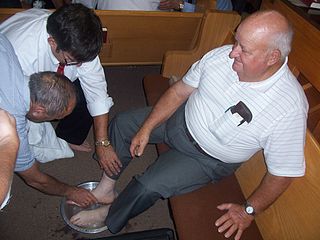
Finally, we must wash each others feet. This commandment from Jesus to love one another comes at the last supper after he has already demonstrated this humble act of service. It is our service to one another that most marks our love and most marks our place as Christ’s followers. With so much disagreement over sacraments like baptism and communion, and the great deal of conversation that must take place around the interpretation of scripture, feet washing is a ready and simple way to enact our love for one another. Every summer gathering of the Ekklesia Project ends with an intra-faith foot washing service. What if we could take this witness and make intrafaith foot washing services a regular practice in our individual places? With such acts of loving one another we will show that we are Christ’s followers. It is a witness the world needs; it is a command we must fulfill.
Previous Post

April 9, 2013
Why Christ Still Has His Wounds
Next Post
April 28, 2013 Birding as Labyrinth
Browse Our Archives
Select a Category Confession Ecclesiology Ecology Fast Feast/Celebration Humility Lament Lectio Lectionary Reflection Meditation Memorization Nonviolence Praise/Thanksgiving Prayer Recollection Reconciliation Review Sabbath Sermons Service Simplicity Solitude Soul WOD Study Submission Uncategorized Vision Works of Mercy Worship
Select a Month June 2015 February 2015 November 2014 September 2014 May 2014 January 2014 August 2013 July 2013 May 2013 April 2013 March 2013 February 2013 January 2013 December 2012 November 2012 October 2012 September 2012 August 2012 July 2012 June 2012 May 2012 April 2012 March 2012 February 2012 January 2012 December 2011
TAKE THE
Religious Wisdom Quiz
What is Paul's longest letter, with the fullest explanation of the gospel?
Select your answer to see how you score.
James 2 Corinthians 1 Corinthians Romans
Related posts from Word + Flesh

Declaring Our Dependence: The Gospel of Neediness In...

Banksy, Jesus, and Emergency Preparedness: The First Sunday...

The Kingdom of God is Like...Wait for It...

Following Rocky Balboa into the Wilderness of Lent
TRENDING AT PATHEOS Progressive Christian

Why Christians Have a Sacred Duty to Vote:...
The Bible offers strong support for the sacred duty to vote. Here...

What Being a Modern-Day Apostle Means to Me
In my last column, I discussed the ins and outs of modern-day...

Did Ancient China Once Worship the God of...
Across human history, a common thread weaves through the origins of the...

Love Your Neighbor – Including Earth-Kin: Lev. 19,...
God’s command to love your neighbor means acting in an ethical and...

Lead a Church Study of “Jesus and Lao...
Guest writer Jack Thomas (The Irreverent Reverend) reflects on leading his church...

Principles for Understanding the Apostolic Ministry Today
Whenever people discover that my formal ministry title is "apostle," as in...
view all Progressive Christian blogs
Ad-Free & Subscriber Log-In Subscription Support
- About Us
- 2026 Calendar
- Videos
- Podcasts
- Library of World Religions
- Faith In Media Tracker
- Advertise With Us
- Write for Us
- Privacy Policy
- Terms of Service
- Do Not Sell My Data
- Contact Us
- Radiant Digital
- Manage Newsletter Subscriptions
- Unsubscribe From Notifications
- Sitemap
Copyright 2008-2026, Patheos. All rights reserved.
Subscription Support Ad-Free & Subscriber Log-In
Follow Patheos