
BuddhistCatholicContemplativeEvangelicalGeneral ChristianHinduJewishLatter-day SaintMuslimNew VisionsProgressive Christian
Beliefs
- Buddhist
- Catholic
- Contemplative
- Evangelical
- General Christian
- Hindu
- Jewish
- Latter-day Saint
- More Voices
- Muslim
- New Visions
- Pagan
- Progressive Christian
Topics
- Religion News
- Food and Religion
- Sports and Religion
- Religious Art
- Religious Music and Entertainment
- Religious Events
- History and Religion
- Style and Religion
- Politics and Religion
- Women in Religion
- Recreation Outdoors and Religion
- Business Finance and Religion
- Careers Workplace and Religion
- Education and Religion
- Family Parenting and Religion
- Health Fitness and Religion
- Home and Religion
- Relationships and Religion
- Technology and Religion
- Travel and Religion
Columnists
- Buddhist Columnists
- Business Finance and Religion Columnists
- Careers Workplace and Religion Columnists
- Catholic Columnists
- Contemplative Columnists
- Education and Religion Columnists
- Evangelists Columnists
- Family Parenting and Religion Columnists
- General Christian Columnists
- Health Fitness and Religion Columnists
- Hindu Columnists
- History and Religion Columnists
- Home and Religion Columnists
- Jewish Columnists
- More Voices Columnists
- Latter Day Columnists
- Muslim Columnists
- New Visions Columnists
- Nonreligious Columnists
- Pagan Columnists
- Politics and Religion Columnists
- Progressive Columnists
- Recreation Outdoors and Religion Columnists
- Relationships and Religion Columnists
- Religion News Columnists
- Religious Art Columnists
- Religious Events Columnists
- Religious Music and Entertainment Columnists
- Sports and Religion Columnists
- Style and Religion Columnists
- Technology and Religion Columnists
- Travel and Religion Columnists
- Women in Religion Columnists
Resource Library
- 2026 Calendar
- Library of World Religions
- The 100 Most Holy Places on Earth
- Patheos Answers
- Podcasts
- Videos
- Faith Leaders Database
- Anglican Episcopalian
- Bahai
- Baptist
- Buddhism
- Christianity
- Confucianism
- Eastern Orthodoxy
- Hinduism
- Holiness and Pentecostal
- ISKCON
- Islam
- Judaism
- Lutheran
- Methodist
- The Church of Jesus Christ of Latter-day Saints
- New Age
- Paganism
- Presbytarian and Reformed
- Protestantism
- Religion Behind the Scenes
- Roman Catholic
- Scientology
- Shia Islam
- Sikhism
- Sufism
- Sunni Islam
- Taoism
- Zen
- See all religions
Research Tools
 Ad-Free & Subscriber Log-In Subscription Support
Follow Patheos 

- Trending:
- Advent
- |
- Forgiveness
- |
- Thanksgiving
- |
- Election
- |
- Seasonal Holidays
- |
- Marriage
 The Soul and the City
- Home
- Latter-day Saint
- The Kindle of a Conservative: Marginal Fragments of a Correlated Worldview (1)
The Kindle of a Conservative: Marginal Fragments of a Correlated Worldview (1)
Last updated on: November 29, 2014 at 8:44 am by rhancock
The Kindle of a Conservative: Marginal Fragments of a Correlated Worldview (1) 2014-11-29T08:44:41-06:00 rhancock
Patheos Explore the world's faith through different perspectives on religion and spirituality! Patheos has the views of the prevalent religions and spiritualities of the world.
I, Ralph C. Hancock,
Having occasionally undertaken to criticize the critics of ordinary, mainstream views of members of the Church of Jesus Christ of Latter-day Saints, views most readily accessible in the more or less authoritative statements of the Authorities these ordinary members sustain,
And thus having inevitably been cast by those comfortably critical critics as a fearful, strident, and narrow-minded defender of a bland, dogmatic and predictable orthodoxy, such as one would expect from an old white male teaching at BYU who must have been raised in a cloistered and reactionary Utah-Mormon environment and somehow managed to jump through the hoops of a Harvard Ph.D. in political philosophy and a publishing career in that field without ever being brought to question the simple pieties of Mormon Doctrine or The 5000-Year Leap,
I here offer to the limitless curiosity of those expansive critical intellects a window into the reading habits of the modern fearfully orthodox counter-intellectual. This promises, or threatens, to be just the first of a series of such windows into the perverse psychology of the conservative Mormon revisionist Straussian kill-joy who insists on disturbing the peace of those scholars and intellectuals who for their part are not at all fearful and strident but rather quite satisfied with the overall tone and direction of the academy and of our intellectual elites more generally, even if they may not be quite as well-paid as they might be in a less conservative and more critically critical society.
In no particular order, then, resisting as best I can my conservative compulsion for simple answers to predictable questions in a closed universe of comfortable assumptions, I lay down these apparently random highlights from the Kindle of a Conservative, little breadcrumbs marking the path that may lead more well-adjusted intellectuals to the grandma’s house of pathology of Mormon anti-intellectualism.
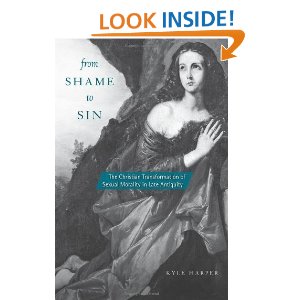
Here are some highlights from a fascinating discussion of the transition from late antiquity to Christian Europe as seen in theological, literary and legal treatments of the problem of Eros: Kyle Harper’s From Shame to Sin. (I’ve yet to figure out just how to fit this into my thoroughly correlated worldview, so feel free to help me.)
The Christians of the second century invent the notion of free will. In its original form, Christian “free will” was a cosmological claim—an argument about the relationship between God’s justice and the individual.
Augustine’s distinctive understandings of divine election and human flesh could push back against centuries of Christian voluntarism reflect the new position of the church as a powerful social institution, part of rather than apart from the world. This book argues that sex was integral to the development of the concept of free will, and that the changing conceptions of the will as a moral problem trace the transformation of a rigorously austere dissent movement into the dominant culture of the Mediterranean world.
Before Augustine, it turns out, it was Christian free will + chastity vs. Pagan fate + sex with slaves!
It would be hard to overestimate the extent to which Christian sexual moralizing, in its first three centuries, was shaped by the boundary between the righteousness of the Christian community and the seething depravity of the vast outside world… the vast gulf between Christian standards and contemporary sexual practice was shaped by an expansive slave trade and a flourishing sex industry.
Have you ever heard of “Jovinian”? He sounds like an early Christian theologian Mormons might want to discover:
The proximate cause of this great outpouring was the brazen doctrine of a Christian teacher named Jovinian, who began to argue, amid the spreading fashion of ascetic extremism, that virginity accrued no special merit to its practitioners, that married and virginal Christians were capable of achieving equal virtue. His teaching touched a deep nerve in Roman society, for he at once gave voice to a certain resentment against ascetic pride and threatened to undermine the core criterion of spiritual elitism at a moment of brisk change. The backlash provoked by Jovinian was fierce, immediate, and unrelenting. The western church mobilized an organized resistance, and in AD 393 Jovinian was officially condemned.
Did you hear that: “married and virginal Christians … capable of … equal virtue”! That might be an idea worth exploring…
And here’s some early Christian pro-chastity feminism:
Christian leaders became desperately aware of the double standard, and the braver among them were perfectly willing to identify its origins. “The laws were made by men, and they are disposed against women.”
Our dear Pelagius plays an all-too-passing role in the story of the making of Medieval Christianity:
The Pelagian controversy, which can appear so compressed in its course and circumstantial in its substance, was an affair of such extraordinary moment because it represented Christian sexuality suddenly coming to terms with the newfound social dominance of the church. The hopeful, if naive, notions of free will, native to primitive Christianity, were washed out by the tidal wave of Augustinian pessimism.
Finally, this from Harper’s eloquent conclusion:
Some of the fatalism of the old order was lost forever, and with it an indifference toward the brutalities accepted in the name of destiny, but also, perhaps, some of the enchantment that comes with the belief that eros makes us part of nature and constitutes a mysterious source of the self…In the freedom of the new order, we recognize how potent was the idea that claims of moral dignity might cut across all accidents of circumstance to the core of the individual’s being. But it is one of history’s true paradoxes that such a model of freedom was harnessed to a movement that was anti-erotic to its very foundations, and that this concept of freedom enabled a model of responsibility that would promote unprecedented accumulations of power in the regulation of sexual acts.
So Augustinian Christianity secured the moral dignity of all human beings (and thus forever undermined the legitimacy of slavery, including, in particular, sex-slavery – which was a big part of slavery), but at the cost of embracing anti-eroticism (if one can “embrace” anti-eroticism). Mormons seem rather to have embraced the task of combining some of paganism’s view that “eros makes us part of nature and constitutes a mysterious source of the self” with the Christian ideas of individual dignity equal chastity and indeed the Pelagian idea of moral agency. A worthy matter for exploration – which, as a conservative and academically undisciplined (unless you count the history of moral & political philosophy) Utah Mormon, I can only offer to the fearlessly inquiring minds of true Mormon intellectuals. I hope your worthy and esteemed scholarly disciplines equip you for the task.
Finally, one question implied but not stated in Harper’s excellent work: pagan sexual license (on the part of males, mainly, of course) was always associated with slavery, that is, with the availability of beautiful but socially negligible young bodies, male and female. Can we really have boundless sexual freedom along with equality, that is, Eros limited only by the criterion of “consent”? Is “consent” up to the task of taming this force, which in pre-Christian days required a whole infrastructure of slavery and prostitution to support it. Just asking. Consult your expert disciplines; there must be opinion surveys on the matter.
Coming soon from Kindle of a Conservative: as yet uncorrelated tidbits from:
David Bentley Hart, The Experience of God
Renaud Camus, Les Inhéritiers (it’s in actual French – of course I learned it on my mission, so that doesn’t count, but still!)
James K.A. Smith, How Not to be Secular
Evelyn Waugh, Brideshead Revisited (sex scenes suitably expurgated)
David Foster Wallace, Infinite Jest (if I can ever get through this truly infinite jest…)
Zuckert & Zuckert, Leo Strauss and the Problem of Political Philosophy (featuring a discussion of the “faith-based Straussianism” of yours truly! … though I would prefer the more awkward but more accurate “faith-open Straussianism)
James Laidlaw, The Subject of Virtue (New Departures in Anthropology)
… and no doubt many more. I’m alerting you less fearful and strident intellectuals, because I’m going to need help correlating all this with my narrow conservative beliefs!
Previous Post

November 18, 2014
Rome Report: Pres. Eyring and Prof. Wardle Praise Complementarity
Next Post
November 30, 2014 Ralph on Rome (the Ancient one)
Browse Our Archives
Select a Category Uncategorized
Select a Month May 2018 March 2018 February 2018 January 2018 December 2017 September 2016 August 2016 June 2016 May 2016 March 2016 February 2016 January 2016 December 2015 May 2015 March 2015 February 2015 January 2015 December 2014 November 2014 October 2014 September 2014
Follow Us!
TAKE THE
Religious Wisdom Quiz
True or False: Believers are instructed to test everything and hold fast to what is good.
Select your answer to see how you score.
TRUE FALSE
Related posts from The Soul and the City
Who’s Afraid of Secularism (4): Humility, Patience and...


Vulgar Elitism & Empty Populism
TRENDING AT PATHEOS Latter-day Saint

Did Prayer Cure His Cancer? Or Was It...
At 4 AM one morning, Joshua W. Brown’s wife awoke to a...

8 Ways a Near-Death Experience Rewires the Soul
Does Consciousness Survive Physical Death? After 50 Years of Research, Dr. Raymond...

Holy Longing: What Our Restlessness Is Telling Us
“One can find so many pains when the rain is falling.” -John...

What this is NOT about. This blog is definitely not about...

Who said the Israelites were God’s chosen? That’s right, they did. Who...

The Spirit World Is the Real World: God...
A Monk’s Wisdom on Body and Spirit I sit with Brother Martin...
view all Latter-day Saint blogs
Ad-Free & Subscriber Log-In Subscription Support
- About Us
- 2026 Calendar
- Videos
- Podcasts
- Library of World Religions
- Faith In Media Tracker
- Advertise With Us
- Write for Us
- Privacy Policy
- Terms of Service
- Do Not Sell My Data
- Contact Us
- Radiant Digital
- Manage Newsletter Subscriptions
- Unsubscribe From Notifications
- Sitemap
Copyright 2008-2026, Patheos, part of the Radiant Digital network of media brands. All rights reserved.
Subscription Support Ad-Free & Subscriber Log-In
Follow Patheos