
BuddhistCatholicContemplativeEvangelicalGeneral ChristianHinduJewishLatter-day SaintMuslimNew VisionsProgressive Christian
Beliefs
- Buddhist
- Catholic
- Contemplative
- Evangelical
- General Christian
- Hindu
- Jewish
- Latter-day Saint
- More Voices
- Muslim
- New Visions
- Pagan
- Progressive Christian
Topics
- Religion News
- Food and Religion
- Sports and Religion
- Religious Art
- Religious Music and Entertainment
- Religious Events
- History and Religion
- Style and Religion
- Politics and Religion
- Women in Religion
- Recreation Outdoors and Religion
- Business Finance and Religion
- Careers Workplace and Religion
- Education and Religion
- Family Parenting and Religion
- Health Fitness and Religion
- Home and Religion
- Relationships and Religion
- Technology and Religion
- Travel and Religion
Columnists
- Buddhist Columnists
- Business Finance and Religion Columnists
- Careers Workplace and Religion Columnists
- Catholic Columnists
- Contemplative Columnists
- Education and Religion Columnists
- Evangelists Columnists
- Family Parenting and Religion Columnists
- General Christian Columnists
- Health Fitness and Religion Columnists
- Hindu Columnists
- History and Religion Columnists
- Home and Religion Columnists
- Jewish Columnists
- More Voices Columnists
- Latter Day Columnists
- Muslim Columnists
- New Visions Columnists
- Nonreligious Columnists
- Pagan Columnists
- Politics and Religion Columnists
- Progressive Columnists
- Recreation Outdoors and Religion Columnists
- Relationships and Religion Columnists
- Religion News Columnists
- Religious Art Columnists
- Religious Events Columnists
- Religious Music and Entertainment Columnists
- Sports and Religion Columnists
- Style and Religion Columnists
- Technology and Religion Columnists
- Travel and Religion Columnists
- Women in Religion Columnists
Resource Library
- 2026 Calendar
- Library of World Religions
- The 100 Most Holy Places on Earth
- Patheos Answers
- Podcasts
- Videos
- Faith Leaders Database
- Anglican Episcopalian
- Bahai
- Baptist
- Buddhism
- Christianity
- Confucianism
- Eastern Orthodoxy
- Hinduism
- Holiness and Pentecostal
- ISKCON
- Islam
- Judaism
- Lutheran
- Methodist
- The Church of Jesus Christ of Latter-day Saints
- New Age
- Paganism
- Presbytarian and Reformed
- Protestantism
- Religion Behind the Scenes
- Roman Catholic
- Scientology
- Shia Islam
- Sikhism
- Sufism
- Sunni Islam
- Taoism
- Zen
- See all religions
Research Tools
 Ad-Free & Subscriber Log-In Subscription Support
Follow Patheos 

- Trending:
- Advent
- |
- Forgiveness
- |
- Thanksgiving
- |
- Election
- |
- Seasonal Holidays
- |
- Marriage

- Home
- Progressive Christian
- Politics and Religion
- Sheep and Goats, Part 3
Sheep and Goats, Part 3
Last updated on: November 23, 2023 at 9:25 am by Herb Montgomery
Sheep and Goats, Part 3 2023-11-23T09:25:33-04:00 Herb Montgomery
Patheos Explore the world's faith through different perspectives on religion and spirituality! Patheos has the views of the prevalent religions and spiritualities of the world.

Lastly, I want to briefly address this language of eternal life or eternal punishment. You can read a more in-depth treatment in the appendix of my new book Finding Jesus: A Story of A Fundamentalist Preacher Who Unexpectedly Discovered the Economic, Social, and Political Teachings of the Gospels.
Welcome Readers! Please subscribe to Social Jesus Here.
(Read this series from the beginning at Part 1 and Part 2.)
First, the idea of an apocalyptic eternal punishment was taught by the Pharisees in Jesus’ society:
“They [the Pharisees] say that all souls are imperishable, but that the souls of good men only pass into other bodies while the souls of evil men are subject to eternal punishment*. (Josephus, The Wars of the Jews, Vol. II, Chapter 8, Paragraph 14)
It’s important to understand the Greek words used to describe this “eternal punishment” as taught by the Pharisees. Aidios (eternal) was “pertaining to an unlimited duration of time” (Louw and Nida’s Greek–English Lexicon of the New Testament Based on Semantic Domains). Timoria (punishment) meant “to punish, with the implication of causing people to suffer what they deserve” (Louw and Nida’s Greek–English Lexicon of the New Testament Based on Semantic Domains). And penal refers to “the satisfaction of him who inflicts” (Thayer’s Greek-English Lexicon of the New Testament).
Why is this important? Because there were other words that one could choose to use if you were talking about eternal punishment as we understand that today. Philo, for instance, mentions eternal punishment but uses a different term than aidios timoria:
“It is better not to promise than not to give prompt assistance, for no blame follows in the former case, but in the latter there is dissatisfaction from the weaker class, and a deep hatred and eternal chastisement [aionion kolasis] from such as are more powerful.” (Philo, Fragments)
Philo uses the words aionion kolasis. Aionion is “indeterminate as to duration” (Mounce’s Concise Greek English Dictionary of the New Testament). In Thayer’s Greek-English Lexicon of the New Testament, the word “gives prominence to the immeasurableness of eternity.”
It’s not that aionion lasts forever, but that linear time is not a constriction. It doesn’t matter if it takes forever for whatever this adjective is describing to accomplish its purpose.
And as it relates to the definition of kolasis, Thayer’s explains, “kolasis is disciplinary and has reference to him who suffers, [while] timoria is penal and has reference to the satisfaction of him who inflicts.” (Thayer’s Greek-English Lexicon of the New Testament)
Plato uses kolasis in terms of discipline:
“If you will think, Socrates, of the nature of punishment, you will see at once that in the opinion of mankind virtue may be acquired; no one punishes [kolasis] the evil-doer under the notion, or for the reason, that he has done wrong—only the unreasonable fury of a beast acts in that manner. But he who desires to inflict rational punishment [kolasis] does not retaliate for a past wrong which cannot be undone; he has regard to the future, and is desirous that the man who is punished [kolasis], and he who sees him punished, may be deterred from doing wrong again. He punishes for the sake of prevention, thereby clearly implying that virtue is capable of being taught.” (Plato, “Protagoras”)
Whereas timora was punishment that satisfied a need in the punisher to see someone suffer for what they had done, kolasis was discipline or punishment to address the need in the one being punished so that they might learn to make different choices. It was redemptive punishment: restorative justice, not retributive justice.
The words the author of Matthew’s gospel choose to use for the goats in our story this week is not aidious timoria (retribution) but aionion kolasis (restoration). And this makes sense. Goats are of such a nature that they will only learn the hard way. Some nations will have to learn the hard way, too.
But whether a nation is a stubborn goat or a sheep that can be gently led, both goats and sheep only survive when they learn the lessons of distributive justice. I love the words of Rev. Dr. Jacqui Lewis speaking of social salvation within the context of our collective lives together:
“I know this to be true: The world doesn’t get great unless we all get better. If there is such a thing as salvation, then we are not saved until everyone is saved; our dignity and liberation are bound together.” (in Fierce Love, p. 14)
And that seems to be what our reading this week is hinting at. A nation’s greatness is not measured by its wealth but by its wealth disparity; not by its GDP but how much poverty it creates to produce that GDP; and not by how powerful its elite members are but by how it chooses to collectively take care of those the system deems to be “the least of these.”
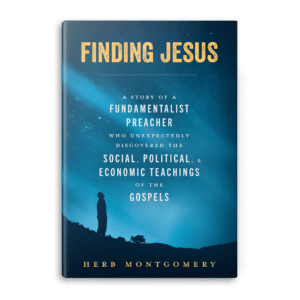 Herb’s new book, Finding Jesus: A story of a fundamentalist preacher who unexpectedly discovered the social, political, and economic teachings of the Gospels, is now available at Renewed Heart Ministries.
General Christian
Politics and Religion
Previous Post

November 22, 2023
Sheep and Goats, Part 2
Next Post

November 28, 2023 Advent and the Refusal to Lose Hope, Part 1
Browse Our Archives
Select a Category Ableism Abolition Advent Anti Semitism Christianity Christmas Climate Justice Criminal Justice Democracy Disability Justice Distributive Justice Easter Economic Justice Environmental Justice Equity Feminism Government Immigration Justice Indigenous Justice Interfaith Law and Order LGBTQ Affirmation Liberation Theology Migrant Justice Myth of Redemptive Suffering Nonviolence Prayer Racial Justice Reparation Resistance Resurrection Social Gospel Social Justice Survival Uncategorized Womanism
Select a Month November 2026 October 2026 September 2026 August 2026 July 2026 June 2026 May 2026 April 2026 March 2026 February 2026 January 2026 December 2025 November 2025 October 2025 September 2025 August 2025 July 2025 June 2025 May 2025 April 2025 March 2025 February 2025 January 2025 December 2024 November 2024 October 2024 September 2024 August 2024 July 2024 June 2024 May 2024 April 2024 March 2024 February 2024 January 2024 December 2023 November 2023 October 2023 September 2023 August 2023 July 2023 June 2023 May 2023 April 2023 March 2023 February 2023 January 2023 December 2022 November 2022 October 2022 September 2022 August 2022 July 2022 June 2022 May 2022 April 2022 March 2022 February 2022 January 2022 December 2021 November 2021 October 2021 September 2021 August 2021 July 2021 June 2021 May 2021 April 2021 March 2021 February 2021 January 2021 December 2020 November 2020 October 2020 September 2020 August 2020 July 2020 June 2020 May 2020 April 2020 March 2020 February 2020 January 2020 December 2019 November 2019 October 2019 September 2019 August 2019 July 2019 June 2019 May 2019 April 2019
Follow Us!
TAKE THE
Religious Wisdom Quiz
Where did Philip meet the Ethiopian eunuch?
Select your answer to see how you score.
Jerusalem road Samaria road Jericho road Desert road
Related posts from Social Jesus

The Danger of Dividing the Sheep and the...


The Talents and Multiplying Resources for the Common...

Parable of the Talents: A Call to Justice,...
TRENDING AT PATHEOS Progressive Christian

The Wasp And I: Meditations on Repentance
How can we enter the power and joy of the repentant self...

Reflections on the Evangelical Theological Society
As I mentioned before, this year, for the first time since 2005,...

Demmed if it do and demmed if it...
"First Presidency Announces Salt Lake Temple Rededication Date" Apropos of that,...

Stop Making Thanksgiving Problematic And Just Give Thanks
“What if, today, we were grateful for everything?” –Charlie Brown I...

Sunday Readings: Stay Awake and Hope
The First Sunday of Advent begins a new liturgical year, and the...

Are You a Scrooge or an Ebenezer?
A Call to Remember As the Christmas season begins, will we remember...
view all Progressive Christian blogs
Ad-Free & Subscriber Log-In Subscription Support
- About Us
- 2026 Calendar
- Videos
- Podcasts
- Library of World Religions
- Faith In Media Tracker
- Advertise With Us
- Write for Us
- Privacy Policy
- Terms of Service
- Do Not Sell My Data
- Contact Us
- Radiant Digital
- Manage Newsletter Subscriptions
- Unsubscribe From Notifications
- Sitemap
Copyright 2008-2026, Patheos, part of the Radiant Digital network of media brands. All rights reserved.
Subscription Support Ad-Free & Subscriber Log-In
Follow Patheos