
BuddhistCatholicContemplativeEvangelicalGeneral ChristianHinduJewishLatter-day SaintMuslimNew VisionsProgressive Christian
Beliefs
- Buddhist
- Catholic
- Contemplative
- Evangelical
- General Christian
- Hindu
- Jewish
- Latter-day Saint
- More Voices
- Muslim
- New Visions
- Pagan
- Progressive Christian
Topics
- Religion News
- Food and Religion
- Sports and Religion
- Religious Art
- Religious Music and Entertainment
- Religious Events
- History and Religion
- Style and Religion
- Politics and Religion
- Women in Religion
- Recreation Outdoors and Religion
- Business Finance and Religion
- Careers Workplace and Religion
- Education and Religion
- Family Parenting and Religion
- Health Fitness and Religion
- Home and Religion
- Relationships and Religion
- Technology and Religion
- Travel and Religion
Columnists
- Buddhist Columnists
- Business Finance and Religion Columnists
- Careers Workplace and Religion Columnists
- Catholic Columnists
- Contemplative Columnists
- Education and Religion Columnists
- Evangelists Columnists
- Family Parenting and Religion Columnists
- General Christian Columnists
- Health Fitness and Religion Columnists
- Hindu Columnists
- History and Religion Columnists
- Home and Religion Columnists
- Jewish Columnists
- More Voices Columnists
- Latter Day Columnists
- Muslim Columnists
- New Visions Columnists
- Nonreligious Columnists
- Pagan Columnists
- Politics and Religion Columnists
- Progressive Columnists
- Recreation Outdoors and Religion Columnists
- Relationships and Religion Columnists
- Religion News Columnists
- Religious Art Columnists
- Religious Events Columnists
- Religious Music and Entertainment Columnists
- Sports and Religion Columnists
- Style and Religion Columnists
- Technology and Religion Columnists
- Travel and Religion Columnists
- Women in Religion Columnists
Resource Library
- 2026 Calendar
- Library of World Religions
- The 100 Most Holy Places on Earth
- Patheos Answers
- Podcasts
- Videos
- Faith Leaders Database
- Anglican Episcopalian
- Bahai
- Baptist
- Buddhism
- Christianity
- Confucianism
- Eastern Orthodoxy
- Hinduism
- Holiness and Pentecostal
- ISKCON
- Islam
- Judaism
- Lutheran
- Methodist
- The Church of Jesus Christ of Latter-day Saints
- New Age
- Paganism
- Presbytarian and Reformed
- Protestantism
- Religion Behind the Scenes
- Roman Catholic
- Scientology
- Shia Islam
- Sikhism
- Sufism
- Sunni Islam
- Taoism
- Zen
- See all religions
Research Tools
 Ad-Free & Subscriber Log-In Subscription Support
Ad-Free & Subscriber Log-In Subscription Support
Follow Patheos 

- Trending:
- Forgiveness
- |
- Marriage
- |
- Consciousness
- |
- Death Penalty
- |
- Election
- |
- Halloween

- Home
- Progressive Christian
- Politics and Religion
- A Wedding Banquet: All Are Invited, Not All Are Welcome, Part 3
A Wedding Banquet: All Are Invited, Not All Are Welcome, Part 3
Last updated on: October 12, 2023 at 9:44 am by Herb Montgomery
A Wedding Banquet: All Are Invited, Not All Are Welcome, Part 3 2023-10-12T09:44:44-04:00 Herb Montgomery
Patheos Explore the world's faith through different perspectives on religion and spirituality! Patheos has the views of the prevalent religions and spiritualities of the world.

Matthew’s Version
Remember that Matthew’s audience was much more Jewish than Luke’s. Luke’s community of readers was more cosmopolitan, and Luke was written in the wake of Paul’s and others’ work to include Gentiles in the Jewish Jesus community.
Welcome Readers! Please subscribe to Social Jesus Here.
(Read this series from the beginning at Part 1 and Part 2.)
Matthew, on the other hand, was written for a Galilean audience. Although that audience included Gentiles, it was a much more Jewish concentrated community of Jesus followers. Like Luke’s gospel, Matthew’s was also written after the Roman destruction of Jerusalem in 70 C.E. These Jewish Jesus followers, like all Jews at this time, were wrestling with what to make of a world that no longer had a Jewish temple and in which Jerusalem was destroyed. In this context, Matthew’s author adapts the parable to their community’s needs: it becomes a parable that explains the destruction of Jerusalem as the result of the leaders’ rejection of the Torah’s economic teachings, especially in regards to the poor. These poor people revolted in the poor people’s revolt of the mid 60’s C.E. Their revolt led to the Roman Jewish War of 66-69 C.E., which in turn resulted in the destruction of Jerusalem the following year.
I want to steer clear of supersessionism here: I don’t interpret Matthew’s parable as anti-Jewish or pro-Christian. That would be harmful and overly simplistic. Again, Matthew’s community was composed of a large number of Jewish Jesus followers in and around Galilee. When Matthew refers to an enraged king who sends his army to destroy murderers and burn their city, he is referring to a long history of the elites and the powerful, those who economically benefited from a system that impoverished others, repeatedly rejecting the economic teachings of the Torah in relation to the poor, the Hebrew justice prophets’ call to return to those teachings, and Jesus’ call to do the same. Jesus stood squarely in the justice tradition of the Hebrew prophets. And so this parable tell its audience that the recent events in Jerusalem were caused by the refusal to embrace economic principles that would have eradicated poverty in their society.
This is important. This is not a parable that says Jerusalem was destroyed because “the Jews rejected Jesus.” No. That is an anti-Jewish interpretation. Rather, this parable claims that Jerusalem was destroyed for refusing to take care of the poor. And that interpretation can lead us to advocate for an end to poverty.
Interpreting this passage in terms of poverty harmonizes with the Hebrew prophets as well. Notice why they stated Sodom and Gomorrah were destroyed:
“Now this was the sin of your sister Sodom: She and her daughters were arrogant, overfed and unconcerned; they did not help the poor and needy.” (Ezekiel 16:49)
Making this connection also helps us understand the last portion of the parable about the person found without a wedding garment. At the time of Matthew’s writing, the community was expanding the invitation into Jesus’ kingdom to those outside of Jewish society. But that invitation still came with the warning that weddings require appropriate attire. Jesus’ kingdom here on earth requires regard for people harmed by our world’s systems. If we disregard the social harm being done to others, especially those most vulnerable to that harm in our present system, we will end up just like those in the parable who were originally invited.
And this leads me to one application to our context today. All are invited to sit at the table of justice but not all are welcome: this table that we sit down to requires that we stand for something. The justice table is about justice for everyone: justice for women, justice for people of color, justice for the LGBTQ community, justice for Indigenous people, justice for the poor and the list could go on. This table is about justice for everyone, especially those the present system does harm. And everyone is invited to the table. But to be welcome at that table, one has to take off the garments of patriarchy and put on the clothes of egalitarianism. One has to take off the garments of racism and put on the clothes of racial justice and inclusion. One has to take off the garments of White supremacy and authoritarianism and put on the clothes of a diverse, democratic society. One has to take off the garments of homophobia, biphobia, and transphobia and put on the clothing of equality. One has to take off the garments of colonialism, and put on the clothing of reparations and repentance. One has to take off the garments of classism and put on the clothing of resource sharing, wealth redistribution, and equity.
All are invited, and not all are welcome. To be welcome at the kingdom table, you have to embrace the values, ethics, and principles for which the table stands, because this is a table that is first and foremost about transforming our present world into a safe, compassionate, just home for everyone.
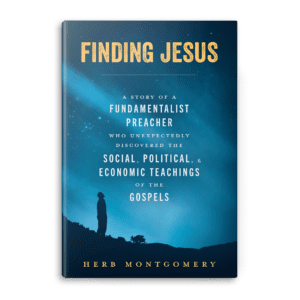 Herb’s new book, Finding Jesus: A story of a fundamentalist preacher who unexpectedly discovered the social, political, and economic teachings of the Gospels, is now available at Renewed Heart Ministries.
General Christian
Politics and Religion

About Herb Montgomery
Herb Montgomery, director of Renewed Heart Ministries, is an author and adult religious re-educator helping Christians explore the intersection of their faith with love, compassion, action, and societal justice. You can read more about the author here.
Previous Post

October 11, 2023
A Wedding Banquet: All Are Invited, Not All Are Welcome, Part 2
Next Post
October 17, 2023 Render to Caesar the Things that Are Caesar’s Part 1
Browse Our Archives
Select a Category Ableism Abolition Advent Anti Semitism Christianity Christmas Climate Justice Criminal Justice Democracy Disability Justice Distributive Justice Easter Economic Justice Environmental Justice Equity Feminism Government Immigration Justice Indigenous Justice Interfaith Law and Order LGBTQ Affirmation Liberation Theology Migrant Justice Myth of Redemptive Suffering Nonviolence Prayer Racial Justice Reparation Resistance Resurrection Social Gospel Social Justice Survival Uncategorized Womanism
Select a Month October 2026 September 2026 August 2026 July 2026 June 2026 May 2026 April 2026 March 2026 February 2026 January 2026 December 2025 November 2025 October 2025 September 2025 August 2025 July 2025 June 2025 May 2025 April 2025 March 2025 February 2025 January 2025 December 2024 November 2024 October 2024 September 2024 August 2024 July 2024 June 2024 May 2024 April 2024 March 2024 February 2024 January 2024 December 2023 November 2023 October 2023 September 2023 August 2023 July 2023 June 2023 May 2023 April 2023 March 2023 February 2023 January 2023 December 2022 November 2022 October 2022 September 2022 August 2022 July 2022 June 2022 May 2022 April 2022 March 2022 February 2022 January 2022 December 2021 November 2021 October 2021 September 2021 August 2021 July 2021 June 2021 May 2021 April 2021 March 2021 February 2021 January 2021 December 2020 November 2020 October 2020 September 2020 August 2020 July 2020 June 2020 May 2020 April 2020 March 2020 February 2020 January 2020 December 2019 November 2019 October 2019 September 2019 August 2019 July 2019 June 2019 May 2019 April 2019
Follow Us!
TAKE THE
Religious Wisdom Quiz
Who said, "I have fought the good fight, I have finished the race"?
Select your answer to see how you score.
Paul John Peter James
Related posts from Social Jesus



A Wedding Banquet and Participating in Justice

A Wedding Banquet and An Invitation to Justice
TRENDING AT PATHEOS Progressive Christian

The Problem with False Prophets
Miller’s Station UMC| 10/18/26| Anchor Verse: Jeremiah 23: 1, 9-23 I...

Emotion in Early Christianity by Andrew Crislip
Andrew Crislip’s Emotion in Early Christianity examines an often overlooked dimension of...

16 Spiritual Touchstones for a More Grounded Life
After decades of spiritual study, here are 16 principles I try...

Catholic Evangelization: Sharing Your Faith Every Day
Welcome back to the Graceful Awakening mini-series called, “From Faith to Mission.” ...

The Pillar of the Boatmen: the Ancient Monument...
The Pillar of the Boatmen is a Romano-Gaulish sculpture that dates from...

In one sense walking into Westminster Abbey is like walking down the...
view all Progressive Christian blogs
Ad-Free & Subscriber Log-In Subscription Support
- About Us
- 2026 Calendar
- Videos
- Podcasts
- Library of World Religions
- Faith In Media Tracker
- Advertise With Us
- Write for Us
- Privacy Policy
- Terms of Service
- Do Not Sell My Data
- Contact Us
- Radiant Digital
- Manage Newsletter Subscriptions
- Unsubscribe From Notifications
- Sitemap
Copyright 2008-2026, Patheos. All rights reserved.
Subscription Support Ad-Free & Subscriber Log-In
Follow Patheos