
BuddhistCatholicContemplativeEvangelicalGeneral ChristianHinduJewishLatter-day SaintMuslimNew VisionsProgressive Christian
Beliefs
- Buddhist
- Catholic
- Contemplative
- Evangelical
- General Christian
- Hindu
- Jewish
- Latter-day Saint
- More Voices
- Muslim
- New Visions
- Pagan
- Progressive Christian
Topics
- Religion News
- Food and Religion
- Sports and Religion
- Religious Art
- Religious Music and Entertainment
- Religious Events
- History and Religion
- Style and Religion
- Politics and Religion
- Women in Religion
- Recreation Outdoors and Religion
- Business Finance and Religion
- Careers Workplace and Religion
- Education and Religion
- Family Parenting and Religion
- Health Fitness and Religion
- Home and Religion
- Relationships and Religion
- Technology and Religion
- Travel and Religion
Columnists
- Buddhist Columnists
- Business Finance and Religion Columnists
- Careers Workplace and Religion Columnists
- Catholic Columnists
- Contemplative Columnists
- Education and Religion Columnists
- Evangelists Columnists
- Family Parenting and Religion Columnists
- General Christian Columnists
- Health Fitness and Religion Columnists
- Hindu Columnists
- History and Religion Columnists
- Home and Religion Columnists
- Jewish Columnists
- More Voices Columnists
- Latter Day Columnists
- Muslim Columnists
- New Visions Columnists
- Nonreligious Columnists
- Pagan Columnists
- Politics and Religion Columnists
- Progressive Columnists
- Recreation Outdoors and Religion Columnists
- Relationships and Religion Columnists
- Religion News Columnists
- Religious Art Columnists
- Religious Events Columnists
- Religious Music and Entertainment Columnists
- Sports and Religion Columnists
- Style and Religion Columnists
- Technology and Religion Columnists
- Travel and Religion Columnists
- Women in Religion Columnists
Resource Library
- 2026 Calendar
- Library of World Religions
- The 100 Most Holy Places on Earth
- Patheos Answers
- Podcasts
- Videos
- Faith Leaders Database
- Anglican Episcopalian
- Bahai
- Baptist
- Buddhism
- Christianity
- Confucianism
- Eastern Orthodoxy
- Hinduism
- Holiness and Pentecostal
- ISKCON
- Islam
- Judaism
- Lutheran
- Methodist
- The Church of Jesus Christ of Latter-day Saints
- New Age
- Paganism
- Presbytarian and Reformed
- Protestantism
- Religion Behind the Scenes
- Roman Catholic
- Scientology
- Shia Islam
- Sikhism
- Sufism
- Sunni Islam
- Taoism
- Zen
- See all religions
Research Tools
 Ad-Free & Subscriber Log-In Subscription Support
Ad-Free & Subscriber Log-In Subscription Support
Follow Patheos 

- Trending:
- Forgiveness
- |
- Marriage
- |
- Consciousness
- |
- Death Penalty
- |
- Election
- |
- Halloween

- Home
- Progressive Christian
- Choosing Peace through Militarized Policing or Distributive Justice (Part 2 of 3)
Choosing Peace through Militarized Policing or Distributive Justice (Part 2 of 3)
Last updated on: June 17, 2020 at 10:00 am by Herb Montgomery
Choosing Peace through Militarized Policing or Distributive Justice (Part 2 of 3) 2020-06-17T09:45:57-04:00 Herb Montgomery
Patheos Explore the world's faith through different perspectives on religion and spirituality! Patheos has the views of the prevalent religions and spiritualities of the world.
Welcome readers! Please subscribe through the buttons on the right if you enjoy this post.
(Read this series from its beginning here.)
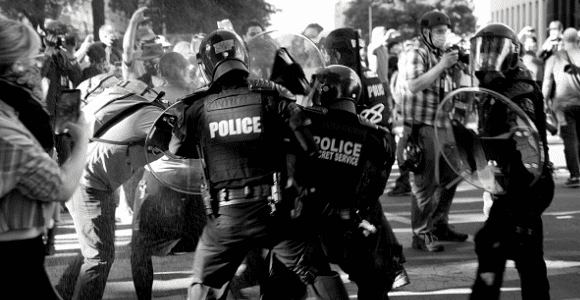
Photo credit: Ryan Kosmides
Again, what we have here is two paths toward peace. One was enforced by militarized power and the other addressed the root causes of injustice that lead to the lack of peace.
One approach toward peace is imposed, and the other is a more organic approach to social causes and effects. When Jerusalem came into view, Jesus stopped and wept: “If you, even you, had only known on this day what would bring you PEACE—but now it is hidden from your eyes” (Luke 19:42–44, emphasis added).
This calls to mind what we are seeing take place in our society presently. The protests are a call for justice that has long gone unheard. Yet Trump is responding, not by listening to the underlying systemic causes and working to address these injustices, but by simply threatening greater force. We have an overfunded, militarized police force and as a country, we spend twice as much on law and order as we do on social welfare.
It is in a context like this that Luke’s Jesus addresses those weeping for him on the way to his execution. Rome executes Jesus because of his economic protest in the temple and his growing number of followers among the disinherited, dispossessed, and disenfranchised.
“Daughters of Jerusalem, do not weep for me; weep for yourselves and for your children…For if they do these things when the tree is green, what will happen when it is dry?”’ (Luke 23:28–30)
Again, many scholars believe Luke’s gospel was written after the fall of Jerusalem in 70 C.E. Luke connects Jesus’ economic teachings about distributive justice, the economic elites’ rejection of those teachings, and the Jewish poor people’s revolt in the late 60s. As I’ve shared in previous weeks, the poor people’s revolt grew into the Roman Jewish war (66-69 C.E.), which resulted in Rome’s violent leveling of Jerusalem in 70 C.E. Luke’s gospel tries to make sense of the devastation of 70 C.E. Christianity has a long, anti-Semitic history of explaining Jerusalem’s destruction as God’s punishment of the city for rejecting Jesus. I don’t believe that. Instead, I see the gospel authors connecting rejection of Jesus’ economic teachings of wealth redistribution and resource-sharing with what later happened in Judea, Galilee, and Samaria. They are making a more organic, intrinsic connection between a society that rejected economic distributive justice and restructuring their community to prioritize the poor on the one hand and the poor people’s uprising and revolt on the other. The results are not divinely imposed or arbitrary. They are the natural outcome of political, economic, and social causes and effects.
This helps us understand the words, “if they do these things when the tree is green, what will happen when it is dry?” If Rome responds to Jesus’ minor protest and demonstration in the temple with such violence as a crucifixion, what will Rome do when it’s facing an entire poor people’s revolt and an all-out class war (i.e. the Jewish-Roman War, 66-69, and the destruction of Jerusalem in 70 C.E.)?
Luke’s Jesus quotes the prophet Hosea, who centuries before had spoken those words about the way Israel would be destroyed by Assyria. “The high places of wickedness will be destroyed—it is the sin of Israel. Thorns and thistles will grow up and cover their altars. Then they will say to the mountains, ‘Cover us!’ and to the hills, ‘Fall on us!’ . . .” (Hosea 10.8-10) Luke applied Hosea’s words to how Jerusalem would be destroyed by Rome.
“As the legions charged in [the Temple], neither persuasion nor threat could check their impetuosity: passion alone was in command . . . Most of the victims were peaceful citizens, weak and unarmed, butchered wherever they were caught. Round the Altar, the heap of corpses grew higher and higher, while down the Sanctuary steps poured a river of blood and the bodies of those killed at the top slithered to the bottom . . . Next [the Romans] came to the last surviving colonnade of the outer court. On this women and children and a mixed crowd of citizens had found a refuge—6000 in all. Before Caesar could reach a decision about them or instruct his officers, the soldiers, carried away by their fury, fired the colonnade from below; as a result, some flung themselves out of the flames to their death, others perished in the blaze: of that vast number there escaped not one.” Josephus, The Jewish War, Williamson and Smallwood, p. 359 (6.5.1; 271–76)
This is where the path of systemic injustice pressed down too long by militarized force ultimately ends. People finally have enough. When the dust settles, there is either change or massive destruction as social unrest is once again quelled, and social change is once again pushed further down the line for a future revolt.
We’ll discuss how this applies to our context, today, next.

About Herb Montgomery
Herb Montgomery, director of Renewed Heart Ministries, is an author and adult religious re-educator helping Christians explore the intersection of their faith with love, compassion, action and societal justice. You can read more about the author here.

Browse Our Archives
Select a Category Ableism Abolition Advent Anti Semitism Christianity Christmas Climate Justice Criminal Justice Democracy Disability Justice Distributive Justice Easter Economic Justice Environmental Justice Equity Feminism Government Immigration Justice Indigenous Justice Interfaith Law and Order LGBTQ Affirmation Liberation Theology Migrant Justice Myth of Redemptive Suffering Nonviolence Prayer Racial Justice Reparation Resistance Resurrection Social Gospel Social Justice Survival Uncategorized Womanism
Select a Month October 2026 September 2026 August 2026 July 2026 June 2026 May 2026 April 2026 March 2026 February 2026 January 2026 December 2025 November 2025 October 2025 September 2025 August 2025 July 2025 June 2025 May 2025 April 2025 March 2025 February 2025 January 2025 December 2024 November 2024 October 2024 September 2024 August 2024 July 2024 June 2024 May 2024 April 2024 March 2024 February 2024 January 2024 December 2023 November 2023 October 2023 September 2023 August 2023 July 2023 June 2023 May 2023 April 2023 March 2023 February 2023 January 2023 December 2022 November 2022 October 2022 September 2022 August 2022 July 2022 June 2022 May 2022 April 2022 March 2022 February 2022 January 2022 December 2021 November 2021 October 2021 September 2021 August 2021 July 2021 June 2021 May 2021 April 2021 March 2021 February 2021 January 2021 December 2020 November 2020 October 2020 September 2020 August 2020 July 2020 June 2020 May 2020 April 2020 March 2020 February 2020 January 2020 December 2019 November 2019 October 2019 September 2019 August 2019 July 2019 June 2019 May 2019 April 2019
Follow Us!
TAKE THE
Religious Wisdom Quiz
What did God tell Isaiah to do for three years as a sign against Egypt and Cush?
Select your answer to see how you score.
Walk barefoot and naked Drink only water Sleep outside Eat bread only
Related posts from Social Jesus



A Wedding Banquet and Participating in Justice

A Wedding Banquet and An Invitation to Justice
TRENDING AT PATHEOS Progressive Christian

Emotion in Early Christianity by Andrew Crislip
Andrew Crislip’s Emotion in Early Christianity examines an often overlooked dimension of...

16 Spiritual Touchstones for a More Grounded Life
After decades of spiritual study, here are 16 principles I try...

Catholic Evangelization: Sharing Your Faith Every Day
Welcome back to the Graceful Awakening mini-series called, “From Faith to Mission.” ...

The Pillar of the Boatmen: the Ancient Monument...
The Pillar of the Boatmen is a Romano-Gaulish sculpture that dates from...

In one sense walking into Westminster Abbey is like walking down the...

'Super Scam Me' Exposes AI Jon Bon Jovi...
Leslie Pickett believed she was in a relationship with Jon Bon Jovi....
view all Progressive Christian blogs
Ad-Free & Subscriber Log-In Subscription Support
- About Us
- 2026 Calendar
- Videos
- Podcasts
- Library of World Religions
- Faith In Media Tracker
- Advertise With Us
- Write for Us
- Privacy Policy
- Terms of Service
- Do Not Sell My Data
- Contact Us
- Radiant Digital
- Manage Newsletter Subscriptions
- Unsubscribe From Notifications
- Sitemap
Copyright 2008-2026, Patheos. All rights reserved.
Subscription Support Ad-Free & Subscriber Log-In
Follow Patheos