
BuddhistCatholicContemplativeEvangelicalGeneral ChristianHinduJewishLatter-day SaintMuslimNew VisionsProgressive Christian
Beliefs
- Buddhist
- Catholic
- Contemplative
- Evangelical
- General Christian
- Hindu
- Jewish
- Latter-day Saint
- More Voices
- Muslim
- New Visions
- Pagan
- Progressive Christian
Topics
- Religion News
- Food and Religion
- Sports and Religion
- Religious Art
- Religious Music and Entertainment
- Religious Events
- History and Religion
- Style and Religion
- Politics and Religion
- Women in Religion
- Recreation Outdoors and Religion
- Business Finance and Religion
- Careers Workplace and Religion
- Education and Religion
- Family Parenting and Religion
- Health Fitness and Religion
- Home and Religion
- Relationships and Religion
- Technology and Religion
- Travel and Religion
Columnists
- Buddhist Columnists
- Business Finance and Religion Columnists
- Careers Workplace and Religion Columnists
- Catholic Columnists
- Contemplative Columnists
- Education and Religion Columnists
- Evangelists Columnists
- Family Parenting and Religion Columnists
- General Christian Columnists
- Health Fitness and Religion Columnists
- Hindu Columnists
- History and Religion Columnists
- Home and Religion Columnists
- Jewish Columnists
- More Voices Columnists
- Latter Day Columnists
- Muslim Columnists
- New Visions Columnists
- Nonreligious Columnists
- Pagan Columnists
- Politics and Religion Columnists
- Progressive Columnists
- Recreation Outdoors and Religion Columnists
- Relationships and Religion Columnists
- Religion News Columnists
- Religious Art Columnists
- Religious Events Columnists
- Religious Music and Entertainment Columnists
- Sports and Religion Columnists
- Style and Religion Columnists
- Technology and Religion Columnists
- Travel and Religion Columnists
- Women in Religion Columnists
Resource Library
- 2026 Calendar
- Library of World Religions
- The 100 Most Holy Places on Earth
- Patheos Answers
- Podcasts
- Videos
- Faith Leaders Database
- Anglican Episcopalian
- Bahai
- Baptist
- Buddhism
- Christianity
- Confucianism
- Eastern Orthodoxy
- Hinduism
- Holiness and Pentecostal
- ISKCON
- Islam
- Judaism
- Lutheran
- Methodist
- The Church of Jesus Christ of Latter-day Saints
- New Age
- Paganism
- Presbytarian and Reformed
- Protestantism
- Religion Behind the Scenes
- Roman Catholic
- Scientology
- Shia Islam
- Sikhism
- Sufism
- Sunni Islam
- Taoism
- Zen
- See all religions
Research Tools
 Ad-Free & Subscriber Log-In Subscription Support
Ad-Free & Subscriber Log-In Subscription Support
Follow Patheos 

- Trending:
- Forgiveness
- |
- Marriage
- |
- Consciousness
- |
- Death Penalty
- |
- Election
- |
- Halloween

- Home
- Progressive Christian
- A Christmas Story for the Marginalized
A Christmas Story for the Marginalized
Last updated on: December 24, 2019 at 12:07 pm by Herb Montgomery
A Christmas Story for the Marginalized 2019-12-24T12:07:33-04:00 Herb Montgomery
Patheos Explore the world's faith through different perspectives on religion and spirituality! Patheos has the views of the prevalent religions and spiritualities of the world.
Welcome readers! Please subscribe through the buttons on the right if you enjoy this post.
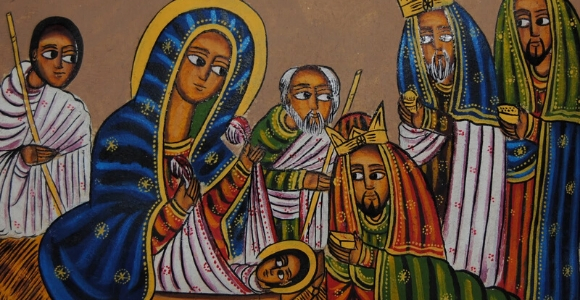
Ethiopian Orthodox Church Nativity Scene painted in traditional style
“The question for those presently at the center is not whether they will include the presently marginalized at their table, but whether they will participate in the socially transformative work that is already taking place on the margins of their society.”
“And there were shepherds living out in the fields nearby, keeping watch over their flocks at night. An angel of the Lord appeared to them, and the glory of the Lord shone around them, and they were terrified. But the angel said to them, ‘Do not be afraid. I bring you good news of great joy that will be for all the people.’” (Luke 2:8–10)
We have entered the holiday season and I want to begin by wishing each of you a very happy one. In the Christian calendar, this is the season of Advent. In Luke’s version of the narratives about Jesus’ birth, the author chooses to center an unlikely community to receive the first announcement of “good news to all people.” This was the community of “shepherds living in the fields nearby.”
In Luke’s society, socially, politically and economically, shepherding filled one of the lowest occupational roles and shepherds bore the brunt of their lower social location. Shepherds were considered untrustworthy, and their work—according to some then-popular interpretations of Torah—made them continually unclean.
The most obvious implication is that the “good news” of the Jesus story first came to a community on the edges of Jesus’ society. His story was going to be first for those on society’s edges, not those in positions of privilege and power.
This narrative contradicts the one that modern, Westernized Christianity has so long used to equate Christianity with social respectability. Today, with few exceptions, the church has often missed out on building relationships and community with people pushed to the fringes of our larger society. I’m being generous when I say it this way: to simply say that Christian communities have “missed out” ignores the reality that the marginalized have been more than simply “missed.” The church has in many cases driven these folks to society’s fringes so that they’re marginalized by the very ones who carry the name of Jesus.
It matters how we understand each version of the stories of Jesus’ birth and what social, economic, political and even religious implications these stories would’ve had for their original listeners and contexts. When we read contextually today, we begin to see a rich field of insights for our work of social justice. Historically, Christians have spent countless hours on apologetics defending certain details in Jesus’ birth narratives but ignored the more socially relevant implications of these stories. One example of a detail we’ve historically focused on is Matthew’s gospel’s virgin birth. This story element would have meant something to those living in Galilee continually bumping up against the Roman myths about the birth of Caesar Augustus. It says little to us today in our scientific age. Yet other elements of Jesus’ birth narratives in both Matthew and Luke still can offer much to us who are working for a world of love and justice today.
How we as Christians hear the Christmas story, read the Christmas story, and interpret the Christmas story matters! Reclaimed interpretations of the Christmas story emphasize details that we can’t afford to miss. Jesus being born into immense poverty, being announced to the socially outcast, bypassing the politically, economically, socially and religiously of the day, and his parents becoming violence-fleeing refugees for the wellbeing of their child—there is an entire foundation here on which to build a framework for Christians who are working toward social justice today.
The story whispers to us of the need for communities to prioritize the poor, the insignificant, forgotten, and the marginalized. These are the people who gathered at this lowly manger and dared to believe that the babe who lay there, this good news, really belonged to them.
The message to the shepherds was, “Do not be afraid. I bring you good news of great joy that will be for all people.” (Luke 2:8–10)
The babe in a manger would not affirm the dominant structure of society of inequity, oppression, exploitation (See Luke 4:18-19). Instead, he would grow up to gather the outcast, the socially marginalized, those labeled and treated as less than by the privileged and powerful. He called for a society that did this, too, and it began with his early followers. Early communities of Jesus-followers were almost wholly comprised of people from society’s edges.
At the heart of Luke’s retelling of the Jesus story (and I believe it was the reason he—unlike Mark and John—included the details of Jesus’ birth) is a desire to contrast Jesus’ vision for human community of no more oppression, exploitation or marginalization with the much larger Roman society they lived in.
We’ll cover these contrasts in Luke in the upcoming weeks leading up to Christmas. I believe they hold wonderful encouragement for those working within or alongside marginalized communities today, especially for Christians who allow Jesus’ teachings to speak into their lives.
And lastly, during this holiday season, in the midst of all that is taking place in the news presently, we must not forget what these stories say to those who are marginalized in our society. We’ll talk about all of this, too. For now, it is enough to meditate on the fact that in the gospels’ birth-narratives about Jesus, it is the marginalized who are centered. It is foreigners, shepherds, the poor, the marginalized, so-called “nobodies,” and even the animals of a stable that gather around the manger to symbolize, I believe, the human community this newborn babe will grow up to speak about. The good news is for them.
People are of infinite value in this story. In these stories, people and communities marginalized by their present society are, especially of immeasurable worth. When I was born, my parents printed and sent out baby announcements to all their family and friends. I don’t know if many parents still do this, but I still have my birth announcement. To think of Jesus’ birth stories in this light, it is the marginalized who are the ones to whom the birth announcements of Jesus’ birth are first sent.
In the hustle and bustle of this season’s celebrations, traditions, and revelry, Christians who still subscribe to various forms of exclusion (xenophobia, racism, homo-, bi-, and transphobias, sexism, etc.) must allow the universal truths this story tells to confront them. If you are a Christian setting out nativity scenes in your home, stop for a moment and look at each of the figurines you’re placing. Who do these figures represent today? How are they represented in your life? Are you one of them? If not, are you living in solidarity with those represented in this scene?
Your nativity scene hints to us that this babe lying in a manger, born into poverty, and surrounded by those on edges of his society, will grow up to cast before the imagination of his listeners a vision for human society and those society considers less-than. His is a story for the powerless, the oppressed, the poor, the marginalized, the unclean, the judged, and the labeled, and excluded, the insignificant, and forgotten. These are the very ones that can gather around this lowly manger and dare to believe that the babe who lies there really is for them.
This last year, one of the RHM recommended reading books was Miguel A. De La Torre’s Reading the Bible from the Margins. Speaking of our nativity scene reminds me of this passage:
“Jesus’s audience was primarily the outcasts of society. This is why it is important to understand the message of Jesus from the perspective of the disenfranchised. The marginalized of Jesus’ time occupied the privileged position of being the first to hear and respond to the gospel. By making the disenfranchised recipients of the Good News, Jesus added a political edge to his message.” (Kindle Location 629)
Jesus’ birth narratives are not calling for societally privileged Christians today to begin including those presently marginalized. On the contrary, the Christmas stories call these specific Christians to recognize that God is already working in the margins of their society. The question for those presently at the center is not whether they will include the presently marginalized at their table, but whether they will participate in the socially transformative work that is already taking place on the margins of their society.
The stories of Jesus are not stories of inclusion where those presently centered maintain their positions of privilege. These are stories about a fundamental change in the way we shape our human communities. And it begins with recognizing the universal truths of the manger scene. Change always happens from the grassroots up, from the margins inward. The question for those at the center is whether they will obstruct those working for a safer, just society, or work in harmony with them.
This is what these stories are saying to me this year. What are they saying to you?
Wherever you are, keep choosing love, compassion, action and reparative, and distributive justice.
Another world is possible if we choose it.
Happy holidays to you all.

About Herb Montgomery
Herb Montgomery, director of Renewed Heart Ministries, is an author and adult religious re-educator helping Christians explore the intersection of their faith with love, compassion, action and societal justice. You can read more about the author here.
Previous Post

December 4, 2019
Inability to Rightly Evaluate What’s Happening
Next Post
December 9, 2019 Social Location Matters
Browse Our Archives
Select a Category Ableism Abolition Advent Anti Semitism Christianity Christmas Climate Justice Criminal Justice Democracy Disability Justice Distributive Justice Easter Economic Justice Environmental Justice Equity Feminism Government Immigration Justice Indigenous Justice Interfaith Law and Order LGBTQ Affirmation Liberation Theology Migrant Justice Myth of Redemptive Suffering Nonviolence Prayer Racial Justice Reparation Resistance Resurrection Social Gospel Social Justice Survival Uncategorized Womanism
Select a Month October 2026 September 2026 August 2026 July 2026 June 2026 May 2026 April 2026 March 2026 February 2026 January 2026 December 2025 November 2025 October 2025 September 2025 August 2025 July 2025 June 2025 May 2025 April 2025 March 2025 February 2025 January 2025 December 2024 November 2024 October 2024 September 2024 August 2024 July 2024 June 2024 May 2024 April 2024 March 2024 February 2024 January 2024 December 2023 November 2023 October 2023 September 2023 August 2023 July 2023 June 2023 May 2023 April 2023 March 2023 February 2023 January 2023 December 2022 November 2022 October 2022 September 2022 August 2022 July 2022 June 2022 May 2022 April 2022 March 2022 February 2022 January 2022 December 2021 November 2021 October 2021 September 2021 August 2021 July 2021 June 2021 May 2021 April 2021 March 2021 February 2021 January 2021 December 2020 November 2020 October 2020 September 2020 August 2020 July 2020 June 2020 May 2020 April 2020 March 2020 February 2020 January 2020 December 2019 November 2019 October 2019 September 2019 August 2019 July 2019 June 2019 May 2019 April 2019
Follow Us!
TAKE THE
Religious Wisdom Quiz
What Christian group is known for its emphasis on "total depravity"?
Select your answer to see how you score.
Reformed (Calvinists) Methodists Baptists Orthodox
Related posts from Social Jesus



Parables of Justice, Compassion, and Inclusion

When Compassion Leads to Action
TRENDING AT PATHEOS Progressive Christian

The Iron Gates and the Lion of the...
Yesterday, I didn't finish my report about, well, yesterday. So I'll...

Dolly Parton’s Last Song Wins Dove Award with...
Bluegrass band The Grascals, speaking on the red carpet at the 57th...

The Image: On the Horror of Capitalism and...
The Image Then went the Pharisees, and took counsel how they might...

We are approaching the date of our new American national holiday: October...

Letters on Living the Faith by C.S. Lewis
Most of us met C.S. Lewis as a public intellectual. Mere Christianity....

When Halloween Unmasks Married Hearts
Written by Dr. David K. Ewen from Eternal Truth Bible College Behind...
view all Progressive Christian blogs
Ad-Free & Subscriber Log-In Subscription Support
- About Us
- 2026 Calendar
- Videos
- Podcasts
- Library of World Religions
- Faith In Media Tracker
- Advertise With Us
- Write for Us
- Privacy Policy
- Terms of Service
- Do Not Sell My Data
- Contact Us
- Radiant Digital
- Manage Newsletter Subscriptions
- Unsubscribe From Notifications
- Sitemap
Copyright 2008-2026, Patheos. All rights reserved.
Subscription Support Ad-Free & Subscriber Log-In
Follow Patheos