
BuddhistCatholicContemplativeEvangelicalGeneral ChristianHinduJewishLatter-day SaintMuslimNew VisionsProgressive Christian
Beliefs
- Buddhist
- Catholic
- Contemplative
- Evangelical
- General Christian
- Hindu
- Jewish
- Latter-day Saint
- More Voices
- Muslim
- New Visions
- Pagan
- Progressive Christian
Topics
- Religion News
- Food and Religion
- Sports and Religion
- Religious Art
- Religious Music and Entertainment
- Religious Events
- History and Religion
- Style and Religion
- Politics and Religion
- Women in Religion
- Recreation Outdoors and Religion
- Business Finance and Religion
- Careers Workplace and Religion
- Education and Religion
- Family Parenting and Religion
- Health Fitness and Religion
- Home and Religion
- Relationships and Religion
- Technology and Religion
- Travel and Religion
Columnists
- Buddhist Columnists
- Business Finance and Religion Columnists
- Careers Workplace and Religion Columnists
- Catholic Columnists
- Contemplative Columnists
- Education and Religion Columnists
- Evangelists Columnists
- Family Parenting and Religion Columnists
- General Christian Columnists
- Health Fitness and Religion Columnists
- Hindu Columnists
- History and Religion Columnists
- Home and Religion Columnists
- Jewish Columnists
- More Voices Columnists
- Latter Day Columnists
- Muslim Columnists
- New Visions Columnists
- Nonreligious Columnists
- Pagan Columnists
- Politics and Religion Columnists
- Progressive Columnists
- Recreation Outdoors and Religion Columnists
- Relationships and Religion Columnists
- Religion News Columnists
- Religious Art Columnists
- Religious Events Columnists
- Religious Music and Entertainment Columnists
- Sports and Religion Columnists
- Style and Religion Columnists
- Technology and Religion Columnists
- Travel and Religion Columnists
- Women in Religion Columnists
Resource Library
- 2026 Calendar
- Library of World Religions
- The 100 Most Holy Places on Earth
- Patheos Answers
- Podcasts
- Videos
- Faith Leaders Database
- Anglican Episcopalian
- Bahai
- Baptist
- Buddhism
- Christianity
- Confucianism
- Eastern Orthodoxy
- Hinduism
- Holiness and Pentecostal
- ISKCON
- Islam
- Judaism
- Lutheran
- Methodist
- The Church of Jesus Christ of Latter-day Saints
- New Age
- Paganism
- Presbytarian and Reformed
- Protestantism
- Religion Behind the Scenes
- Roman Catholic
- Scientology
- Shia Islam
- Sikhism
- Sufism
- Sunni Islam
- Taoism
- Zen
- See all religions
Research Tools
 Ad-Free & Subscriber Log-In Subscription Support
Ad-Free & Subscriber Log-In Subscription Support
Follow Patheos 

- Trending:
- Forgiveness
- |
- Marriage
- |
- Consciousness
- |
- Death Penalty
- |
- Election
- |
- Halloween

-
More
- Home
- Progressive Christian
- Book Review: How to be a Stoic
Book Review: How to be a Stoic
Last updated on: March 22, 2020 at 9:20 pm by Andrew
Book Review: How to be a Stoic 2020-03-22T21:20:53-05:00 Andrew
Patheos Explore the world's faith through different perspectives on religion and spirituality! Patheos has the views of the prevalent religions and spiritualities of the world.
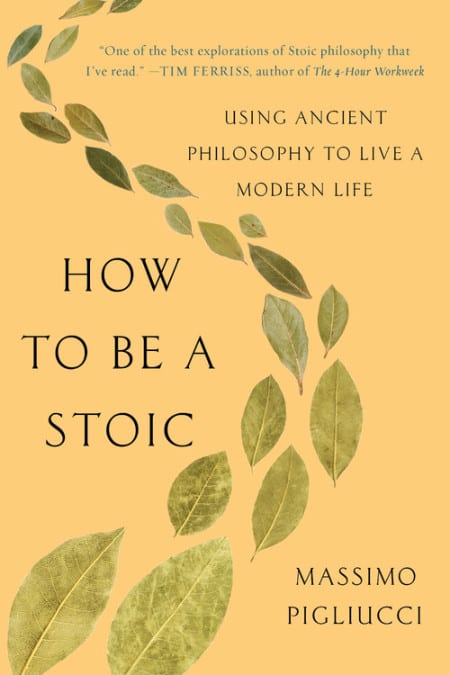 For those interested in an overview of the history and practice of Stoicism, author Massimo Pigliucci soars as a tour guide par excellence, as does his unique background as a scientist, philosopher, practicing Stoic, author, and communicator.
Focus on what you can control; anything else is a harmful double edge sword, it wastes time and energy on what you cannot influence and it distracts from what you can. Stated more eloquently by the author (bold my emphasis):
“Stoicism is not about suppressing or hiding emotion – rather it is about acknowledging our emotions, reflecting on what causes them, and redirecting them for our own good. It is also about keeping in mind what is and what is not under our control, focusing our efforts on the former and not wasting time on the latter. It is about practicing virtue and excellence and navigating the world to the best of our abilities, while being mindful of the moral dimension of our actions.” (page 2)
It sounds easy, but try it for 24 hours, or even one hour – and specifically during a dark and challenging hour/day/month/year. At the time of this review, we are in the midst of the unprecedented Coronavirus outbreak. I can say this with certainty: my now Stoic practicing mindset is reacting much differently than I would have preciously. If Victor Frankl (and many others) can survive the Holocaust by focusing on what they can control, I can stay calm and focus on what I can control during this pandemic (or a worse outbreak, war, or even in small day to day challenges in dealing with friends, families, coworkers, etc.).
For my readers, you know I’ve been tremendously inspired by the idea of Aristotelian ethics and virtue theory. Add Frankl’s Man’s Search for Meaning and logotherapy (which was inspired by Stoic principles as Massimo points out), and my discovery and practice of meditation, I was already a Stoic – I just didn’t know it yet.
To be clear, the author points out that “Stoicism is a philosophy, not a type of therapy” (page 9). The practice of the philosophy can be therapeutic, but Stoicism is itself is not a therapy (like logotherapy); rather the underlying Stoic philosophical principles are part of the foundation (of logotherapy, for example). The beauty of the philosophy is how simple, yet demanding it is. It ultimately amounts to moral character being “the only truly worthy thing to cultivate” and “your ability to live a moral life and thus achieve what Stoics call ataraxia, or tranquility of mind” (page 10). It is adopting this life philosophy, and focusing on what you can control, that dramatically changes one’s outlook and behavior.
Stoicism is also not a theology. The author (an atheist) points out that Stoics “believed that the universe is structured according to what they called the Logos, which can be interpreted as either God or simply what is sometimes termed ‘Einstein’s god’: the simple, indubitable fact that Nature is understandable by reason” (page 6), which appeals to him as a nonreligious person – it serves as an “ecumenical philosophy, one that can share goals and at least some general attitudes with other major ethical traditions across the world” (page 10). This is incredibly appealing to me (progressive Christian, to say the least) for the same reasons. As I penned in my book Meta (co-authored by Adam Lee), “we can stand together as friends and change the world—uniting to fight against injustices like poverty and human trafficking. We’ll debate on the metaphysics on the car ride over”. Stoic principles allow this common ground of practical ethics, moral character, and striving to reach one’s potential by living in accordance to the Logos, however one defines it; for the early Stoics God was “a material God immanent in the cosmos” (page 22).
The author does a very nice job laying out Stoicism’s basic principles, then moving into the history of Stoicism from early Stoa and founder Zeno, to late Stoa and emperor Marcus Aurelius – and how many philosophers and theologians like Augustine, Aquinas, Bacon, and Descartes were deeply influenced by Stoicism – as were relatively recent psychologists in Viktor Frankl (and his logotherapy) and Albert Ellis (and his rational emotive behavior therapy).
It was truly surprising to me to learn both the influence of Stoicism and the power of Stoic principles in doing what virtue requires and focusing on what you can control. Another key example pointed out by the author is the Serenity Prayer which has inspired countless people, and of course serves as a bedrock of 12 step programs (bold emphasis mine):
God, grant me the serenity to accept the things I cannot change,
Courage to change the things I can
And the wisdom to know the difference
It’s easy to see the Stoic influence when you look at Epictetus’ (a prominent Stoic figure) early rendition of similar sentiments:
“Make the best use of what is in your power, and take the rest as it happens. Some things are up to us and some things are not up to us. Our opinions are up to us, and our our impulses, desires, aversions-in short, whatever is our own doing. Our bodies are not up to us, nor are our possessions, our reputations, or our public offices, or, that its, whatever is not our own doing.”
The author nails a key point that some key tenants of Stoicism are shared in other prevalent philosophical and theological traditions (including Judaism, Christianity, Buddhism, and Taoism), “some of these parallels are the result of direct or indirect reciprocal influence, and others represent the independent convergence of wise minds reflecting on the human condition” (page 31). In short, for most of us, these key principles shouldn’t be shocking (as these tenants are common to many virtue ideologies, and with that, if we think about when we’ve practiced these tenants, we’re typically our best selves), hence my previous feeling that I was always a Stoic, I just didn’t know it.
Think about it. When you’re worrying about what you cannot control, what is your typical mental state? What behavior typically follows? At the other end, when you focus on what you can control and do what virtue demands, what is your typical mental state and behavior? This is the essence of the “dichotomy of control”.
The fourth chapter on “Living According to Nature” nicely illustrates the difference between Stoicism and other prominent ethical systems. The attraction is that it extends far beyond the classical ideas of “good” in deontological and consequentialist forms of ethics. To be clear, it doesn’t deny moral truths in these ethical systems, it’s just that a virtue-based ethic like Stoicism requires more than just these ethical systems alone. The Stoic ethic, aims for eudaimonia, the ethically good life where one’s actions require what virtue demands as a social and rational animal living in communion with humankind (along with all living creatures and our planet, for that matter).
So let’s say you’re ready to jump in with both feet. What about that small (or large) circle of people that are impossible to be around, treat us terribly, or are just sometimes very difficult? What a perfect challenge to do what virtue demands and focus on what we can control and positively influence. Besides, it’s only due to their lack of wisdom, so losing your patience is not only exacerbating the situation, it’s falling short of your own potential and your commitment to yourself and others. If you raised children, you will definitely know what I am getting at (both in success and failure).
Along these lines, anger is a big one for the Stoics; and unsurprisingly – it is one of the easiest distractions to focusing on what you can control and doing what virtue demands. Contra the common misunderstanding that “being Stoic” means being emotionless, Stoics fully expect anger to present (and other emotions like anxiety, worry, etc) its ugly head. To Epictetus’ sentiments above, it’s how we handle that anger (and anxiety, worry, etc.) that matters. To the example above, in raising a child, we can only do so much to control his/her behavior; when they genuinely surprise us with their lack of virtue, how do we respond with the anger that presents?
The twelfth chapter on “How to Deal with Anger, Anxiety, and Loneliness” is an outstanding application to the ideas presented prior throughout the text. We will most certainly have certain situations and/or raw emotions present themselves in life, but there is always a good, better, and best (or bad, real bad, and worst) way to respond. Take, for example, a season of solitude:
“We may have little or no control over the external circumstances that force us into being alone at some time in our lives. But (save for pathological conditions, for which one needs to seek medical help), it is our choice, our own attitude, that turns solitude, into loneliness. We may be alone, but we do not consequently need to feel helpless” (page 185)
In the final chapter, the author lays out twelve main “spiritual exercises” that he drew from Epictetus’ Enchiridion; daily exercises that reinforce Stoicism as a life philosophy. Things like “examine your impressions”, “pause and take a deep breath”, and “how can I use virtue here and now?”, combined with the Stoic requirement of “reflect on your day” – a life philosophy now takes on specific daily practices that reinforce it.
How to be a Stoic: Using Ancient Philosophy to Live a Modern Life is an outstanding and accessible must-read for anyone with an interest in philosophy, ethics, and psychology (whether or not you are a Stoic). Whether or not you are converted, you’ll be inspired. And if you are inspired, perhaps, like me, you’re already converted, you just didn’t know it yet.
Next Post
March 31, 2020 Podcast Episode 5: Massimo Pigliucci on Stoicism and Some Big Questions
Browse Our Archives
Select a Category Book Reviews Deep Scene Breakdown Deep Song Breakdown Events with Adam Lee Iron Heart Musings Podcast Quote Bank
Select a Month January 2026 September 2025 August 2025 June 2025 March 2025 February 2025 November 2024 August 2024 April 2024 March 2024 February 2024 January 2024 December 2023 September 2023 August 2023 April 2023 March 2023 February 2023 December 2022 October 2022 September 2022 August 2022 June 2022 May 2022 April 2022 March 2022 February 2022 January 2022 December 2021 November 2021 October 2021 September 2021 February 2021 January 2021 December 2020 November 2020 August 2020 June 2020 March 2020 December 2019 November 2019 October 2019 September 2019 August 2019 June 2019 May 2019 March 2019 November 2018 October 2018 August 2018 July 2018 June 2018 May 2018 April 2018 March 2018 February 2018 January 2018 December 2017 November 2017 September 2017 August 2017 May 2016 April 2016 November 2015 October 2015 August 2015 July 2015 June 2015 May 2015 March 2015 January 2015 December 2014 November 2014 October 2014 September 2014 August 2014 June 2014 May 2014 April 2014 March 2014
Follow Us!
TAKE THE
Religious Wisdom Quiz
What is the Jewish ritual bath called?
Select your answer to see how you score.
Shofar Matzah Mikveh Mezuzah
Related posts from Soapbox Redemption

Book Review: Free Speech and Why You Should...

Book Review: Why Does the World Exist?

Book Review: Man's Search for Meaning
TRENDING AT PATHEOS Progressive Christian

What Being a Modern-Day Apostle Means to Me
In my last column, I discussed the ins and outs of modern-day...

Did Ancient China Once Worship the God of...
Across human history, a common thread weaves through the origins of the...

Love Your Neighbor – Including Earth-Kin: Lev. 19,...
God’s command to love your neighbor means acting in an ethical and...

Lead a Church Study of “Jesus and Lao...
Guest writer Jack Thomas (The Irreverent Reverend) reflects on leading his church...

Pastoral Wisdom for Responding to Sermon Pushback
Getting sermon pushback on your social justice sermon? Learn practical, Proverbs-based strategies...

Principles for Understanding the Apostolic Ministry Today
Whenever people discover that my formal ministry title is "apostle," as in...
view all Progressive Christian blogs
Ad-Free & Subscriber Log-In Subscription Support
- About Us
- 2026 Calendar
- Videos
- Podcasts
- Library of World Religions
- Faith In Media Tracker
- Advertise With Us
- Write for Us
- Privacy Policy
- Terms of Service
- Do Not Sell My Data
- Contact Us
- Radiant Digital
- Manage Newsletter Subscriptions
- Unsubscribe From Notifications
- Sitemap
Copyright 2008-2026, Patheos. All rights reserved.
Subscription Support Ad-Free & Subscriber Log-In
Follow Patheos