
BuddhistCatholicContemplativeEvangelicalGeneral ChristianHinduJewishLatter-day SaintMuslimNew VisionsProgressive Christian
Beliefs
- Buddhist
- Catholic
- Contemplative
- Evangelical
- General Christian
- Hindu
- Jewish
- Latter-day Saint
- More Voices
- Muslim
- New Visions
- Pagan
- Progressive Christian
Topics
- Religion News
- Food and Religion
- Sports and Religion
- Religious Art
- Religious Music and Entertainment
- Religious Events
- History and Religion
- Style and Religion
- Politics and Religion
- Women in Religion
- Recreation Outdoors and Religion
- Business Finance and Religion
- Careers Workplace and Religion
- Education and Religion
- Family Parenting and Religion
- Health Fitness and Religion
- Home and Religion
- Relationships and Religion
- Technology and Religion
- Travel and Religion
Columnists
- Buddhist Columnists
- Business Finance and Religion Columnists
- Careers Workplace and Religion Columnists
- Catholic Columnists
- Contemplative Columnists
- Education and Religion Columnists
- Evangelists Columnists
- Family Parenting and Religion Columnists
- General Christian Columnists
- Health Fitness and Religion Columnists
- Hindu Columnists
- History and Religion Columnists
- Home and Religion Columnists
- Jewish Columnists
- More Voices Columnists
- Latter Day Columnists
- Muslim Columnists
- New Visions Columnists
- Nonreligious Columnists
- Pagan Columnists
- Politics and Religion Columnists
- Progressive Columnists
- Recreation Outdoors and Religion Columnists
- Relationships and Religion Columnists
- Religion News Columnists
- Religious Art Columnists
- Religious Events Columnists
- Religious Music and Entertainment Columnists
- Sports and Religion Columnists
- Style and Religion Columnists
- Technology and Religion Columnists
- Travel and Religion Columnists
- Women in Religion Columnists
Resource Library
- 2026 Calendar
- Library of World Religions
- The 100 Most Holy Places on Earth
- Patheos Answers
- Podcasts
- Videos
- Faith Leaders Database
- Anglican Episcopalian
- Bahai
- Baptist
- Buddhism
- Christianity
- Confucianism
- Eastern Orthodoxy
- Hinduism
- Holiness and Pentecostal
- ISKCON
- Islam
- Judaism
- Lutheran
- Methodist
- The Church of Jesus Christ of Latter-day Saints
- New Age
- Paganism
- Presbytarian and Reformed
- Protestantism
- Religion Behind the Scenes
- Roman Catholic
- Scientology
- Shia Islam
- Sikhism
- Sufism
- Sunni Islam
- Taoism
- Zen
- See all religions
Research Tools
 Ad-Free & Subscriber Log-In Subscription Support
Ad-Free & Subscriber Log-In Subscription Support
Follow Patheos 

- Trending:
- Forgiveness
- |
- Marriage
- |
- Consciousness
- |
- Death Penalty
- |
- Election
- |
- Halloween

-
More
- Home
- Progressive Christian
- Natural Teleology, Panspermia, and Demarcation…
Natural Teleology, Panspermia, and Demarcation…
Last updated on: April 26, 2014 at 6:38 pm by Andrew
Natural Teleology, Panspermia, and Demarcation… 2014-04-26T18:38:20-05:00 Andrew
Patheos Explore the world's faith through different perspectives on religion and spirituality! Patheos has the views of the prevalent religions and spiritualities of the world.
Not natural theology, natural teleology…
Say what?
Like the teleological argument, just no God. That’s right, fine turning is not just reserved for theists. I recently came across the term in Thomas Nagel’s Mind and Cosmos where he described natural teleology as “other laws of nature that our biased toward the marvelous”, ultimately an undiscovered and “irreducible part of the natural order” that will account for the origin of time, life, consciousness, and moral realism, which he claims are lacking in current “Neo-Darwinian” naturalistic view point. Why am I even writing about this you might ask?
Because it’s my blog and I’ll do what I want.
https://www.youtube.com/watch?v=V6Uo1nNt6LU
Just kidding.
Loosen up. Relax. Smile.
I’m interested in philosophy, science, and theology and I’m always fascinated when theorists cross their respective boundaries. Stay with me.
The backlashing and controversy surrounding Nagel’s book is unsurprising. First of all, it’s complete pseudoscience. Utterly fascinating, but pseudoscience. Secondly, it challenges physicalism of mind, where many scientists and philosophers have claimed consciousness is either illusory (there really are no “mental” states) or that conscious mental states do exist but are/will be explained naturalistically.
Nagel, an atheist, more than steps out of his comfort zone as a philosopher of mind and get his hands into the cosmos and the origin of life. Most atheists are happen to admit that profound mysteries of universe and life remain, but rarely is the “the unexplained” a call for such creativity. And Nagel certainly steps out. But he’s not alone and this phrase reminded me of some other brave scientists who left the bounds of science with their creative ideas.
Somewhat related to natural teleology, it also turns out that intelligent design is not just exclusive to theists. Does the phrase “panspermia” ring a bell? It’s the idea that life began in space and travelled to earth by meteor shower.
It’s based on the principle that the universe and life is so colossally improbable, it must be, in the words of Fred Hoyle, “a put up job”. There must design behind all of this, just a natural one (Fred was a naturalist). So let’s talk about Fred for a moment.
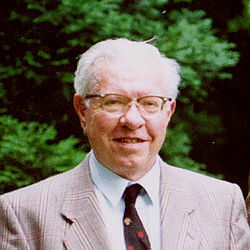 Fred was big time.
He was the famed English astronomer that discovered the mechanism known as nucleosynthesis in which carbon was produced by nuclear reactions in stars. What the big deal?
No carbon in the universe – no life.
It turns out that the energy levels for nucleosynthesis of carbon needed to be at the perfect level, at the perfect place, at the perfect time. They we’re. What are the odds wondered Fred?
“Would you not say to yourself, ‘Some super-calculating intellect must have designed the properties of the carbon atom, otherwise the chance of my finding such an atom through the blind forces of nature would be utterly minuscule. A common sense interpretation of the facts suggests that a superintellect has monkeyed with physics, as well as with chemistry and biology, and that there are no blind forces worth speaking about in nature. The numbers one calculates from the facts seem to me so overwhelming as to put this conclusion almost beyond question.’ (Fred Hoyle, “The Universe: Past and Present Reflections.” Engineering and Science, November, 1981. pp. 8–12)
Fred had some other “Big” ideas. Have you heard of the term “Big Bang”? That’s Fred’s. Not the discovery that confirmed the term, but the term itself. He mockingly coined the phrase and rejected a finite universe with a beginning because it struck a rather curious theistic note.
He postulated a steady state universe that was infinite, yet he could not look past the anthropic principle or intelligent design, just deemed them natural causes. His version of panspermia was prompted by the apparent impossibility of abiogenesis of life on earth. It must have originated somewhere else.
“The notion that not only the biopolymer but the operating program of a living cell could be arrived at by chance in a primordial organic soup here on the Earth is evidently nonsense of a high order… If one proceeds directly and straightforwardly in this matter, without being deflected by a fear of incurring the wrath of scientific opinion, one arrives at the conclusion that biomaterials with their amazing measure or order must be the outcome of intelligent design.” (Hoyle, Fred, Evolution from Space)
Hoyle’s contribution to science was amazing, but his speculations outside of science were far reaching. A naturalistic anthropic principle?
Let’s move to “directed panspermia”. As opposed to the meteor-shower type panspermia, this panspermia proposes life was seeded here by alien civilizations.
Far out.
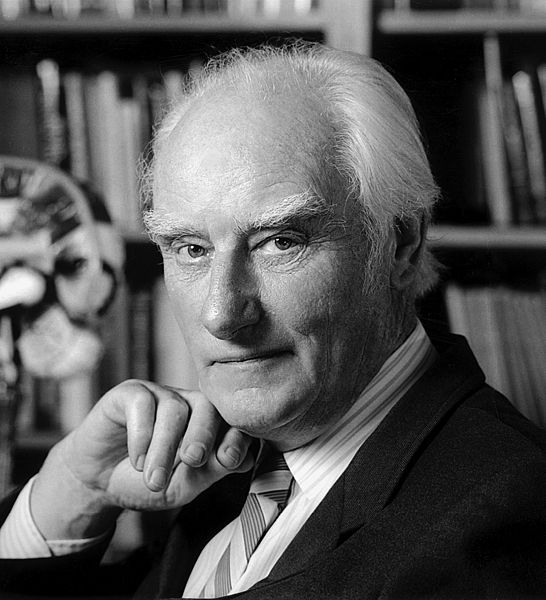 Enter Nobel Nobel Prize winner and co-discoverer of the structure of the DNA molecule Francis Crick. The improbability of the origin of life on earth was more than noted in his book, Life Itself.
“An honest man, armed with all the knowledge available to us now, could only state that, in some sense, the origin of life appears at the moment to be almost a miracle…”
It would be myopic to impose that he was suggesting a miracle, he clearly wasn’t. He was very much aware that his theory was beyond the purview science, but he was offering a pseudoscientific speculation as to how the origin of life could have been, should we not amount of a naturalistic explanation. He also very much sought after naturalistic solutions to the origin of life on earth (without direct panspermia), but realized even those attempts may ultimately remain a mystery.
“…So many are the conditions which would have had to have been satisfied to get it going. But this should not be taken to imply that there are good reasons to believe that it could not have started on the earth by a perfectly reasonable sequence of fairly ordinary chemical reactions. The plain fact is that the time available was too long, the many microenvironments on the earth’s surface too diverse, the various chemical possibilities too numerous and our own knowledge and imagination too feeble to allow us to be able to unravel exactly how it might or might not have happened such a long time ago, especially as we have no experimental evidence from that era to check our ideas against.” (Francis Crick, Life Itself)
Many, I’ve found, are surprised that the brilliant minds and discoverers of nucleosynthesis and the DNA structure espoused these views. Cosmology, quantum mechanics, and evolutionary biology have advanced leaps and bounds since these discoveries and speculative theories continue to be pushed forward, though the origin of time and life remain a profound mystery.
Which brings me to my final thought.
I am always fascinated when scientists become philosophers, when physics crosses over into metaphysics. I’ve had numerous discussions with people on the value and utility of philosophy and have really enjoyed the philosopher of science Massimo Piggliucci’s perspective on this as well as “demarcation” (drawing lines of separation between science and other beliefs) as he was first a biologist, then later became a philosopher of science.
One gem about philosophy (and there are many in my opinion) is that it draws the lines of separation. It calls Genesis theology. It calls the Big Bang science. It calls “natural teleology” and “direct panspermia” pseudoscience. Then, it can proceed to ask normative questions in each area (i.e., philosophy of science, philosophy of mind, philosophy of religion).
So there you have it, a few words on physics, metaphysics, and the role of philosophy in demarcation.
Image source: Christina Carson
Previous Post
April 1, 2014
Book Review: Science and Religion (Dennett vs. Plantinga)
Next Post

May 16, 2014 Alone in the Dark...
Browse Our Archives
Select a Category Book Reviews Deep Scene Breakdown Deep Song Breakdown Events with Adam Lee Iron Heart Musings Podcast Quote Bank
Select a Month January 2026 September 2025 August 2025 June 2025 March 2025 February 2025 November 2024 August 2024 April 2024 March 2024 February 2024 January 2024 December 2023 September 2023 August 2023 April 2023 March 2023 February 2023 December 2022 October 2022 September 2022 August 2022 June 2022 May 2022 April 2022 March 2022 February 2022 January 2022 December 2021 November 2021 October 2021 September 2021 February 2021 January 2021 December 2020 November 2020 August 2020 June 2020 March 2020 December 2019 November 2019 October 2019 September 2019 August 2019 June 2019 May 2019 March 2019 November 2018 October 2018 August 2018 July 2018 June 2018 May 2018 April 2018 March 2018 February 2018 January 2018 December 2017 November 2017 September 2017 August 2017 May 2016 April 2016 November 2015 October 2015 August 2015 July 2015 June 2015 May 2015 March 2015 January 2015 December 2014 November 2014 October 2014 September 2014 August 2014 June 2014 May 2014 April 2014 March 2014
Follow Us!
TAKE THE
Religious Wisdom Quiz
True or False: Moses was hidden in a basket among the reeds of the Nile River as a baby.
Select your answer to see how you score.
TRUE FALSE
Related posts from Soapbox Redemption

Praying with Strangers in an Uber in Memphis

Fernando Goldsztein on the Medulloblastoma Initiative

Iron Heart: 2nd Period Over (Ringing the Bell...

Protons in Memphis and our Deepest Fear
TRENDING AT PATHEOS Progressive Christian

Why Christians Have a Sacred Duty to Vote:...
The Bible offers strong support for the sacred duty to vote. Here...

What Being a Modern-Day Apostle Means to Me
In my last column, I discussed the ins and outs of modern-day...

Did Ancient China Once Worship the God of...
Across human history, a common thread weaves through the origins of the...

Love Your Neighbor – Including Earth-Kin: Lev. 19,...
God’s command to love your neighbor means acting in an ethical and...

Lead a Church Study of “Jesus and Lao...
Guest writer Jack Thomas (The Irreverent Reverend) reflects on leading his church...

Principles for Understanding the Apostolic Ministry Today
Whenever people discover that my formal ministry title is "apostle," as in...
view all Progressive Christian blogs
Ad-Free & Subscriber Log-In Subscription Support
- About Us
- 2026 Calendar
- Videos
- Podcasts
- Library of World Religions
- Faith In Media Tracker
- Advertise With Us
- Write for Us
- Privacy Policy
- Terms of Service
- Do Not Sell My Data
- Contact Us
- Radiant Digital
- Manage Newsletter Subscriptions
- Unsubscribe From Notifications
- Sitemap
Copyright 2008-2026, Patheos. All rights reserved.
Subscription Support Ad-Free & Subscriber Log-In
Follow Patheos