
BuddhistCatholicContemplativeEvangelicalGeneral ChristianHinduJewishLatter-day SaintMuslimNew VisionsProgressive Christian
Beliefs
- Buddhist
- Catholic
- Contemplative
- Evangelical
- General Christian
- Hindu
- Jewish
- Latter-day Saint
- More Voices
- Muslim
- New Visions
- Pagan
- Progressive Christian
Topics
- Religion News
- Food and Religion
- Sports and Religion
- Religious Art
- Religious Music and Entertainment
- Religious Events
- History and Religion
- Style and Religion
- Politics and Religion
- Women in Religion
- Recreation Outdoors and Religion
- Business Finance and Religion
- Careers Workplace and Religion
- Education and Religion
- Family Parenting and Religion
- Health Fitness and Religion
- Home and Religion
- Relationships and Religion
- Technology and Religion
- Travel and Religion
Columnists
- Buddhist Columnists
- Business Finance and Religion Columnists
- Careers Workplace and Religion Columnists
- Catholic Columnists
- Contemplative Columnists
- Education and Religion Columnists
- Evangelists Columnists
- Family Parenting and Religion Columnists
- General Christian Columnists
- Health Fitness and Religion Columnists
- Hindu Columnists
- History and Religion Columnists
- Home and Religion Columnists
- Jewish Columnists
- More Voices Columnists
- Latter Day Columnists
- Muslim Columnists
- New Visions Columnists
- Nonreligious Columnists
- Pagan Columnists
- Politics and Religion Columnists
- Progressive Columnists
- Recreation Outdoors and Religion Columnists
- Relationships and Religion Columnists
- Religion News Columnists
- Religious Art Columnists
- Religious Events Columnists
- Religious Music and Entertainment Columnists
- Sports and Religion Columnists
- Style and Religion Columnists
- Technology and Religion Columnists
- Travel and Religion Columnists
- Women in Religion Columnists
Resource Library
- 2026 Calendar
- Library of World Religions
- The 100 Most Holy Places on Earth
- Patheos Answers
- Podcasts
- Videos
- Faith Leaders Database
- Anglican Episcopalian
- Bahai
- Baptist
- Buddhism
- Christianity
- Confucianism
- Eastern Orthodoxy
- Hinduism
- Holiness and Pentecostal
- ISKCON
- Islam
- Judaism
- Lutheran
- Methodist
- The Church of Jesus Christ of Latter-day Saints
- New Age
- Paganism
- Presbytarian and Reformed
- Protestantism
- Religion Behind the Scenes
- Roman Catholic
- Scientology
- Shia Islam
- Sikhism
- Sufism
- Sunni Islam
- Taoism
- Zen
- See all religions
Research Tools
 Ad-Free & Subscriber Log-In Subscription Support
Ad-Free & Subscriber Log-In Subscription Support
Follow Patheos 

- Trending:
- Forgiveness
- |
- Marriage
- |
- Consciousness
- |
- Death Penalty
- |
- Election
- |
- Halloween

-
More
- Home
- Progressive Christian
- Book Review: Science and Religion (Dennett vs. Plantinga)
Book Review: Science and Religion (Dennett vs. Plantinga)
Last updated on: May 21, 2014 at 11:50 am by Andrew
Book Review: Science and Religion (Dennett vs. Plantinga) 2014-05-21T11:50:30-05:00 Andrew
Patheos Explore the world's faith through different perspectives on religion and spirituality! Patheos has the views of the prevalent religions and spiritualities of the world.
 A great read.
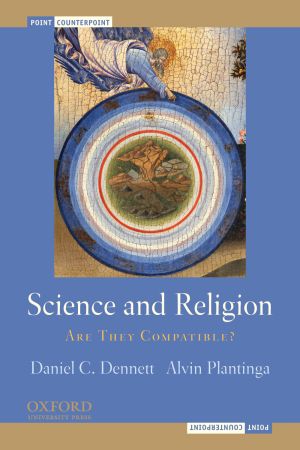
Two heavy -weight philosophers of mind, Alvin Plantinga and Daniel Dennett, both with opposing views on the question: Science and Religion: Are They Compatible?
For those with an interest in the philosophy, faith, and science discussion – you will not be disappointed. These two are both philosophical giants and provide solid philosophical point, counterpoint. It’s brief, only about 77 pages, and though the content can get philosophically heavy at times, it is an easy and enjoyable read for those that enjoy these topics and the point, counterpoint format.
Plantinga, a Christian, takes the affirmative view, that science and religion are in fact compatible. Plantinga surveys some points on fine tuning, though admits this argument is rarely a basis for theism. Where he focuses his arguments are on rationality and warrant in a theistic view, and their absence in a naturalistic worldview. Plantinga states (page 9):
“As I argue in Warranted Christian Belief, if theistic belief is true, then very likely it has both rationality and warrant in the basic way, that is, not on the basic of propositional evidence. If theistic belief is true, then very likely there is a cognitive structure something like John Calvin’s sensus divinitatis, an original source of warranted theistic belief. In this way belief in God, like belief in other minds, has its own source of rationality and warrant, and doesn’t depend on argument from other sources of estimable qualities.”
He affirms the reliability of reason in a theistic worldview and interestingly posits evolution, if true, would not threaten the faculty of reason, if it was divinely guided. His point here is not to argue for theistic evolution, rather, (and here is where it gets interesting) that naturalism and evolution are incompatible. The conflict, says Plantinga (page 17):
“… Is between science and naturalism, not science and theistic religion. What I’ll argue is that naturalism is incompatible with evolution, in the sense that one can’t rationally accept them both.”
Dennett, a naturalist, takes the opposing view, that science and religion are completely incompatible. Rather than theism, he cunningly posits “Supermanism”, where Superman seeding life on this planet is just as preposterous as theism and shifts the burden of proof to Plantinga. He also attacks fine tuning, intelligent design, and “irreducible complexity” as a mere “God of gaps” argument and that we need not conjure up the supernatural, rather just continue exploration of the natural world. The gaps exist, in Dennett’s view (page 33):
“… For the trivial reason that it will take biologists centuries to investigate all the nooks and crannies of the biosphere.”
He also blames the gaps on sociological reasons, that scientists prefer to tackle meaningful scientific questions, not working on the minutiae of how certain features evolved and rendering “irreducible complexity” wrong. This, he argues, would be a waste of a scientific career. He continues (page 34):
“That’s how sure they are that the theory of evolution by natural selection is fundamentally confirmed. Of course they might be wrong, but who would advise them to risk wasting their professional careers on such a hunch?”
On the faculty of reason, he argues that evolution has provided us with a “belief tracking mechanism”. In his words (51-52):
“It is precisely the truth-tracking competence of belief-fixing mechanisms that explains their ‘adaptivity’ in the same way that it is the blood-pumping competence of hearts that explains theirs. Hearts are for circulating the blood and brains are for tracking the relevant conditions of the environment and getting it right.”
Plantinga restates his “evolutionary argument against naturalism” by clarifying his point is not to refute evolution, rather unguided evolution, in producing a reliable truth-tracking system (page 67):
“What I do claim, however, in this crucial first premise, is that the conditional probability of our faculties being reliable, given naturalism and evolution, is low.”
Summary:
Outstanding.
Two very delightful thinkers and writers, I could not put the book down. I appreciated the eloquence and class of both sides in the arguments and rebuttals. For Dennett, theism is a “failure of the imagination” and science continues to eliminate the gaps. For Plantinga, naturalism is self-refuting given unguided evolution, and theism isn’t losing ground to science, rather science continues to reveal God’s handiwork.
A wonderfully written dialogue, I score Plantinga the victor on this one. My view is certainly biased, given our mutual worldview, but I felt the cogency of his arguments were stronger. I appreciated Dennett’s counterpoints, but remain unconvinced by his arguments that truth-tracking brains “get it right” because of evolution. Now, I do agree with Dennett that we “have it right”, that is, our reasoning is valid and that we have some sense of truth (morality for example), but not in his explanation of how. For an unguided evolutionary account would select for survival, not truth.
“We, the individual survival machines in the world, can expect to live a few more decades. But the genes in the world have an expectation of life which must be measured not in decades but in thousands and millions of years … One of the most striking properties of the survival-machine behavior is its apparent purposiveness … The ‘purpose machine’, the machine or thing that behaves as if it had a conscious purpose, is equipped with some kind of measuring device which measures the discrepancy between the current state of things and the ‘desired state’ … The genes too control the behavior of their survival machines, not directly with their fingers on puppet strings, but indirectly like the computer programmer.” (Richard Dawkins, The Selfish Gene)
Unguided evolution certainly speaks of pragmatism and survival. How could “selfish genes” produce anything else? But what of truth, the faculty of reason, morality, etc?
Is there more to truth than that which has evolved?
I say yes.
Previous Post

March 21, 2014
Locker Room Theology
Next Post

April 24, 2014 Natural Teleology, Panspermia, and Demarcation...
Browse Our Archives
Select a Category Book Reviews Deep Scene Breakdown Deep Song Breakdown Events with Adam Lee Iron Heart Musings Podcast Quote Bank
Select a Month January 2026 September 2025 August 2025 June 2025 March 2025 February 2025 November 2024 August 2024 April 2024 March 2024 February 2024 January 2024 December 2023 September 2023 August 2023 April 2023 March 2023 February 2023 December 2022 October 2022 September 2022 August 2022 June 2022 May 2022 April 2022 March 2022 February 2022 January 2022 December 2021 November 2021 October 2021 September 2021 February 2021 January 2021 December 2020 November 2020 August 2020 June 2020 March 2020 December 2019 November 2019 October 2019 September 2019 August 2019 June 2019 May 2019 March 2019 November 2018 October 2018 August 2018 July 2018 June 2018 May 2018 April 2018 March 2018 February 2018 January 2018 December 2017 November 2017 September 2017 August 2017 May 2016 April 2016 November 2015 October 2015 August 2015 July 2015 June 2015 May 2015 March 2015 January 2015 December 2014 November 2014 October 2014 September 2014 August 2014 June 2014 May 2014 April 2014 March 2014
Follow Us!
TAKE THE
Religious Wisdom Quiz
Which foreign woman married King Ahab and promoted Baal worship in Israel?
Select your answer to see how you score.
Tamar Athaliah Jezebel Rahab
Related posts from Soapbox Redemption

Book Review: Free Speech and Why You Should...

Book Review: How to be a Stoic

Book Review: Why Does the World Exist?

TRENDING AT PATHEOS Progressive Christian

Why Christians Have a Sacred Duty to Vote:...
The Bible offers strong support for the sacred duty to vote. Here...

What Being a Modern-Day Apostle Means to Me
In my last column, I discussed the ins and outs of modern-day...

Did Ancient China Once Worship the God of...
Across human history, a common thread weaves through the origins of the...

Love Your Neighbor – Including Earth-Kin: Lev. 19,...
God’s command to love your neighbor means acting in an ethical and...

Lead a Church Study of “Jesus and Lao...
Guest writer Jack Thomas (The Irreverent Reverend) reflects on leading his church...

Principles for Understanding the Apostolic Ministry Today
Whenever people discover that my formal ministry title is "apostle," as in...
view all Progressive Christian blogs
Ad-Free & Subscriber Log-In Subscription Support
- About Us
- 2026 Calendar
- Videos
- Podcasts
- Library of World Religions
- Faith In Media Tracker
- Advertise With Us
- Write for Us
- Privacy Policy
- Terms of Service
- Do Not Sell My Data
- Contact Us
- Radiant Digital
- Manage Newsletter Subscriptions
- Unsubscribe From Notifications
- Sitemap
Copyright 2008-2026, Patheos. All rights reserved.
Subscription Support Ad-Free & Subscriber Log-In
Follow Patheos