
BuddhistCatholicContemplativeEvangelicalGeneral ChristianHinduJewishLatter-day SaintMuslimNew VisionsProgressive Christian
Beliefs
- Buddhist
- Catholic
- Contemplative
- Evangelical
- General Christian
- Hindu
- Jewish
- Latter-day Saint
- More Voices
- Muslim
- New Visions
- Pagan
- Progressive Christian
Topics
- Religion News
- Food and Religion
- Sports and Religion
- Religious Art
- Religious Music and Entertainment
- Religious Events
- History and Religion
- Style and Religion
- Politics and Religion
- Women in Religion
- Recreation Outdoors and Religion
- Business Finance and Religion
- Careers Workplace and Religion
- Education and Religion
- Family Parenting and Religion
- Health Fitness and Religion
- Home and Religion
- Relationships and Religion
- Technology and Religion
- Travel and Religion
Columnists
- Buddhist Columnists
- Business Finance and Religion Columnists
- Careers Workplace and Religion Columnists
- Catholic Columnists
- Contemplative Columnists
- Education and Religion Columnists
- Evangelists Columnists
- Family Parenting and Religion Columnists
- General Christian Columnists
- Health Fitness and Religion Columnists
- Hindu Columnists
- History and Religion Columnists
- Home and Religion Columnists
- Jewish Columnists
- More Voices Columnists
- Latter Day Columnists
- Muslim Columnists
- New Visions Columnists
- Nonreligious Columnists
- Pagan Columnists
- Politics and Religion Columnists
- Progressive Columnists
- Recreation Outdoors and Religion Columnists
- Relationships and Religion Columnists
- Religion News Columnists
- Religious Art Columnists
- Religious Events Columnists
- Religious Music and Entertainment Columnists
- Sports and Religion Columnists
- Style and Religion Columnists
- Technology and Religion Columnists
- Travel and Religion Columnists
- Women in Religion Columnists
Resource Library
- 2026 Calendar
- Library of World Religions
- The 100 Most Holy Places on Earth
- Patheos Answers
- Podcasts
- Videos
- Faith Leaders Database
- Anglican Episcopalian
- Bahai
- Baptist
- Buddhism
- Christianity
- Confucianism
- Eastern Orthodoxy
- Hinduism
- Holiness and Pentecostal
- ISKCON
- Islam
- Judaism
- Lutheran
- Methodist
- The Church of Jesus Christ of Latter-day Saints
- New Age
- Paganism
- Presbytarian and Reformed
- Protestantism
- Religion Behind the Scenes
- Roman Catholic
- Scientology
- Shia Islam
- Sikhism
- Sufism
- Sunni Islam
- Taoism
- Zen
- See all religions
Research Tools
 Ad-Free & Subscriber Log-In Subscription Support
Ad-Free & Subscriber Log-In Subscription Support
Follow Patheos 

- Trending:
- Forgiveness
- |
- Marriage
- |
- Consciousness
- |
- Death Penalty
- |
- Election
- |
- Halloween

- Home
- Progressive Christian
- Politics and Religion
- Why Humans Need Stories That Don’t Pretend to Be God
Why Humans Need Stories That Don’t Pretend to Be God
Last updated on: August 20, 2026 at 1:27 pm by Stuart Delony
Why Humans Need Stories That Don’t Pretend to Be God 2026-08-20T13:27:51-04:00 Stuart Delony
Patheos Explore the world's faith through different perspectives on religion and spirituality! Patheos has the views of the prevalent religions and spiritualities of the world.
DALL-E
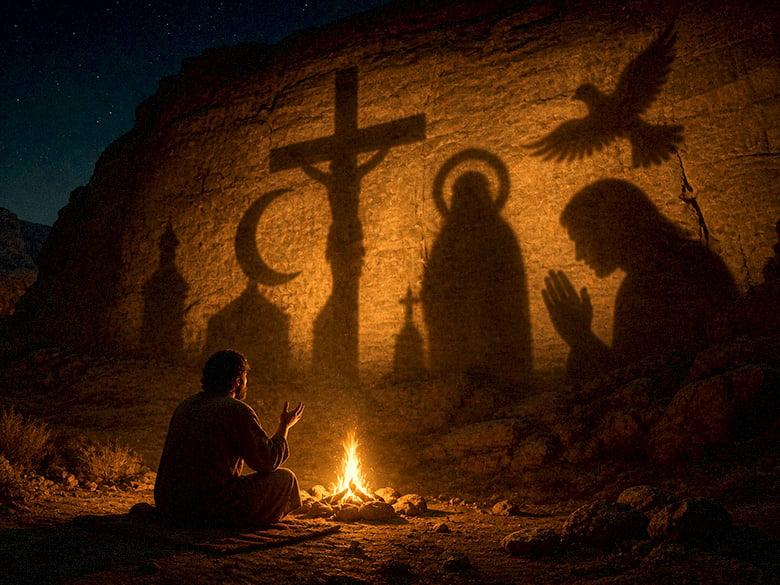
Christians love mocking mythology. Zeus throwing lightning bolts. Thor with a hammer. Athena popping out of someone’s head fully armored. Primitive people making up stories to explain thunder and crops.
And yet those same Christians will turn around and insist their own sacred narrative is not myth at all—it’s literal, historical, divinely dictated reality. Apparently every culture in human history created myths… except the one you happened to be born into.
The irony is almost impressive.
Human beings are myth-making creatures. We organize life through stories. Strip away literal belief and the function is still there—shaping identity, morality, belonging, and meaning. The real problem was never myth. The problem is what happens when myths claim unquestionable authority over reality and over people. That’s when stories stop helping humans make sense of the world and start controlling them.
The question was never whether myths exist. The real question is whether those stories serve people or rule them.
Humans Run on Story
Even people who leave religion often assume they’re leaving myth behind. The brain doesn’t work that way.
Humans instinctively interpret life through narrative. Archetypes, heroes, villains, transformation, redemption—these patterns appear across every culture because they help us organize experience. Without them, life becomes a series of disconnected events. Religion formalized that instinct by offering a cosmic story to live inside.
The problem is that over time those stories stopped being symbolic frameworks and started becoming systems of authority. What began as narrative became doctrine. What began as metaphor hardened into cosmology. And once that happened, the story stopped functioning as a mirror for human experience and became something else—a system demanding obedience.
You can watch it happen inside Christianity’s own origins. The early teachings of Jesus moved like ethical myth at its best. Parables weren’t doctrinal statements—they were narrative provocations, short ambiguous stories designed to destabilize assumptions and force listeners to wrestle with meaning. They didn’t close interpretation. They opened it. But once Christianity became institutional, that narrative style hardened into theology. Symbolic language turned into cosmology. The parable became dogma. And once that happened, the myth stopped belonging to the people listening. It belonged to the institution interpreting it.
When Myth Turns Toxic
The moment a myth claims divine authority over reality, it stops functioning as a story and starts functioning as a control structure.
Kings rule because gods chose them. Priests interpret divine truth for everyone else. Entire populations are told their place in the hierarchy was ordained by heaven. Questioning the story becomes rebellion against the universe itself.
This is the move fundamentalism perfected—metaphor into literal cosmology, symbolic stories into historical fact, institutions positioning themselves as the official interpreters of divine truth. The myth stopped being something humans used to explore meaning. It became something used to police belief. And once that happens, the story no longer belongs to the people living inside it. It belongs to whoever controls the interpretation.
Myth Is Narrative Technology
For people leaving rigid religious systems, myth itself often becomes the enemy. Every sacred narrative feels like manipulation. That reaction is understandable—but it misses something important.
Stories are tools. They can justify crusades and empires. They can also inspire abolition movements, civil rights struggles, and mutual care. Myth is narrative technology, and the real question isn’t whether we use it. We will. The question is whether those myths liberate imagination or imprison it.
What Ethical Myth-Making Looks Like
Ethical myth stays honest about being a story. It keeps the frame visible and invites reflection rather than demanding submission. The danger in many religious traditions is that metaphor slowly mutates into ontology—a story about meaning becomes a claim about how the universe literally works, and suddenly disagreement isn’t interpretation anymore, it’s heresy.
Ethical myth refuses to sanctify power. If a story exists primarily to stabilize hierarchy—gods choosing kings, priests mediating divine will, empires claiming sacred purpose—it fails immediately. A healthy myth challenges abusive power rather than protecting it.
Ethical myth stays open to revision. The moment a culture treats a narrative as fixed revelation, interpretation becomes dangerous and critique becomes rebellion. Healthy stories assume something more honest: future generations will see things we miss. They belong to the living, not the dead.
And ethical myth orients itself toward human flourishing rather than institutional loyalty. The value of a story isn’t measured by obedience but by whether it increases compassion, dignity, justice, and mutual care. If a myth requires people to harm themselves or others in order to remain faithful, it isn’t sacred. It’s abusive.
Traditions That Almost Got It Right
Some traditions came surprisingly close.
Buddhist teaching stories and koans function more like philosophical tools than religious commands—they provoke insight rather than demanding belief. Greek myths were often told as interpretive stories about human nature, not divine law: hubris, love, jealousy, fate, all held open for reflection.
Jewish midrash is the clearest model. It treats sacred texts as something to wrestle with rather than freeze in place—interpretation becomes part of the tradition itself, layered and ongoing, with rabbis openly disagreeing across centuries. The story remains alive precisely because no single reading ever gets to be final. Meaning emerges through engagement rather than submission.
In each case the myth stays dynamic. Nobody owns the interpretation permanently.
Stories Shape the World
None of this means stories are harmless. They justify wars and define enemies. They also inspire justice movements, compassion, and solidarity. Myths are powerful precisely because they give people orientation inside the chaos of life.
That’s why ethical myth-making matters. If we’re going to use stories to understand ourselves—and we will—we should be careful about the kinds we tell. Stories that cultivate humility, courage, curiosity, and care. Stories that help people imagine a more compassionate world without demanding obedience to institutions claiming divine authority.
Stories that help people think.
Myths That Liberate
Human beings will always tell stories to explain who we are and why our lives matter. That isn’t a flaw in human psychology. It’s one of our most powerful creative instincts.
The real problem was never myth. The problem was pretending our myths belonged to God instead of to us. Because once a story claims divine authority, questioning it becomes rebellion—and the story itself becomes a cage.
Ethical myth-making does something much simpler. It keeps the story honest. And in doing so, it leaves the imagination free.
General Christian
History and Religion
Previous Post

May 5, 2026
When a Pastor Falls — and Why the Ending Never Changes
Next Post

May 19, 2026 The Cloning Problem in Christianity
Recent Comments
"I've seen Noah believers use the claim "every culture tells stories of a flood, so ..."
Noah Was Never About the Animals
"So we shouldn't obey God?"
Noah Was Never About the Animals
"Great article, Stuart. Important insights.For many years, as a theologically "educated" Evangelical (all well pre-MAGA, ..."
Noah Was Never About the Animals
"https://media1.giphy.com/me..."
Noah Was Never About the Animals
Browse Our Archives
Select a Category Abuse & Power abuse coverups Abuse in the Church Advent AI AI and Technology American Christianity American democracy American Evangelicalism American Governance Antisemitism Apocalypse Culture Apocalyptic Theology Authentic Love Author Insights Authoritarianism Bible Bible & Scripture Bible Criticism Biblical Authority Biblical Interpretation Biblical Satire Book of Revelation book reviews Books and Reviews Capitalism Catholicism Charismatic Christianity Christian Activism Christian apocalypse culture Christian Commentary Christian Conservatism Christian Critique Christian Culture Christian History Christian Literature Christian Living Christian Music Christian Mysticism Christian Myths Christian Nationalism Christian Satire Christian Traditions Christian Zionism Christianity Christmas Church & Culture Church Abuse Church Accountability Church and State church corruption Church Critique Church Culture Church History Church Leadership Church Power and Abuse Churches of God Civil Rights Comic Book Analysis Commentary community Complementarianism Conservative Politics Conspiracy Theories Consumerism conversations cosmic philosophy Creation and Spirituality Creationism Critical Essays critical thinking Critique Cults Cultural Commentary cultural identity culture Culture and Society Culture Critique culture war Christianity Culture Wars Current Event Data & Religion Deconstruction Dominionism Dunning-Krueger Effect Easter Economics Editorial Education and Religion Election Emotional Health in Religion Emotional Wellness Empire End Times End Times Theology Environment Environmental Collapse equality Eschatology ethics Evangelical Culture Evangelical Hypocrisy Evangelicalism Evangelicalism Critique Evangelism existential journey Exorcisms Faith Faith & Culture Faith & Deconstruction Faith & Doubt Faith & Identity Faith & Politics Faith and Culture faith and doubt Faith and Mental Health Faith and Power Faith and Spirituality Faith critique Faith Deconstruction Faith Exploration Faith Formation faith journey Faith vs. Science Faith-based Scams False Prophets family Family and Relationships Family Gatherings Feminism Feminism and Conservatism football Gaza gender Gender and Power Gender Equality Gender Roles Geopolitics gospel music Grace Grief and Loss Growth and Change Gun Violence Hamas Healing and Recovery Healthcare Justice historical analysis History History and Religion Holiday Survival Holidays hope Humor Identity Idolatry in Modern Christianity Independence Day Intellectual Reads Interfaith Dialogue interview Israel Jesus' Teachings Kamala Kamala Harris Lament Late-Stage Capitalism leadership LGBTQ+ Literary Analysis Love MAGA Masculinity Meaning & Ethics Media Analysis Media and Religion Memorial Day mental health Militarism mimetic theory Misinterpretations Misogyny Modern Christianity modern culture modern faith Monasticism Music Music and Culture Mysticism Nationalism Nature and the Divine NCAA NDA opinion Orthodoxy vs Orthopraxy Pacifism Patriarchy Peace Personal Development Personal Growth Personal Reflection philosophy Philosophy of Faith podcast Political Commentary Political Humor Political Theology politics Politics & Culture politics & current events Politics and Religion pop culture Post-Evangelical power and control Power and Religion Power Dynamics Privilege Progressive Christian Progressive Christianity Prophetic Satire Prophetic Witness Prosperity Gospel psychology Psychology and Society Purity Culture Quantum Physics radical love rapture theology Recognizing Cultish Behavior Reflection and Critique Refugee & Immigration Policy Relationships Religion Religion & Culture Religion & Politics Religion & Spirituality Religion and Ethics Religion and Politics Religion and Public Safety Religion and Science Religion and Society Religion History Religion News Religious Accountability Religious Criticism Religious Critique Religious Diversity Religious Hypocrisy Religious Propaganda religious satire Reproductive Rights Resilience Resurrection Revelation sarcasm satire Satirical Guides Scandal Science & Spirituality Science and Religion science fiction review scriptural interpretation scripture Scripture & Misreadings Seasonal Holidays Second Amendment Sermon on the Mount Sex Sexuality and Culture Skepticism Snarky Faith Social Analysis Social Commentary Social Issues Social Justice Social Media Critique Social Trends society Society & Culture Soul Southern Baptist Convention Spiritual Abuse spiritual exploration Spiritual Growth Spiritual Practices Spiritual Psychology spiritual truths Spirituality sports Storytelling and Theology suffering Superstition & Faith Technology & Religion Televangelists Television Thanksgiving theocracy Theology Theology Gone Wrong Toxic Theology Trump Trump and Religion U.S. Politics UFO Uncategorized War War and Religion weaponized scripture Weaponized Theology White Supremacy Women’s Autonomy Worship Worship Culture
Select a Month October 2026 September 2026 August 2026 July 2026 June 2026 May 2026 April 2026 March 2026 February 2026 January 2026 December 2025 November 2025 October 2025 September 2025 August 2025 July 2025 June 2025 May 2025 April 2025 March 2025 February 2025 January 2025 December 2024 November 2024 October 2024 September 2024 August 2024 July 2024 June 2024 May 2024 April 2024 March 2024 February 2024 January 2024 December 2023 November 2023 October 2023 September 2023 August 2023 July 2023 June 2023
Follow Us!
TAKE THE
Religious Wisdom Quiz
What does Paul say happens when we are baptized into Christ Jesus?
Select your answer to see how you score.
We receive the Holy Spirit We become children of God We are saved We are baptized into his death
Related posts from Snarky Faith
The Cat Is Alive. Please Stop Asking Questions.

Solomon's Paradox: Everyone's Deceived but Us
Noah Was Never About the Animals
TRENDING AT PATHEOS Progressive Christian

Emotion in Early Christianity by Andrew Crislip
Andrew Crislip’s Emotion in Early Christianity examines an often overlooked dimension of...

16 Spiritual Touchstones for a More Grounded Life
After decades of spiritual study, here are 16 principles I try...

Catholic Evangelization: Sharing Your Faith Every Day
Welcome back to the Graceful Awakening mini-series called, “From Faith to Mission.” ...

The Pillar of the Boatmen: the Ancient Monument...
The Pillar of the Boatmen is a Romano-Gaulish sculpture that dates from...

In one sense walking into Westminster Abbey is like walking down the...

'Super Scam Me' Exposes AI Jon Bon Jovi...
Leslie Pickett believed she was in a relationship with Jon Bon Jovi....
view all Progressive Christian blogs
What Are Your Thoughts?leave a comment
Ad-Free & Subscriber Log-In Subscription Support
- About Us
- 2026 Calendar
- Videos
- Podcasts
- Library of World Religions
- Faith In Media Tracker
- Advertise With Us
- Write for Us
- Privacy Policy
- Terms of Service
- Do Not Sell My Data
- Contact Us
- Radiant Digital
- Manage Newsletter Subscriptions
- Unsubscribe From Notifications
- Sitemap
Copyright 2008-2026, Patheos. All rights reserved.
Subscription Support Ad-Free & Subscriber Log-In
Follow Patheos