
BuddhistCatholicContemplativeEvangelicalGeneral ChristianHinduJewishLatter-day SaintMuslimNew VisionsProgressive Christian
Beliefs
- Buddhist
- Catholic
- Contemplative
- Evangelical
- General Christian
- Hindu
- Jewish
- Latter-day Saint
- More Voices
- Muslim
- New Visions
- Pagan
- Progressive Christian
Topics
- Religion News
- Food and Religion
- Sports and Religion
- Religious Art
- Religious Music and Entertainment
- Religious Events
- History and Religion
- Style and Religion
- Politics and Religion
- Women in Religion
- Recreation Outdoors and Religion
- Business Finance and Religion
- Careers Workplace and Religion
- Education and Religion
- Family Parenting and Religion
- Health Fitness and Religion
- Home and Religion
- Relationships and Religion
- Technology and Religion
- Travel and Religion
Columnists
- Buddhist Columnists
- Business Finance and Religion Columnists
- Careers Workplace and Religion Columnists
- Catholic Columnists
- Contemplative Columnists
- Education and Religion Columnists
- Evangelists Columnists
- Family Parenting and Religion Columnists
- General Christian Columnists
- Health Fitness and Religion Columnists
- Hindu Columnists
- History and Religion Columnists
- Home and Religion Columnists
- Jewish Columnists
- More Voices Columnists
- Latter Day Columnists
- Muslim Columnists
- New Visions Columnists
- Nonreligious Columnists
- Pagan Columnists
- Politics and Religion Columnists
- Progressive Columnists
- Recreation Outdoors and Religion Columnists
- Relationships and Religion Columnists
- Religion News Columnists
- Religious Art Columnists
- Religious Events Columnists
- Religious Music and Entertainment Columnists
- Sports and Religion Columnists
- Style and Religion Columnists
- Technology and Religion Columnists
- Travel and Religion Columnists
- Women in Religion Columnists
Resource Library
- 2026 Calendar
- Library of World Religions
- The 100 Most Holy Places on Earth
- Patheos Answers
- Podcasts
- Videos
- Faith Leaders Database
- Anglican Episcopalian
- Bahai
- Baptist
- Buddhism
- Christianity
- Confucianism
- Eastern Orthodoxy
- Hinduism
- Holiness and Pentecostal
- ISKCON
- Islam
- Judaism
- Lutheran
- Methodist
- The Church of Jesus Christ of Latter-day Saints
- New Age
- Paganism
- Presbytarian and Reformed
- Protestantism
- Religion Behind the Scenes
- Roman Catholic
- Scientology
- Shia Islam
- Sikhism
- Sufism
- Sunni Islam
- Taoism
- Zen
- See all religions
Research Tools
 Ad-Free & Subscriber Log-In Subscription Support
Ad-Free & Subscriber Log-In Subscription Support
Follow Patheos 

- Trending:
- Forgiveness
- |
- Marriage
- |
- Consciousness
- |
- Death Penalty
- |
- Election
- |
- Halloween
 Slow Church
- Home
- Progressive Christian
- Three Ways We Can Foster Gratitude in Our Churches
Three Ways We Can Foster Gratitude in Our Churches
Last updated on: November 30, 2014 at 12:57 am by John Pattison
Three Ways We Can Foster Gratitude in Our Churches 2014-11-30T00:57:04-05:00 John Pattison
Patheos Explore the world's faith through different perspectives on religion and spirituality! Patheos has the views of the prevalent religions and spiritualities of the world.
 Note: The last three days we’ve been focusing on gratitude as a communal discipline. On Thanksgiving Day, we examined our culture of dissatisfaction and the link between gratitude and justice, between ingratitude and injustice. Yesterday, we talked about how gratitude can open our eyes to the abundance all around us. Today, we conclude our series by describing three ways–three, out of many possibilities–that we can foster a gifts perspective in our churches. They are Asset Mapping, Appreciative Inquiry, and Asset-Based Community Development.
Asset Mapping in Congregations
The process of asset mapping is one tool church communities can use to sharpen their focus on available assets, the gifts that God has already provided. In his helpful book The Power of Asset Mapping: How Your Congregation Can Act on Its Gifts, Luther Snow names five different types of assets that a congregation should consider:
- Physical assets: things that you can touch and see, from land and equipment to natural beauty and the environment
- Individual assets: the talents, skill and experiences of individuals
- Associational assets: voluntary groups and networks of people (both formal and informal)
- Institutions: agencies, corporations, and other organizations with budgets and staff (both non-profit and for profit)
- Economic assets: community assets involving money, such as our spending power, our investments, and our capacity to produce goods and services for money.
The process of asset mapping not only helps us recognize the assets in these categories, it helps us connect the dots to make these assets work together for the flourishing of our neighborhoods. In short, asset mapping is a way to initiate conversations about the gifts and resources we have as church communities and about imagining new ways to organize and catalyze these gifts.
Appreciative Inquiry
Another tool for cultivating gratitude in our church communities is Appreciative Inquiry (AI), a process for organizational change deeply rooted in grateful reflection on the organization’s shared history. Mark Lau Branson, in his book Memories, Hopes and Conversations: Appreciative Inquiry and Congregational Change, says, “The thesis of Appreciative Inquiry is that an organization, such as a church, can be recreated by its conversations. And if that new creation is to feature the most life-giving forces and forms possible, then the conversations must be shaped by appreciative questions.” Drawing upon gratitude for God’s past work in the congregation, AI revolves around five processes:
- Choose the positive as a the focus of inquiry
- Inquire into stories of life-giving forces
- Locate themes that appear in the stories and select topics for further inquiry
- Create shared images for a preferred future
- Find innovative ways to create that future
Branson’s book, while drawing upon his rich knowledge of AI, is structured around the story of his own congregation, First Presbyterian Church of Altadena, and how they have been transformed by their engagements with AI. When Branson started working with the church, it was struggling. The church had just lost a pastor, and faced significant divisions in leadership and theology. The demographics of the neighborhood surrounding the church were changing, which stirred up confusion in the congregation. “Even with a few newcomers,” Branson concludes, “there was no shared vision, no common hope of an enlivened future.” Over a period of two years, the church immersed itself in appreciative reflection on its history and theology. These conversations dramatically revitalized the life of that church: “Members are [now] more empowered, imaginations are more engaged, and new initiatives are being welcomed. The tone, the mood of the church is one of expectancy, knowing we have hard work to do while also confident that we are in the midst of generative trajectories.”
Asset-Based Community Development
Congregations that are gratefully engaged with the story of what God is doing in their midst are, through that process, learning to cultivate community. In agriculture, cultivation is an act of collaboration between the divine and the human. Ultimately, plants and animals are gifts from God, but through attentive breeding or pollination and care, humans can cultivate certain advantageous strains of a particular plant or animal. To cultivate a piece of land is to prepare it to for sowing, paying special attention to the health and fertility of the soil. Similarly, the cultivation of community, involves organizing the gifts God has provided in ways that promote the flourishing of community in the church and the neighborhood.
In the work of cultivating community, we have found the language and ideas of Asset-Based Community Development (ABCD) to be particularly helpful. ABCD is based on the community organizing and community development work of John McKnight and John Kretzmann, and is introduced most thoroughly in the book these two co-authored, Building Communities from the Inside Out.
McKnight and Kretzmann contrast asset-based development with “needs-based development,” which they sometimes call the “deficiency model.” Needs-based development is particularly tempting in devastated communities–such as struggling rural towns or inner-city neighborhoods, as well as a growing number of older suburban communities–where some prominent needs are on bold display. But the deficiency model tends to define neighbors by their needs, and the solutions it offers can leave neighbors increasingly reliant on outside service providers. Not only does this needs-based approach fragment traditional care relationships of neighbors, it ignores the strengths and capacities that are already present. It also tends to be specialist-driven, which means “the relationships that count for most local residents are no longer those inside the community, those neighbor-to-neighbor links of mutual support and problem solving.” Focusing on needs often “deepens the cycle of dependence,” which can lead to feelings of powerlessness and hopelessness.
Asset-based development, in contrast, seeks to empower neighbors and leverage their skills to the benefit of the whole community. ABCD is defined by three characteristics: One, it starts with what is present not what is absent. Two, it is internally focused, emphasizing the “agenda building and problem-solving capacities of local residents, local associations and local institutions,” and “the primacy of local definition, investment, creativity, hope and control.” Three, it is relationship driven. ABCD leaders must “constantly build and rebuild the relationships between and among local residents, local associations and local institutions.”
Englewood Christian Church (where Chris is a member) has been engaged in community development work for almost two decades. This work is driven by an asset-based philosophy, which they have come to see as a concrete practice of gratitude. They start with the assets that are already in place in the neighborhood and leverage those to provide vision and resources for addressing challenging issues. For instance, their neighborhood has a high rate of abandoned properties. This is usually viewed as problematic. For Englewood, however, these properties become assets, which they gratefully acquired for little or no cost and fixed up for members of their congregation or other neighbors.
They recently had the opportunity to convert the school building next door to their church into 32 units of mixed income coming. When someone moves into the building, they sit down with him or her and listen to what they are gifted at or passionate about. Even if a person has very visible struggles, they strive to practice gratitude by receiving that person as a gift, and working with him or her to connect their skills and gifts with opportunities in the neighborhood where they would be appreciated. They helped an artist get his work displayed in the building’s community room. Several residents work part-time keeping the building clean. Another resident, working in conjunction with their community development corporation, has started an amazing tamale restaurant on their block. Gratitude is foundational to their life together. They strive to receive one another, their neighbors and their place, as gifts of God, intended not for their private good as individuals or as a church, but for God’s work of reconciliation in helping their place to heal and flourish.
Conclusion
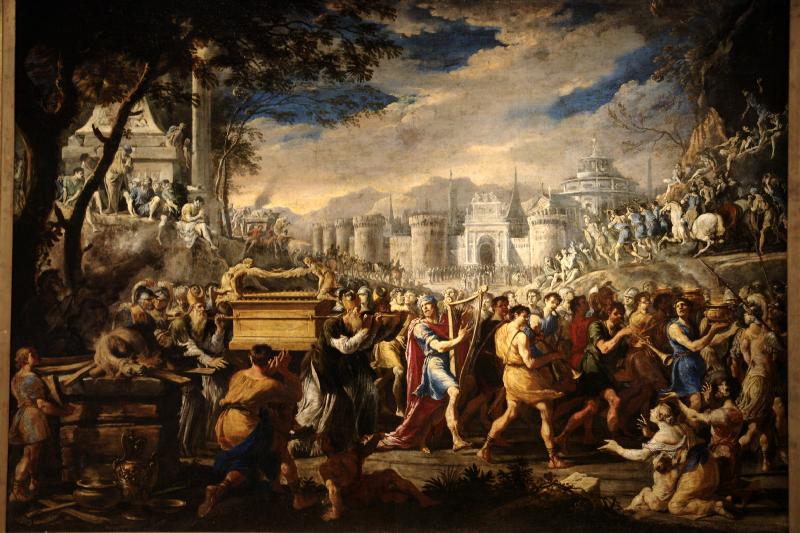
What would it look like for us to incorporate gratitude into our life together? The answers to that question are as numerous and diverse as our churches. Perhaps we can be inspired by the story of the ark being brought to Jerusalem and placed in the tent King David had pitched for it. In this “vibrant picture of the various dimensions of the practice of gratitude within worship,” we see that David appointed certain people to invoke, thank, and praise the God of Israel, to make burnt offerings according to God’s commands, to play music, and to sing liturgies of praise.
Years ago someone told me that they could tell how in love I was with my wife because of the way I “spoke well” of her when she wasn’t in the room. Think of how important it is then for the Church—the Bride of Christ—to speak well of the Bridegroom to each other, and to share stories about God’s marvelous works and faithfulness! One of the most compelling images to me in all of scripture is in 2 Chronicles 5. There we see that when the trumpeters and singers made themselves heard in unison, singing praise to God—“For he is good, / for his steadfast love endures forever.”—the house of the Lord was filled with a cloud, “for the glory of the Lord filled the house of God” (vss. 11-14). We think this is still possible for our churches. Our sanctuaries, school gyms, and living rooms—or wherever we gather to speak well of God—might not be filled with a cloud, but I think that when we remember God’s abundant provision, our faith communities will be filled with a joyful overflowing of the Spirit of God.
Churches can incorporate gratitude into many facets of community life, including times of discernment and prayer and in the midst of our community business. Shared meals are infused with a spirit of gratitude. What better time to remember God’s provision than when we are surrounded by good food and good friends? Gratitude is also intimately connected to Sabbath rest and delight. “Gratitude and wonder are squeezed out when our lives are packed full with busyness and responsibilities,” writes Christine Pohl. “There is simply no room, no time to notice. We experience God’s gifts when we pause long enough to notice them…”
Finally, we encourage every faith community to research and tell the history of their church and neighborhood. This history is a record of good times and bad, of birth and death, marriage and divorce, of struggles and tragedies and unexpected blessings, and of the many ways our communities have been touched by the changing tide of events. When we learn, rehearse, and recite that story, what will emerge is our own psalm of thanksgiving.
Previous Post
November 28, 2014
Cultivating Gratitude in Our Communities
Next Post

December 12, 2014 Worst Christian Book Covers of 2014...
Browse Our Archives
Select a Category Abundance Advent Books Community Conferences Conversations Ecology Economics Emergent Eucharist Family Food Gratitude Happenings Health history Hospitality Justice Lent Meditations Neighborhoods News Peace Place Poetry Politics Sabbath Scripture Stories Technology The Table Theology Uncategorized What is Slow Church? Youth
Select a Month January 2017 December 2016 November 2016 March 2016 June 2015 March 2015 February 2015 December 2014 November 2014 October 2014 September 2014 August 2014 July 2014 June 2014 May 2014 April 2014 March 2014 February 2014 January 2014 December 2013 November 2013 October 2013 September 2013 August 2013 July 2013 June 2013 May 2013 April 2013 March 2013 February 2013 January 2013 December 2012 November 2012 October 2012 September 2012 August 2012 July 2012 June 2012 May 2012 April 2012 March 2012 February 2012 January 2012 December 2011 November 2011 October 2011 September 2011
Follow Us!
TAKE THE
Religious Wisdom Quiz
What does the name "Daniel" mean?
Select your answer to see how you score.
The Lord is my shepherd Chosen one God is my judge God is my strength
Related posts from Slow Church

Deeper into Your Love and Compassion - A...
Cultivating Gratitude in Our Communities


TRENDING AT PATHEOS Progressive Christian

Why Christians Have a Sacred Duty to Vote:...
The Bible offers strong support for the sacred duty to vote. Here...

What Being a Modern-Day Apostle Means to Me
In my last column, I discussed the ins and outs of modern-day...

Did Ancient China Once Worship the God of...
Across human history, a common thread weaves through the origins of the...

Love Your Neighbor – Including Earth-Kin: Lev. 19,...
God’s command to love your neighbor means acting in an ethical and...

Lead a Church Study of “Jesus and Lao...
Guest writer Jack Thomas (The Irreverent Reverend) reflects on leading his church...

Principles for Understanding the Apostolic Ministry Today
Whenever people discover that my formal ministry title is "apostle," as in...
view all Progressive Christian blogs
Ad-Free & Subscriber Log-In Subscription Support
- About Us
- 2026 Calendar
- Videos
- Podcasts
- Library of World Religions
- Faith In Media Tracker
- Advertise With Us
- Write for Us
- Privacy Policy
- Terms of Service
- Do Not Sell My Data
- Contact Us
- Radiant Digital
- Manage Newsletter Subscriptions
- Unsubscribe From Notifications
- Sitemap
Copyright 2008-2026, Patheos. All rights reserved.
Subscription Support Ad-Free & Subscriber Log-In
Follow Patheos