
BuddhistCatholicContemplativeEvangelicalGeneral ChristianHinduJewishLatter-day SaintMuslimNew VisionsProgressive Christian
Beliefs
- Buddhist
- Catholic
- Contemplative
- Evangelical
- General Christian
- Hindu
- Jewish
- Latter-day Saint
- More Voices
- Muslim
- New Visions
- Pagan
- Progressive Christian
Topics
- Religion News
- Food and Religion
- Sports and Religion
- Religious Art
- Religious Music and Entertainment
- Religious Events
- History and Religion
- Style and Religion
- Politics and Religion
- Women in Religion
- Recreation Outdoors and Religion
- Business Finance and Religion
- Careers Workplace and Religion
- Education and Religion
- Family Parenting and Religion
- Health Fitness and Religion
- Home and Religion
- Relationships and Religion
- Technology and Religion
- Travel and Religion
Columnists
- Buddhist Columnists
- Business Finance and Religion Columnists
- Careers Workplace and Religion Columnists
- Catholic Columnists
- Contemplative Columnists
- Education and Religion Columnists
- Evangelists Columnists
- Family Parenting and Religion Columnists
- General Christian Columnists
- Health Fitness and Religion Columnists
- Hindu Columnists
- History and Religion Columnists
- Home and Religion Columnists
- Jewish Columnists
- More Voices Columnists
- Latter Day Columnists
- Muslim Columnists
- New Visions Columnists
- Nonreligious Columnists
- Pagan Columnists
- Politics and Religion Columnists
- Progressive Columnists
- Recreation Outdoors and Religion Columnists
- Relationships and Religion Columnists
- Religion News Columnists
- Religious Art Columnists
- Religious Events Columnists
- Religious Music and Entertainment Columnists
- Sports and Religion Columnists
- Style and Religion Columnists
- Technology and Religion Columnists
- Travel and Religion Columnists
- Women in Religion Columnists
Resource Library
- 2026 Calendar
- Library of World Religions
- The 100 Most Holy Places on Earth
- Patheos Answers
- Podcasts
- Videos
- Faith Leaders Database
- Anglican Episcopalian
- Bahai
- Baptist
- Buddhism
- Christianity
- Confucianism
- Eastern Orthodoxy
- Hinduism
- Holiness and Pentecostal
- ISKCON
- Islam
- Judaism
- Lutheran
- Methodist
- The Church of Jesus Christ of Latter-day Saints
- New Age
- Paganism
- Presbytarian and Reformed
- Protestantism
- Religion Behind the Scenes
- Roman Catholic
- Scientology
- Shia Islam
- Sikhism
- Sufism
- Sunni Islam
- Taoism
- Zen
- See all religions
Research Tools
 Ad-Free & Subscriber Log-In Subscription Support
Follow Patheos 

- Trending:
- Advent
- |
- Forgiveness
- |
- Thanksgiving
- |
- Election
- |
- Seasonal Holidays
- |
- Marriage
 Slow Church
- Home
- Progressive Christian
- Pope Francis on “Slow” Evangelism [Tim Colegrove – Slow Church Planting, Part 2]
Pope Francis on “Slow” Evangelism [Tim Colegrove – Slow Church Planting, Part 2]
Last updated on: January 9, 2014 at 4:45 pm by Christopher Smith
Pope Francis on “Slow” Evangelism [Tim Colegrove – Slow Church Planting, Part 2] 2014-01-09T16:45:31-05:00 Christopher Smith
Patheos Explore the world's faith through different perspectives on religion and spirituality! Patheos has the views of the prevalent religions and spiritualities of the world.
Guest Blogger: Timothy Colegrove Tim and Alice Colegrove live and work in Boston, MA where they serve with the Conservative Mennonite Conference (CMC) as evangelists and prospective church-planters. Their vision is to establish a multi-ethnic evangelical Anabaptist church in the city of Boston committed to discipling new believers, breaking down socio-economic barriers, and gathering an eclectic community around Jesus’ table. Prior to working with the CMC, Tim and Alice served for many years as advocates, street pastors, and family to homeless youth in Harvard Square.
You can contact Tim at timothy[dot]colegrove [ a t ] g m a i l [dot] c o m
“A Church which “goes forth” is a Church whose doors are open. Going out to others in order to reach the fringes of humanity does not mean rushing out aimlessly into the world. Often it is better simply to slow down, to put aside our eagerness in order to see and listen to others, to stop rushing from one thing to another and to remain with someone who has faltered along the way.”
-Pope Francis I
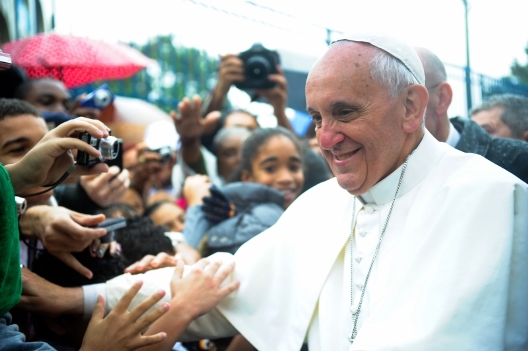
It seems that one can hardly switch on a smartphone without catching wind of something beautiful that Pope Francis has done. From inviting the homeless into his residence to washing the feet of prisoners in Rome, Francis offers a refreshingly Christ-like example. Needless to say, in an age of bad news it has been deeply encouraging for me to hear something positive said of a well-known Christian figure.
As I took time this week to read Francis’s apostolic exhortation, the Evangelii Gaudium (which can be accessed here at the Vatican’s website), I was struck by how aggressively he has challenged the dehumanizing spirit of isolation and enmity that is so pervasive in the world today. Not only does Francis challenge the exclusion inherent in today’s global economic conditions, but also the spirit of isolation and exclusion brought about by greed and individualism. In his reflection on the joy of the Gospel in the preface to the Evangelii, he cites Pope Paul VI who wrote, “technological society has succeeded in multiplying occasions of pleasure, yet has found it very difficult to engender joy.” Francis seeks to counter this trend within the Church by emphasizing the role of joyful invitation in the communication of the Gospel. He writes,
“Instead of seeming to impose new obligations, they [Christians] should appear as people who wish to share their joy, who point to a horizon of beauty and who invite others to a delicious banquet. It is not by proselytizing that the Church grows, but “by attraction.”
Throughout the Evangelii, Francis communicates a vision of a renewed universal Church whose evangelism is marked by joy, connectedness, authenticity, and intimacy. Francis’s vision for the Church is decidedly local; beckoning Catholic hierarchy to consider a decentralization of ecclesial power while emphasizing the importance of the local parish and the role of pastoral workers and missionaries in contextualizing the Gospel in their own communities. Francis quite clearly shares the Slow Church desire to, “unmask and repent of our industrialized approaches to church.” In his exhortation Francis lays out a clear vision for how the church can reimagine its life together and rediscover the communal feast waiting at Christ’s table.
With all his talk of localization, relational prioritization, and intimacy might I suggest that we have a “slow Pope?”
As Alice and I move forward in our mission to plant a church with the Conservative Mennonite Conference in Boston, I find myself in strange unity with the Pope. Who would have imagined that a Mennonite would find such agreement with the head of the Catholic Church, an institution that viciously oppressed early Anabaptist disciples? Yet while reading the Evangelii, I could feel my heart breaking out in applause and spirit-filled agreement at his call to greater connection with other disciples and with the communities around us. Undoubtedly this is the Church that a relationally starved culture needs so badly.
I sense the relational poverty that Pope Francis has challenged in my own community of Boston, even as I live in what is arguably one of the most community-centered neighborhoods of the city. I can feel myself fighting it every time I pull out my smartphone during a meal, every time I try to make plans with a friend but find my schedule too crowded. I can sense its presence in every biting partisan argument I overhear and every careless opinion offered in a public forum. Yet I’m aware also of those times when I am engaged in the fight to end this poverty. I sense the battle is being won every time I write a poem or sing songs with my friends, share a pint at a local pub, pray with others in my community, or choose to pick up the phone instead of leaving a message on somebody’s Facebook page. When I take the time to listen carefully and truly empathize with a person God loves. It is in these intimate encounters with others that Francis enjoins us to seek fertile soil for the Gospel to take root. As he writes in the Evangelii:
“… the Gospel tells us constantly to run the risk of a face-to-face encounter with others, with their physical presence which challenges us, with their pain and their pleas, with their joy which infects us in our close and continuous interaction. True faith in the incarnate Son of God is inseparable from self-giving, from membership in the community, from service, from reconciliation with others.”
As church-planters, this is the kind of intimacy and emotional vulnerability that Alice and I hope to see in the church community we are forming. Yet what my ministry experience has taught me is that it cannot be achieved without a significant investment of time. If we desire to see the Gospel move out in power and love in our communities there is one simple thing we will absolutely need to do: clear our schedules and make time for people. In his exhortation, Francis urges us to remember that the Church must be first and foremost a community, not a program or an institution. Human beings are the materials of which Christ’s body is assembled, and human beings must not be treated like projects. This essential challenge for the church to return to its glorious humanity is at the heart of Francis’s Evangelii. Francis is calling the universal Church to communicate the Gospel in the midst of our relationships, to see evangelism as a natural joy rather than a burdensome mandate. In this context, Francis urges us to practice patience and to recognize that this means being committed to the “long game” that will inevitably involve suffering and sacrifice. As he writes in his exhortation:
“An evangelizing community gets involved by word and deed in people’s daily lives; it bridges distances, it is willing to abase itself if necessary, and it embraces human life, touching the suffering flesh of Christ in others. Evangelizers thus take on the “smell of the sheep” and the sheep are willing to hear their voice. An evangelizing community is also supportive, standing by people at every step of the way, no matter how difficult or lengthy this may prove to be. It is familiar with patient expectation and apostolic endurance. Evangelization consists mostly of patience and disregard for constraints of time.”
Though many of his commentators have expressed excitement about the Evangelii’s emphasis on social justice and global poverty, what I am most excited about is his renewed focus on people and community. As we move forward with the work of church-planting here in Boston, I hope to see us embody Francis’s refreshingly human ecclesial posture. In an age of instant machines and careless commerce, I look forward with hope to seeing a local expression of the universal Church Francis envisions; marked by a deep authenticity, a patient love for mankind, and full of the joy that the Gospel of Jesus Christ brings.
Image Credit: Creative Commons Licensed via Wikimedia Commons
Previous Post

December 18, 2013
The most important book of 2013...
Next Post
January 13, 2014 Slow Church Conference - Indianapolis - April 3-5
Browse Our Archives
Select a Category Abundance Advent Books Community Conferences Conversations Ecology Economics Emergent Eucharist Family Food Gratitude Happenings Health history Hospitality Justice Lent Meditations Neighborhoods News Peace Place Poetry Politics Sabbath Scripture Stories Technology The Table Theology Uncategorized What is Slow Church? Youth
Select a Month January 2017 December 2016 November 2016 March 2016 June 2015 March 2015 February 2015 December 2014 November 2014 October 2014 September 2014 August 2014 July 2014 June 2014 May 2014 April 2014 March 2014 February 2014 January 2014 December 2013 November 2013 October 2013 September 2013 August 2013 July 2013 June 2013 May 2013 April 2013 March 2013 February 2013 January 2013 December 2012 November 2012 October 2012 September 2012 August 2012 July 2012 June 2012 May 2012 April 2012 March 2012 February 2012 January 2012 December 2011 November 2011 October 2011 September 2011
Follow Us!
TAKE THE
Religious Wisdom Quiz
What Christian group believes in continuing revelation from prophets?
Select your answer to see how you score.
Latter-day Saints Lutherans Presbyterians Baptists
Related posts from Slow Church

Deeper into Your Love and Compassion - A...
Scot McKnight - A Fellowship of Differents [Patheos...
Two Slow Church-related ebooks on sale now!
Alexander Schmemann - Lent is a Time of...
TRENDING AT PATHEOS Progressive Christian

Personal Devotion After Deconstruction
It’s pretty standard for progressive believers to reject aspects of their religious...

The Secret behind A Charlie Brown Thanksgiving
Where Franklin Sat at Charlie Brown's Thanksgiving Table Sparky was sticking to...

Bridging the Gap Between God and Man
From Far Off to the Ultimate Embrace “God is a Spirit: and...

Let Matthew 25 Guide You to a Greater...
With the crisp feel of fall in the air, our minds quickly...

Can a Chatbot Touch Your Soul?
Can a chatbot offer genuine spiritual counsel? One conversation brought me to...

Religion and Politics: How Should We Then Live?
Two cultural axioms get repeated in polite company. Don't mix religion and...
view all Progressive Christian blogs
Ad-Free & Subscriber Log-In Subscription Support
- About Us
- 2026 Calendar
- Videos
- Podcasts
- Library of World Religions
- Faith In Media Tracker
- Advertise With Us
- Write for Us
- Privacy Policy
- Terms of Service
- Do Not Sell My Data
- Contact Us
- Radiant Digital
- Manage Newsletter Subscriptions
- Unsubscribe From Notifications
- Sitemap
Copyright 2008-2026, Patheos, part of the Radiant Digital network of media brands. All rights reserved.
Subscription Support Ad-Free & Subscriber Log-In
Follow Patheos