
BuddhistCatholicContemplativeEvangelicalGeneral ChristianHinduJewishLatter-day SaintMuslimNew VisionsProgressive Christian
Beliefs
- Buddhist
- Catholic
- Contemplative
- Evangelical
- General Christian
- Hindu
- Jewish
- Latter-day Saint
- More Voices
- Muslim
- New Visions
- Pagan
- Progressive Christian
Topics
- Religion News
- Food and Religion
- Sports and Religion
- Religious Art
- Religious Music and Entertainment
- Religious Events
- History and Religion
- Style and Religion
- Politics and Religion
- Women in Religion
- Recreation Outdoors and Religion
- Business Finance and Religion
- Careers Workplace and Religion
- Education and Religion
- Family Parenting and Religion
- Health Fitness and Religion
- Home and Religion
- Relationships and Religion
- Technology and Religion
- Travel and Religion
Columnists
- Buddhist Columnists
- Business Finance and Religion Columnists
- Careers Workplace and Religion Columnists
- Catholic Columnists
- Contemplative Columnists
- Education and Religion Columnists
- Evangelists Columnists
- Family Parenting and Religion Columnists
- General Christian Columnists
- Health Fitness and Religion Columnists
- Hindu Columnists
- History and Religion Columnists
- Home and Religion Columnists
- Jewish Columnists
- More Voices Columnists
- Latter Day Columnists
- Muslim Columnists
- New Visions Columnists
- Nonreligious Columnists
- Pagan Columnists
- Politics and Religion Columnists
- Progressive Columnists
- Recreation Outdoors and Religion Columnists
- Relationships and Religion Columnists
- Religion News Columnists
- Religious Art Columnists
- Religious Events Columnists
- Religious Music and Entertainment Columnists
- Sports and Religion Columnists
- Style and Religion Columnists
- Technology and Religion Columnists
- Travel and Religion Columnists
- Women in Religion Columnists
Resource Library
- 2026 Calendar
- Library of World Religions
- The 100 Most Holy Places on Earth
- Patheos Answers
- Podcasts
- Videos
- Faith Leaders Database
- Anglican Episcopalian
- Bahai
- Baptist
- Buddhism
- Christianity
- Confucianism
- Eastern Orthodoxy
- Hinduism
- Holiness and Pentecostal
- ISKCON
- Islam
- Judaism
- Lutheran
- Methodist
- The Church of Jesus Christ of Latter-day Saints
- New Age
- Paganism
- Presbytarian and Reformed
- Protestantism
- Religion Behind the Scenes
- Roman Catholic
- Scientology
- Shia Islam
- Sikhism
- Sufism
- Sunni Islam
- Taoism
- Zen
- See all religions
Research Tools
 Ad-Free & Subscriber Log-In Subscription Support
Ad-Free & Subscriber Log-In Subscription Support
Follow Patheos 

- Trending:
- Forgiveness
- |
- Marriage
- |
- Consciousness
- |
- Death Penalty
- |
- Election
- |
- Halloween
 Slow Church
- Home
- Progressive Christian
- Animate.Faith: A New Kind of Christian Education
Animate.Faith: A New Kind of Christian Education
Last updated on: June 3, 2013 at 5:58 pm by Christopher Smith
Animate.Faith: A New Kind of Christian Education 2013-06-03T17:58:13-05:00 Christopher Smith
Patheos Explore the world's faith through different perspectives on religion and spirituality! Patheos has the views of the prevalent religions and spiritualities of the world.

[ This post is part of the Patheos Book Club discussion of animate.faith ]
I recently had the opportunity to review the new animate.faith curriculum from Sparkhouse, which is a groundbreaking effort to create a new kind of Christian education resource for emerging/progressive church communities. The curriculum consists of a DVD with seven segments by respected teachers (and bonus segments consisting of interviews with the seven speakers), a facilitator’s guide and a participant’s journal. While the DVD and facilitator’s guide are essential to the curriculum, I tend to agree with Adam Walker Cleaveland’s assessment that the participant’s journal is optional at best, although definitely a lovely example of Paul Soupiset’s innovative design work (more on this momentarily). Animate launches participants into conversation about seven concepts that lie at the heart of the Christian faith (given here with the featured speaker that addresses each topic:
- God: Brian McClaren [ Sample clip ]
- Religion: Lillian Daniel [ Sample clip ]
- Jesus: Mark Scandrette [ Sample clip ]
- Salvation: Shane Hipps [ Sample clip ]
- Cross: Nadia Bolz-Weber [ Sample clip ]
- Bible: Lauren Winner [ Sample clip ]
- Church: Bruce Reyes-Chow [ Sample clip ]
Overall, animate.faith is a superb resource, that unlike most church curricula that I am familiar with, offers participants more questions than answers. Each of the above videos are designed to draw people into conversation about the basic elements of Christian theology, and the choice of speakers, the format and the keen design of the segments all work together to promote conversation.
Although all of the segments are helpful, two of them stood out for me, in regard to the Slow Church project that John and I are working on. My favorite of the clips was Lillian Daniel’s, which challenges the notion of the spiritual buffet (my term, not hers), that sort of individualistic faith that picks wisdom and practices from a number of religious traditions, in order to fit one’s tastes. Instead, Daniel challenges us to sink our roots into something that is bigger than ourselves, specifically a religious tradition, adopting the language and practices that are peculiar to that tradition. This segment resonated with me, as John and I maintain in the Slow Church book that tradition is all too often discarded in the pursuit of an efficient, industrialized Christianity.
The other segment that I found to be especially compelling was the final one, Bruce Reyes-Chow’s discussion of church. Although, his repeated use of the language of “going to church” (instead of BEING a part of or BELONGING TO a church community) was grating, I found his argument for church as family — in all its brokenness — a poignant (and, of course, biblically-rooted too). Just as the local food economy is central to the Slow Food movement, so too, the local church (it’s own sort of economy, rooted in God’s abundant provision) is central to our account of Slow Church, and Bruce does a fine job of making the case for the importance of being engaged in a local congregation.
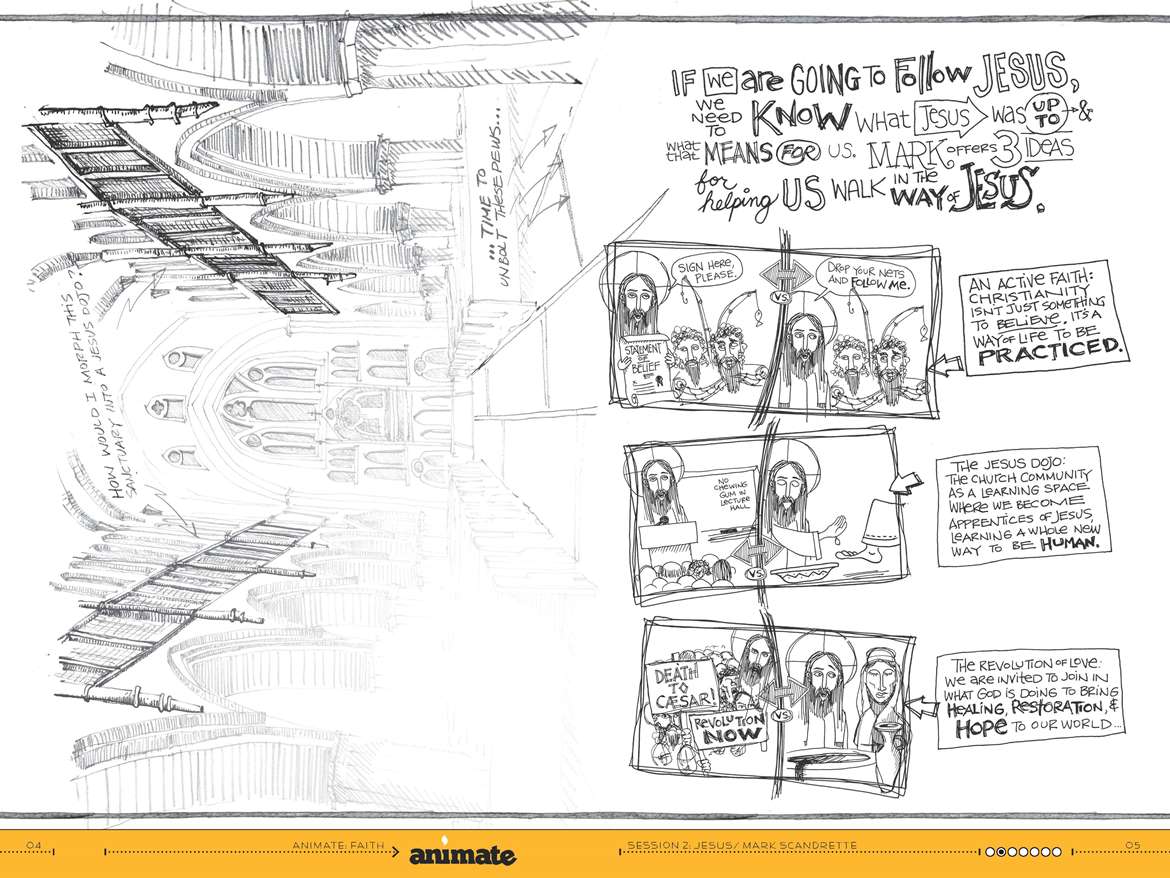
The best part of this animate curriculum, might perhaps be the lovely and engaging drawings and design-work of Paul Soupiset (read a Q/A with Paul about this project here). The coordination of the design for this whole curriculum (all of the segments of the DVD, as well as the art-intense volumes of both the facilitator’s guide and the participant’s journal) was certainly a massive undertaking, and Soupiset has gracefully pulled off a striking product. His illustrations throughout the videos, keep the viewers engaged and keenly and effectively illustrate key points of the speakers’ talks. His pen and ink drawings through the two books of the curriculum (see example above), similarly make the finest and most innovatively designed church curricula that I have ever seen. Unlike most curricula, Soupiset’s illustrations and diagrams will capture and lock into the attentions of even the most attention-deficient participants. In a similar fashion to the questioning, dialogical style of the speakers on the DVD, Soupiset’s art sparks the imaginations of participants and guides them deeper into conversation.
Animate is a superb resource that will be engaging and beneficial for a wide variety of church settings — even ones that do not identify themselves as emerging or progressive.
Previous Post
May 31, 2013
Chris Smith's Summer Reading...
Next Post

June 16, 2013 Eyes of the Heart: A Photographic Journey Toward Receptivity
Browse Our Archives
Select a Category Abundance Advent Books Community Conferences Conversations Ecology Economics Emergent Eucharist Family Food Gratitude Happenings Health history Hospitality Justice Lent Meditations Neighborhoods News Peace Place Poetry Politics Sabbath Scripture Stories Technology The Table Theology Uncategorized What is Slow Church? Youth
Select a Month January 2017 December 2016 November 2016 March 2016 June 2015 March 2015 February 2015 December 2014 November 2014 October 2014 September 2014 August 2014 July 2014 June 2014 May 2014 April 2014 March 2014 February 2014 January 2014 December 2013 November 2013 October 2013 September 2013 August 2013 July 2013 June 2013 May 2013 April 2013 March 2013 February 2013 January 2013 December 2012 November 2012 October 2012 September 2012 August 2012 July 2012 June 2012 May 2012 April 2012 March 2012 February 2012 January 2012 December 2011 November 2011 October 2011 September 2011
Follow Us!
TAKE THE
Religious Wisdom Quiz
Who were Isaac and Rebekah's twin sons?
Select your answer to see how you score.
Esau and Jacob Joseph and Benjamin Cain and Abel Simeon and Levi
Related posts from Slow Church


The Hopeful Politics of "Everyday Attentive Reciprocity"

A Politics of Hope in the Trump Age
TRENDING AT PATHEOS Progressive Christian

Why Christians Have a Sacred Duty to Vote:...
The Bible offers strong support for the sacred duty to vote. Here...

What Being a Modern-Day Apostle Means to Me
In my last column, I discussed the ins and outs of modern-day...

Did Ancient China Once Worship the God of...
Across human history, a common thread weaves through the origins of the...

Love Your Neighbor – Including Earth-Kin: Lev. 19,...
God’s command to love your neighbor means acting in an ethical and...

Lead a Church Study of “Jesus and Lao...
Guest writer Jack Thomas (The Irreverent Reverend) reflects on leading his church...

Principles for Understanding the Apostolic Ministry Today
Whenever people discover that my formal ministry title is "apostle," as in...
view all Progressive Christian blogs
Ad-Free & Subscriber Log-In Subscription Support
- About Us
- 2026 Calendar
- Videos
- Podcasts
- Library of World Religions
- Faith In Media Tracker
- Advertise With Us
- Write for Us
- Privacy Policy
- Terms of Service
- Do Not Sell My Data
- Contact Us
- Radiant Digital
- Manage Newsletter Subscriptions
- Unsubscribe From Notifications
- Sitemap
Copyright 2008-2026, Patheos. All rights reserved.
Subscription Support Ad-Free & Subscriber Log-In
Follow Patheos