
BuddhistCatholicContemplativeEvangelicalGeneral ChristianHinduJewishLatter-day SaintMuslimNew VisionsProgressive Christian
Beliefs
- Buddhist
- Catholic
- Contemplative
- Evangelical
- General Christian
- Hindu
- Jewish
- Latter-day Saint
- More Voices
- Muslim
- New Visions
- Pagan
- Progressive Christian
Topics
- Religion News
- Food and Religion
- Sports and Religion
- Religious Art
- Religious Music and Entertainment
- Religious Events
- History and Religion
- Style and Religion
- Politics and Religion
- Women in Religion
- Recreation Outdoors and Religion
- Business Finance and Religion
- Careers Workplace and Religion
- Education and Religion
- Family Parenting and Religion
- Health Fitness and Religion
- Home and Religion
- Relationships and Religion
- Technology and Religion
- Travel and Religion
Columnists
- Buddhist Columnists
- Business Finance and Religion Columnists
- Careers Workplace and Religion Columnists
- Catholic Columnists
- Contemplative Columnists
- Education and Religion Columnists
- Evangelists Columnists
- Family Parenting and Religion Columnists
- General Christian Columnists
- Health Fitness and Religion Columnists
- Hindu Columnists
- History and Religion Columnists
- Home and Religion Columnists
- Jewish Columnists
- More Voices Columnists
- Latter Day Columnists
- Muslim Columnists
- New Visions Columnists
- Nonreligious Columnists
- Pagan Columnists
- Politics and Religion Columnists
- Progressive Columnists
- Recreation Outdoors and Religion Columnists
- Relationships and Religion Columnists
- Religion News Columnists
- Religious Art Columnists
- Religious Events Columnists
- Religious Music and Entertainment Columnists
- Sports and Religion Columnists
- Style and Religion Columnists
- Technology and Religion Columnists
- Travel and Religion Columnists
- Women in Religion Columnists
Resource Library
- 2026 Calendar
- Library of World Religions
- The 100 Most Holy Places on Earth
- Patheos Answers
- Podcasts
- Videos
- Faith Leaders Database
- Anglican Episcopalian
- Bahai
- Baptist
- Buddhism
- Christianity
- Confucianism
- Eastern Orthodoxy
- Hinduism
- Holiness and Pentecostal
- ISKCON
- Islam
- Judaism
- Lutheran
- Methodist
- The Church of Jesus Christ of Latter-day Saints
- New Age
- Paganism
- Presbytarian and Reformed
- Protestantism
- Religion Behind the Scenes
- Roman Catholic
- Scientology
- Shia Islam
- Sikhism
- Sufism
- Sunni Islam
- Taoism
- Zen
- See all religions
Research Tools
 Ad-Free & Subscriber Log-In Subscription Support
Ad-Free & Subscriber Log-In Subscription Support
Follow Patheos 

- Trending:
- Forgiveness
- |
- Marriage
- |
- Consciousness
- |
- Death Penalty
- |
- Election
- |
- Halloween
 Slow Church
- Home
- Progressive Christian
- Holy Saturday and Unanswered Questions
Holy Saturday and Unanswered Questions
Last updated on: March 29, 2013 at 10:12 am by John Pattison
Holy Saturday and Unanswered Questions 2013-03-29T10:12:56-05:00 John Pattison
Patheos Explore the world's faith through different perspectives on religion and spirituality! Patheos has the views of the prevalent religions and spiritualities of the world.
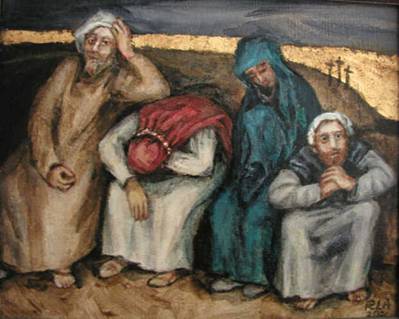
[Author’s Note: A couple years ago I was asked to contribute to an article for Relevant Magazine about “five things we wish our pastors knew.” Other contributors included Anne Marie Miller, Enuma Okoro, Matthew Paul Turner, and Jason Boyett. I wrote my piece as a kind of open letter to our church’s new pastor. I’m reposting it here because it was written during, and inspired by, Holy Week.]
Good Friday, Holy Saturday and Easter Sunday represent the hinge of human history. We celebrate Good Friday and Easter Sunday because they make everything else possible. But I think it’s a mistake to miss Holy Saturday altogether. Since sentences are my stock-in-trade, I sometimes think of Good Friday as an exclamation point (full-stop), Easter Sunday as a colon (momentum) and Holy Saturday as the important ellipsis between them. Good Friday and Easter Sunday are dramatic answers; Holy Saturday is about as-yet-unanswered questions. This is why I relate so much to Holy Saturday. It’s also the reason I’m writing to you: because I think you should know I’m living with more questions than answers.
I bring this up because I don’t want you to assume—and I doubt you do—that everyone in the congregation is in the same theological place. I was raised in a conservative evangelical church, converted to Catholicism in my late 20s, lapsed, helped start a couple house churches in Portland and somehow ended up (happily) at our Evangelical Quaker church in rural Oregon. I read books by acceptable theologians, read exactly four Christian magazines and listen to one or two Christian podcasts. But I read the unacceptable theologians, too. My faith has been challenged by art and inspired by science. I have found wisdom studying Judaism, Buddhism and Confucianism. And I can be just as swayed by pop theology compressed into 140 very powerful characters.
So I’m bringing to the community a collection of beliefs as comprehensive and imperfect as any seminary education. I’m packing a lot of questions, too. One Sunday, I remember hearing about the book unChristian, which the pastor had just read on vacation. Early in the book, David Kinnaman, one of the authors, says many young believers bring to Christianity the same challenges, doubts and questions that outsiders do. I count myself among this number. How has evangelicalism become so entangled with conservative politics? Why do Christians seem so anti-intellectual? Why do Christians seem so anti-homosexual?
Our community has gathered in a particular time and setting, and for the most part we share a Christian vernacular. It occurs to me, though, that sometimes the things we think we have in common can obscure rather than illuminate the truth. I’ve also noticed that two people can use the same language—describing Scripture as the “Word of God,” for example—and talk past each other, or talk at cross-purposes, or neglect to deeply consider where the phrase “Word of God” comes from and what are its implications.
I see this as an opportunity. We have the chance to unpack and repack our luggage like experienced travelers, shedding assumptions that aren’t worth their weight, reexamining old artifacts and seeing them fresh in light of the intervening miles. Questions like, “Why do I believe such-and-such?” and, “Why do other people believe such-and-such?” and, “What does such-and-such even mean?” can produce tension. But tension—when handled intentionally, patiently and gently—is sometimes where the energy is. This can come from the pulpit, but it should probably also happen conversationally at the congregational level. None of us knows precisely what the next leg of the journey looks like, but I am bound by membership to you and our church, and I am committed to walking it with you.
Previous Post

March 27, 2013
Reconciled Diversity: Or, Why I Go to the Inhabit Conference
Browse Our Archives
Select a Category Abundance Advent Books Community Conferences Conversations Ecology Economics Emergent Eucharist Family Food Gratitude Happenings Health history Hospitality Justice Lent Meditations Neighborhoods News Peace Place Poetry Politics Sabbath Scripture Stories Technology The Table Theology Uncategorized What is Slow Church? Youth
Select a Month January 2017 December 2016 November 2016 March 2016 June 2015 March 2015 February 2015 December 2014 November 2014 October 2014 September 2014 August 2014 July 2014 June 2014 May 2014 April 2014 March 2014 February 2014 January 2014 December 2013 November 2013 October 2013 September 2013 August 2013 July 2013 June 2013 May 2013 April 2013 March 2013 February 2013 January 2013 December 2012 November 2012 October 2012 September 2012 August 2012 July 2012 June 2012 May 2012 April 2012 March 2012 February 2012 January 2012 December 2011 November 2011 October 2011 September 2011
Follow Us!
TAKE THE
Religious Wisdom Quiz
What does "Eli" mean in Hebrew?
Select your answer to see how you score.
Holy one Strength in God My God The Lord saves
Related posts from Slow Church

Scot McKnight - A Fellowship of Differents [Patheos...

Options for the Coming Age: Benedict, Jeremiah, Both,...

Relationally-Based Community Development [Economics of Church and Seminary...

A Community of Simple Living [Economics of Church...
TRENDING AT PATHEOS Progressive Christian

Why Christians Have a Sacred Duty to Vote:...
The Bible offers strong support for the sacred duty to vote. Here...

What Being a Modern-Day Apostle Means to Me
In my last column, I discussed the ins and outs of modern-day...

Did Ancient China Once Worship the God of...
Across human history, a common thread weaves through the origins of the...

Love Your Neighbor – Including Earth-Kin: Lev. 19,...
God’s command to love your neighbor means acting in an ethical and...

Lead a Church Study of “Jesus and Lao...
Guest writer Jack Thomas (The Irreverent Reverend) reflects on leading his church...

Principles for Understanding the Apostolic Ministry Today
Whenever people discover that my formal ministry title is "apostle," as in...
view all Progressive Christian blogs
Ad-Free & Subscriber Log-In Subscription Support
- About Us
- 2026 Calendar
- Videos
- Podcasts
- Library of World Religions
- Faith In Media Tracker
- Advertise With Us
- Write for Us
- Privacy Policy
- Terms of Service
- Do Not Sell My Data
- Contact Us
- Radiant Digital
- Manage Newsletter Subscriptions
- Unsubscribe From Notifications
- Sitemap
Copyright 2008-2026, Patheos. All rights reserved.
Subscription Support Ad-Free & Subscriber Log-In
Follow Patheos