
BuddhistCatholicContemplativeEvangelicalGeneral ChristianHinduJewishLatter-day SaintMuslimNew VisionsProgressive Christian
Beliefs
- Buddhist
- Catholic
- Contemplative
- Evangelical
- General Christian
- Hindu
- Jewish
- Latter-day Saint
- More Voices
- Muslim
- New Visions
- Pagan
- Progressive Christian
Topics
- Religion News
- Food and Religion
- Sports and Religion
- Religious Art
- Religious Music and Entertainment
- Religious Events
- History and Religion
- Style and Religion
- Politics and Religion
- Women in Religion
- Recreation Outdoors and Religion
- Business Finance and Religion
- Careers Workplace and Religion
- Education and Religion
- Family Parenting and Religion
- Health Fitness and Religion
- Home and Religion
- Relationships and Religion
- Technology and Religion
- Travel and Religion
Columnists
- Buddhist Columnists
- Business Finance and Religion Columnists
- Careers Workplace and Religion Columnists
- Catholic Columnists
- Contemplative Columnists
- Education and Religion Columnists
- Evangelists Columnists
- Family Parenting and Religion Columnists
- General Christian Columnists
- Health Fitness and Religion Columnists
- Hindu Columnists
- History and Religion Columnists
- Home and Religion Columnists
- Jewish Columnists
- More Voices Columnists
- Latter Day Columnists
- Muslim Columnists
- New Visions Columnists
- Nonreligious Columnists
- Pagan Columnists
- Politics and Religion Columnists
- Progressive Columnists
- Recreation Outdoors and Religion Columnists
- Relationships and Religion Columnists
- Religion News Columnists
- Religious Art Columnists
- Religious Events Columnists
- Religious Music and Entertainment Columnists
- Sports and Religion Columnists
- Style and Religion Columnists
- Technology and Religion Columnists
- Travel and Religion Columnists
- Women in Religion Columnists
Resource Library
- 2026 Calendar
- Library of World Religions
- The 100 Most Holy Places on Earth
- Patheos Answers
- Podcasts
- Videos
- Faith Leaders Database
- Anglican Episcopalian
- Bahai
- Baptist
- Buddhism
- Christianity
- Confucianism
- Eastern Orthodoxy
- Hinduism
- Holiness and Pentecostal
- ISKCON
- Islam
- Judaism
- Lutheran
- Methodist
- The Church of Jesus Christ of Latter-day Saints
- New Age
- Paganism
- Presbytarian and Reformed
- Protestantism
- Religion Behind the Scenes
- Roman Catholic
- Scientology
- Shia Islam
- Sikhism
- Sufism
- Sunni Islam
- Taoism
- Zen
- See all religions
Research Tools
 Ad-Free & Subscriber Log-In Subscription Support
Ad-Free & Subscriber Log-In Subscription Support
Follow Patheos 

- Trending:
- Forgiveness
- |
- Marriage
- |
- Consciousness
- |
- Death Penalty
- |
- Election
- |
- Halloween
 Slow Church
- Home
- Progressive Christian
- The World is Not Ours to Save…Whew! [Patheos Book Club]
The World is Not Ours to Save…Whew! [Patheos Book Club]
Last updated on: March 4, 2013 at 9:00 am by Christopher Smith
The World is Not Ours to Save…Whew! [Patheos Book Club] 2013-03-04T09:00:20-05:00 Christopher Smith
Patheos Explore the world's faith through different perspectives on religion and spirituality! Patheos has the views of the prevalent religions and spiritualities of the world.
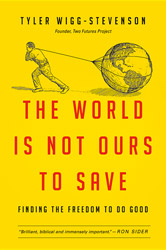 I was asked to write a reflection on Tyler Wigg-Stevenson’s new book The World is Not Ours to Save: Finding the Freedom to Do Good (IVP 2013) for the Patheos Book Club. But for those who have been following the “Slow Church and the Urgency of Justice” Series, this post is also relevant to that conversation.
I recently had the chance to interview Wigg-Stevenson for the current issue of The Englewood Review of Books, so I will borrow a couple of snippets from that interview as I reflect on the book.
Cause fatigue is a significant problem among activists in the twenty-first century. As an activist himself, the founder of the anti-nuclear Two Futures Project, Tyler Wigg-Stevenson has seen cause fatigue firsthand. “As I listened more and more to what seemed to be the heartbeat of this generation,” he told me, “I began to hear dissonant tones that I know all too well: the anxiety and helplessness that comes when you look at the world’s sinful brokenness with eyes wide open.”
The greatest contribution of this book is that it offers a theological corrective to cause fatigue. Although justice is at the heart of God’s reconciling mission in the world, the burden is not primarily on us, as humanity, to fix the world. We should be engaged in God’s work, but ultimately it is God who transforms and not us. Wigg-Stevenson observes:
The first half of the book critiques the way our activist mindset often leads us astray. We’re inclined to get our calling wrong, in that we feel the need to be heroes. We can radically underestimate the challenge and complexity of the problems we face, and therefore the type of responses they demand. We tend to domesticate God in support of our causes. And we easily divide the world into ‘us-them,’ rather than realizing that we are, all of us, what’s wrong with the world we’re trying to fix.
Wigg-Stevenson describes the corrective theology he is proposing, one that will resonate with Slow Church readers, in terms of four facets. First, He emphasizes that Christ (and not us) is the hero of the biblical story. He explains:
I start the book by looking at the activist calling, which I think easily turns into an idolatry of leadership and “making an impact,” or the misguided notion that we’re all supposed to be heroes for Jesus and the kingdom of God – kicking in brothel doors, liberating vans of trafficked children, chaining ourselves to nuclear missile silos, etc. That sort of thing.
Our concepts of heroism can actually subtly delight in the very thing that we’re trying to be heroic against. That is, there’s always the temptation to love the fight more than the kingdom you’re ostensibly serving. Everywhere I go I hear about people wanting to “make a difference” – and it’s just taken for granted that the difference we’re supposed to be making will be a good thing! A critical view of Christian history should make us far more humble and cautious about pursuing “impact” than we often are. … [The] Christian life isn’t about being at the center of things. The story is about Jesus, and we’re all bit players, extras whose names don’t show up in the credits. This calls us to a different attitude of engagement with the great injustices of our day. It’s no less active and no less outraged, but it’s got a sense of perspective about how we fit into the drama.
The second facet that Wigg-Stevenson names is the deep brokenness of the world. We are inclined, he points out, to ignore history. “We cannot escape our connection to history, which is shot through with sin, with evils that cannot be undone,” he says, “this connection limits the extent to which we can repair the present (or the future) in the same way that it is impossible to paint over a rotten wall or build a large structure on a compromised foundation. We live on top of unmendable cracks, and the insoluble nature of the world means that the question posed to us is not ‘how do we fix this?’ but ‘how can we live out the love of God in this midst of such brokenness?'” (p. 41).
Thirdly, Wigg-Stevenson reminds us that we serve God and not vice versa. “When we are trying to save the world, it is an all-too ready temptation to search for a God who will validate our preexisting purposes—a sort of cosmic Fix-it Man. The misrepresentation is seldom willful; I don’t know any Christian activists who intentionally misuse God’s name willy-nilly as a moral trump card. But I think a great many of us frequently speak about God, in relation to our work, in ways that domesticate the divine to our earthly causes.” (p. 64)
Finally, he observes that reconciliation requires more than eliminating evil and evildoers. Most activism is predicating upon an “if-only” premise. “In other words, if only that problem out there could be dealt with. But this fails to recognize the degree to which we are ourselves the world’s most intractable problem. We are not all equally culpable for all wrongs, of course. But the solution to humanity’s condition cannot be viewed as the eradication of wrongs and wrongdoers, because we are all implicated.” (p. 76).
The theology that Wigg-Stevenson offers in this new book is indeed freeing, not only liberating us from cause-fatigue, but posing key questions about our identity: are we activists who happen to be Christians also, or are we primarily Christians who are called to engage in God’s work of reconciling all creation? These questions resonate with the Slow Church vision; it is not enough to seek ends similar to those of the kingdom of God, but our means must also be infused with our seeking to be faithful to the way of Jesus. The sort of conversation between theology and activism that Wigg-Stevenson proposes is deeply needed in our times. It also is striking relevant to the questions about Slow Church and justice that we have been exploring here recently.
Previous Post
February 28, 2013
Be Strong in the Lord's Power
Next Post

March 4, 2013 Lenten Reading: Sermon on the Mount #5
Browse Our Archives
Select a Category Abundance Advent Books Community Conferences Conversations Ecology Economics Emergent Eucharist Family Food Gratitude Happenings Health history Hospitality Justice Lent Meditations Neighborhoods News Peace Place Poetry Politics Sabbath Scripture Stories Technology The Table Theology Uncategorized What is Slow Church? Youth
Select a Month January 2017 December 2016 November 2016 March 2016 June 2015 March 2015 February 2015 December 2014 November 2014 October 2014 September 2014 August 2014 July 2014 June 2014 May 2014 April 2014 March 2014 February 2014 January 2014 December 2013 November 2013 October 2013 September 2013 August 2013 July 2013 June 2013 May 2013 April 2013 March 2013 February 2013 January 2013 December 2012 November 2012 October 2012 September 2012 August 2012 July 2012 June 2012 May 2012 April 2012 March 2012 February 2012 January 2012 December 2011 November 2011 October 2011 September 2011
Follow Us!
TAKE THE
Religious Wisdom Quiz
Who was Jeremiah's faithful secretary and scribe?
Select your answer to see how you score.
Eliakim Baruch Zephaniah Micah
Related posts from Slow Church


The Hopeful Politics of "Everyday Attentive Reciprocity"

Scot McKnight - A Fellowship of Differents [Patheos...
TRENDING AT PATHEOS Progressive Christian

Why Christians Have a Sacred Duty to Vote:...
The Bible offers strong support for the sacred duty to vote. Here...

What Being a Modern-Day Apostle Means to Me
In my last column, I discussed the ins and outs of modern-day...

Did Ancient China Once Worship the God of...
Across human history, a common thread weaves through the origins of the...

Love Your Neighbor – Including Earth-Kin: Lev. 19,...
God’s command to love your neighbor means acting in an ethical and...

Lead a Church Study of “Jesus and Lao...
Guest writer Jack Thomas (The Irreverent Reverend) reflects on leading his church...

Principles for Understanding the Apostolic Ministry Today
Whenever people discover that my formal ministry title is "apostle," as in...
view all Progressive Christian blogs
Ad-Free & Subscriber Log-In Subscription Support
- About Us
- 2026 Calendar
- Videos
- Podcasts
- Library of World Religions
- Faith In Media Tracker
- Advertise With Us
- Write for Us
- Privacy Policy
- Terms of Service
- Do Not Sell My Data
- Contact Us
- Radiant Digital
- Manage Newsletter Subscriptions
- Unsubscribe From Notifications
- Sitemap
Copyright 2008-2026, Patheos. All rights reserved.
Subscription Support Ad-Free & Subscriber Log-In
Follow Patheos