
BuddhistCatholicContemplativeEvangelicalGeneral ChristianHinduJewishLatter-day SaintMuslimNew VisionsProgressive Christian
Beliefs
- Buddhist
- Catholic
- Contemplative
- Evangelical
- General Christian
- Hindu
- Jewish
- Latter-day Saint
- More Voices
- Muslim
- New Visions
- Pagan
- Progressive Christian
Topics
- Religion News
- Food and Religion
- Sports and Religion
- Religious Art
- Religious Music and Entertainment
- Religious Events
- History and Religion
- Style and Religion
- Politics and Religion
- Women in Religion
- Recreation Outdoors and Religion
- Business Finance and Religion
- Careers Workplace and Religion
- Education and Religion
- Family Parenting and Religion
- Health Fitness and Religion
- Home and Religion
- Relationships and Religion
- Technology and Religion
- Travel and Religion
Columnists
- Buddhist Columnists
- Business Finance and Religion Columnists
- Careers Workplace and Religion Columnists
- Catholic Columnists
- Contemplative Columnists
- Education and Religion Columnists
- Evangelists Columnists
- Family Parenting and Religion Columnists
- General Christian Columnists
- Health Fitness and Religion Columnists
- Hindu Columnists
- History and Religion Columnists
- Home and Religion Columnists
- Jewish Columnists
- More Voices Columnists
- Latter Day Columnists
- Muslim Columnists
- New Visions Columnists
- Nonreligious Columnists
- Pagan Columnists
- Politics and Religion Columnists
- Progressive Columnists
- Recreation Outdoors and Religion Columnists
- Relationships and Religion Columnists
- Religion News Columnists
- Religious Art Columnists
- Religious Events Columnists
- Religious Music and Entertainment Columnists
- Sports and Religion Columnists
- Style and Religion Columnists
- Technology and Religion Columnists
- Travel and Religion Columnists
- Women in Religion Columnists
Resource Library
- 2026 Calendar
- Library of World Religions
- The 100 Most Holy Places on Earth
- Patheos Answers
- Podcasts
- Videos
- Faith Leaders Database
- Anglican Episcopalian
- Bahai
- Baptist
- Buddhism
- Christianity
- Confucianism
- Eastern Orthodoxy
- Hinduism
- Holiness and Pentecostal
- ISKCON
- Islam
- Judaism
- Lutheran
- Methodist
- The Church of Jesus Christ of Latter-day Saints
- New Age
- Paganism
- Presbytarian and Reformed
- Protestantism
- Religion Behind the Scenes
- Roman Catholic
- Scientology
- Shia Islam
- Sikhism
- Sufism
- Sunni Islam
- Taoism
- Zen
- See all religions
Research Tools
 Ad-Free & Subscriber Log-In Subscription Support
Ad-Free & Subscriber Log-In Subscription Support
Follow Patheos 

- Trending:
- Forgiveness
- |
- Marriage
- |
- Consciousness
- |
- Death Penalty
- |
- Election
- |
- Halloween
 Slow Church
- Home
- Progressive Christian
- The Hope-full Politics of the Table
The Hope-full Politics of the Table
Last updated on: November 5, 2012 at 11:33 am by Christopher Smith
The Hope-full Politics of the Table 2012-11-05T11:33:39-05:00 Christopher Smith
Patheos Explore the world's faith through different perspectives on religion and spirituality! Patheos has the views of the prevalent religions and spiritualities of the world.
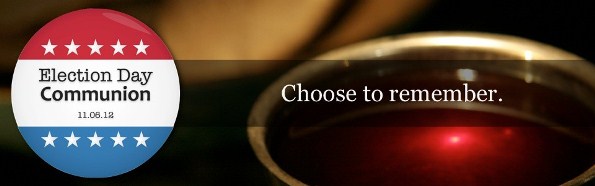
The following is a reflection that I will share tomorrow night as part of the Election Day Communion service here at Englewood Christian Church.
Why celebrate communion on election day?
To do so is not merely a religious act, we have intentionally chosen to break bread together — not to have a worship or prayer service (good as those things are). Tonight on the eve of this election day, we are celebrating our unity in seeking the Kingdom of God together. But for many people, I imagine, the Kingdom of God is an abstract and nebulous thing. Perhaps we should think of the Kingdom in an incarnational, embodied way. After all, Jesus himself observed that the “Kingdom of God is within you (all).” Just as Jesus was incarnated — took on human flesh — in a particular time and place, so too, the Reign of God emerges as we submit ourselves to the work of the Holy Spirit in all the particularity of our local congregations. And at the center of the our life together lies a political act, eating together. Jesus on the night he was betrayed, instructed his disciples to “do this in remembrance of me.” But as John Howard Yoder and others have pointed out, to what does the pronoun “this” refer? The example of the early church demonstrates, Yoder argues, that they understood Jesus’ words as referring to neither the Passover meal nor a religious ritual of bread and cup. Rather, they understood Jesus as saying that we remember him, whenever we share a meal together. The words remembrance and remembering are also significant. To remember something, is to bring it to life again, in a manner of speaking to give it arms, legs, etc., thus to re-member or re-embody it. Such remembrance is a political act, as we embody (and re-embody) Christ together, we do so within the life and shape of a particular place.
The eucharistic table then is not only at the center of our worship as followers of Jesus, it is also at the center of our politics. Ultimately politics is the caring for the places in which we dwell and for the neighbors who dwell here with us. At the table, we learn an economic politics of sharing. Yoder observes that “[Bread] is daily sustenance. Bread eaten together is economic sharing. Not merely symbolically, but also in fact, eating together extends to a wider circle the economic solidarity normally obtained in the family.” (Body Politics, 20) At the table, we learn a politics of hospitality, welcoming the stranger and sharing our sustenance with her or him. At the table, we learn a politics of dialogue, learning to talk together in a world that is increasingly marked by a lack of dialogue, particularly across the partisan divide.
So what does this politics of the table that we are learning have to do with the politics of our city, state and nation? Certainly, these each have some degree of bearing on the life of our places, but they each are respectively another level removed from the incarnational politics of the local church. Maybe we participate in these broader forms of politics, and maybe we don’t, and there are a multitude of forms that our participation might take — among which voting is only one. But regardless, our participation must take a backseat to the politics of the Kingdom of God that is unfolding in our neighborhood as we continue to regularly eat, and live and be an embodiment of Christ in this place.
Tonight, we celebrate a politics of hope, a hope confirmed in the resurrection of Christ, who is remembered in our very midst, as we share our lives together around the table, eating and talking. We celebrate a politics of not of greed and self-interest, but of the self-emptying generosity of Christ, who preferred others to himself and gave everything, even his life, that we might know life in abundance. The life and hope of Christ flows outward from our common table, forming us as we engage our neighbors and those from other places. The world is being transformed and will continue to be so, but not by the political parties, corporate lobbying interests or other powers of this age; the transformation will be slow and attentive and will be grounded in the grassroots movement of local communities of Christ’s followers who share their food and their lives together from day to day. This transformation is the hope that we are celebrating tonight; it is the hope that energizes us and the hope that will be the salvation not just of us as individuals, but of the creation as a whole.
Previous Post

November 2, 2012
Wendell Berry and The Body.
Next Post

November 6, 2012 A Hymn for Election Day.
Browse Our Archives
Select a Category Abundance Advent Books Community Conferences Conversations Ecology Economics Emergent Eucharist Family Food Gratitude Happenings Health history Hospitality Justice Lent Meditations Neighborhoods News Peace Place Poetry Politics Sabbath Scripture Stories Technology The Table Theology Uncategorized What is Slow Church? Youth
Select a Month January 2017 December 2016 November 2016 March 2016 June 2015 March 2015 February 2015 December 2014 November 2014 October 2014 September 2014 August 2014 July 2014 June 2014 May 2014 April 2014 March 2014 February 2014 January 2014 December 2013 November 2013 October 2013 September 2013 August 2013 July 2013 June 2013 May 2013 April 2013 March 2013 February 2013 January 2013 December 2012 November 2012 October 2012 September 2012 August 2012 July 2012 June 2012 May 2012 April 2012 March 2012 February 2012 January 2012 December 2011 November 2011 October 2011 September 2011
Follow Us!
TAKE THE
Religious Wisdom Quiz
What does James say about faith without works?
Select your answer to see how you score.
Faith without works is dead. Faith is only for the righteous. Faith alone is enough. Works without faith is dead.
Related posts from Slow Church

The Hopeful Politics of "Everyday Attentive Reciprocity"

A Politics of Hope in the Trump Age

Deeper into Your Love and Compassion - A...
Indiana's New RFRA Bill Hits Home on Indy's...
TRENDING AT PATHEOS Progressive Christian

Why Christians Have a Sacred Duty to Vote:...
The Bible offers strong support for the sacred duty to vote. Here...

What Being a Modern-Day Apostle Means to Me
In my last column, I discussed the ins and outs of modern-day...

Did Ancient China Once Worship the God of...
Across human history, a common thread weaves through the origins of the...

Love Your Neighbor – Including Earth-Kin: Lev. 19,...
God’s command to love your neighbor means acting in an ethical and...

Lead a Church Study of “Jesus and Lao...
Guest writer Jack Thomas (The Irreverent Reverend) reflects on leading his church...

Principles for Understanding the Apostolic Ministry Today
Whenever people discover that my formal ministry title is "apostle," as in...
view all Progressive Christian blogs
Ad-Free & Subscriber Log-In Subscription Support
- About Us
- 2026 Calendar
- Videos
- Podcasts
- Library of World Religions
- Faith In Media Tracker
- Advertise With Us
- Write for Us
- Privacy Policy
- Terms of Service
- Do Not Sell My Data
- Contact Us
- Radiant Digital
- Manage Newsletter Subscriptions
- Unsubscribe From Notifications
- Sitemap
Copyright 2008-2026, Patheos. All rights reserved.
Subscription Support Ad-Free & Subscriber Log-In
Follow Patheos