
BuddhistCatholicContemplativeEvangelicalGeneral ChristianHinduJewishLatter-day SaintMuslimNew VisionsProgressive Christian
Beliefs
- Buddhist
- Catholic
- Contemplative
- Evangelical
- General Christian
- Hindu
- Jewish
- Latter-day Saint
- More Voices
- Muslim
- New Visions
- Pagan
- Progressive Christian
Topics
- Religion News
- Food and Religion
- Sports and Religion
- Religious Art
- Religious Music and Entertainment
- Religious Events
- History and Religion
- Style and Religion
- Politics and Religion
- Women in Religion
- Recreation Outdoors and Religion
- Business Finance and Religion
- Careers Workplace and Religion
- Education and Religion
- Family Parenting and Religion
- Health Fitness and Religion
- Home and Religion
- Relationships and Religion
- Technology and Religion
- Travel and Religion
Columnists
- Buddhist Columnists
- Business Finance and Religion Columnists
- Careers Workplace and Religion Columnists
- Catholic Columnists
- Contemplative Columnists
- Education and Religion Columnists
- Evangelists Columnists
- Family Parenting and Religion Columnists
- General Christian Columnists
- Health Fitness and Religion Columnists
- Hindu Columnists
- History and Religion Columnists
- Home and Religion Columnists
- Jewish Columnists
- More Voices Columnists
- Latter Day Columnists
- Muslim Columnists
- New Visions Columnists
- Nonreligious Columnists
- Pagan Columnists
- Politics and Religion Columnists
- Progressive Columnists
- Recreation Outdoors and Religion Columnists
- Relationships and Religion Columnists
- Religion News Columnists
- Religious Art Columnists
- Religious Events Columnists
- Religious Music and Entertainment Columnists
- Sports and Religion Columnists
- Style and Religion Columnists
- Technology and Religion Columnists
- Travel and Religion Columnists
- Women in Religion Columnists
Resource Library
- 2026 Calendar
- Library of World Religions
- The 100 Most Holy Places on Earth
- Patheos Answers
- Podcasts
- Videos
- Faith Leaders Database
- Anglican Episcopalian
- Bahai
- Baptist
- Buddhism
- Christianity
- Confucianism
- Eastern Orthodoxy
- Hinduism
- Holiness and Pentecostal
- ISKCON
- Islam
- Judaism
- Lutheran
- Methodist
- The Church of Jesus Christ of Latter-day Saints
- New Age
- Paganism
- Presbytarian and Reformed
- Protestantism
- Religion Behind the Scenes
- Roman Catholic
- Scientology
- Shia Islam
- Sikhism
- Sufism
- Sunni Islam
- Taoism
- Zen
- See all religions
Research Tools
 Ad-Free & Subscriber Log-In Subscription Support
Ad-Free & Subscriber Log-In Subscription Support
Follow Patheos 

- Trending:
- Forgiveness
- |
- Marriage
- |
- Consciousness
- |
- Death Penalty
- |
- Election
- |
- Halloween
 Slow Church
- Home
- Progressive Christian
- The Groaning Table
The Groaning Table
Last updated on: October 20, 2012 at 3:53 pm by Christopher Smith
The Groaning Table 2012-10-20T15:53:42-05:00 Christopher Smith
Patheos Explore the world's faith through different perspectives on religion and spirituality! Patheos has the views of the prevalent religions and spiritualities of the world.
 After recently re-reading Wendell Berry’s essay “Health is Membership” and being struck by its pertinency today, I asked a few friends to read the essay and write a Slow Church-related reflection on the essay. The is the second of these reflections by my friend Rachel Marie Stone. ~Chris
** Read the first “Health is Membership” reflection by Brent Bill*
My grandmother was born at home in New York City in 1925 – exactly the time when more and more women, especially city women, began to choose hospital over home as the place to have babies. It wasn’t that my great-grandmother was afraid of the hospital or of doctors; or that she wanted to keep the baby away from sick people who might have contaminated the hospital halls. Rather, it was that she’d heard that the hospital didn’t have very good food.
I remember great-grandma Katherine the way you remember a dream by the mid-afternoon, in random yet related pieces. When I think of her, I see first a shadowy image of her – a tall, square-shouldered woman – in a chair, which cuts quickly to a snapshot of her smiling over a plump, baby version of me in a garish vinyl seat. There’s also a 5-second clip of the two of us laughing over the black dog, Chloe, who prances and plays a piece of red blanket. And that is it. The rest of what I know is what I have been told.
She was born in the 19th century to a mother who had left Ireland in the potato famine and who then married a horse trainer that she met on the steps of the 42nd Street library. She had influenza in the pandemic of 1918; she spent a year in bed and recovered. This is a fact my grandmother will refer repeatedly to as evidence, first, that we are the inheritors of ‘hardy genes’; second, that resting in bed is the best medicine for a cold; third, that, before going to bed with a cold, you should have a hot toddy made with Christian Brothers brandy, a remedy of Irish Catholic grandmothers, never known to fail.
I want to believe all of this so much; to exist someplace where the advice to drink a hot toddy and go to bed when I’m feeling achy and congested is solid wisdom (not antiquated and vaguely irresponsible) while the advice to take some drops of echinacea and zinc and continue dragging myself through my routines is dangerous and faddish. To live in a world where a woman’s decision to give birth at home because she knows that, at home, the food will be good is sensible, not selfish.
After all, in those days, women stayed in the hospital for ten or fourteen days following the births of their babies; that’s anywhere from thirty to forty-two meals. And women who have just had a baby are hungry, and not just an ordinary kind of hungry, but the kind of hungry that sends you into the refrigerator in the middle of the night because you’re convinced that your stomach has begun to consume itself. It’s like a righteous hunger; a hunger that feels justified in demanding satisfaction NOW!
I can understand why my great-grandmother didn’t want go through that in a hospital with food of undetermined quality. I certainly wouldn’t want to – I spent just one day in the hospital after the birth of our son and had to send my husband out for some real eats. Before the birth of our second son at a birth center in Scotland, I planned to have cheese, crackers, and wine waiting in the trunk of the car. This seems a bit silly to me even now, and then my mind wanders over to look through the dream-snapshots of great-grandma Katherine, and remembers that righteous hunger, and it seems again sensible and wise that a woman should want good food when she has given birth.
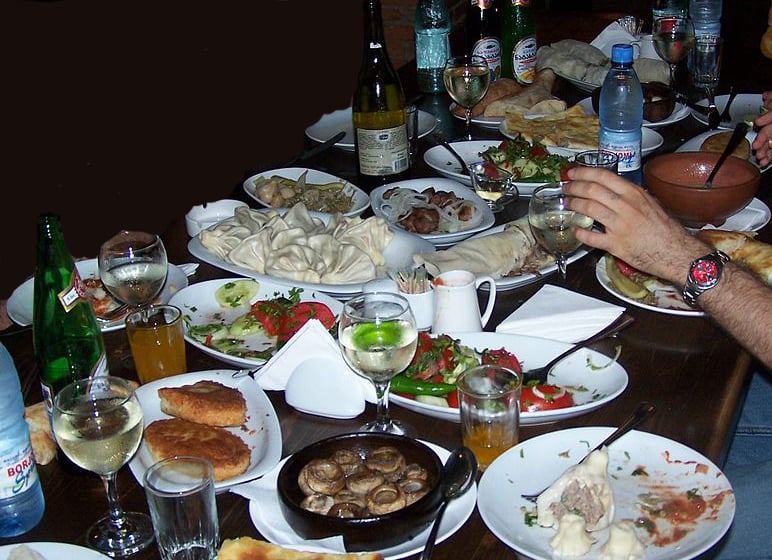
There is in fact a long tradition of food being important after a birth. In the United States, especially in New England, when most births took place at home, they were attended mostly by one’s friends and neighbors, the preparation and serving of food was one of the main duties that the women in the community would step in to help with for several weeks after the birth. (We can see the vestiges of this today in the tradition of after-baby casseroles.) And when the woman was sufficiently recovered to resume her normal activities, she would, in turn, offer a “groaning table” (a reference both to the groaning of a woman in labor and to the groaning of the table itself under the weight of the food) – a feast of special, rich foods – to all those who had helped her. It was a jolly restoration of the newly-delivered woman to normal activities, a way of expressing gratitude, and a celebration. The ‘groaning table’ completed her healing.
What does it imply about our priorities if we tend to think of a woman’s need for nourishing, delicious food after childbirth as amusing, or trivial, or selfish? Doesn’t it imply, as Wendell Berry suggests, that we regard food’s truest role as simply “another unpleasant substance to inject,” its higher properties of pleasure and conviviality and connection to the soil and one another as mere garnish to the “real” work of inserting vitamins, minerals, proteins and energy into the machines of our body? In “Health as Membership,” Berry notes, as my great-grandmother did, that, in hospitals, food “tends to range from unappetizing to sickening,” and, yet, “nothing is more pleasing and heartening than a plate of nourishing, tasty, beautiful food artfully and lovingly prepared. Anything less is unhealthy, as well as a desecration.” What has a hospital tray – smelling vaguely of disinfectant and eaten alone as visitors look on with distaste – to do with a “groaning table”?
And so, perhaps, great-grandma was not batty after all in refusing to go along with the new trends by making her way to the hospital when her time came. Maybe she wasn’t selfish or epicurean or fussy for wanting to rest, at home, with good food, where her Irish mother could boil potatoes and cabbage and cook the life out of slabs of beef and make her really good cups of tea. Probably she’d never read – as I have – of the groaning table, or of ‘social childbirth.’ Certainly she’d never read Wendell Berry and his proposal of rest and food and connection to one another as the “basic principles of our art and science of healing,” as they surely are.
But I want to believe that she knew it all. And so when I have a cold, I think of her and have a hot toddy before crawling into bed.
————
 Rachel Marie Stone has contributed to Christianity Today, RELEVANT, Books and Culture, The Christian Century, Sojourners, catapult/*cino, and other publications, including her her local newspaper, The Suffolk Times. Her first book, Eat With Joy: Redeeming God’s Gift of Food will be released by InterVarsity Press in March 2013. In addition to writing, Rachel is a Presbyterian (USA) mission co-worker who is headed, with her husband and two sons, to Malawi, Africa, in November 2012. You can find her blogging on food, family, faith, birth, and justice at http://rachelmariestone.com/, or find her her on Twitter at @Rachel_M_Stone.
Image via Wikimedia Commons

Previous Post

October 18, 2012
Fostering Cultures of Mutual Generosity
Next Post

October 30, 2012 What if Columbus and Cortez had their own Reality TV Show?
Browse Our Archives
Select a Category Abundance Advent Books Community Conferences Conversations Ecology Economics Emergent Eucharist Family Food Gratitude Happenings Health history Hospitality Justice Lent Meditations Neighborhoods News Peace Place Poetry Politics Sabbath Scripture Stories Technology The Table Theology Uncategorized What is Slow Church? Youth
Select a Month January 2017 December 2016 November 2016 March 2016 June 2015 March 2015 February 2015 December 2014 November 2014 October 2014 September 2014 August 2014 July 2014 June 2014 May 2014 April 2014 March 2014 February 2014 January 2014 December 2013 November 2013 October 2013 September 2013 August 2013 July 2013 June 2013 May 2013 April 2013 March 2013 February 2013 January 2013 December 2012 November 2012 October 2012 September 2012 August 2012 July 2012 June 2012 May 2012 April 2012 March 2012 February 2012 January 2012 December 2011 November 2011 October 2011 September 2011
Follow Us!
TAKE THE
Religious Wisdom Quiz
What did David use to kill Goliath?
Select your answer to see how you score.
Sword Stone Arrow Spear
Related posts from Slow Church

Deeper into Your Love and Compassion - A...

Scot McKnight - A Fellowship of Differents [Patheos...
Ragan Sutterfield - This is my Body [Patheos...

TRENDING AT PATHEOS Progressive Christian

Why Christians Have a Sacred Duty to Vote:...
The Bible offers strong support for the sacred duty to vote. Here...

What Being a Modern-Day Apostle Means to Me
In my last column, I discussed the ins and outs of modern-day...

Did Ancient China Once Worship the God of...
Across human history, a common thread weaves through the origins of the...

Love Your Neighbor – Including Earth-Kin: Lev. 19,...
God’s command to love your neighbor means acting in an ethical and...

Lead a Church Study of “Jesus and Lao...
Guest writer Jack Thomas (The Irreverent Reverend) reflects on leading his church...

Principles for Understanding the Apostolic Ministry Today
Whenever people discover that my formal ministry title is "apostle," as in...
view all Progressive Christian blogs
Ad-Free & Subscriber Log-In Subscription Support
- About Us
- 2026 Calendar
- Videos
- Podcasts
- Library of World Religions
- Faith In Media Tracker
- Advertise With Us
- Write for Us
- Privacy Policy
- Terms of Service
- Do Not Sell My Data
- Contact Us
- Radiant Digital
- Manage Newsletter Subscriptions
- Unsubscribe From Notifications
- Sitemap
Copyright 2008-2026, Patheos. All rights reserved.
Subscription Support Ad-Free & Subscriber Log-In
Follow Patheos