
BuddhistCatholicContemplativeEvangelicalGeneral ChristianHinduJewishLatter-day SaintMuslimNew VisionsProgressive Christian
Beliefs
- Buddhist
- Catholic
- Contemplative
- Evangelical
- General Christian
- Hindu
- Jewish
- Latter-day Saint
- More Voices
- Muslim
- New Visions
- Pagan
- Progressive Christian
Topics
- Religion News
- Food and Religion
- Sports and Religion
- Religious Art
- Religious Music and Entertainment
- Religious Events
- History and Religion
- Style and Religion
- Politics and Religion
- Women in Religion
- Recreation Outdoors and Religion
- Business Finance and Religion
- Careers Workplace and Religion
- Education and Religion
- Family Parenting and Religion
- Health Fitness and Religion
- Home and Religion
- Relationships and Religion
- Technology and Religion
- Travel and Religion
Columnists
- Buddhist Columnists
- Business Finance and Religion Columnists
- Careers Workplace and Religion Columnists
- Catholic Columnists
- Contemplative Columnists
- Education and Religion Columnists
- Evangelists Columnists
- Family Parenting and Religion Columnists
- General Christian Columnists
- Health Fitness and Religion Columnists
- Hindu Columnists
- History and Religion Columnists
- Home and Religion Columnists
- Jewish Columnists
- More Voices Columnists
- Latter Day Columnists
- Muslim Columnists
- New Visions Columnists
- Nonreligious Columnists
- Pagan Columnists
- Politics and Religion Columnists
- Progressive Columnists
- Recreation Outdoors and Religion Columnists
- Relationships and Religion Columnists
- Religion News Columnists
- Religious Art Columnists
- Religious Events Columnists
- Religious Music and Entertainment Columnists
- Sports and Religion Columnists
- Style and Religion Columnists
- Technology and Religion Columnists
- Travel and Religion Columnists
- Women in Religion Columnists
Resource Library
- 2026 Calendar
- Library of World Religions
- The 100 Most Holy Places on Earth
- Patheos Answers
- Podcasts
- Videos
- Faith Leaders Database
- Anglican Episcopalian
- Bahai
- Baptist
- Buddhism
- Christianity
- Confucianism
- Eastern Orthodoxy
- Hinduism
- Holiness and Pentecostal
- ISKCON
- Islam
- Judaism
- Lutheran
- Methodist
- The Church of Jesus Christ of Latter-day Saints
- New Age
- Paganism
- Presbytarian and Reformed
- Protestantism
- Religion Behind the Scenes
- Roman Catholic
- Scientology
- Shia Islam
- Sikhism
- Sufism
- Sunni Islam
- Taoism
- Zen
- See all religions
Research Tools
 Ad-Free & Subscriber Log-In Subscription Support
Ad-Free & Subscriber Log-In Subscription Support
Follow Patheos 

- Trending:
- Forgiveness
- |
- Marriage
- |
- Consciousness
- |
- Death Penalty
- |
- Election
- |
- Halloween
 Slow Church
- Home
- Progressive Christian
- Liberty Hyde Bailey Poetry Reflections
Liberty Hyde Bailey Poetry Reflections
Last updated on: February 21, 2012 at 9:26 am by Christopher Smith
Liberty Hyde Bailey Poetry Reflections 2012-02-21T09:26:16-05:00 Christopher Smith
Patheos Explore the world's faith through different perspectives on religion and spirituality! Patheos has the views of the prevalent religions and spiritualities of the world.
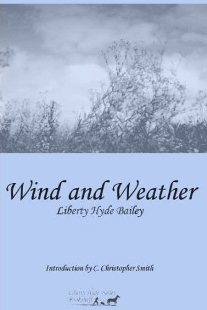 One of the great gifts of my writing retreat at the Convent in Cincinnati last week (here’s a glimpse inside the Convent’s own story of stability, written by one of my fellow retreatants) was the realization of how important Liberty Hyde Bailey‘s work, and especially his poetry, has been in framing the concept of Slow Church in my head and in the life I share in community with others at Englewood Christian Church.
Liberty Hyde Bailey was one of the most prominent American botanists of the early twentieth century, who taught at the university that would become Michigan State and then later at Cornell in upstate New York. But of more interest to me is his work as a nature and agrarian writer, one of the respected grandfathers of the New Agrarian movement (Wendell Berry, Wes Jackson, Gene Logsdon, Norman Wirzba, et al).
On the retreat, I had the opportunity to read aloud the introduction to Bailey’s collection of poetry, Wind and Weather, that I wrote several years ago. [ You can read the full intro here.] I read it as one of the most deeply moving — and despite my impersonal voice in it — personal pieces that I have written in the last several years. Bailey’s poetry has played a vital role in helping me to come to know and love the Englewood neighborhood, an urban place that by most social and aesthetic standards doesn’t have a lot going for it. Over the coming weeks, I would like to share occasional Slow Church-related reflections on Bailey’s poetry here.
Today, I’ll begin with a few snippets from the introduction that I wrote:
For our church communities today, however, perhaps the most striking part of Bailey’s understanding of poetry is his notion that “poetry is prophecy” (OTN 32). There are, of course, many ways in which the term “prophecy” is used. Bailey describes the function of prophecy as helping humanity in the effort of “acquiring a stronger hold on aspirations that are simple and elemental and universal” (OTN 32-33). Such a return to the simple, elemental and universal, parallels Bailey’s description of the prophetic, in his book The Holy Earth: there he notes that prophecy is rooted in a vision of the eschatological reconciliation of all things, especially the reconciliation of humankind with nature. Thus, Bailey’s poetry is prophetic, first and foremost, because it points to a vision of an inter-connected creation that is reminiscent of the scriptural eschatology of shalom, “the reconciliation of all things.” This vision of harmony in creation flows throughout the poems of Wind and Weather, but is most poignantly expressed in poems like “Here”:
Where I shall fall there let me lie,
From end to end the earth is mine
For kin with me are the land and sky
and ev’ry spot is home benign.
or “Brotherhood”:
I am the bird in its nest of straw
And I abide by my time and law,
I am the tree standing night and day,
And I am the plant that fades away;
And men grow green and the men grow brown,
And life rises up and death drops down;
And men, and life, and the things that be
They flow on and on unceasingly.
I am the wind that blows to the sky,
And ageless cloud that goes floating by;
I am the rain and the river flow,
I am the seasons that come and go;
I am the dusk and the morning light,
The call of day and the voice of night;
And I pass out to the silent sea,
Flowing and flowing eternally.
Bailey’s poems herein stand as firm reminders that art (written, visual or otherwise) plays a key, prophetic role in the life of the Church, by helping us imagine and keep before our minds the end of creation, the reconciliation toward which all history is flowing. Bailey emphasizes this point in The Holy Earth: “[The biblical prophet] Isaiah proclaimed the redemption of the wilderness and the solitary place with the redemption of man, when they shall rejoice and blossom as the rose, and when the glowing sand shall become a pool and the thirsty ground springs of water” (THE 11-12). Thus, for Bailey, the nature poet today functions in a similar way, reminding his listeners that their salvation is bound up with that of all nature.
…
the heart of Bailey’s ethical vision – the intertwining of prayer and work – is embodied in “Country Church”:
…
And out of it all
As the seasons fall
I build my great temple alway;
I point to the skies,
But my footstone lies
In commonplace work of the day;
For I preach the worth
Of the native earth, –
To love and to work is to pray.
(emphasis added)
I recently had the opportunity to share a few words at the funeral of my grandfather, a lifelong farmer. I read this poem to his rural church congregation there and encouraged them that Bailey’s vision as expressed here captures the essence of our gathered obedience to the way of Christ. A church community – rural, urban or otherwise – can, in my estimation, do no better than to set their sights on embodying such a prayerful, diligent and connected life, as is depicted in Bailey’s “Country Church.” …
Ultimately, the tone of Bailey’s prophetic vision is one of hope. We see this hope set forth best in “The Signs of Life”:
…
The gaps fill in; the earth is rife
With energy that mastereth –
The upwards signs of birth and life
Are greater than the signs of death.
Here we are reminded of the scriptural theme that though the resurrection of Jesus, death will be swallowed up in life. This theme echoes throughout the poems of Wind and Weather and indeed is another reason why we, the Church, should immerse ourselves in Bailey’s poetry.
Bailey’s Works Mentioned:
WNW – Wind and Weather. Indianapolis: Doulos Christou Books, 2008. Reprint edition.
THE – The Holy Earth. Indianapolis: Doulos Christou Books, 2008. Reprint edition.
OTN – Outlook to Nature. New York: Macmillan, 1905. [ Available as a FREE ebook ]
Previous Post

February 20, 2012
Submerging Church [Ekklesia Project Guest Post by Lee Wyatt]
Next Post

February 23, 2012 Hungering and Thirsting After Righteousness [Guest Post -Thomas Turner]
Browse Our Archives
Select a Category Abundance Advent Books Community Conferences Conversations Ecology Economics Emergent Eucharist Family Food Gratitude Happenings Health history Hospitality Justice Lent Meditations Neighborhoods News Peace Place Poetry Politics Sabbath Scripture Stories Technology The Table Theology Uncategorized What is Slow Church? Youth
Select a Month January 2017 December 2016 November 2016 March 2016 June 2015 March 2015 February 2015 December 2014 November 2014 October 2014 September 2014 August 2014 July 2014 June 2014 May 2014 April 2014 March 2014 February 2014 January 2014 December 2013 November 2013 October 2013 September 2013 August 2013 July 2013 June 2013 May 2013 April 2013 March 2013 February 2013 January 2013 December 2012 November 2012 October 2012 September 2012 August 2012 July 2012 June 2012 May 2012 April 2012 March 2012 February 2012 January 2012 December 2011 November 2011 October 2011 September 2011
Follow Us!
TAKE THE
Religious Wisdom Quiz
What does 1 Peter say wives can do to win over their unbelieving husbands?
Select your answer to see how you score.
Show them love Pray for them constantly Share the gospel Win them without words by their behavior
Related posts from Slow Church
Indiana's New RFRA Bill Hits Home on Indy's...

Chris Smith and Tim Soerens in Conversation [...
Slow Church Stories #2: Munsey Memorial United Methodist...
Willie Jennings - Slow Church Conference - Lecture...
TRENDING AT PATHEOS Progressive Christian

Why Christians Have a Sacred Duty to Vote:...
The Bible offers strong support for the sacred duty to vote. Here...

What Being a Modern-Day Apostle Means to Me
In my last column, I discussed the ins and outs of modern-day...

Did Ancient China Once Worship the God of...
Across human history, a common thread weaves through the origins of the...

Love Your Neighbor – Including Earth-Kin: Lev. 19,...
God’s command to love your neighbor means acting in an ethical and...

Lead a Church Study of “Jesus and Lao...
Guest writer Jack Thomas (The Irreverent Reverend) reflects on leading his church...

Principles for Understanding the Apostolic Ministry Today
Whenever people discover that my formal ministry title is "apostle," as in...
view all Progressive Christian blogs
Ad-Free & Subscriber Log-In Subscription Support
- About Us
- 2026 Calendar
- Videos
- Podcasts
- Library of World Religions
- Faith In Media Tracker
- Advertise With Us
- Write for Us
- Privacy Policy
- Terms of Service
- Do Not Sell My Data
- Contact Us
- Radiant Digital
- Manage Newsletter Subscriptions
- Unsubscribe From Notifications
- Sitemap
Copyright 2008-2026, Patheos. All rights reserved.
Subscription Support Ad-Free & Subscriber Log-In
Follow Patheos