
BuddhistCatholicContemplativeEvangelicalGeneral ChristianHinduJewishLatter-day SaintMuslimNew VisionsProgressive Christian
Beliefs
- Buddhist
- Catholic
- Contemplative
- Evangelical
- General Christian
- Hindu
- Jewish
- Latter-day Saint
- More Voices
- Muslim
- New Visions
- Pagan
- Progressive Christian
Topics
- Religion News
- Food and Religion
- Sports and Religion
- Religious Art
- Religious Music and Entertainment
- Religious Events
- History and Religion
- Style and Religion
- Politics and Religion
- Women in Religion
- Recreation Outdoors and Religion
- Business Finance and Religion
- Careers Workplace and Religion
- Education and Religion
- Family Parenting and Religion
- Health Fitness and Religion
- Home and Religion
- Relationships and Religion
- Technology and Religion
- Travel and Religion
Columnists
- Buddhist Columnists
- Business Finance and Religion Columnists
- Careers Workplace and Religion Columnists
- Catholic Columnists
- Contemplative Columnists
- Education and Religion Columnists
- Evangelists Columnists
- Family Parenting and Religion Columnists
- General Christian Columnists
- Health Fitness and Religion Columnists
- Hindu Columnists
- History and Religion Columnists
- Home and Religion Columnists
- Jewish Columnists
- More Voices Columnists
- Latter Day Columnists
- Muslim Columnists
- New Visions Columnists
- Nonreligious Columnists
- Pagan Columnists
- Politics and Religion Columnists
- Progressive Columnists
- Recreation Outdoors and Religion Columnists
- Relationships and Religion Columnists
- Religion News Columnists
- Religious Art Columnists
- Religious Events Columnists
- Religious Music and Entertainment Columnists
- Sports and Religion Columnists
- Style and Religion Columnists
- Technology and Religion Columnists
- Travel and Religion Columnists
- Women in Religion Columnists
Resource Library
- 2026 Calendar
- Library of World Religions
- The 100 Most Holy Places on Earth
- Patheos Answers
- Podcasts
- Videos
- Faith Leaders Database
- Anglican Episcopalian
- Bahai
- Baptist
- Buddhism
- Christianity
- Confucianism
- Eastern Orthodoxy
- Hinduism
- Holiness and Pentecostal
- ISKCON
- Islam
- Judaism
- Lutheran
- Methodist
- The Church of Jesus Christ of Latter-day Saints
- New Age
- Paganism
- Presbytarian and Reformed
- Protestantism
- Religion Behind the Scenes
- Roman Catholic
- Scientology
- Shia Islam
- Sikhism
- Sufism
- Sunni Islam
- Taoism
- Zen
- See all religions
Research Tools
 Ad-Free & Subscriber Log-In Subscription Support
Ad-Free & Subscriber Log-In Subscription Support
Follow Patheos 

- Trending:
- Forgiveness
- |
- Marriage
- |
- Consciousness
- |
- Death Penalty
- |
- Election
- |
- Halloween
 Slow Church
- Home
- Progressive Christian
- Wendell Berry on the Necessity of Limits.
Wendell Berry on the Necessity of Limits.
Last updated on: February 12, 2012 at 10:00 pm by Christopher Smith
Wendell Berry on the Necessity of Limits. 2012-02-12T22:00:47-05:00 Christopher Smith
Patheos Explore the world's faith through different perspectives on religion and spirituality! Patheos has the views of the prevalent religions and spiritualities of the world.
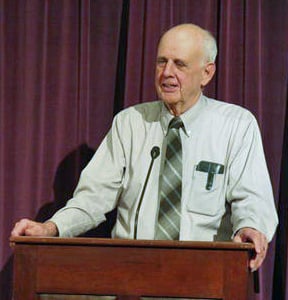
I’m settling in with friends old and new at the Convent in Cincinnati for a writers’ retreat this week. I’m hoping to make some much-needed progress on the chapters of the Slow Church book that I’m writing.
I have taken the opportunity this weekend before and on my way to the retreat to read some of what Wendell Berry has said about the necessity of limits. I’ve been meaning to do so for awhile, but this weekend I stumbled upon this fabulous essay that Berry wrote in 2008 for Harpers Magazine — Faustian Economics: Hell Hath No Limits. This is a short essay and well worth reading.
Berry gets to the heart of the issue:
The problem with us is not only prodigal extravagance but also an assumed limitlessness. We have obscured the issue by refusing to see that limitlessness is a godly trait. We have insistently, and with relief, defined ourselves as animals or as “higher animals.” But to define ourselves as animals, given our specifically human powers and desires, is to define ourselves as limitless animals—which of course is a contradiction in terms. Any definition is a limit, which is why the God of Exodus refuses to define Himself: “I am that I am.”
And later:
In keeping with our unrestrained consumptiveness, the commonly accepted basis of our economy is the supposed possibility of limitless growth, limitless wants, limitless wealth, limitless natural resources, limitless energy, and limitless debt. The idea of a limitless economy implies and requires a doctrine of general human limitlessness: all are entitled to pursue without limit whatever they conceive as desirable—a license that classifies the most exalted Christian capitalist with the lowliest pornographer.
What does Berry recommend for us as we start to repent of our limitless living?
[Our] human and earthly limits, properly understood, are not confinements but rather inducements to formal elaboration and elegance, to fullness of relationship and meaning. Perhaps our most serious cultural loss in recent centuries is the knowledge that some things, though limited, are inexhaustible. For example, an ecosystem, even that of a working forest or farm, so long as it remains ecologically intact, is inexhaustible. A small place, as I know from my own experience, can provide opportunities of work and learning, and a fund of beauty, solace, and pleasure—in addition to its difficulties—that cannot be exhausted in a lifetime or in generations.
To recover from our disease of limitlessness, we will have to give up the idea that we have a right to be godlike animals, that we are potentially omniscient and omnipotent, ready to discover “the secret of the universe.” We will have to start over, with a different and much older premise: the naturalness and, for creatures of limited intelligence, the necessity, of limits. We must learn again to ask how we can make the most of what we are, what we have, what we have been given. If we always have a theoretically better substitute available from somebody or someplace else, we will never make the most of anything. It is hard to make the most of one life. If we each had two lives, we would not make much of either. Or as one of my best teachers said of people in general: “They’ll never be worth a damn as long as they’ve got two choices.”
To deal with the problems, which after all are inescapable, of living with limited intelligence in a limited world, I suggest that we may have to remove some of the emphasis we have lately placed on science and technology and have a new look at the arts. For an art does not propose to enlarge itself by limitless extension but rather to enrich itself within bounds that are accepted prior to the work.
I challenge you to read this essay and reflect on how our cultural lack of limits has impacted our churches. The limitlessness that Berry describes, I would argue, has swept away many of our churches. First, that the lives of our members have been driven by limitlessness, and torn us asunder by our hypermobility and chasing after “better substitutes” as Berry has described here. Secondly, by falling in line with a narrative of limitlessness, many of our churches have uprooted themselves from the places that they were at some time in the past and relocated to new places that seemed to be “better substitutes.” Thirdly, (and I’ll stop here and take in the comments your thoughts of other ways that our churches have been driven by limitlessness) Church Growth theology is an embodiment of limitlessness in our church communities: churches can and should grow and grow without end or limit.
This theme of limits is one that will undoubtedly recur throughout the Slow Church book…
Previous Post

February 10, 2012
Becoming Conversational #10 - Start a Community Garden.
Next Post

February 16, 2012 Inhabit Conference
Browse Our Archives
Select a Category Abundance Advent Books Community Conferences Conversations Ecology Economics Emergent Eucharist Family Food Gratitude Happenings Health history Hospitality Justice Lent Meditations Neighborhoods News Peace Place Poetry Politics Sabbath Scripture Stories Technology The Table Theology Uncategorized What is Slow Church? Youth
Select a Month January 2017 December 2016 November 2016 March 2016 June 2015 March 2015 February 2015 December 2014 November 2014 October 2014 September 2014 August 2014 July 2014 June 2014 May 2014 April 2014 March 2014 February 2014 January 2014 December 2013 November 2013 October 2013 September 2013 August 2013 July 2013 June 2013 May 2013 April 2013 March 2013 February 2013 January 2013 December 2012 November 2012 October 2012 September 2012 August 2012 July 2012 June 2012 May 2012 April 2012 March 2012 February 2012 January 2012 December 2011 November 2011 October 2011 September 2011
Follow Us!
TAKE THE
Religious Wisdom Quiz
How many friends came to speak with Job?
Select your answer to see how you score.
Five Two Four Three
Related posts from Slow Church

The Hopeful Politics of "Everyday Attentive Reciprocity"

A Politics of Hope in the Trump Age

Deeper into Your Love and Compassion - A...

TRENDING AT PATHEOS Progressive Christian

Why Christians Have a Sacred Duty to Vote:...
The Bible offers strong support for the sacred duty to vote. Here...

What Being a Modern-Day Apostle Means to Me
In my last column, I discussed the ins and outs of modern-day...

Did Ancient China Once Worship the God of...
Across human history, a common thread weaves through the origins of the...

Love Your Neighbor – Including Earth-Kin: Lev. 19,...
God’s command to love your neighbor means acting in an ethical and...

Lead a Church Study of “Jesus and Lao...
Guest writer Jack Thomas (The Irreverent Reverend) reflects on leading his church...

Principles for Understanding the Apostolic Ministry Today
Whenever people discover that my formal ministry title is "apostle," as in...
view all Progressive Christian blogs
Ad-Free & Subscriber Log-In Subscription Support
- About Us
- 2026 Calendar
- Videos
- Podcasts
- Library of World Religions
- Faith In Media Tracker
- Advertise With Us
- Write for Us
- Privacy Policy
- Terms of Service
- Do Not Sell My Data
- Contact Us
- Radiant Digital
- Manage Newsletter Subscriptions
- Unsubscribe From Notifications
- Sitemap
Copyright 2008-2026, Patheos. All rights reserved.
Subscription Support Ad-Free & Subscriber Log-In
Follow Patheos