
BuddhistCatholicContemplativeEvangelicalGeneral ChristianHinduJewishLatter-day SaintMuslimNew VisionsProgressive Christian
Beliefs
- Buddhist
- Catholic
- Contemplative
- Evangelical
- General Christian
- Hindu
- Jewish
- Latter-day Saint
- More Voices
- Muslim
- New Visions
- Pagan
- Progressive Christian
Topics
- Religion News
- Food and Religion
- Sports and Religion
- Religious Art
- Religious Music and Entertainment
- Religious Events
- History and Religion
- Style and Religion
- Politics and Religion
- Women in Religion
- Recreation Outdoors and Religion
- Business Finance and Religion
- Careers Workplace and Religion
- Education and Religion
- Family Parenting and Religion
- Health Fitness and Religion
- Home and Religion
- Relationships and Religion
- Technology and Religion
- Travel and Religion
Columnists
- Buddhist Columnists
- Business Finance and Religion Columnists
- Careers Workplace and Religion Columnists
- Catholic Columnists
- Contemplative Columnists
- Education and Religion Columnists
- Evangelists Columnists
- Family Parenting and Religion Columnists
- General Christian Columnists
- Health Fitness and Religion Columnists
- Hindu Columnists
- History and Religion Columnists
- Home and Religion Columnists
- Jewish Columnists
- More Voices Columnists
- Latter Day Columnists
- Muslim Columnists
- New Visions Columnists
- Nonreligious Columnists
- Pagan Columnists
- Politics and Religion Columnists
- Progressive Columnists
- Recreation Outdoors and Religion Columnists
- Relationships and Religion Columnists
- Religion News Columnists
- Religious Art Columnists
- Religious Events Columnists
- Religious Music and Entertainment Columnists
- Sports and Religion Columnists
- Style and Religion Columnists
- Technology and Religion Columnists
- Travel and Religion Columnists
- Women in Religion Columnists
Resource Library
- 2026 Calendar
- Library of World Religions
- The 100 Most Holy Places on Earth
- Patheos Answers
- Podcasts
- Videos
- Faith Leaders Database
- Anglican Episcopalian
- Bahai
- Baptist
- Buddhism
- Christianity
- Confucianism
- Eastern Orthodoxy
- Hinduism
- Holiness and Pentecostal
- ISKCON
- Islam
- Judaism
- Lutheran
- Methodist
- The Church of Jesus Christ of Latter-day Saints
- New Age
- Paganism
- Presbytarian and Reformed
- Protestantism
- Religion Behind the Scenes
- Roman Catholic
- Scientology
- Shia Islam
- Sikhism
- Sufism
- Sunni Islam
- Taoism
- Zen
- See all religions
Research Tools
 Ad-Free & Subscriber Log-In Subscription Support
Ad-Free & Subscriber Log-In Subscription Support
Follow Patheos 

- Trending:
- Forgiveness
- |
- Marriage
- |
- Consciousness
- |
- Death Penalty
- |
- Election
- |
- Halloween
 Slow Church
- Home
- Progressive Christian
- What I’m Reading Now: Bonhoeffer, by Eric Metaxas
What I’m Reading Now: Bonhoeffer, by Eric Metaxas
Last updated on: February 4, 2012 at 12:13 pm by John Pattison
What I’m Reading Now: Bonhoeffer, by Eric Metaxas 2012-02-04T12:13:33-05:00 John Pattison
Patheos Explore the world's faith through different perspectives on religion and spirituality! Patheos has the views of the prevalent religions and spiritualities of the world.
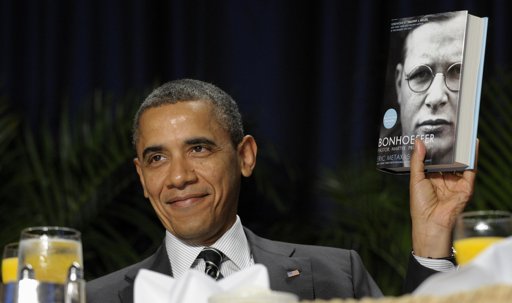 I have read five books so far in 2012. Two were by Martin Luther King – A Call to Conscience, a collection of speeches, and A Knock at Midnight, a collection of sermons – and a third book was Manning Marable’s recent biography Malcolm X: A Life of Reinvention. (I wrote a bit about the Marable book here and here.) I am now approximately four-fifths of the way through Eric Metaxas’s biography of Dietrich Bonhoeffer, Bonhoeffer: Pastor, Martyr, Prophet, Spy. Not long after starting the Bonhoeffer biography, I realized that Bonhoeffer, Malcolm X, and Dr. King all have something in common: they all died – were killed – when they were 39 years old. Today, February 4, is Bonhoeffer’s birthday.
Eric Metaxas was the keynote speaker at the 60th annual National Prayer Breakfast, held last Wednesday. Metaxas gave President Obama a copy of his book, saying, “President George W. Bush read this. So…no pressure.”
I’m enjoying Bonhoeffer. Dietrich Bonhoeffer is a fascinating subject, and Metaxas is a lively and engaging writer. Most of you probably know the story of how Bonhoeffer, a pastor and theologian, collaborated with the German resistance to try to assassinate Adolf Hitler. For this, Bonhoeffer was sent to the Buchenwald and Flossenbürg concentration camps, and executed one month before Germany lost the war.
Bonhoeffer played a key role in a different kind of resistance, working with the global ecumenical movement and the German Confessing Church to oppose the so-called Deutche Christen (“German Christians”), sycophants who tied themselves in theological knots to conform with Nazism’s antisemitic, nationalistic, and fascistic ideology. (Here is a link to the flag of the German Christians. If life was an Indiana Jones movie, there would be a hole where the swastika is.)
Dietrich’s faith and courage are on full display in the biography – as is the courage and “good cheer” of his parents and the entire, extraordinary Bonhoeffer family. Metaxas uses letters and diaries to give us an intimate look into what Dietrich was thinking and feeling when he studied at Union Theological Seminary in New York City, visited black churches in Harlem and learned more about systemic racism against blacks in the American South (he saw parallels with the crescendoing antisemitism back home), pastored German-language churches in London, ran illegal seminaries for the Confessing Church in Germany, and became directly involved in counter-intelligence work.
My main complaint with Bonhoeffer: Pastor, Martyr, Prophet, Spy is that Metaxas rarely talks about Bonhoeffer’s other enduring legacy: the books he wrote. Bonhoeffer’s most famous work, The Cost of Discipleship, appears nine times in 544 pages. Ethics is talked about just 14 times, though, to be fair, it is given its own subsection. (Metaxas writes, “The solution is to do the will of God, to do it radically and courageously and joyfully.”) Life Together, a devotional classic, is mentioned just four times. Metaxas almost never talks about how the books were written, only that they were being written at all. Most often, the books’ contents are described only when they directly relate to something happening in Bonhoeffer’s life.
This is a missed opportunity, and not only because I want to know more about how the books took shape. American evangelicals have the reputation of being anti-intellectual. That is painting with a broad brush, but the reputation is mostly deserved. Though I read historian Mark Noll’s The Scandal of the Evangelical Mind more than a decade ago, I’m still haunted by that book’s first line: “The scandal of the evangelical mind is that there is not much of an evangelical mind.” I’m not belittling Metaxas’s Bonhoeffer as lightweight, merely a historical thriller or ripping good yarn. Far from it. This is a book of great substance. And Metaxas does a brilliant job of putting Bonhoeffer’s life in its historical and theological context.
But talking more about Bonhoeffer’s books would further remind modern evangelicals that they are, in Noll’s words, “the spiritual descendants of leaders and movements distinguished by probing, creative, fruitful attention to the mind.” It would reinforce the fact that Bonhoeffer inspires and challenges us today not just as a man of action and modern martyr, but as a Christian who thought deeply about what it means to live faithfully as a follower of Jesus. I would like to see readers proceed from Bonhoeffer: Pastor, Martyr, Prophet, Spy to Bonhoeffer’s own Life Together or Cost of Discipleship.
One reason I’m surprised that Metaxas didn’t write more about Bonhoeffer’s books is that Metaxas obviously cares about the intersection of faith, culture, and intellectual vigor. He is the founder and host of Socrates in the City, a speakers series in New York City that has featured the likes of Dinesh D’Souza, Os Guiness, Sir John Polkinghorne, and N.T. Wright. Its tagline is “The Unexamined Life is Not Worth Living.”
***
In other Bonhoeffer-related news: If you are in the Pacific Northwest (or are willing to travel), you should think about going to the Ekklesia Project’s Northwest Regional Meeting. The conference is in Portland later this month. The theme is “Engaging the Life and Thought of Dietrich Bonhoeffer.”
[This] conference is dedicated to fostering subversive Christian friendships in which Christians from a variety of denominational, cultural, and economic locations can find encouragement and edification from one another. The fundamental purpose of this meeting is to spur one another on to live faithfully into Christ’s call to radical discipleship.
Our speaker for this year is Barry Harvey. Barry is professor of theology at Baylor University in Waco, Texas. He is the author of Can These Bones Live? and Another City, and has written and spoken extensively on the witness and wisdom of Bonhoeffer.
There is one session on the evening of Friday the 17th. The topic that night is “Learning to Live Polyphonically in a World Come of Age.” Two sessions will be held on Saturday the 18th on the topics of “Praying the Psalms with Dietrich Bonhoeffer” and “A Tale of Two Pastors: Bonhoeffer’s Participation in the Plot Against Hitler.”
You can get more information about the conference at the event’s Facebook page or by contacting Michael Munk here: michaelmunk [at] earthlink.net.
I am going to be there. Are you?


Browse Our Archives
Select a Category Abundance Advent Books Community Conferences Conversations Ecology Economics Emergent Eucharist Family Food Gratitude Happenings Health history Hospitality Justice Lent Meditations Neighborhoods News Peace Place Poetry Politics Sabbath Scripture Stories Technology The Table Theology Uncategorized What is Slow Church? Youth
Select a Month January 2017 December 2016 November 2016 March 2016 June 2015 March 2015 February 2015 December 2014 November 2014 October 2014 September 2014 August 2014 July 2014 June 2014 May 2014 April 2014 March 2014 February 2014 January 2014 December 2013 November 2013 October 2013 September 2013 August 2013 July 2013 June 2013 May 2013 April 2013 March 2013 February 2013 January 2013 December 2012 November 2012 October 2012 September 2012 August 2012 July 2012 June 2012 May 2012 April 2012 March 2012 February 2012 January 2012 December 2011 November 2011 October 2011 September 2011
Follow Us!
TAKE THE
Religious Wisdom Quiz
Who is the coauthor of some of Paul's epistles and delivered them to churches?
Select your answer to see how you score.
Timothy Barnabas Andrew Silas
Related posts from Slow Church

The Hopeful Politics of "Everyday Attentive Reciprocity"

Scot McKnight - A Fellowship of Differents [Patheos...
Ragan Sutterfield - This is my Body [Patheos...
Two Slow Church-related ebooks on sale now!
TRENDING AT PATHEOS Progressive Christian

Why Christians Have a Sacred Duty to Vote:...
The Bible offers strong support for the sacred duty to vote. Here...

What Being a Modern-Day Apostle Means to Me
In my last column, I discussed the ins and outs of modern-day...

Did Ancient China Once Worship the God of...
Across human history, a common thread weaves through the origins of the...

Love Your Neighbor – Including Earth-Kin: Lev. 19,...
God’s command to love your neighbor means acting in an ethical and...

Lead a Church Study of “Jesus and Lao...
Guest writer Jack Thomas (The Irreverent Reverend) reflects on leading his church...

Principles for Understanding the Apostolic Ministry Today
Whenever people discover that my formal ministry title is "apostle," as in...
view all Progressive Christian blogs
Ad-Free & Subscriber Log-In Subscription Support
- About Us
- 2026 Calendar
- Videos
- Podcasts
- Library of World Religions
- Faith In Media Tracker
- Advertise With Us
- Write for Us
- Privacy Policy
- Terms of Service
- Do Not Sell My Data
- Contact Us
- Radiant Digital
- Manage Newsletter Subscriptions
- Unsubscribe From Notifications
- Sitemap
Copyright 2008-2026, Patheos. All rights reserved.
Subscription Support Ad-Free & Subscriber Log-In
Follow Patheos