
BuddhistCatholicContemplativeEvangelicalGeneral ChristianHinduJewishLatter-day SaintMuslimNew VisionsProgressive Christian
Beliefs
- Buddhist
- Catholic
- Contemplative
- Evangelical
- General Christian
- Hindu
- Jewish
- Latter-day Saint
- More Voices
- Muslim
- New Visions
- Pagan
- Progressive Christian
Topics
- Religion News
- Food and Religion
- Sports and Religion
- Religious Art
- Religious Music and Entertainment
- Religious Events
- History and Religion
- Style and Religion
- Politics and Religion
- Women in Religion
- Recreation Outdoors and Religion
- Business Finance and Religion
- Careers Workplace and Religion
- Education and Religion
- Family Parenting and Religion
- Health Fitness and Religion
- Home and Religion
- Relationships and Religion
- Technology and Religion
- Travel and Religion
Columnists
- Buddhist Columnists
- Business Finance and Religion Columnists
- Careers Workplace and Religion Columnists
- Catholic Columnists
- Contemplative Columnists
- Education and Religion Columnists
- Evangelists Columnists
- Family Parenting and Religion Columnists
- General Christian Columnists
- Health Fitness and Religion Columnists
- Hindu Columnists
- History and Religion Columnists
- Home and Religion Columnists
- Jewish Columnists
- More Voices Columnists
- Latter Day Columnists
- Muslim Columnists
- New Visions Columnists
- Nonreligious Columnists
- Pagan Columnists
- Politics and Religion Columnists
- Progressive Columnists
- Recreation Outdoors and Religion Columnists
- Relationships and Religion Columnists
- Religion News Columnists
- Religious Art Columnists
- Religious Events Columnists
- Religious Music and Entertainment Columnists
- Sports and Religion Columnists
- Style and Religion Columnists
- Technology and Religion Columnists
- Travel and Religion Columnists
- Women in Religion Columnists
Resource Library
- 2026 Calendar
- Library of World Religions
- The 100 Most Holy Places on Earth
- Patheos Answers
- Podcasts
- Videos
- Faith Leaders Database
- Anglican Episcopalian
- Bahai
- Baptist
- Buddhism
- Christianity
- Confucianism
- Eastern Orthodoxy
- Hinduism
- Holiness and Pentecostal
- ISKCON
- Islam
- Judaism
- Lutheran
- Methodist
- The Church of Jesus Christ of Latter-day Saints
- New Age
- Paganism
- Presbytarian and Reformed
- Protestantism
- Religion Behind the Scenes
- Roman Catholic
- Scientology
- Shia Islam
- Sikhism
- Sufism
- Sunni Islam
- Taoism
- Zen
- See all religions
Research Tools
 Ad-Free & Subscriber Log-In Subscription Support
Ad-Free & Subscriber Log-In Subscription Support
Follow Patheos 

- Trending:
- Forgiveness
- |
- Marriage
- |
- Consciousness
- |
- Death Penalty
- |
- Election
- |
- Halloween
 Slow Church
- Home
- Progressive Christian
- Dorothy Day’s Birthday
Dorothy Day’s Birthday
Last updated on: November 8, 2011 at 5:06 pm by John Pattison
Dorothy Day’s Birthday 2011-11-08T17:06:25-05:00 John Pattison
Patheos Explore the world's faith through different perspectives on religion and spirituality! Patheos has the views of the prevalent religions and spiritualities of the world.
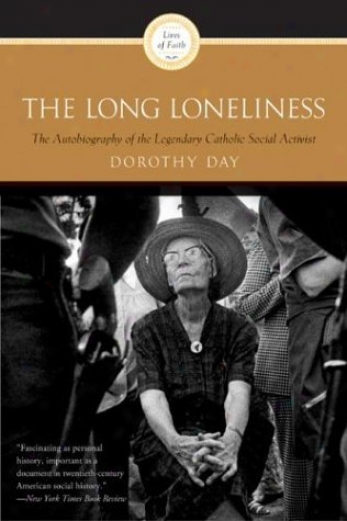 Today is the birthday of Dorothy Day – the journalist and social activist who co-founded the Catholic Worker movement. To mark the occasion, I’m posting the essay I wrote about Day’s classic autobiography, The Long Loneliness. The essay first appeared in Besides the Bible: 100 Books that Have, Should, or Will Create Christian Culture (Biblica, 2010). I also encourage you to check out this wonderful video of Dorothy Day on the Christopher Closeup show.
The photograph on the cover of HarperOne’s 1997 edition of The Long Loneliness, Dorothy Day’s classic spiritual autobiography, captures the cofounder of the Catholic Worker Movement at age 75, just minutes before she is arrested. Day had traveled to California’s San Joaquin Valley, grape country, to support the right of the United Farm Workers to strike. In the photograph, she is seated outside on a portable stool, legs crossed, hands on one knee, wearing glasses, a plaid dress, and a wide-brimmed straw hat. She is framed by two figures in the foreground. They are armed policemen, there to take her into custody, and Day looks up at one of them with an expression of serene defiance.
Great-grandmothers don’t often have FBI files 500 pages thick. But saints have a way of disturbing the peace. And by 1973, the year that photo was taken, Dorothy Day had been disturbing the peace for more than half a century—first as a radical bohemian, then as a radical Christian. Day converted to Catholicism in 1927 at the age of 30. Having spent the previous decade writing about issues of labor, poverty, and human rights for radical newspapers, Day lamented that the communists, socialists, and anarchists were consistently sacrificing their own well-being for the good of the poor and their fellow workers, while the church seemed unwilling to do the same.
Then, on a reporting trip to Washington, D.C., in 1933, the depths of the Great Depression, Day knelt in the national shrine at Catholic University and asked God to show her how to use her gifts to help the poor and disenfranchised. The very next day, she walked into her apartment back in New York and found a man waiting for her. His name was Peter Maurin and he was there to convince Day to start a truly permanent revolution—what Day would later describe as “a revolution of the heart, a revolution which has to start with each one of us ” The Catholic Worker was born.
The Catholic Worker opened houses of hospitality in inner cities, as well as in extremely poor rural areas. Day and Maurin also organized the Catholic Worker newspaper, which from 1933 to the present has been sold at a cover price of just one penny. Over the years, contributors have included Thomas Merton, Jacques Maritain, and Daniel Berrigan. Day served as the paper’s editor until her death in 1980. Maurin wanted to create a society in which it is easier for people to be good, and from the beginning, the Catholic Worker newspaper has staked out a position of extreme libertarianism, equally distrustful of the welfare state and big corporations because of their power to alienate a man from himself, his community, and God.
Catholic Workers also participated in bold acts of nonviolent disobedience against racism, social injustice, and war. Day was arrested multiple times in the late 1950s for refusing to comply with the rules of New York City’s civil defense drills. For her 1957 witness against the nuclear arms race, she was sentenced to thirty days in jail, where she worked on a book about her favorite saint, Thérèse of Lisieux, “the Little Flower.” Catholic Workers joined protests and picket lines. They held signs bearing quotes from papal encyclicals about workers’ rights. A policeman ordered to break up one such protest said it was like arresting the pope himself.
There are currently about 185 Catholic Worker houses of hospitality around the world, offering food, clothing, and shelter to those who are most in need. These communities provide active support of labor unions and human rights, and pacifism remains a central tenet of the movement.
Day once told a group of visiting Harvard students that the meaning of her life was to live up to the moral vision of the church, and of some of her favorite writers, including Dostoevsky, Tolstoy, and Dickens. Indeed, The Long Loneliness can be read as both the autobiography of a reader and a prooftext on the power of books to change lives.
The Catholic Church is currently considering Dorothy Day for sainthood, and while Day drew sustenance from the lives of the saints, one wonders how she would feel about the prospect of joining them. Day was asked about this once when she was alive, and she replied, in essence, “I don’t want to be dismissed so easily.” Day seemed uncomfortable with the church resting on its laurels on her account. Not when there is still work to be done.
Previous Post

November 7, 2011
Embracing Failure: A Reflection by Derek Penwell
Next Post
November 12, 2011 Video: Walter Brueggemann - "Slow Wisdom as a Sub-Version of Reality"
Browse Our Archives
Select a Category Abundance Advent Books Community Conferences Conversations Ecology Economics Emergent Eucharist Family Food Gratitude Happenings Health history Hospitality Justice Lent Meditations Neighborhoods News Peace Place Poetry Politics Sabbath Scripture Stories Technology The Table Theology Uncategorized What is Slow Church? Youth
Select a Month January 2017 December 2016 November 2016 March 2016 June 2015 March 2015 February 2015 December 2014 November 2014 October 2014 September 2014 August 2014 July 2014 June 2014 May 2014 April 2014 March 2014 February 2014 January 2014 December 2013 November 2013 October 2013 September 2013 August 2013 July 2013 June 2013 May 2013 April 2013 March 2013 February 2013 January 2013 December 2012 November 2012 October 2012 September 2012 August 2012 July 2012 June 2012 May 2012 April 2012 March 2012 February 2012 January 2012 December 2011 November 2011 October 2011 September 2011
Follow Us!
TAKE THE
Religious Wisdom Quiz
According to 3 John, who loves to be first and will not welcome the brothers?
Select your answer to see how you score.
Demetrius Diotrephes Alexander Gaius
Related posts from Slow Church

The Hopeful Politics of "Everyday Attentive Reciprocity"

Scot McKnight - A Fellowship of Differents [Patheos...
Ragan Sutterfield - This is my Body [Patheos...
Two Slow Church-related ebooks on sale now!
TRENDING AT PATHEOS Progressive Christian

Why Christians Have a Sacred Duty to Vote:...
The Bible offers strong support for the sacred duty to vote. Here...

What Being a Modern-Day Apostle Means to Me
In my last column, I discussed the ins and outs of modern-day...

Did Ancient China Once Worship the God of...
Across human history, a common thread weaves through the origins of the...

Love Your Neighbor – Including Earth-Kin: Lev. 19,...
God’s command to love your neighbor means acting in an ethical and...

Lead a Church Study of “Jesus and Lao...
Guest writer Jack Thomas (The Irreverent Reverend) reflects on leading his church...

Principles for Understanding the Apostolic Ministry Today
Whenever people discover that my formal ministry title is "apostle," as in...
view all Progressive Christian blogs
Ad-Free & Subscriber Log-In Subscription Support
- About Us
- 2026 Calendar
- Videos
- Podcasts
- Library of World Religions
- Faith In Media Tracker
- Advertise With Us
- Write for Us
- Privacy Policy
- Terms of Service
- Do Not Sell My Data
- Contact Us
- Radiant Digital
- Manage Newsletter Subscriptions
- Unsubscribe From Notifications
- Sitemap
Copyright 2008-2026, Patheos. All rights reserved.
Subscription Support Ad-Free & Subscriber Log-In
Follow Patheos