
BuddhistCatholicContemplativeEvangelicalGeneral ChristianHinduJewishLatter-day SaintMuslimNew VisionsProgressive Christian
Beliefs
- Buddhist
- Catholic
- Contemplative
- Evangelical
- General Christian
- Hindu
- Jewish
- Latter-day Saint
- More Voices
- Muslim
- New Visions
- Pagan
- Progressive Christian
Topics
- Religion News
- Food and Religion
- Sports and Religion
- Religious Art
- Religious Music and Entertainment
- Religious Events
- History and Religion
- Style and Religion
- Politics and Religion
- Women in Religion
- Recreation Outdoors and Religion
- Business Finance and Religion
- Careers Workplace and Religion
- Education and Religion
- Family Parenting and Religion
- Health Fitness and Religion
- Home and Religion
- Relationships and Religion
- Technology and Religion
- Travel and Religion
Columnists
- Buddhist Columnists
- Business Finance and Religion Columnists
- Careers Workplace and Religion Columnists
- Catholic Columnists
- Contemplative Columnists
- Education and Religion Columnists
- Evangelists Columnists
- Family Parenting and Religion Columnists
- General Christian Columnists
- Health Fitness and Religion Columnists
- Hindu Columnists
- History and Religion Columnists
- Home and Religion Columnists
- Jewish Columnists
- More Voices Columnists
- Latter Day Columnists
- Muslim Columnists
- New Visions Columnists
- Nonreligious Columnists
- Pagan Columnists
- Politics and Religion Columnists
- Progressive Columnists
- Recreation Outdoors and Religion Columnists
- Relationships and Religion Columnists
- Religion News Columnists
- Religious Art Columnists
- Religious Events Columnists
- Religious Music and Entertainment Columnists
- Sports and Religion Columnists
- Style and Religion Columnists
- Technology and Religion Columnists
- Travel and Religion Columnists
- Women in Religion Columnists
Resource Library
- 2026 Calendar
- Library of World Religions
- The 100 Most Holy Places on Earth
- Patheos Answers
- Podcasts
- Videos
- Faith Leaders Database
- Anglican Episcopalian
- Bahai
- Baptist
- Buddhism
- Christianity
- Confucianism
- Eastern Orthodoxy
- Hinduism
- Holiness and Pentecostal
- ISKCON
- Islam
- Judaism
- Lutheran
- Methodist
- The Church of Jesus Christ of Latter-day Saints
- New Age
- Paganism
- Presbytarian and Reformed
- Protestantism
- Religion Behind the Scenes
- Roman Catholic
- Scientology
- Shia Islam
- Sikhism
- Sufism
- Sunni Islam
- Taoism
- Zen
- See all religions
Research Tools
 Ad-Free & Subscriber Log-In Subscription Support
Ad-Free & Subscriber Log-In Subscription Support
Follow Patheos 

- Trending:
- Forgiveness
- |
- Marriage
- |
- Consciousness
- |
- Death Penalty
- |
- Election
- |
- Halloween

- Home
- Progressive Christian
- Wendell Berry
Wendell Berry
Last updated on: September 1, 2026 at 5:06 pm by Fred Clark
Wendell Berry 2026-09-01T17:06:15-04:00 Fred Clark
Patheos Explore the world's faith through different perspectives on religion and spirituality! Patheos has the views of the prevalent religions and spiritualities of the world.
The luminous, prickly, joyful, poet/farmer/novelist/essayist/conservationist Wendell Berry has died at age 92.
I first encountered Berry through his essays, which are forceful, fierce, and fearsome. Like the essays of James Baldwin, they have an unnerving clarity of language and a clarity of thought that make you wonder which came first (both — the answer is both).
 Berry’s essays are about farming and poetry and marriage and community and fidelity and responsibility. I am neither a farmer, nor a poet, but a Wendell Berry essay on farming or on poetry was never only about poetry or about farming, but about all those other things which, for him, were inseparably related and which, for you the reader, would be inseparably related as well by the time you’d finished reading.
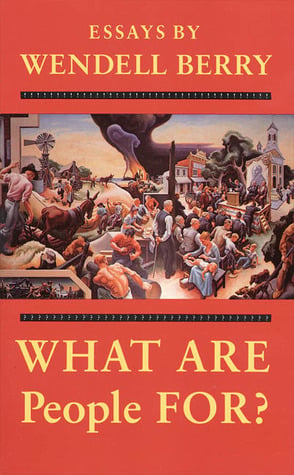
Berry was Southern and Baptist and Southern Baptist, but not like that. He was always a pervasively religious writer, but rarely explicitly so. This is reflected in the title of the first book of his that I read, the collection of essays titled “What Are People For?” That’s telos and purpose and meaning and the sacredness of creation.
“There are no unsacred places,” Berry wrote. “there are only sacred places and desecrated places.” Likewise, there are no unsacred people.
I often think of that title as a useful way of evaluating politics and politicians. For some politics and some politicians, “What Are People For?” is a question to be answered by pollsters who measure the people’s opinions based on a menu of options, for and against, and set an agenda based on what most people tell the pollsters they are “for.” Other forms of politics and politicians understand that question the way Berry did, and allow that understanding to shape their agenda.
After devouring several volumes of Berry’s essays — Home Economics, Standing By Words, The Unsettling of America, The Hidden Wound — I turned to his poetry, which is lovely, dark, and deep.
Here is one of his Sabbath poems:
Whatever happens
those who have learned
to love one another
have made their way
to the lasting world
and will not leave,
whatever happens.
And here is a bit of what I think of as the Berriest of Berry’s poems, “Manifesto: The Mad Farmer Liberation Front“:
Love the quick profit, the annual raise,
vacation with pay. Want more
of everything ready-made. Be afraid
to know your neighbors and to die.
And you will have a window in your head.
Not even your future will be a mystery
any more. Your mind will be punched in a card
and shut away in a little drawer.
When they want you to buy something
they will call you. When they want you
to die for profit they will let you know.So, friends, every day do something
that won’t compute. Love the Lord.
Love the world. Work for nothing.
Take all that you have and be poor.
Love someone who does not deserve it.
Denounce the government and embrace
the flag. Hope to live in that free
republic for which it stands. …As soon as the generals and the politicos
can predict the motions of your mind,
lose it. Leave it as a sign
to mark the false trail, the way
you didn’t go. Be like the fox
who makes more tracks than necessary,
some in the wrong direction.
Practice resurrection.
And here is perhaps his most famous and beloved poem, “The Peace of Wild Things”:
When despair for the world grows in me
and I wake in the night at the least sound
in fear of what my life and my children’s lives may be,
I go and lie down where the wood drake
rests in his beauty on the water, and the great heron feeds.
I come into the peace of wild things
who do not tax their lives with forethought
of grief. I come into the presence of still water.
And I feel above me the day-blind stars
waiting with their light. For a time
I rest in the grace of the world, and am free.
Wendell Berry also wrote novels and short stories, nearly all set in a fictionalized version of his home county in rural Kentucky. My mother loved these books and I loved reading them with her. (At one point we got out a piece of paper and worked out the timelines and the family trees, and sketched a map — Berry’s fiction is a work of world-building that Tolkien would have admired.)
One of my favorite passages in his fiction is one I cannot find just now. One of Berry’s protagonists, I forget which, is in an airport, watching travelers pass by and looking up at the big board announcing departures and arrivals. Beautiful, remarkable people are passing by on their way to beautiful, remarkable places — Paris, New York, London, Rome — and he ponders all the possibilities and possible lives available to them and even to him. Those other places may be good places and those other lives may be good lives, but they are not where he belongs, and so he wishes those beautiful strangers well and he chooses, again, to choose to return to where he belongs.
That airport scene is full of Berry’s wise, joyful fidelity. And it displays a generosity that overcomes the crankiness that sometimes creeps into Berry’s essays. It recognizes that those other lives can also be good and right and meaningful — that some people, after all, do belong in places like Paris or New York, and that Port William and Port Henry are not the only sacred, or the only undesecrated places, where one can belong and live a meaningful life of belonging.
“Find out who you are and do it on purpose,” the late great poet of Tennessee said. And Wendell Berry, the late great poet of Kentucky, did just that. He chose that and stood by his choosing. He found his purpose and he did it on purpose and he never looked back.
Previous Post

August 31, 2026
Speaking (and singing) of the dead
Next Post

September 2, 2026 Help (if you can)
Recent Comments
"*Snerk*"
The purpose-driven labor priest
"No, actually, it's a couple on fb and Instagram.my FB is mostly political of late. ..."
The purpose-driven labor priest
"I get that couple on Instagram, not Facebook. Which is funny, because I'm pretty sure ..."
The purpose-driven labor priest
"Danny filed for bankruptcy in 2023, so his agent has probably been signing him on ..."
The purpose-driven labor priest
Browse Our Archives
Select a Category class warfare evangelicals Iraq Left Behind Mammon music Uncategorized
Select a Month October 2026 September 2026 August 2026 July 2026 June 2026 May 2026 April 2026 March 2026 January 2026 December 2025 November 2025 October 2025 September 2025 August 2025 July 2025 June 2025 May 2025 April 2025 March 2025 February 2025 January 2025 December 2024 November 2024 October 2024 September 2024 August 2024 July 2024 June 2024 May 2024 April 2024 March 2024 February 2024 January 2024 December 2023 November 2023 October 2023 September 2023 August 2023 July 2023 June 2023 May 2023 April 2023 March 2023 February 2023 January 2023 December 2022 November 2022 October 2022 September 2022 August 2022 July 2022 June 2022 May 2022 April 2022 March 2022 February 2022 January 2022 December 2021 November 2021 October 2021 September 2021 August 2021 July 2021 June 2021 May 2021 April 2021 March 2021 February 2021 January 2021 December 2020 November 2020 October 2020 September 2020 August 2020 July 2020 June 2020 May 2020 April 2020 March 2020 February 2020 January 2020 December 2019 November 2019 October 2019 September 2019 August 2019 July 2019 June 2019 May 2019 April 2019 March 2019 February 2019 January 2019 December 2018 November 2018 October 2018 September 2018 August 2018 July 2018 June 2018 May 2018 April 2018 March 2018 February 2018 January 2018 December 2017 November 2017 October 2017 September 2017 August 2017 July 2017 June 2017 May 2017 April 2017 March 2017 February 2017 January 2017 December 2016 November 2016 October 2016 September 2016 August 2016 July 2016 June 2016 May 2016 April 2016 March 2016 February 2016 January 2016 December 2015 November 2015 October 2015 September 2015 August 2015 July 2015 June 2015 May 2015 April 2015 March 2015 February 2015 January 2015 December 2014 November 2014 October 2014 September 2014 August 2014 July 2014 June 2014 May 2014 April 2014 March 2014 February 2014 January 2014 December 2013 November 2013 October 2013 September 2013 August 2013 July 2013 June 2013 May 2013 April 2013 March 2013 February 2013 January 2013 December 2012 November 2012 October 2012 September 2012 August 2012 July 2012 June 2012 May 2012 April 2012 March 2012 February 2012 January 2012 December 2011 November 2011 October 2011 September 2011 August 2011 July 2011 June 2011 May 2011 April 2011 March 2011 February 2011 January 2011 December 2010 November 2010 October 2010 September 2010 August 2010 July 2010 June 2010 May 2010 April 2010 March 2010 February 2010 January 2010 December 2009 November 2009 October 2009 September 2009 August 2009 July 2009 June 2009 May 2009 April 2009 March 2009 February 2009 January 2009 December 2008 November 2008 October 2008 September 2008 August 2008 July 2008 June 2008 May 2008 April 2008 March 2008 February 2008 January 2008 December 2007 November 2007 October 2007 September 2007 August 2007 July 2007 June 2007 May 2007 April 2007 March 2007 February 2007 January 2007 December 2006 November 2006 October 2006 September 2006 August 2006 July 2006 June 2006 May 2006 April 2006 March 2006 February 2006 January 2006 December 2005 November 2005 October 2005 September 2005 August 2005 July 2005 June 2005 May 2005 April 2005 March 2005 February 2005 January 2005 December 2004 November 2004 October 2004 September 2004 August 2004 July 2004 June 2004 May 2004 April 2004 March 2004 February 2004 January 2004 December 2003 November 2003 October 2003 September 2003
Follow Us!
TAKE THE
Religious Wisdom Quiz
Which disciple is known as 'the Twin'?
Select your answer to see how you score.
Philip Andrew James Thomas
Related posts from slacktivist

The purpose-driven labor priest

'A hermeneutical Pandora’s box'

No, most white evangelicals are not 'egalitarian'

TRENDING AT PATHEOS Progressive Christian

Catholic Evangelization: Sharing Your Faith Every Day
Welcome back to the Graceful Awakening mini-series called, “From Faith to Mission.” ...

The Pillar of the Boatmen: the Ancient Monument...
The Pillar of the Boatmen is a Romano-Gaulish sculpture that dates from...

In one sense walking into Westminster Abbey is like walking down the...

'Super Scam Me' Exposes AI Jon Bon Jovi...
Leslie Pickett believed she was in a relationship with Jon Bon Jovi....

The Brazilian Remake of Kendricks' 'Flywheel' Opens in...
“Flywheel,” the story that launched the Kendrick Brothers’ filmmaking career is getting...

The Dangers of Gradual Accommodation (Winking at Sin)
Recently, the “law of gradualness” resurfaced during the opening of a weeklong,...
view all Progressive Christian blogs
What Are Your Thoughts?leave a comment
Ad-Free & Subscriber Log-In Subscription Support
- About Us
- 2026 Calendar
- Videos
- Podcasts
- Library of World Religions
- Faith In Media Tracker
- Advertise With Us
- Write for Us
- Privacy Policy
- Terms of Service
- Do Not Sell My Data
- Contact Us
- Radiant Digital
- Manage Newsletter Subscriptions
- Unsubscribe From Notifications
- Sitemap
Copyright 2008-2026, Patheos. All rights reserved.
Subscription Support Ad-Free & Subscriber Log-In
Follow Patheos