
BuddhistCatholicContemplativeEvangelicalGeneral ChristianHinduJewishLatter-day SaintMuslimNew VisionsProgressive Christian
Beliefs
- Buddhist
- Catholic
- Contemplative
- Evangelical
- General Christian
- Hindu
- Jewish
- Latter-day Saint
- More Voices
- Muslim
- New Visions
- Pagan
- Progressive Christian
Topics
- Religion News
- Food and Religion
- Sports and Religion
- Religious Art
- Religious Music and Entertainment
- Religious Events
- History and Religion
- Style and Religion
- Politics and Religion
- Women in Religion
- Recreation Outdoors and Religion
- Business Finance and Religion
- Careers Workplace and Religion
- Education and Religion
- Family Parenting and Religion
- Health Fitness and Religion
- Home and Religion
- Relationships and Religion
- Technology and Religion
- Travel and Religion
Columnists
- Buddhist Columnists
- Business Finance and Religion Columnists
- Careers Workplace and Religion Columnists
- Catholic Columnists
- Contemplative Columnists
- Education and Religion Columnists
- Evangelists Columnists
- Family Parenting and Religion Columnists
- General Christian Columnists
- Health Fitness and Religion Columnists
- Hindu Columnists
- History and Religion Columnists
- Home and Religion Columnists
- Jewish Columnists
- More Voices Columnists
- Latter Day Columnists
- Muslim Columnists
- New Visions Columnists
- Nonreligious Columnists
- Pagan Columnists
- Politics and Religion Columnists
- Progressive Columnists
- Recreation Outdoors and Religion Columnists
- Relationships and Religion Columnists
- Religion News Columnists
- Religious Art Columnists
- Religious Events Columnists
- Religious Music and Entertainment Columnists
- Sports and Religion Columnists
- Style and Religion Columnists
- Technology and Religion Columnists
- Travel and Religion Columnists
- Women in Religion Columnists
Resource Library
- 2026 Calendar
- Library of World Religions
- The 100 Most Holy Places on Earth
- Patheos Answers
- Podcasts
- Videos
- Faith Leaders Database
- Anglican Episcopalian
- Bahai
- Baptist
- Buddhism
- Christianity
- Confucianism
- Eastern Orthodoxy
- Hinduism
- Holiness and Pentecostal
- ISKCON
- Islam
- Judaism
- Lutheran
- Methodist
- The Church of Jesus Christ of Latter-day Saints
- New Age
- Paganism
- Presbytarian and Reformed
- Protestantism
- Religion Behind the Scenes
- Roman Catholic
- Scientology
- Shia Islam
- Sikhism
- Sufism
- Sunni Islam
- Taoism
- Zen
- See all religions
Research Tools
 Ad-Free & Subscriber Log-In Subscription Support
Follow Patheos 

- Trending:
- Advent
- |
- Forgiveness
- |
- Thanksgiving
- |
- Election
- |
- Seasonal Holidays
- |
- Marriage

- Home
- Progressive Christian
- On Christianity and Aliens (cont’d.)
On Christianity and Aliens (cont’d.)
Last updated on: June 29, 2026 at 4:11 pm by Fred Clark
On Christianity and Aliens (cont’d.) 2026-06-29T16:11:55-04:00 Fred Clark
Patheos Explore the world's faith through different perspectives on religion and spirituality! Patheos has the views of the prevalent religions and spiritualities of the world.
Two recent articles reinforce what we discussed here last week about Christianity and “aliens” (See part 1 here and part 2 here). These pieces also work as counterparts to one another.
“Religious groups are more prepared for aliens than you think,” Jack Jenkins writes for Religion News Service.
The “you” in that headline is someone who imagines that evidence of intelligent extraterrestrial life would be an existential threat to the religion of most earthlings — that it would call into question everything they believe, massively disrupting or even disproving the tenets of their faith.
Jenkins surveys a bit of the history of religious folk who’ve been thinking and writing about this for a very long time, and he talks to some scholars who have studied this, and he finds that for a great many religious believers, that’s just not so:
For all the profound implications of intelligent extraterrestrial life, experts say the possibility is far less bracing for many religious practitioners across the globe. In fact, scholars argue many major faith groups have not only been thinking about the prospect of aliens for some time, some have even outlined extensive theological answers to the question of extraterrestrial life — or even fully embraced the idea.
On the other hand, Rick Pidcock’s Baptist News piece confirms what “you [might] think” about how religious believers and religious belief would be utterly devastated by proof of “space aliens” — provided that the religious believers you’re thinking of are white evangelicals (and white fundamentalists) in America. Pidcock’s “What Disclosure Day reveals about evangelicals’ fears” examines how 21st-century American white evangelicalism has thought about the possibility of intelligent extraterrestrial life and rejected it as something incompatible with Christianity as they imagine it to be.
Pidcock covers some of the same territory as Joel Duff does in his post about young-earth creationists’ refusal to accept the possibility of such intelligent alien life.
Taken together, these pieces demonstrate and locate the dividing line between the kind of religion that would survive “Disclosure Day” and the kind of religion that would not. That divide has little to do with doctrine or devotion, or with science or education. it has to do, rather, with the line dividing empathy and narcissism.
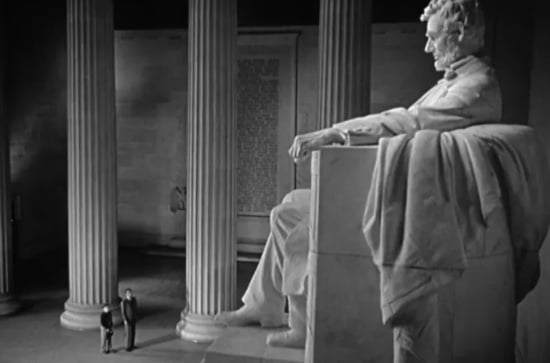
Klaatu and Bobby visit the Lincoln Memorial in “The Day the Earth Stood Still” (1951).
Here, again, it is easiest for me to discuss this in terms of my own religion, Christianity. We Christians believe that human beings are beloved by God and have infinite value, and we ground that belief in several of our fundamental doctrines: Creation, redemption, incarnation, revelation, eschatology.
The Christians whose faith would be shattered by proof of extraterrestrial intelligence are deeply committed to these core doctrines as the basis for human worth and for God’s love for us humans. But so are the Christians whose faith would be undisturbed by “Disclosure Day” or by First Contact.
The divide is not due to their devotion to these doctrines. It is, rather, due to whether they are able and willing to accept that these doctrines might be true for anyone else.
God created you and God redeemed you and you are beloved by God. Can you imagine this is true for anyone other than you? Can you accept that this might be true for anyone other than you?
If your answer to those questions is Yes, then Disclosure Day is no threat to your faith.
If your answer to those questions is No, then Disclosure Day would be an intolerable, existential threat to your religion.
But then again, if your answer to those questions is No, your religion is already threatened. It would be destroyed by proof of extraterrestrial intelligent life, but it would also be destroyed by acceptance of the fact of terrestrial intelligent life outside of your clan or sect or tribe.
Your faith can be shattered not just by visitors from Vulcan and Vega, but by visitors from Samaria and the uttermost parts of the earth. It is existentially threatened by the idea that God might also love anybody who isn’t you.
You can see this in Jenkins’ conversations with professors Diana Pasulka and Paul Gutjahr, both of whom note that Christians have been speculating about “space aliens” for ages, and that for most Christians in most times, the possibility of alien life has not been perceived as a threat. (Some fascinating tidbits there about Cotton Mather and the Seventh-Day Adventist Ellen G. White, who seems to be an earlier source of the “unfallen worlds” premise of C.S. Lewis’ Space Trilogy.)
But you can see it especially in the white evangelical/fundamentalist panic discussed by Pidcock and Duff. For those believers, the Christian doctrines of creation, redemption, revelation, incarnation, etc., can only be meaningful if they are particular and exclusive. They can only be true if they are true only for me and for mine.
Here’s Joel Duff on the white creationist rejection of the possibility of extraterrestrial life:
For most of its modern history the young-earth movement treated Earth’s uniqueness as essentially settled. The stars were made “for signs and for seasons, and for days and years” (Genesis 1:14), not as habitats for other beings; the search for life elsewhere was read as an outworking of evolutionary assumptions and therefore something to be opposed; and to find the heavens empty was taken as a quiet falsification of those evolutionary assumptions. The instinct, in other words, was not merely that life elsewhere is unlikely, but that the very expectation of it belongs to a rival worldview.
The most forceful contemporary version of this position comes from Ken Ham and Answers in Genesis, who argue that intelligent extraterrestrial life is not just improbable but, in their words, “completely unbiblical.” What is striking is that the argument is fundamentally soteriological rather than astronomical. Laid out in their own terms it runs roughly like this. Adam’s sin brought a curse upon the whole created order (Romans 8). Christ became the “last Adam,” a kinsman-redeemer who took on human flesh and died “once for all” (Hebrews 9:28); he did not, as AiG memorably puts it, become a “God-Klingon” on some other world.
And here’s Pidcock discussing the same white creationist views:
To fundamentalists, the entire universe is earth centric. Because they believe God’s ultimate drama is a hierarchy of authority and submission being played out on earth, they have to fit any unusual phenomena into their narrative for the earth. And because the genealogies in the Bible add up to about a 6,000-year-old earth, the entire universe must not be older than 6,000 years.
So to fundamentalists, there could not be a civilization of aliens who were far more ancient than humans because they would be far more ancient than the universe itself.
This is what Duff describes as a “quiet falsification of those evolutionary assumptions.” Cotton Mather (!) considered the vastness of the universe and the innumerable stars and confidently asserted that the vast, omnipotent God he believed in must surely have created other peoples on all of those other worlds. But modern young-earth fundamentalists understand that the vast distances of space are measured in time — in light-years — and that to accept the vastness of those distances would be to accept that vastness of time, something they regard as “unbiblical.” So they choose to believe in a much smaller universe and a much smaller God.
Pidcock gets to the heart of this in discussing how these fundamentalists reject not just the possibility of aliens from outer space, but of the aliens from here on earth — the aliens named repeatedly in their Bibles as part of that resounding biblical refrain about “widows, orphans, aliens, and the poor.”
While Spielberg sees the curiosity about aliens as an opportunity for empathy to cultivate kindness toward one another, the Trump administration views it as an opportunity to cultivate cruelty.
“For 60 years, the U.S. government has kept a closely guarded secret,” the White House announced on a new “aliens” page on their website. “Aliens have been walking among us, living in our neighborhoods, and interacting with us in our daily lives. They’ve shopped in the same stores, attended the same classes as our children, and lived seemingly normal human existences. With one exception — they do not belong here. Millions arrived under the cover of darkness and embedded themselves directly into our society. Countless presidents, congressmen and senior officials knew exactly what was happening. Instead of protecting American citizens, they chose to cover it up and even accelerate the invasion.”
As the reader scrolls down the White House website, they come to an “alien arrest map” that shows specifically where these “aliens” have been caught.
But the catch is, these aren’t aliens from other planets. They’re immigrants. And the database is created by ICE.
“If you’ve witnessed an alien abduction, do not be alarmed,” the White House website says. “The alien is in good hands. We will take care of it … and return it safely to its place of origin.”
It?
It’s no wonder Trump chose to court white evangelicals. Their opposition to empathy fuels his rise to power through the dehumanization of anyone who isn’t white or straight or male.
God loves you. If you think that means God doesn’t love anybody else, then your faith would be destroyed on the Day the Earth Stood Still.
And if you think that means God doesn’t love anybody else, then your faith can be destroyed by recognizing the humanity of any neighbor who doesn’t look or talk exactly like you.
Such a faith needs to be destroyed so that it can be replaced with something better, less harmful, and more sustainable.
Previous Post

June 28, 2026
Sunday reading
Next Post

July 1, 2026 Neither picks my pocket nor breaks my leg
Recent Comments
"Earth would be in trouble from the wind, anyway.Not that we'll be around to find ..."
"I can't buy the admirals in command having a critical meeting in a room high ..."
"McCoy's response, in "Spock's World", was "Damn right - it has a nightmare!""
"Do they not have double-walled vacuum (AKA Thermos) bottles? Or double-walled mugs for their coffee?"
Browse Our Archives
Select a Category class warfare evangelicals Iraq Left Behind Mammon music Uncategorized
Select a Month November 2026 October 2026 September 2026 August 2026 July 2026 June 2026 May 2026 April 2026 March 2026 January 2026 December 2025 November 2025 October 2025 September 2025 August 2025 July 2025 June 2025 May 2025 April 2025 March 2025 February 2025 January 2025 December 2024 November 2024 October 2024 September 2024 August 2024 July 2024 June 2024 May 2024 April 2024 March 2024 February 2024 January 2024 December 2023 November 2023 October 2023 September 2023 August 2023 July 2023 June 2023 May 2023 April 2023 March 2023 February 2023 January 2023 December 2022 November 2022 October 2022 September 2022 August 2022 July 2022 June 2022 May 2022 April 2022 March 2022 February 2022 January 2022 December 2021 November 2021 October 2021 September 2021 August 2021 July 2021 June 2021 May 2021 April 2021 March 2021 February 2021 January 2021 December 2020 November 2020 October 2020 September 2020 August 2020 July 2020 June 2020 May 2020 April 2020 March 2020 February 2020 January 2020 December 2019 November 2019 October 2019 September 2019 August 2019 July 2019 June 2019 May 2019 April 2019 March 2019 February 2019 January 2019 December 2018 November 2018 October 2018 September 2018 August 2018 July 2018 June 2018 May 2018 April 2018 March 2018 February 2018 January 2018 December 2017 November 2017 October 2017 September 2017 August 2017 July 2017 June 2017 May 2017 April 2017 March 2017 February 2017 January 2017 December 2016 November 2016 October 2016 September 2016 August 2016 July 2016 June 2016 May 2016 April 2016 March 2016 February 2016 January 2016 December 2015 November 2015 October 2015 September 2015 August 2015 July 2015 June 2015 May 2015 April 2015 March 2015 February 2015 January 2015 December 2014 November 2014 October 2014 September 2014 August 2014 July 2014 June 2014 May 2014 April 2014 March 2014 February 2014 January 2014 December 2013 November 2013 October 2013 September 2013 August 2013 July 2013 June 2013 May 2013 April 2013 March 2013 February 2013 January 2013 December 2012 November 2012 October 2012 September 2012 August 2012 July 2012 June 2012 May 2012 April 2012 March 2012 February 2012 January 2012 December 2011 November 2011 October 2011 September 2011 August 2011 July 2011 June 2011 May 2011 April 2011 March 2011 February 2011 January 2011 December 2010 November 2010 October 2010 September 2010 August 2010 July 2010 June 2010 May 2010 April 2010 March 2010 February 2010 January 2010 December 2009 November 2009 October 2009 September 2009 August 2009 July 2009 June 2009 May 2009 April 2009 March 2009 February 2009 January 2009 December 2008 November 2008 October 2008 September 2008 August 2008 July 2008 June 2008 May 2008 April 2008 March 2008 February 2008 January 2008 December 2007 November 2007 October 2007 September 2007 August 2007 July 2007 June 2007 May 2007 April 2007 March 2007 February 2007 January 2007 December 2006 November 2006 October 2006 September 2006 August 2006 July 2006 June 2006 May 2006 April 2006 March 2006 February 2006 January 2006 December 2005 November 2005 October 2005 September 2005 August 2005 July 2005 June 2005 May 2005 April 2005 March 2005 February 2005 January 2005 December 2004 November 2004 October 2004 September 2004 August 2004 July 2004 June 2004 May 2004 April 2004 March 2004 February 2004 January 2004 December 2003 November 2003 October 2003 September 2003
Follow Us!
TAKE THE
Religious Wisdom Quiz
What is the last book in the Old Testament?
Select your answer to see how you score.
Genesis Malachi Daniel Jonah
Related posts from slacktivist


Smart people saying smart things (11.24.26)

'Statements of Faith' never get shorter

TRENDING AT PATHEOS Progressive Christian

Happy Thanksgiving! I published this Thanksgiving column back in 2017 in...

More Than a Meal: A Messianic Thanksgiving
A Messianic Thanksgiving What if Thanksgiving became more than a meal to...

The Darkening of the Sun, Moon, and Stars
The darkening of the sun and moon and the falling of stars...

Gratitude as the Parent of All Virtues
Giving thanks stems from gratitude. Cicero said that gratitude is the parent...

Make Thanksgiving Bring Family Closer
Written by Dr. David K. Ewen from Eternal Truth Bible College Start...

Ghosts, Spirits, and Wizards in Post-Puritan New England
As it is Thanksgiving, I have a seasonal post concerned with New...
view all Progressive Christian blogs
What Are Your Thoughts?leave a comment
Ad-Free & Subscriber Log-In Subscription Support
- About Us
- 2026 Calendar
- Videos
- Podcasts
- Library of World Religions
- Faith In Media Tracker
- Advertise With Us
- Write for Us
- Privacy Policy
- Terms of Service
- Do Not Sell My Data
- Contact Us
- Radiant Digital
- Manage Newsletter Subscriptions
- Unsubscribe From Notifications
- Sitemap
Copyright 2008-2026, Patheos, part of the Radiant Digital network of media brands. All rights reserved.
Subscription Support Ad-Free & Subscriber Log-In
Follow Patheos