
BuddhistCatholicContemplativeEvangelicalGeneral ChristianHinduJewishLatter-day SaintMuslimNew VisionsProgressive Christian
Beliefs
- Buddhist
- Catholic
- Contemplative
- Evangelical
- General Christian
- Hindu
- Jewish
- Latter-day Saint
- More Voices
- Muslim
- New Visions
- Pagan
- Progressive Christian
Topics
- Religion News
- Food and Religion
- Sports and Religion
- Religious Art
- Religious Music and Entertainment
- Religious Events
- History and Religion
- Style and Religion
- Politics and Religion
- Women in Religion
- Recreation Outdoors and Religion
- Business Finance and Religion
- Careers Workplace and Religion
- Education and Religion
- Family Parenting and Religion
- Health Fitness and Religion
- Home and Religion
- Relationships and Religion
- Technology and Religion
- Travel and Religion
Columnists
- Buddhist Columnists
- Business Finance and Religion Columnists
- Careers Workplace and Religion Columnists
- Catholic Columnists
- Contemplative Columnists
- Education and Religion Columnists
- Evangelists Columnists
- Family Parenting and Religion Columnists
- General Christian Columnists
- Health Fitness and Religion Columnists
- Hindu Columnists
- History and Religion Columnists
- Home and Religion Columnists
- Jewish Columnists
- More Voices Columnists
- Latter Day Columnists
- Muslim Columnists
- New Visions Columnists
- Nonreligious Columnists
- Pagan Columnists
- Politics and Religion Columnists
- Progressive Columnists
- Recreation Outdoors and Religion Columnists
- Relationships and Religion Columnists
- Religion News Columnists
- Religious Art Columnists
- Religious Events Columnists
- Religious Music and Entertainment Columnists
- Sports and Religion Columnists
- Style and Religion Columnists
- Technology and Religion Columnists
- Travel and Religion Columnists
- Women in Religion Columnists
Resource Library
- 2026 Calendar
- Library of World Religions
- The 100 Most Holy Places on Earth
- Patheos Answers
- Podcasts
- Videos
- Faith Leaders Database
- Anglican Episcopalian
- Bahai
- Baptist
- Buddhism
- Christianity
- Confucianism
- Eastern Orthodoxy
- Hinduism
- Holiness and Pentecostal
- ISKCON
- Islam
- Judaism
- Lutheran
- Methodist
- The Church of Jesus Christ of Latter-day Saints
- New Age
- Paganism
- Presbytarian and Reformed
- Protestantism
- Religion Behind the Scenes
- Roman Catholic
- Scientology
- Shia Islam
- Sikhism
- Sufism
- Sunni Islam
- Taoism
- Zen
- See all religions
Research Tools
 Ad-Free & Subscriber Log-In Subscription Support
Follow Patheos 

- Trending:
- Advent
- |
- Forgiveness
- |
- Thanksgiving
- |
- Election
- |
- Seasonal Holidays
- |
- Marriage

- Home
- Progressive Christian
- Flattening and collapsing, egad!
Flattening and collapsing, egad!
Last updated on: June 2, 2026 at 4:48 pm by Fred Clark
Flattening and collapsing, egad! 2026-06-02T16:48:24-04:00 Fred Clark
Patheos Explore the world's faith through different perspectives on religion and spirituality! Patheos has the views of the prevalent religions and spiritualities of the world.
Sunday was Trinity Sunday, which I jokingly warn my clergy friends each year is a trap designed to lure them into preaching something that can be condemned as heretical. Preaching on the doctrine of the Trinity is like walking a tightrope — a narrow, invariable path with the threat of danger on every side. This doctrine seems like a machine designed to generate heresies and accusations of heresies. Trying to explain or explore the meaning of the Trinity is to invite accusations and attacks — an easy way to get in trouble.
The way I tend to get in trouble is by reminding my fellow humans that our constructs and formulations for understanding God are all going to be inadequate because, well, God is God and we are not and we’re trying to grasp something and someone far beyond our ability to grasp. So I’ll point out that the Trinity is, like all of our God talk, a metaphor, and the kinds of people who get upset whenever you point out that anything is a metaphor will, of course, get upset with me, but their being upset with me doesn’t change the fact that we’re all still finite, imperfect creatures speculatively trying to understand an infinite creator and thus finite, imperfect metaphors are the best we’re going to manage.
Every year around Trinity Sunday I wind up rewatching this classic, hilarious video from Lutheran Satire, in which a pair of inquisitorial cartoon twins bully St. Patrick as he tries to suggest analogies for understanding the Trinity:
After rebuking Patrick’s various attempts for lapsing into “modalism” and “Arianism” and “partialism,” the flustered and frustrated saint sighs deeply and retreats to the safety of an Athanasian recitation: “Fine! The Trinity is a mystery which cannot be comprehended by human reason, but is understood only through faith, and is best confessed in the words of the Athanasian Creed, which states that we worship one God in Trinity, and Trinity in unity, neither confusing the persons nor dividing the substance, and we are compelled by the Christian truth to confess that each distinct person is God and Lord and that the deity of the Father, the Son, and the Holy Spirit is one, equal in glory, co-equal in majesty.”
You’ll notice that even that brief restatement of the official, permissible doctrine spends as much time saying what it’s not saying as what it is — as much time warning against the pitfalls and perils of getting this wrong as it spends explaining what it is we’re actually trying to say or believe here. That approach and tone and wary substance hardly seems like the stuff of a great annual sermon. It’s less like preaching than like being a junior official at the State Department being forced to answer a question about the status of Taiwan.
I appreciate that the lawyerly theological objections of those cartoon twins can actually be important. How we imagine or understand or talk about what God is like shapes how we imagine/understand/talk about what God desires, which can in turn influence how we think about and how we behave toward other people. That matters. That is what matters and, ultimately, that is all that matters.
Putting that so bluntly causes some of my brethren to recoil in horror. You’re flattening the vertical into the horizontal! You’re collapsing the transcendent into the immanent! Danger Will Robinson!
And that’s where I sometimes get as flustered and frustrated as Patrick in that cartoon and will just lean into their confusion and respond, “Yes! Fine! Flatten and collapse the snot out of that ethereal, otherworldly nonsense!” And then I’ll get as angrily insistent and repetitive on that subject as 1 John 4 and wind up being just as ignored and unpersuasive as that passage seems to be.
When I’m less frustrated, I’ll try to point out that these constructs of vertical versus horizontal or transcendent versus immanent are bogus and misleading — confusions of person and divisions of substance. These are not opposites or oppositions or parts or fragments or modes or divisions. The second is like unto it. The second is the same exact thing in different words.
Yes, I will tend to emphasize the temporal, horizontal, immanent and tangible because I am a temporal, finite creature who is far more capable of understanding that as something I can observe, measure, and comprehend. Unlike the abstractions and infinities and mysteries of the transcendent and the vertical, it is possible for me — for us — to look at and to touch the concrete realities of the here and now and thus to discern, with far greater possibility of accuracy and reliability, whether or not we’re getting it right.
The so-called “horizontal” is thus the test and the proof and the standard by which we can judge our otherwise immeasurable and incomprehensible suppositions and speculations about the so-called “vertical.” This is, again, the epistemology of 1 Corinthians 13 — love is the only thing we can be certain of. However elegant and refined and meticulous one’s systematic theology may appear to be, if it does not bear good fruit it must therefore be wrong. If our “vertical” theology or our elaborate speculations about the transcendent do not result in our learning to do justice and love mercy — to bring good news to widows, orphans, strangers, and the poor, to feed the hungry and to welcome strangers and to clothe the naked — then it’s all error and heresy and bunk.
When theologians start to sound like the twins in that video, it’s often from a genuine concern that theological error will lead to sin. Sure, there are some who are just playing Gotcha! games because they enjoy that sort of thing, but usually if someone is going on about the dangers of “modalism,” it’s because they perceive such misperceptions as actually dangerous. They worry that this erroneous way of thinking about God will ultimately lead us to mistreat our neighbors. I think that’s why St. Nicolas wound up throwing hands at the Council of Nicea — not because he was defending an abstraction, but because he feared that the error he was condemning would lead to bad behavior and wind up being bad news for the poor.
I respect that worry, but I think it misreads the way that most of us humans actually work most of the time. I think we tend to work the other way around. We form our abstract theologies and ideologies as a justification for our actions more than we tend to act on the basis of those supposedly pre-existing theologies and ideologies. We are capable of reason, but we’re better at rationalizing than rationally deciding.
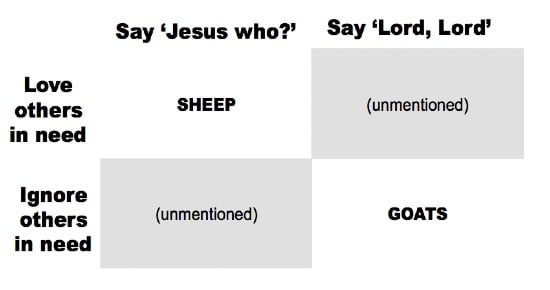
Think again of Jesus’s parable of the Sheep and the Goats in Matthew 25. We’re always tempted to misread this story by filling in the blanks. The story gives us two — and only two — categories: Sheep and Goats. The Goats all recognize Jesus and call him Lord, but they all also failed to feed or to clothe him in his need. None of the Sheep have any idea at all about who this guy is, but they all passed the test when it came to “I was hungry and you fed me.” The Goats, in other words, all had correct “vertical” theology, but failed the “horizontal” test, while the Sheep all passed the horizontal test while having no “vertical” theology at all.
We Christians read this story as people who like to think that we have good and proper and correct “vertical” theology. So we take those two variables and chart them out to supply the “missing” quadrants I’ve illustrated above. Surely those unmentioned quadrants must also exist, right? We want them to exist and we need them to exist, so we mentally add these options to the story, supplying the safe place for us to stand which it had otherwise refused to provide.
That move is not entirely wrong. It would be a mistake, I think, to read Jesus’s parable and take as its message the idea that anyone who calls him “Lord” must, therefore, be a damnable “Goat” consigned to “the eternal fire prepared for the devil and his angels.”* That would be missing — or evading — the point of this story in the same convenient direction of elevating one proper, correct “vertical” formula above the “horizontal” matters it presents as paramount.
Supply all the missing categories and quadrants you like and the meaning of the story remains unchanged. “Love your neighbor” is both necessary and sufficient. That is not a collapsing or a flattening. It is a recognition that the supposed fragments or modes or parts we relegate to the “horizontal” or the “immanent” are, in fact, the essence of the supposed fragments or modes or parts we relegate to the “vertical” and the “transcendent.” This is not a mystery and it is not beyond the reach of human comprehension.
* The parable of the Sheep and the Goats is one of the very few places in the Bible where one can find imagery like this that seems to fit with the much later, extra-biblical folklore of “Hell.” Nearly all such passages regarding fiery torment are in red letters, in the parables of Jesus in the Gospels. Every such passage insists, emphatically, on a soteriology that every single proponent of the folklore of Hell rejects and denies and condemns. “Hell” is not in the Bible, but if you already have the idea of Hell and you go looking for places where you can squeeze it back onto the page, the only places you’ll find that allow you to do that will be passages that very clearly and explicitly state that “Hell” is for Dives.
Previous Post
June 1, 2026
A first person, extremely possessive pronoun
Next Post

June 4, 2026 'Where, exactly, this is all heading'
Recent Comments
"Earth would be in trouble from the wind, anyway.Not that we'll be around to find ..."
"I can't buy the admirals in command having a critical meeting in a room high ..."
"McCoy's response, in "Spock's World", was "Damn right - it has a nightmare!""
"Do they not have double-walled vacuum (AKA Thermos) bottles? Or double-walled mugs for their coffee?"
Browse Our Archives
Select a Category class warfare evangelicals Iraq Left Behind Mammon music Uncategorized
Select a Month November 2026 October 2026 September 2026 August 2026 July 2026 June 2026 May 2026 April 2026 March 2026 January 2026 December 2025 November 2025 October 2025 September 2025 August 2025 July 2025 June 2025 May 2025 April 2025 March 2025 February 2025 January 2025 December 2024 November 2024 October 2024 September 2024 August 2024 July 2024 June 2024 May 2024 April 2024 March 2024 February 2024 January 2024 December 2023 November 2023 October 2023 September 2023 August 2023 July 2023 June 2023 May 2023 April 2023 March 2023 February 2023 January 2023 December 2022 November 2022 October 2022 September 2022 August 2022 July 2022 June 2022 May 2022 April 2022 March 2022 February 2022 January 2022 December 2021 November 2021 October 2021 September 2021 August 2021 July 2021 June 2021 May 2021 April 2021 March 2021 February 2021 January 2021 December 2020 November 2020 October 2020 September 2020 August 2020 July 2020 June 2020 May 2020 April 2020 March 2020 February 2020 January 2020 December 2019 November 2019 October 2019 September 2019 August 2019 July 2019 June 2019 May 2019 April 2019 March 2019 February 2019 January 2019 December 2018 November 2018 October 2018 September 2018 August 2018 July 2018 June 2018 May 2018 April 2018 March 2018 February 2018 January 2018 December 2017 November 2017 October 2017 September 2017 August 2017 July 2017 June 2017 May 2017 April 2017 March 2017 February 2017 January 2017 December 2016 November 2016 October 2016 September 2016 August 2016 July 2016 June 2016 May 2016 April 2016 March 2016 February 2016 January 2016 December 2015 November 2015 October 2015 September 2015 August 2015 July 2015 June 2015 May 2015 April 2015 March 2015 February 2015 January 2015 December 2014 November 2014 October 2014 September 2014 August 2014 July 2014 June 2014 May 2014 April 2014 March 2014 February 2014 January 2014 December 2013 November 2013 October 2013 September 2013 August 2013 July 2013 June 2013 May 2013 April 2013 March 2013 February 2013 January 2013 December 2012 November 2012 October 2012 September 2012 August 2012 July 2012 June 2012 May 2012 April 2012 March 2012 February 2012 January 2012 December 2011 November 2011 October 2011 September 2011 August 2011 July 2011 June 2011 May 2011 April 2011 March 2011 February 2011 January 2011 December 2010 November 2010 October 2010 September 2010 August 2010 July 2010 June 2010 May 2010 April 2010 March 2010 February 2010 January 2010 December 2009 November 2009 October 2009 September 2009 August 2009 July 2009 June 2009 May 2009 April 2009 March 2009 February 2009 January 2009 December 2008 November 2008 October 2008 September 2008 August 2008 July 2008 June 2008 May 2008 April 2008 March 2008 February 2008 January 2008 December 2007 November 2007 October 2007 September 2007 August 2007 July 2007 June 2007 May 2007 April 2007 March 2007 February 2007 January 2007 December 2006 November 2006 October 2006 September 2006 August 2006 July 2006 June 2006 May 2006 April 2006 March 2006 February 2006 January 2006 December 2005 November 2005 October 2005 September 2005 August 2005 July 2005 June 2005 May 2005 April 2005 March 2005 February 2005 January 2005 December 2004 November 2004 October 2004 September 2004 August 2004 July 2004 June 2004 May 2004 April 2004 March 2004 February 2004 January 2004 December 2003 November 2003 October 2003 September 2003
Follow Us!
TAKE THE
Religious Wisdom Quiz
Who said, "Silver and gold have I none, but what I have I give to you"?
Select your answer to see how you score.
Paul John James Peter
Related posts from slacktivist


Smart people saying smart things (11.24.26)
'Statements of Faith' never get shorter

TRENDING AT PATHEOS Progressive Christian

Happy Thanksgiving! I published this Thanksgiving column back in 2017 in...

More Than a Meal: A Messianic Thanksgiving
A Messianic Thanksgiving What if Thanksgiving became more than a meal to...

The Darkening of the Sun, Moon, and Stars
The darkening of the sun and moon and the falling of stars...

Gratitude as the Parent of All Virtues
Giving thanks stems from gratitude. Cicero said that gratitude is the parent...

Make Thanksgiving Bring Family Closer
Written by Dr. David K. Ewen from Eternal Truth Bible College Start...

Ghosts, Spirits, and Wizards in Post-Puritan New England
As it is Thanksgiving, I have a seasonal post concerned with New...
view all Progressive Christian blogs
What Are Your Thoughts?leave a comment
Ad-Free & Subscriber Log-In Subscription Support
- About Us
- 2026 Calendar
- Videos
- Podcasts
- Library of World Religions
- Faith In Media Tracker
- Advertise With Us
- Write for Us
- Privacy Policy
- Terms of Service
- Do Not Sell My Data
- Contact Us
- Radiant Digital
- Manage Newsletter Subscriptions
- Unsubscribe From Notifications
- Sitemap
Copyright 2008-2026, Patheos, part of the Radiant Digital network of media brands. All rights reserved.
Subscription Support Ad-Free & Subscriber Log-In
Follow Patheos