
BuddhistCatholicContemplativeEvangelicalGeneral ChristianHinduJewishLatter-day SaintMuslimNew VisionsProgressive Christian
Beliefs
- Buddhist
- Catholic
- Contemplative
- Evangelical
- General Christian
- Hindu
- Jewish
- Latter-day Saint
- More Voices
- Muslim
- New Visions
- Pagan
- Progressive Christian
Topics
- Religion News
- Food and Religion
- Sports and Religion
- Religious Art
- Religious Music and Entertainment
- Religious Events
- History and Religion
- Style and Religion
- Politics and Religion
- Women in Religion
- Recreation Outdoors and Religion
- Business Finance and Religion
- Careers Workplace and Religion
- Education and Religion
- Family Parenting and Religion
- Health Fitness and Religion
- Home and Religion
- Relationships and Religion
- Technology and Religion
- Travel and Religion
Columnists
- Buddhist Columnists
- Business Finance and Religion Columnists
- Careers Workplace and Religion Columnists
- Catholic Columnists
- Contemplative Columnists
- Education and Religion Columnists
- Evangelists Columnists
- Family Parenting and Religion Columnists
- General Christian Columnists
- Health Fitness and Religion Columnists
- Hindu Columnists
- History and Religion Columnists
- Home and Religion Columnists
- Jewish Columnists
- More Voices Columnists
- Latter Day Columnists
- Muslim Columnists
- New Visions Columnists
- Nonreligious Columnists
- Pagan Columnists
- Politics and Religion Columnists
- Progressive Columnists
- Recreation Outdoors and Religion Columnists
- Relationships and Religion Columnists
- Religion News Columnists
- Religious Art Columnists
- Religious Events Columnists
- Religious Music and Entertainment Columnists
- Sports and Religion Columnists
- Style and Religion Columnists
- Technology and Religion Columnists
- Travel and Religion Columnists
- Women in Religion Columnists
Resource Library
- 2026 Calendar
- Library of World Religions
- The 100 Most Holy Places on Earth
- Patheos Answers
- Podcasts
- Videos
- Faith Leaders Database
- Anglican Episcopalian
- Bahai
- Baptist
- Buddhism
- Christianity
- Confucianism
- Eastern Orthodoxy
- Hinduism
- Holiness and Pentecostal
- ISKCON
- Islam
- Judaism
- Lutheran
- Methodist
- The Church of Jesus Christ of Latter-day Saints
- New Age
- Paganism
- Presbytarian and Reformed
- Protestantism
- Religion Behind the Scenes
- Roman Catholic
- Scientology
- Shia Islam
- Sikhism
- Sufism
- Sunni Islam
- Taoism
- Zen
- See all religions
Research Tools
 Ad-Free & Subscriber Log-In Subscription Support
Follow Patheos 

- Trending:
- Advent
- |
- Forgiveness
- |
- Thanksgiving
- |
- Election
- |
- Seasonal Holidays
- |
- Marriage

- Home
- Progressive Christian
- George Washington praying for the return of his slaves
George Washington praying for the return of his slaves
Last updated on: May 28, 2026 at 6:08 pm by Fred Clark
George Washington praying for the return of his slaves 2026-05-28T18:08:28-04:00 Fred Clark
Patheos Explore the world's faith through different perspectives on religion and spirituality! Patheos has the views of the prevalent religions and spiritualities of the world.
NPR’s Neda Ulaby looks at David Barton’s favorite painting: “Conservative Christians love this painting of George Washington. The event it depicts may not have happened.”
This is about the image of Washington praying at Valley Forge, which some regard, as Ulaby says, as “a powerful statement about how the United States was founded as a Christian nation.” Specifically, this is about Arnold Friberg’s giant painting of this apocryphal scene, his 1975 “The Prayer at Valley Forge,” which was commissioned for the celebration of the Bicentennial.
According to the museum’s wall text: “‘The Prayer at Valley Forge’ is a poignant portrayal of George Washington during one of the most critical moments in the American Revolution. In the harsh winter of 1777-78, amidst the immense hardships faced by the Continental Army at Valley Forge, many believe Washington knelt in a moment of solitary prayer, seeking guidance and strength from God.”
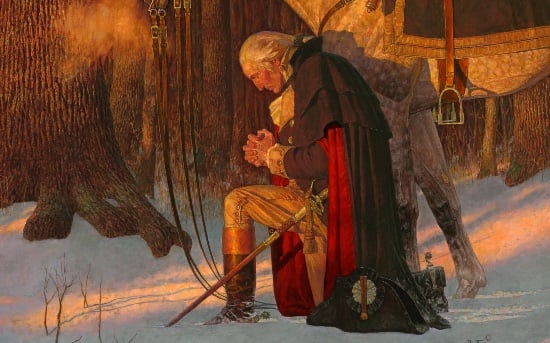
I would suggest that everything you need to know about the “conservative [white] Christians” who revere this painting and the “founded as a [white] Christian nation” ideology they use it to promote is revealed by the fact that it is a painting of George Washington praying at Valley Forge and not a painting of Joshua Chamberlain praying at Gettysburg. Once you understand why these folks love the former and would despise the latter, and why, you’re 99% of the way to understanding just about everything about America in 2026.
Ulaby’s report focuses on whether or not the prayer depicted in Friberg’s painting “really happened.” And the answer is that it almost certainly did not. This was a legend concocted by Parson Weems, who cashed in with a notoriously mythologizing “biography” of Washington published shortly after the first president’s death:
Historians do not believe there is much evidence for this story. Thomas Tweed, professor emeritus at the University of Notre Dame, has written about its origins, which came from a popular biography written shortly after Washington’s death entitled The Life of George Washington: With Curious Anecdotes, Equally Honourable to Himself and Exemplary to His Young Countrymen.
“Parson Weems, Washington’s early biographer, concocted that story — as well as the yarn about George and the cherry tree — to establish the moral character and personal piety of the first president and, thereby, advance a particular view of national belonging and church-state relations,” Tweed wrote in an essay for Yale University Press.
After the publication of Weems’ book in 1800, images of the first president praying became a meme — long before there were memes. Paintings and engravings were reproduced on china plates and on postage stamps in the 1920s. It appeared on the cover of the popular magazine The Saturday Evening Post in 1935, and reproduced in stained glass in a special prayer room built in the U.S. Capitol for members of Congress in the 1950s.
Tweed’s article, like Ulaby’s, capably covers the dubious history depicted in the painting, so let us consider instead something that Friberg and all of those earlier painters and illustrators got right in this image: Washington’s outfit — his uniform and his clothing.
The clothing Washington wore at Valley Forge was made by his personal tailor at Mount Vernon, an Englishman named Andrew Judge. Judge came to Virginia as an indentured servant and worked for the Washingtons in the 1770s until the term of his indenture was completed, after which he moved to Alexandria, Virginia. So Andrew Judge was never President Washington’s tailor, but he was General Washington’s tailor.
Every painting and image we have of George Washington during the Revolution shows him wearing the clothes that Andrew Judge made for him. All of those snazzy uniforms and martial regalia and coats and capes were Judge’s handiwork.
But that is not why we remember Andrew Judge. We remember him because of his daughter. Andrew Judge was a good tailor, but he was a lousy father.
While indentured at Mount Vernon, Judge fathered a child with Betty, an enslaved woman that the Washingtons did not permit to marry or to have a surname. Martha Washington had inherited Betty as her property after the death of her first husband. When Betty’s daughter was born at Mount Vernon in 1773, the white laws of the white colony of Virginia stated that because she was the property of Martha Washington, her child was also Washington’s property. And so Oney Judge was born a slave, not a person but a thing. A thing “owned” by Martha Washington. (“People as things, that’s where it starts.”)
Oney Judge grew up enslaved and worked for Martha Washington at Mount Vernon all through the Revolution and early years of the new country under the Articles of Confederation. After the Constitution was adopted and George Washington was elected as the first president, she was moved with the family to the president’s house in Philadelphia, which served as the capital during Washington’s years in office. (Washington was not president in “Washington,” it was still being built and would not be named that until after his death.)
Living in Philadelphia created a problem for the Washington household. Pennsylvania law held that anyone who lived here uninterrupted for six months had established legal residency, and residents of Pennsylvania were, according to state law, not permitted to own slaves. So George and Martha Washington made regular visits to Mount Vernon and regular “tours of the South” to ensure they never accidentally established legal residency here.
This residency law also applied to all of the slaves in Washington’s household, which meant the Washingtons also had to ensure that the half-dozen enslaved people who lived with them at the president’s home in Philly got cycled out of town and back to Mount Vernon every five and a half months or so.
That’s why the president’s entire household was preparing a brief visit back to Virginia in May of 1796. This is also when Oney Judge learned that Martha Washington intended to “gift” her to Washington’s granddaughter as a wedding present. And so, as Oney Judge put it in an 1845 interview:
Whilst they were packing up to go to Virginia, I was packing to go, I didn’t know where; for I knew that if I went back to Virginia, I should never get my liberty. I had friends among the colored people of Philadelphia, had my things carried there beforehand, and left Washington’s house while they were eating dinner.
She boarded a ship to New Hampshire and never looked back. George Washington sent slavecatchers and government officials after her to recapture his “stolen property,” but her neighbors in the free state of New Hampshire helped her elude those kidnappers. Bounties and rewards were offered for her capture and re-enslavement for years afterwards.
Oney Judge married — becoming Oney Judge Staines — and had free children of her own. This apparently enraged Washington, who regarded those children as his rightful property — property she was obstinately and insubordinately stealing from him. So she wrote a letter to the president, offering a deal. She would voluntarily return to enslavement in his household if he would promise not to pursue the enslavement of her children. Parson Weems does not tell us whether or not Washington knelt in prayer to consider this offer, but we know that he rejected it, angrily, unable to abide the suggestion that he would deign to negotiate with a woman who was only three-quarters white.
Oney Judge Staines joined a church in New Hampshire and became known and respected for her devotion and piety. She was, her neighbors all said, a good Christian woman. A painting of Oney Judge kneeling in prayer would be a depiction of a real and frequent actual historical event.
She lived a free woman in New Hampshire until her death in 1848. The year before that she was interviewed by the Rev. Benjamin Chase, writing for an abolitionist newspaper. Chase asked her about the pious, “Prayer at Valley Forge” myth of George Washington as portrayed by Parson Weems and the like. She said “the stories told of Washington’s piety and prayers, so far as she ever saw or heard while she was his slave, have no foundation. Card-playing and wine-drinking were the business at his parties, and he had more of such company Sundays than on any other day.”
Regarding her eyewitness account of life as a slave in the president’s house, Chase wrote:
Card-playing and wine-drinking were the business at his parties, and he had more of such company Sundays than on any other day. I do not mention this as showing, in my estimation, his anti-Christian character, so much as the bare fact of being a slaveholder, and not a hundredth part so much as trying to kidnap this woman; but, in the minds of the community, it will weigh infinitely more.
Chase is, appropriately, gobsmacked by the hypocrisy of the white Christians who gave greater weight to “card-playing and wine-drinking” than to “the bare fact of being a slaveholder” and “trying to kidnap this woman” (and her children!). But this isn’t so much hypocrisy as a coping mechanism and a permission structure. It is the psychological mechanism by which these white Christians are able to wake up every day and continue to think of themselves as white Christians.
How can they regard themselves as disciples of Jesus when they enslave others? How can they tell themselves, every day, “I am a good person,” when they are, every day, complicit in staggering injustice and cruel harm to their neighbors?
“Whoever claims to love God yet hates a brother or sister is a liar,” 1 John 4 says. And at some level they know this to be true. They know that their actions prove them to be liars — to be Bad People. They know. And yet such knowledge is intolerable, unbearable. It is undeniable, yet it must be denied because their whole identity — whole self-image and sense of meaning — depends on them telling themselves, every day, “I am a Good Christian and a Good Person.”
They managed to semi-maintain this illusion and this self-deception by pretending that some token claim of moral superiority “weighed infinitely more” than the glaring, massive sin at the true heart of their lives and identities. They kept the self-deception going by telling themselves “I abstain from card-playing and wine-drinking and this makes me a Good Christian and a Good Person, never mind my enslavement and oppression of God’s children.”
Did this work for them? Well, sort of.
It worked the same way that it worked for later generations of their descendants, who told themselves “I support anti-Communism and this makes me a Good Christian and a Good Person, never mind my support for segregation and tacit support for lynching.” And it worked the same way it worked for those people’s children and grandchildren, who tell themselves “I want to criminalize abortion, and this makes me a Good Christian and a Good Person, never mind my devoted support for repealing every achievement of the Civil Rights Movement and my steadfast opposition to pluralist democracy.”
It can kind of sort of work for you if you really devote yourself to the denial of the undeniable and just work really hard at reassuring yourself that, whatever nagging doubts may flicker at the edge of your thoughts, surely you must be a better person than those card-playing, wine-drinking, Commie baby-killers.
And but so anyway, no, George Washington never knelt in prayer before chopping down a cherry tree at Valley Forge.
Previous Post
May 26, 2026
Why don't you come to your senses?
Next Post
May 29, 2026 LBCF: Three Days of the Chicken
Recent Comments
"The opossum has the right idea. 😱"
"https://bsky.app/profile/did:plc:qrz3lhbyuxbeilrc6nekdqme/feed/645e79ca5148Pop Gun"
"Worldbuilding detail I'm toying with for my Isekai Foster Home story:Elves, dwarves and halflings have ..."
""Better a Balafon than a bonnacon, and better a bonnacon than a balatron" as the ..."
A rough month for the ‘Jim ..."
Browse Our Archives
Select a Category class warfare evangelicals Iraq Left Behind Mammon music Uncategorized
Select a Month November 2026 October 2026 September 2026 August 2026 July 2026 June 2026 May 2026 April 2026 March 2026 January 2026 December 2025 November 2025 October 2025 September 2025 August 2025 July 2025 June 2025 May 2025 April 2025 March 2025 February 2025 January 2025 December 2024 November 2024 October 2024 September 2024 August 2024 July 2024 June 2024 May 2024 April 2024 March 2024 February 2024 January 2024 December 2023 November 2023 October 2023 September 2023 August 2023 July 2023 June 2023 May 2023 April 2023 March 2023 February 2023 January 2023 December 2022 November 2022 October 2022 September 2022 August 2022 July 2022 June 2022 May 2022 April 2022 March 2022 February 2022 January 2022 December 2021 November 2021 October 2021 September 2021 August 2021 July 2021 June 2021 May 2021 April 2021 March 2021 February 2021 January 2021 December 2020 November 2020 October 2020 September 2020 August 2020 July 2020 June 2020 May 2020 April 2020 March 2020 February 2020 January 2020 December 2019 November 2019 October 2019 September 2019 August 2019 July 2019 June 2019 May 2019 April 2019 March 2019 February 2019 January 2019 December 2018 November 2018 October 2018 September 2018 August 2018 July 2018 June 2018 May 2018 April 2018 March 2018 February 2018 January 2018 December 2017 November 2017 October 2017 September 2017 August 2017 July 2017 June 2017 May 2017 April 2017 March 2017 February 2017 January 2017 December 2016 November 2016 October 2016 September 2016 August 2016 July 2016 June 2016 May 2016 April 2016 March 2016 February 2016 January 2016 December 2015 November 2015 October 2015 September 2015 August 2015 July 2015 June 2015 May 2015 April 2015 March 2015 February 2015 January 2015 December 2014 November 2014 October 2014 September 2014 August 2014 July 2014 June 2014 May 2014 April 2014 March 2014 February 2014 January 2014 December 2013 November 2013 October 2013 September 2013 August 2013 July 2013 June 2013 May 2013 April 2013 March 2013 February 2013 January 2013 December 2012 November 2012 October 2012 September 2012 August 2012 July 2012 June 2012 May 2012 April 2012 March 2012 February 2012 January 2012 December 2011 November 2011 October 2011 September 2011 August 2011 July 2011 June 2011 May 2011 April 2011 March 2011 February 2011 January 2011 December 2010 November 2010 October 2010 September 2010 August 2010 July 2010 June 2010 May 2010 April 2010 March 2010 February 2010 January 2010 December 2009 November 2009 October 2009 September 2009 August 2009 July 2009 June 2009 May 2009 April 2009 March 2009 February 2009 January 2009 December 2008 November 2008 October 2008 September 2008 August 2008 July 2008 June 2008 May 2008 April 2008 March 2008 February 2008 January 2008 December 2007 November 2007 October 2007 September 2007 August 2007 July 2007 June 2007 May 2007 April 2007 March 2007 February 2007 January 2007 December 2006 November 2006 October 2006 September 2006 August 2006 July 2006 June 2006 May 2006 April 2006 March 2006 February 2006 January 2006 December 2005 November 2005 October 2005 September 2005 August 2005 July 2005 June 2005 May 2005 April 2005 March 2005 February 2005 January 2005 December 2004 November 2004 October 2004 September 2004 August 2004 July 2004 June 2004 May 2004 April 2004 March 2004 February 2004 January 2004 December 2003 November 2003 October 2003 September 2003
Follow Us!
TAKE THE
Religious Wisdom Quiz
Who climbed a sycamore tree to see Jesus?
Select your answer to see how you score.
Simon Bartimaeus Zacchaeus Nicodemus
Related posts from slacktivist


A rough month for the 'Jim Crow theobros'
Long strings of words, ready-made

TRENDING AT PATHEOS Progressive Christian

Miller’s Station UMC| 21 November 2026| Anchor Verse Luke 1: 26-38; 46-56...

Spirituality without Supernaturalism

Finding Gratitude in the Growth You Didn't Choose
I Wouldn't Have Chosen This My life has had many twists and...
We shouldn't act as if WE'RE in the...
I'm lately seeing a remarkable amount of online fear-mongering and sensationalized...
Salisbury Cathedral (outside)-- Part Four
There is a relatively new statue outside the cathedral of the 'walking...
I Was in Prison ... On Matthew 25:35-36
I Was in Prison...and You Came to Me "for I was hungry...
view all Progressive Christian blogs
What Are Your Thoughts?leave a comment
Ad-Free & Subscriber Log-In Subscription Support
- About Us
- 2026 Calendar
- Videos
- Podcasts
- Library of World Religions
- Faith In Media Tracker
- Advertise With Us
- Write for Us
- Privacy Policy
- Terms of Service
- Do Not Sell My Data
- Contact Us
- Radiant Digital
- Manage Newsletter Subscriptions
- Unsubscribe From Notifications
- Sitemap
Copyright 2008-2026, Patheos. All rights reserved.
Subscription Support Ad-Free & Subscriber Log-In
Follow Patheos