
BuddhistCatholicContemplativeEvangelicalGeneral ChristianHinduJewishLatter-day SaintMuslimNew VisionsProgressive Christian
Beliefs
- Buddhist
- Catholic
- Contemplative
- Evangelical
- General Christian
- Hindu
- Jewish
- Latter-day Saint
- More Voices
- Muslim
- New Visions
- Pagan
- Progressive Christian
Topics
- Religion News
- Food and Religion
- Sports and Religion
- Religious Art
- Religious Music and Entertainment
- Religious Events
- History and Religion
- Style and Religion
- Politics and Religion
- Women in Religion
- Recreation Outdoors and Religion
- Business Finance and Religion
- Careers Workplace and Religion
- Education and Religion
- Family Parenting and Religion
- Health Fitness and Religion
- Home and Religion
- Relationships and Religion
- Technology and Religion
- Travel and Religion
Columnists
- Buddhist Columnists
- Business Finance and Religion Columnists
- Careers Workplace and Religion Columnists
- Catholic Columnists
- Contemplative Columnists
- Education and Religion Columnists
- Evangelists Columnists
- Family Parenting and Religion Columnists
- General Christian Columnists
- Health Fitness and Religion Columnists
- Hindu Columnists
- History and Religion Columnists
- Home and Religion Columnists
- Jewish Columnists
- More Voices Columnists
- Latter Day Columnists
- Muslim Columnists
- New Visions Columnists
- Nonreligious Columnists
- Pagan Columnists
- Politics and Religion Columnists
- Progressive Columnists
- Recreation Outdoors and Religion Columnists
- Relationships and Religion Columnists
- Religion News Columnists
- Religious Art Columnists
- Religious Events Columnists
- Religious Music and Entertainment Columnists
- Sports and Religion Columnists
- Style and Religion Columnists
- Technology and Religion Columnists
- Travel and Religion Columnists
- Women in Religion Columnists
Resource Library
- 2026 Calendar
- Library of World Religions
- The 100 Most Holy Places on Earth
- Patheos Answers
- Podcasts
- Videos
- Faith Leaders Database
- Anglican Episcopalian
- Bahai
- Baptist
- Buddhism
- Christianity
- Confucianism
- Eastern Orthodoxy
- Hinduism
- Holiness and Pentecostal
- ISKCON
- Islam
- Judaism
- Lutheran
- Methodist
- The Church of Jesus Christ of Latter-day Saints
- New Age
- Paganism
- Presbytarian and Reformed
- Protestantism
- Religion Behind the Scenes
- Roman Catholic
- Scientology
- Shia Islam
- Sikhism
- Sufism
- Sunni Islam
- Taoism
- Zen
- See all religions
Research Tools
 Ad-Free & Subscriber Log-In Subscription Support
Follow Patheos 

- Trending:
- Advent
- |
- Forgiveness
- |
- Thanksgiving
- |
- Election
- |
- Seasonal Holidays
- |
- Marriage

- Home
- Progressive Christian
- Team Everybody sliding into our DMs
Team Everybody sliding into our DMs
Last updated on: March 28, 2026 at 5:44 pm by Fred Clark
Team Everybody sliding into our DMs 2026-03-28T17:44:20-04:00 Fred Clark
Patheos Explore the world's faith through different perspectives on religion and spirituality! Patheos has the views of the prevalent religions and spiritualities of the world.
Here’s a quick look at one of my favorite examples of what I mean when I talk about the Bible as being a collection of arguments. I don’t mean arguments about the Bible, but arguments within it — arguments between the various biblical writers and editors and redactors.
Perhaps the biggest and most frequently occurring argument within the Bible is the one about exclusion vs. inclusion. Did God choose Abram to bestow upon him an exceptional privilege, or to commission him for an exceptional mission? Are the people of God those who are distinct from everybody else, or is it their job to invite and to demonstrate to the entire world that everybody is the people of God?
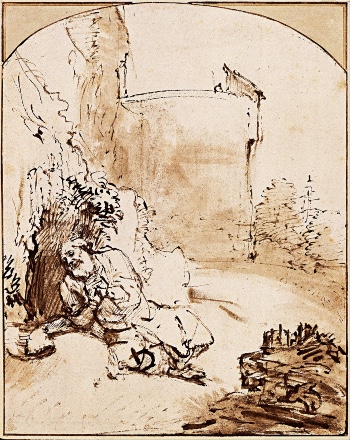
“The Prophet Jonah before the Walls of Nineveh,” by Rembrandt (ca. 1655). “I’m so angry I wish I were dead” is no way to go through life, son.
The anthology of anthologies that we call the Bible includes voices advocating for both sides of this argument. It gives us scores of exclusionist arguments and just as many inclusionist arguments. I usually describe this running biblical argument as the fight between Team Jonah and Team Everybody.
That tells you which side I side with, since the book of Jonah is itself a vicious polemic written against Team Jonah, arguing that the exclusionist understanding of the people of God is not merely mistaken, but foolish and spiteful and self-destructive. (And suggesting, in the view of the author of Jonah, that the biblical writers on the other side of this argument are pretty much just a bunch of miserable jerks.)
The book of Acts also sides with the author of the book of Jonah, but it’s not so much a polemic against Team Jonah as it is a start-to-finish argument on behalf of Team Everybody. Where the author of Jonah is landing punches, the author of Acts is giving out hugs, because if Everybody Means Everybody, then Everybody even includes the Jonah types who think it doesn’t.
And Acts is not subtle about this. It starts with Jesus’s final commission to his followers, commanding them to invite in and include Everybody “in Jerusalem, and in all Judea and Samaria, and to the ends of the earth.” Then comes Pentecost — the proclamation of Good News for Everybody that’s miraculously heard in every language of the world.
Despite that one-two punch of the Great Commission and Pentecost, these first Christians of the not-yet-church struggle to get on board with Team Everybody. This is a major theme — almost a running gag — throughout the first half of the book. But by chapter 15 of Acts, they finally — somewhat belatedly and somewhat begrudgingly — all agree to get with the program. This happens at what we call the Council of Jerusalem, where James gets the final word and affirms the church’s allegiance with Team Everybody.
James does so by quoting from the book of Amos. “The words of the prophets are in agreement with this,” he says, and then he recites from Amos 9:12: “that the rest of mankind may seek the Lord, even all the Gentiles who bear my name.”
Here’s where this gets very interesting, and why this is such a good example of what I mean by the ongoing internal argument within the Bible between exclusion and inclusion, between Team Jonah and Team Everybody. Because that passage from Amos that James quotes sure sounds like a clear statement of inclusion. What is the duty of God’s people? It is to ensure “that the rest of humanity may seek the Lord, even all the Gentiles.” Even the great city of Ninevah and all the heathen sailors.
But if you’re reading James there as he recites from Amos in Acts 15:17, you’ll see a little footnote in your English translation of the Bible. When you look down to the bottom of the page, it will give you the citation, Amos 9:12. And then, if you turn in that same Bible you’re holding to Amos 9:12, you’ll read something very different from what James read. You’ll read, instead, this: “so that they may possess the remnant of Edom and all the nations.”
That doesn’t sound like Team Everybody at all. That sounds like something you’d say at a pep rally for Team Jonah. What does it mean to be God’s people? It means we get to possess the lands of Edom — we’re preferred over our cousins, “and all the nations.” It means we’re special and blessed above everybody else. Suck on that, Ninevah!
So what’s going on here?
It’s a little complicated, and that complication is hinted at by the footnote in Acts 15 in the NIV, which says, “Amos 9:11,12 (see Septuagint).” James may have been reading from the Greek translation of Amos found in the Septuagint instead of from the Hebrew Masoretic Text version of that book that was used for the “Old Testament” in our English Bibles.
But I’ll try here to avoid getting into the weeds of LXX and MT and all that. I’m not any kind of expert in ancient languages and I’m not writing here for experts in ancient languages.
The fascinating, basic gist of the issue here is that the oldest written versions of the book of Amos were in a form of Hebrew that didn’t have punctuation, or upper and lower cases. Or written vowels.
What that means, among other things, is that one word in Amos 9:12 was just written “DM.” The reader might decide to plug in one set of vowels and have that read as “Edom” — meaning the descendants of Esau and the land east of Israel where the people of Edom lived. Or the reader might also, just as legitimately, opt to plug in another set of vowels and thus read the word as “adam” — meaning humanity, humankind as a whole.
Something similar is also true of the rest of that passage, where the conflicting readings of “seek” versus “possess” are both available as legitimate options for what the text may intend. (Plenty of articles on this by actual scholars if you’re up for that, but I’m not gonna get into the details here, because I’m only half sure that I even half-understand discussions about “pronominal suffixes” and whatnot.)
The bottom line is that in our English Bibles, Acts 15 quotes Amos 9 and our version of Amos 9 doesn’t say what Acts says it says. And in the simplest terms, this conflict between those passages may be due to Jesus’s brother reading from a different translation of Amos than the one used for our Bibles. The one James had plugged in one set of vowels — DM as “adam,” while our version of Amos is based on a different translation that plugged in different vowels — DM as “Edom.”
That’s possible and maybe even likely. But I like to imagine the scene there at the Council of Jerusalem with James opening up an older scroll of Amos, one with the ancient writing that included no indication as to which vowels belonged there.
Things are tense. Barnabas and Paul have just made their plea for Team Everybody, “telling about the signs and wonders God [was doing] among the Gentiles.” Philip isn’t there to make this case with them because he’s probably off somewhere baptizing yet another queer Black guy or Samaritan sorcerer or some such. Team Everybody finally has Peter on their side, thanks to Cornelius & Co., but people like Cornelius don’t have a say in this Council, since the whole point of the gathering is to decide whether or not they can or will be included.
And now their fate seems to rest in the hands of James who has, so far, been less than receptive to the radical inclusivity of Philip and Barnabas and Paul. Their fate and my fate, too, since what’s being decided here is whether or not people like me are allowed to be part of Everybody — whether or not even people like me can be included as God’s people.
James turns to Amos chapter 9 and this is what it says, in all caps, with no vowels: DM.
And now James has a choice to make.
This is what we find, too, when we turn to “the Bible.” It affords and accommodates different and opposite meanings, depending on how we choose to read it. We can choose to view it as a text assuring us that we are the special ones who will get to “possess” every last remnant of the lands and legacies of “Edom” and of all the excluded whose birthright we have taken for our own.
Or we can choose to read it as a text that calls us to call in “the rest of humanity,” so that Everybody may seek the Lord.
James chose wisely. He cast the deciding vote for Team Everybody.
I happen to think he chose correctly. But then, like Cornelius and his household, and like Simon of Samaria, and like the Ethiopian eunuch and his queen, I am not a disinterested party here.
Previous Post

March 27, 2026
LBCF: The trepid reporter
Next Post

March 29, 2026 Sunday reading
Recent Comments
"The vacuum of space is a terrible conductor of heat."
"Oh absolutely. It is generally agreed that Mercury and Venus are toasted, Mars is probably ..."
"They thought the goats were bowing and prostrating themselves to demonstrate extreme penitence, but it ..."
"Meanwhile, I have not yet had the opportunity to read the novel Whalefall (since adapted ..."
Browse Our Archives
Select a Category class warfare evangelicals Iraq Left Behind Mammon music Uncategorized
Select a Month November 2026 October 2026 September 2026 August 2026 July 2026 June 2026 May 2026 April 2026 March 2026 January 2026 December 2025 November 2025 October 2025 September 2025 August 2025 July 2025 June 2025 May 2025 April 2025 March 2025 February 2025 January 2025 December 2024 November 2024 October 2024 September 2024 August 2024 July 2024 June 2024 May 2024 April 2024 March 2024 February 2024 January 2024 December 2023 November 2023 October 2023 September 2023 August 2023 July 2023 June 2023 May 2023 April 2023 March 2023 February 2023 January 2023 December 2022 November 2022 October 2022 September 2022 August 2022 July 2022 June 2022 May 2022 April 2022 March 2022 February 2022 January 2022 December 2021 November 2021 October 2021 September 2021 August 2021 July 2021 June 2021 May 2021 April 2021 March 2021 February 2021 January 2021 December 2020 November 2020 October 2020 September 2020 August 2020 July 2020 June 2020 May 2020 April 2020 March 2020 February 2020 January 2020 December 2019 November 2019 October 2019 September 2019 August 2019 July 2019 June 2019 May 2019 April 2019 March 2019 February 2019 January 2019 December 2018 November 2018 October 2018 September 2018 August 2018 July 2018 June 2018 May 2018 April 2018 March 2018 February 2018 January 2018 December 2017 November 2017 October 2017 September 2017 August 2017 July 2017 June 2017 May 2017 April 2017 March 2017 February 2017 January 2017 December 2016 November 2016 October 2016 September 2016 August 2016 July 2016 June 2016 May 2016 April 2016 March 2016 February 2016 January 2016 December 2015 November 2015 October 2015 September 2015 August 2015 July 2015 June 2015 May 2015 April 2015 March 2015 February 2015 January 2015 December 2014 November 2014 October 2014 September 2014 August 2014 July 2014 June 2014 May 2014 April 2014 March 2014 February 2014 January 2014 December 2013 November 2013 October 2013 September 2013 August 2013 July 2013 June 2013 May 2013 April 2013 March 2013 February 2013 January 2013 December 2012 November 2012 October 2012 September 2012 August 2012 July 2012 June 2012 May 2012 April 2012 March 2012 February 2012 January 2012 December 2011 November 2011 October 2011 September 2011 August 2011 July 2011 June 2011 May 2011 April 2011 March 2011 February 2011 January 2011 December 2010 November 2010 October 2010 September 2010 August 2010 July 2010 June 2010 May 2010 April 2010 March 2010 February 2010 January 2010 December 2009 November 2009 October 2009 September 2009 August 2009 July 2009 June 2009 May 2009 April 2009 March 2009 February 2009 January 2009 December 2008 November 2008 October 2008 September 2008 August 2008 July 2008 June 2008 May 2008 April 2008 March 2008 February 2008 January 2008 December 2007 November 2007 October 2007 September 2007 August 2007 July 2007 June 2007 May 2007 April 2007 March 2007 February 2007 January 2007 December 2006 November 2006 October 2006 September 2006 August 2006 July 2006 June 2006 May 2006 April 2006 March 2006 February 2006 January 2006 December 2005 November 2005 October 2005 September 2005 August 2005 July 2005 June 2005 May 2005 April 2005 March 2005 February 2005 January 2005 December 2004 November 2004 October 2004 September 2004 August 2004 July 2004 June 2004 May 2004 April 2004 March 2004 February 2004 January 2004 December 2003 November 2003 October 2003 September 2003
Follow Us!
TAKE THE
Religious Wisdom Quiz
Who was the Amalekite king spared by Saul, contrary to God's command?
Select your answer to see how you score.
Abner Ish-bosheth Agag Goliath
Related posts from slacktivist

It's not 'pick and choose.' It's pick a...

The phantom menace of biblical chronology
I got an A on my 6th-grade Bible...
TRENDING AT PATHEOS Progressive Christian

Gratitude as the Parent of All Virtues
Giving thanks stems from gratitude. Cicero said that gratitude is the parent...

Make Thanksgiving Bring Family Closer
Written by Dr. David K. Ewen from Eternal Truth Bible College Start...

Ghosts, Spirits, and Wizards in Post-Puritan New England
As it is Thanksgiving, I have a seasonal post concerned with New...

Here are two Thanksgiving columns that I originally wrote for the...

Book III, Chapter 3: Christ "Classic" (Matt. 9:9-34)
Book III, Chapter 3: Christ "Classic" (Matt. 9:9-34) In honor of tomorrow's...

Jesus explicitly mentions the book of Jonah twice, but he retells the...
view all Progressive Christian blogs
What Are Your Thoughts?leave a comment
Ad-Free & Subscriber Log-In Subscription Support
- About Us
- 2026 Calendar
- Videos
- Podcasts
- Library of World Religions
- Faith In Media Tracker
- Advertise With Us
- Write for Us
- Privacy Policy
- Terms of Service
- Do Not Sell My Data
- Contact Us
- Radiant Digital
- Manage Newsletter Subscriptions
- Unsubscribe From Notifications
- Sitemap
Copyright 2008-2026, Patheos, part of the Radiant Digital network of media brands. All rights reserved.
Subscription Support Ad-Free & Subscriber Log-In
Follow Patheos