
BuddhistCatholicContemplativeEvangelicalGeneral ChristianHinduJewishLatter-day SaintMuslimNew VisionsProgressive Christian
Beliefs
- Buddhist
- Catholic
- Contemplative
- Evangelical
- General Christian
- Hindu
- Jewish
- Latter-day Saint
- More Voices
- Muslim
- New Visions
- Pagan
- Progressive Christian
Topics
- Religion News
- Food and Religion
- Sports and Religion
- Religious Art
- Religious Music and Entertainment
- Religious Events
- History and Religion
- Style and Religion
- Politics and Religion
- Women in Religion
- Recreation Outdoors and Religion
- Business Finance and Religion
- Careers Workplace and Religion
- Education and Religion
- Family Parenting and Religion
- Health Fitness and Religion
- Home and Religion
- Relationships and Religion
- Technology and Religion
- Travel and Religion
Columnists
- Buddhist Columnists
- Business Finance and Religion Columnists
- Careers Workplace and Religion Columnists
- Catholic Columnists
- Contemplative Columnists
- Education and Religion Columnists
- Evangelists Columnists
- Family Parenting and Religion Columnists
- General Christian Columnists
- Health Fitness and Religion Columnists
- Hindu Columnists
- History and Religion Columnists
- Home and Religion Columnists
- Jewish Columnists
- More Voices Columnists
- Latter Day Columnists
- Muslim Columnists
- New Visions Columnists
- Nonreligious Columnists
- Pagan Columnists
- Politics and Religion Columnists
- Progressive Columnists
- Recreation Outdoors and Religion Columnists
- Relationships and Religion Columnists
- Religion News Columnists
- Religious Art Columnists
- Religious Events Columnists
- Religious Music and Entertainment Columnists
- Sports and Religion Columnists
- Style and Religion Columnists
- Technology and Religion Columnists
- Travel and Religion Columnists
- Women in Religion Columnists
Resource Library
- 2026 Calendar
- Library of World Religions
- The 100 Most Holy Places on Earth
- Patheos Answers
- Podcasts
- Videos
- Faith Leaders Database
- Anglican Episcopalian
- Bahai
- Baptist
- Buddhism
- Christianity
- Confucianism
- Eastern Orthodoxy
- Hinduism
- Holiness and Pentecostal
- ISKCON
- Islam
- Judaism
- Lutheran
- Methodist
- The Church of Jesus Christ of Latter-day Saints
- New Age
- Paganism
- Presbytarian and Reformed
- Protestantism
- Religion Behind the Scenes
- Roman Catholic
- Scientology
- Shia Islam
- Sikhism
- Sufism
- Sunni Islam
- Taoism
- Zen
- See all religions
Research Tools
 Ad-Free & Subscriber Log-In Subscription Support
Follow Patheos 

- Trending:
- Advent
- |
- Forgiveness
- |
- Thanksgiving
- |
- Election
- |
- Seasonal Holidays
- |
- Marriage

- Home
- Progressive Christian
- John MacArthur, dead fundamentalist
John MacArthur, dead fundamentalist
Last updated on: July 22, 2025 at 2:56 pm by Fred Clark
John MacArthur, dead fundamentalist 2025-07-22T14:56:58-04:00 Fred Clark
Patheos Explore the world's faith through different perspectives on religion and spirituality! Patheos has the views of the prevalent religions and spiritualities of the world.
Mega-church pastor John MacArthur has died at age 86.
Headlines announcing his death refer to him as a “prominent evangelical” or an “influential evangelical” or, in one case, a “firebrand evangelical,” all of which is inaccurate. MacArthur was prominent and influential and a firebrand, but he was not an “evangelical.” He was a fundamentalist.
That distinction may seem like a fine point here in 2025, but it used to be a very big deal indeed. In fact, this is where the word “evangelical” as it is used today in American Christianity comes from.
 Back in the 1950s, Billy Graham was desperate to distinguish himself and his ministry from the negative attitudes and — even more so — the negative connotations and negative perceptions — of fundamentalism. So Billy and those in his orbit rebranded as “Neo-evangelicals.” Billy and Carl Henry and folks at places like Christianity Today and Wheaton College embraced the new term as a way of pointing a finger at fundamentalists and saying, loudly, “We are not that.” It was their way of coming out and being separate from come-ye-out-and-be-ye-separate fundamentalism.
The “Neo-” prefix dropped away pretty quickly, but the “evangelical” part of the label stuck, and for most of the rest of the 20th century, this is what it meant: “We are evangelicals, as opposed to fundamentalists.”
And for most of the rest of the 20th century, fundamentalists agreed with and appreciated the distinction. You could hear this in a joke I often heard growing up in a fundamentalist church and private school: “An ‘evangelical’ is someone who says to a liberal, ‘I’ll agree to call you a Christian if you agree to call me a scholar.'”
This is why it was a big deal and a cause of great consternation at my church and school when some of us chose to go off to evangelical colleges — places like Wheaton and Houghton and — gasp! — Eastern. These schools were viewed as more insidiously dangerous than Rutgers. That secular state school was regarded as enemy territory — Sodom on the Raritan — but at least there you knew what you were getting into and knew to be on guard. Better the lies of an honest enemy than the pernicious half-truths of those sneaky evangelicals.
I’d be willing to bet John MacArthur repeated and laughed at that joke back in the 1980s. It certainly expressed his opinion of most evangelical seminaries and institutions, which is why he wouldn’t abide having any of his followers attend them, insisting that they attend his own schools instead.
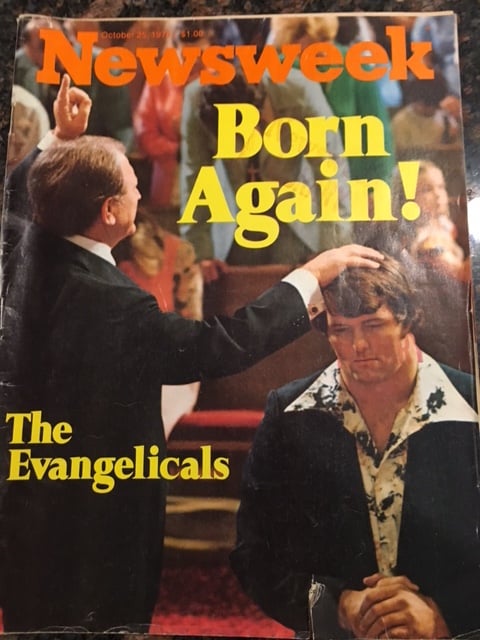
That joke — which I’ve sometimes seen attributed to one of the Bobs Jones — also captures fundies’ resentment of the success of Graham’s “evangelical” rebrand. Graham and other “evangelicals” had achieved a level of cultural acceptance, influence, and even admiration that fundamentalists rejected as worldly compromise, but simultaneously envied. Billy gets his picture taken with presidents and gets to pray at their inaugurations and funerals. Fundamentalists told themselves that this proved he was compromised in a way they never would be, but also it drove them crazy that he got invited to such events and they never did. In 1976, Newsweek ran a cover story proclaiming it the “Year of the Evangelical.” It just wasn’t fair that there’d never be a cover celebrating the “Year of the Fundamentalist.”
The rebranding was, all told, a smashing success. “Evangelical” as then defined — meaning “not like those fundamentalists over there, no sir, none of that” — allowed the new movement to shake off all of the negative connotations and cultural stigma long attached to “fundamentalism.”
That stigma is often exemplified in the example of the Scopes “Monkey” trial of Inherit the Wind fame (or infamy), which has been discussed a bit lately due to the centenary of that event this year.* But decades later, when Billy and friends embraced their “Neo-evangelical” rebrand to escape that association, they were worrying about more contemporary connotations — including the way that white fundamentalism had become the angry face of defending segregation. The Neo-evangelicals were not supporters of the Civil Rights Movement, but Graham recognized that identifying with the uncompromising defense of Jim Crow segregation — as his fundamentalist father-in-law, Nelson Bell, explicitly argued was a white Christian’s biblical duty — would distract from his focus on mass evangelism.
Consider the book Graham’s friend and partner Carl F.H. Henry wrote in 1947, before the group spun off from the rest of fundamentalism to rebrand itself as something else. That book was called The Uneasy Conscience of Modern Fundamentalism, and that was exactly what Henry described — a fundamentalist Christianity that had lost its moral authority because it had lost its moral compass, retreating from public life and failing to address “social ills” including “racial hatred and intolerance.”
This is not in any way to suggest that the “Neo-evangelicals” split away from their fundamentalist roots due to concerns about social justice or Civil Rights or segregation. Far from it. Henry’s main argument was that he and his fellow fundamentalists were correct to have rejected the “heresy” of the Social Gospel, but that perhaps they had taken it a bit too far in rejecting all social engagement and maybe it was time to seek some luke-warm third way so that the wider public might come to perceive them as relevant and as less ungood. But the “uneasy conscience” Henry describes — the moral anxiety — was at the heart of the distinct identity he and Graham would come to carve out as “evangelicalism.” That moral anxiety is the dim semi-recognition that the things we refuse to look at — or to think about or to hear or to learn — might challenge our ability to regard ourselves as the morally distinct and morally superior people beloved and blessed by God. And for white Christians of any kind here in America, that moral anxiety is always about social justice, Civil Rights, segregation, “racial hatred and intolerance.”
One response to this anxiety — this “uneasy conscience” — is to seek to do good. Another response is to seek to be perceived as good. The former leads to repentance. The latter leads to rebranding.
The rebranding was a smashing success on that level as well, assuaging the uneasy conscience and the moral anxiety enough to forestall any urgent need for repentance.
Anyway, by the 1980s, the white fundamentalists who had once been so happy to see those squishy, sophisticated, worldly respect-craving evangelicals depart were now coveting the cultural influence and acceptance enjoyed by those same former kin. And so, into the 1990s and the turn of the century, most fundamentalists followed the road map laid out by Graham and Henry and the rest. They simply stopped calling themselves fundamentalists and started calling themselves evangelicals.
Sometimes this change in branding came with some overly rehearsed indignation as fundamentalists who had, for years, proudly claimed that name as a badge of honor suddenly pretended to be offended when others applied it to them, recoiling as if it were a slur. Sometimes it involved a kind of Orwellian gaslighting, as when Jerry Falwell Sr. began describing Liberty Baptist College as an “evangelical” school and pretending that he’d never said otherwise. In other cases it was more subtle, as in the case of the fightin’ fundamentalists who finished their successful fundamentalist takeover of the Southern Baptist Convention and its seminaries and celebrated the triumph of fundamentalism by phasing out every use of that term.
By the year 2000, every prominent fundamentalist had been rebranded as an evangelical. Jerry Falwell, Pat Robertson, Tim LaHaye, Al Mohler, John MacArthur, Ken Ham … they were all just “evangelicals” now. And thus “evangelicalism,” as a whole, became more and more like them.
And by this point, the evangelicals who used to be what everyone (including themselves) called “fundamentalists” vastly outnumber the evangelicals of the sort who wanted to be something different and distinct from fundamentalism. Thus, today, “evangelical” no longer means “as opposed to fundamentalist.” It now means “as opposed to Mainline Protestant.” And when given that meaning, every fundamentalist is called an evangelical.
Or, in the case of the late John MacArthur, was called an evangelical.
Hemant Mehta had only just finished writing about the lawsuit filed by a former member of MacArthur’s church — “Woman sues John MacArthur’s church for publicly shaming her for wanting to leave an abusive marriage” — when he had to update that story with the news of MacArthur’s death.
It was a short update. “John MacArthur died on Monday night,” he wrote. “He was a racist, sexist, conspiracy theorist who protected abusers.”
Accurate, but also incomplete. I would add that MacArthur was also an astonishingly arrogant man, while also a remarkably credulous one. He wasn’t a gullible rube about every conspiracy theory, but if the lie was at all flattering to him, he’d fall for it every time, regardless of the source of that lie.
That’s why the last thing I wrote about MacArthur here recommended that he carve out a few hours of time to look at some tentacle porn on 4chan — “John MacArthur and the Anime Death Tentacle Rape Whorehouse.” The title of that post comes from the name of the site where the covid conspiracies MacArthur was promoting originated. I’m sure he didn’t get those ideas directly from his own visits to that horrific cesspool, but that was the source of what he was teaching and I thought it would be instructive and edifying for him to gain a deeper appreciation for the kind of people he was treating as authorities.
MacArthur’s QAnon-adjacent covid denialism put him at odds with public health officials and that, in turn, put him at odds with everything he had previously said and taught about “Romans 13” and “submission to divinely ordained government.” Hobgoblin of small minds and all that.
We also occasionally checked in with MacArthur due to his decades-long war with Pentecostal and charismatic Christians. And we followed along, sometimes with commentary, as Warren Throckmorton tried to make sense of MacArthur’s dubious, weird story about going to the Lorraine Motel right after Martin Luther King Jr. was killed there. That story was fascinating not because everyone else MacArthur claimed was there denies his account, but because he always seemed to imagine that if it was true it would somehow be a lifelong get-out-of-jail-free card, licensing him to spout whatever racist crap he wanted without criticism because he once rode in a car with John Perkins.
Anyway, MacArthur is dead now. He is in the presence of God where he is surely disappointed to learn that the folklore of “Hell” is not true and that God is not at all the kind of Cosmic Monster God would have to be for God to make or want to make such a horrible idea real. I suppose for somebody like MacArthur, the absence of eternal, merciless Hell for other people is something like Hell for him.
* See, for example, this piece from NPR: “100 years after evolution went on trial, the Scopes case still reverberates.” Among those quoted in the piece is Ken Ham, the fundamentalist young-earth “creationist” who runs the Creation Museum and Ark Encounter. Although this report doesn’t do this, Ham is, like MacArthur, frequently identified in the media as an “evangelical.”
That description of Ham would have been inaccurate back in the 1980s, when “evangelical” meant “as opposed to fundamentalist.” Today, when “evangelical” means “as opposed to Mainline Protestant” or, more generally, means “a white, patriarchal, nationalist religious movement made up of Christians who seek power to transform American culture,” it is accurate.
Of course, even going by the (Neo-)original meaning from the 1950s-1970s, things like the Scopes trial or the Ark Encounter were not clearly on one side of the evangelical/fundamentalist boundary. Biology and geology professors at Wheaton College know the science, and understand that guys like Ken Ham are dishonest grifters, but they’re still not allowed to say that out loud in class.
Previous Post

July 18, 2025
LBCF: Still not creepy enough
Next Post
July 25, 2025 LBCF: What's on second?
Recent Comments
"I mean... it's at least a move in a possibly good direction for her to ..."
"I suspect the real problem is that the current US armed forces CinC and his ..."
"In confirmation class in the (Lutheran Church Missouri Synod) church I grew up in, pretty ..."
"(Suddenly a giant bat swoops down and grabs it away. Soon an entire flock of ..."
Browse Our Archives
Select a Category class warfare evangelicals Iraq Left Behind Mammon music Uncategorized
Select a Month November 2026 October 2026 September 2026 August 2026 July 2026 June 2026 May 2026 April 2026 March 2026 January 2026 December 2025 November 2025 October 2025 September 2025 August 2025 July 2025 June 2025 May 2025 April 2025 March 2025 February 2025 January 2025 December 2024 November 2024 October 2024 September 2024 August 2024 July 2024 June 2024 May 2024 April 2024 March 2024 February 2024 January 2024 December 2023 November 2023 October 2023 September 2023 August 2023 July 2023 June 2023 May 2023 April 2023 March 2023 February 2023 January 2023 December 2022 November 2022 October 2022 September 2022 August 2022 July 2022 June 2022 May 2022 April 2022 March 2022 February 2022 January 2022 December 2021 November 2021 October 2021 September 2021 August 2021 July 2021 June 2021 May 2021 April 2021 March 2021 February 2021 January 2021 December 2020 November 2020 October 2020 September 2020 August 2020 July 2020 June 2020 May 2020 April 2020 March 2020 February 2020 January 2020 December 2019 November 2019 October 2019 September 2019 August 2019 July 2019 June 2019 May 2019 April 2019 March 2019 February 2019 January 2019 December 2018 November 2018 October 2018 September 2018 August 2018 July 2018 June 2018 May 2018 April 2018 March 2018 February 2018 January 2018 December 2017 November 2017 October 2017 September 2017 August 2017 July 2017 June 2017 May 2017 April 2017 March 2017 February 2017 January 2017 December 2016 November 2016 October 2016 September 2016 August 2016 July 2016 June 2016 May 2016 April 2016 March 2016 February 2016 January 2016 December 2015 November 2015 October 2015 September 2015 August 2015 July 2015 June 2015 May 2015 April 2015 March 2015 February 2015 January 2015 December 2014 November 2014 October 2014 September 2014 August 2014 July 2014 June 2014 May 2014 April 2014 March 2014 February 2014 January 2014 December 2013 November 2013 October 2013 September 2013 August 2013 July 2013 June 2013 May 2013 April 2013 March 2013 February 2013 January 2013 December 2012 November 2012 October 2012 September 2012 August 2012 July 2012 June 2012 May 2012 April 2012 March 2012 February 2012 January 2012 December 2011 November 2011 October 2011 September 2011 August 2011 July 2011 June 2011 May 2011 April 2011 March 2011 February 2011 January 2011 December 2010 November 2010 October 2010 September 2010 August 2010 July 2010 June 2010 May 2010 April 2010 March 2010 February 2010 January 2010 December 2009 November 2009 October 2009 September 2009 August 2009 July 2009 June 2009 May 2009 April 2009 March 2009 February 2009 January 2009 December 2008 November 2008 October 2008 September 2008 August 2008 July 2008 June 2008 May 2008 April 2008 March 2008 February 2008 January 2008 December 2007 November 2007 October 2007 September 2007 August 2007 July 2007 June 2007 May 2007 April 2007 March 2007 February 2007 January 2007 December 2006 November 2006 October 2006 September 2006 August 2006 July 2006 June 2006 May 2006 April 2006 March 2006 February 2006 January 2006 December 2005 November 2005 October 2005 September 2005 August 2005 July 2005 June 2005 May 2005 April 2005 March 2005 February 2005 January 2005 December 2004 November 2004 October 2004 September 2004 August 2004 July 2004 June 2004 May 2004 April 2004 March 2004 February 2004 January 2004 December 2003 November 2003 October 2003 September 2003
Follow Us!
TAKE THE
Religious Wisdom Quiz
Who was thrown into a muddy cistern for prophesying Jerusalem's fall?
Select your answer to see how you score.
Jeremiah Micah Isaiah Baruch
Related posts from slacktivist

Is this the right room for an argument?

The Amish are not 'Evangelicals.' They're Amish.

The lumpers, the splitters, and me

'Is it right on red or left on...
TRENDING AT PATHEOS Progressive Christian
Jesus is Coming with Glory and Power
https://www.youtube.com/watch?v=_lt60EDHOQ4&list=RD_lt60EDHOQ4&start_radio=1

The Late Francis Frangipane & the Failure Too...
I learned today that another one of my heroes has gone to...

Thomas Paine, the Smiths, the apostles in England,...
I'm pleased to announce that the Becoming Brigham Black Friday Sale,...

CatholicTV Series: Six Black Catholics on Path to...
WATERTOWN, Mass., November 9, 2026 – In recognition of Black Catholic History...

New Advent Journal Invites Catholics to Be Pilgrims
Florissant, MO, November 16, 2026— What if Advent were more than a...

INNER CIRCLE: John's Quantum Gospel
INTRODUCTION In this next Inner Circle series, which I anticipate will...
view all Progressive Christian blogs
What Are Your Thoughts?leave a comment
Ad-Free & Subscriber Log-In Subscription Support
- About Us
- 2026 Calendar
- Videos
- Podcasts
- Library of World Religions
- Faith In Media Tracker
- Advertise With Us
- Write for Us
- Privacy Policy
- Terms of Service
- Do Not Sell My Data
- Contact Us
- Radiant Digital
- Manage Newsletter Subscriptions
- Unsubscribe From Notifications
- Sitemap
Copyright 2008-2026, Patheos, part of the Radiant Digital network of media brands. All rights reserved.
Subscription Support Ad-Free & Subscriber Log-In
Follow Patheos