
BuddhistCatholicContemplativeEvangelicalGeneral ChristianHinduJewishLatter-day SaintMuslimNew VisionsProgressive Christian
Beliefs
- Buddhist
- Catholic
- Contemplative
- Evangelical
- General Christian
- Hindu
- Jewish
- Latter-day Saint
- More Voices
- Muslim
- New Visions
- Pagan
- Progressive Christian
Topics
- Religion News
- Food and Religion
- Sports and Religion
- Religious Art
- Religious Music and Entertainment
- Religious Events
- History and Religion
- Style and Religion
- Politics and Religion
- Women in Religion
- Recreation Outdoors and Religion
- Business Finance and Religion
- Careers Workplace and Religion
- Education and Religion
- Family Parenting and Religion
- Health Fitness and Religion
- Home and Religion
- Relationships and Religion
- Technology and Religion
- Travel and Religion
Columnists
- Buddhist Columnists
- Business Finance and Religion Columnists
- Careers Workplace and Religion Columnists
- Catholic Columnists
- Contemplative Columnists
- Education and Religion Columnists
- Evangelists Columnists
- Family Parenting and Religion Columnists
- General Christian Columnists
- Health Fitness and Religion Columnists
- Hindu Columnists
- History and Religion Columnists
- Home and Religion Columnists
- Jewish Columnists
- More Voices Columnists
- Latter Day Columnists
- Muslim Columnists
- New Visions Columnists
- Nonreligious Columnists
- Pagan Columnists
- Politics and Religion Columnists
- Progressive Columnists
- Recreation Outdoors and Religion Columnists
- Relationships and Religion Columnists
- Religion News Columnists
- Religious Art Columnists
- Religious Events Columnists
- Religious Music and Entertainment Columnists
- Sports and Religion Columnists
- Style and Religion Columnists
- Technology and Religion Columnists
- Travel and Religion Columnists
- Women in Religion Columnists
Resource Library
- 2026 Calendar
- Library of World Religions
- The 100 Most Holy Places on Earth
- Patheos Answers
- Podcasts
- Videos
- Faith Leaders Database
- Anglican Episcopalian
- Bahai
- Baptist
- Buddhism
- Christianity
- Confucianism
- Eastern Orthodoxy
- Hinduism
- Holiness and Pentecostal
- ISKCON
- Islam
- Judaism
- Lutheran
- Methodist
- The Church of Jesus Christ of Latter-day Saints
- New Age
- Paganism
- Presbytarian and Reformed
- Protestantism
- Religion Behind the Scenes
- Roman Catholic
- Scientology
- Shia Islam
- Sikhism
- Sufism
- Sunni Islam
- Taoism
- Zen
- See all religions
Research Tools
 Ad-Free & Subscriber Log-In Subscription Support
Follow Patheos 

- Trending:
- Advent
- |
- Forgiveness
- |
- Thanksgiving
- |
- Election
- |
- Seasonal Holidays
- |
- Marriage

- Home
- Progressive Christian
- Who shot Myrtle Cook?
Who shot Myrtle Cook?
Last updated on: August 30, 2023 at 6:09 pm by Fred Clark
Who shot Myrtle Cook? 2023-08-30T18:09:16-04:00 Fred Clark
Patheos Explore the world's faith through different perspectives on religion and spirituality! Patheos has the views of the prevalent religions and spiritualities of the world.
The irreplaceable Undine* introduces us to a 98-year-old cold case from Vinton, Iowa: “Murder of a Prohibitionist: The Myrtle Cook Mystery.”
Some murder cases are impossible to solve because of the inability to find anyone who had a discernible motive to kill the victim. Other cases grow cold because so many people had a motive, the police are left spoiled for choice. The following 1925 mystery is a perfect example of the latter.
If one wanted to be tactful, one could describe Myrtle Underwood Cook of Vinton, Iowa, as a strong-minded, courageous woman of deeply-held beliefs. Or you could be blunt and suggest that she was an overbearing, bigoted busybody. The 41-year old Mrs. Cook was a very active lady. She was an ardent prohibitionist–so ardent, that she habitually copied license plate numbers of cars she suspected were rum-running, and spied on her neighbors for any sign of illegal tippling. She made a perfect pest of herself to the local authorities, demanding that they go after anyone she believed was distributing alcohol. She managed to have a number of bootleggers arrested. When she wasn’t chasing after peddlers of bathtub gin, Mrs. Cook was head of the Benton County women’s organization of the Ku Klux Klan. Although fellow prohibitionists considered her a local hero, she was, unsurprisingly, not very popular in other circles. In fact, a sizable portion of Vinton’s residents saw her as a “meddler and a disagreeable gossip.”
It may seem inappropriate to describe the story of an apparent cold-blooded murder as “fun,” but I can’t help it. This story is sordid, horrible fun. Just consider the writerly aptitude of that name, Myrtle Underwood Cook. And then marvel at the central-casting perfection of the only picture we have of her.
The story is also funny — funny in much the same way that the ending of “A Good Man Is Hard to Find” is funny.
On September 7, 1925, Myrtle Cook was writing her speech for the next day’s meeting of the local Women’s Christian Temperance Union when she was killed by a bullet fired through her living room window.
So who shot Myrtle Cook? Spouses are always suspects, but Clifford Cook was out of town the night of the murder, just as he’d been out of town for most of their marriage. He wanted to get away from Myrtle, but didn’t seem to want to do away with her.
Mr. Cook, like many others, suggested his wife had been killed by rum-runners. This was during Prohibition, remember, when alcohol was illegal for the non-wealthy and thus was supplied by gangs of smugglers who were just as violent as drug gangs are nowadays. As president of the local WCTU chapter, Myrtle was a pebble in the shoe of those gangs. But local police investigated several members of local liquor smuggling gangs and didn’t find any evidence connecting any of them to the murder.
While the violent gangs Myrtle opposed were investigated, the violent gang she herself belonged to never was — probably because membership in the Klan, unlike membership in the WCTU, didn’t set her apart from or against most of her neighbors in Vinton. So even though the Klan had killed far more Americans than all of the rum-runners, bootleggers, and Chicago mobsters put together, Myrtle Cook’s Klan ties weren’t part of her murder investigation.
After all, how could the KKK be a suspect in Myrtle’s death when they gave her such a grand funeral?
The preacher who officiated the funeral dressed in the iconic white robe of Ku Klux Klan. Several other Klan members lined the sidewalk as Cook’s casket made its way from the church to Evergreen Cemetery. A cross was set on fire at the graveside ceremony. While Mrs. Cook was a member of the Christian Church, the funeral was held in the Methodist Church because it was larger. The pastors who officiated the service were both members of the KKK.
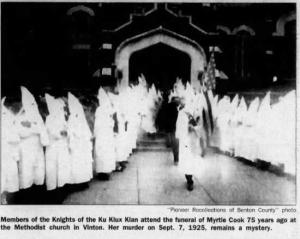
The Vinton Klan was ecumenical. It was a violent terrorist organization, yes — Vinton was an all-white sundown town in 1925 — but it was also a pre-eminent social club that included not just the local clergy but also, almost certainly, local law enforcement. Maybe the police never investigated the local Klan because, as members of that organization, they knew it wasn’t involved.
Or maybe police never investigated the Klan in Myrtle’s death because, as members of that organization, they knew it was.
This is my theory of the crime — one for which I have zero evidence, mind you. But all those hoods and robes aren’t free, you know. Running the biggest Klavern in Benton County takes money. And Prohibition meant there was a lot of money sloshing around for anyone involved in the now-illegal liquor business. It seems more than a little likely that some of that money went to local law enforcement — both official and unofficial. So my theory is that members of the local KKK were involved with rum-running in Vinton — either as direct operators or as indirect beneficiaries from bribes and kickbacks to ensure the business wasn’t interfered with.
After the ratification of the 18th Amendment and passage of the Volstead Act,** the once-daunting Temperance Union became the dog that caught the car. Membership in the WCTU waned and it didn’t pose much of a threat to those now making a fortune in the now-criminal enterprise of rum-running. But Myrtle Cook was a different matter. She was starting to cost them money.
So I think the police and the Klan — to the extent these were at all distinct categories — either knew who shot Myrtle Cook and covered it up, or else they were directly involved in the murder themselves.
That, at least, is how I would tell this story if I were the Coen brothers writing a screenplay, or Noah Hawley working on the plot for season five of Fargo.
 I’d probably also bring Billy Sunday into the mix. This would be a teeny bit of a stretch since, based on what I’ve found in a quick-and-dirty Google hunt, Sunday’s revival campaign and traveling circus didn’t come through Vinton in 1925. (He was there a few years earlier and a few years later.)
But this is, after all, a story set in Iowa in the 1920s and it’s a story about Prohibitionist activists and the Ku Klux Klan, so how could it not include a visit from Billy Sunday?
During one of Billy Sunday’s revivals in Indiana in 1922, representatives from the local KKK showed up in full costume and presented him with a $50 donation and a letter commending him for promoting their Christian religion. Sunday told the audience that he was shocked and unsure of what to say, but grateful for the support for his ministry even from an organization to which, he insisted, he had no connection.
This was Sunday’s Klan shtick. He did this same bit, feigning surprise, almost everywhere he went because almost everywhere he went in the ’20s, this same thing happened:
The Palladium reported that Sunday was “dumbfounded,” even though this was not his first encounter with the Klan. “The klan [sic] has made a present to Mr. Sunday in every city he has been in during the last year. . . . Even the Klan in Sioux City did the same thing,” Sunday confidant Robert Matthews told the press.
So I’m putting Billy Sunday in the TV show, even if he wasn’t directly present in the actual story.
Myrtle Underwood Cook’s dual role as president of both the local WCTU chapter and of the women’s auxiliary of the local KKK had me re-reading this recent Religion Dispatches post excerpted from Andrew Monteith’s book, Christian Nationalism and the Birth of the War on Drugs, “From Christian Temperance to D.A.R.E. — The War on Drugs Has Its Roots in White Christian Nationalism.”
The WCTU started as a reformist and, in many ways, progressive movement. It was an attempt to impose one gargantuan, procrustean solution to a host of very real social ills and a source of actual human suffering. But it was also, from its earliest days, a movement that attracted activists driven by anti-immigrant sentiment, xenophobia, and racism and that welcomed their support and participation.
The Frances Willard House Museum faces that history with its exhibit and website “Truth-Telling: Frances Willard and Ida B. Wells.” (The short version: Wells was right; Willard was wrong, and also kinda racist.) Willard’s national leadership of the WCTU was, as the kids say these days, more than a bit problematic.
Work that down to the local level of local chapters in places like Vinton, Iowa, and you end up with Myrtle Cook and her dual leadership roles in the WCTU and the KKK.
The life and death of Myrtle Underwood Cook offers a window into the intersection between reformism and racism, between church and Klan, between the criminality of the rum-runners and the criminality of the white-robed clergy at her funeral. There’s more than enough here for the stuff of some prestigious university-press book of scholarly research.
I hope that somebody writes that book. I probably won’t read it — can’t usually afford those university press books — but I hope somebody writes it so I can read the reviews and the interviews with the author.
Mainly, though, I want to see this season of Fargo.
* I’ve been reading Undine’s Strange Company blog since approximately forever. Since dial-up maybe. It’s terrific fun — a fascinating, idiosyncratic, eclectic stream of strange tales, Gothic Americana, Forteana, disappearances, and true crime. The blog is true to its tag-line, a quote from Edgar Allan Poe: “We should pass over all biographies of ‘the good and the great,’ while we search carefully the slight records of wretches who died in prison, in Bedlam, or upon the gallows.”
Imagine having a clever, mordantly funny friend who works in an archive of old local newspapers and obscure, out-of-print books and getting the chance to ask them, “So, did you find anything interesting today?” It’s like that.
** The 18th Amendment did not automatically outlaw the sale and consumption of alcohol. It simply meant that any law that did so would now be constitutional as opposed to an unconstitutional interference with individual liberty and commerce. The Volstead Act was the actual law that enacted Prohibition. This is how the Constitution works, which is why the rights and protections afforded by the Reconstruction Amendments remain mostly theoretical, still awaiting the legislation that would enforce them.
Previous Post

August 28, 2023
Recent reads
Next Post

September 1, 2023 And we'll be together, in just a little while
Recent Comments
"really wish twitter vibe code causes it to go down soon, as the mass migration ..."
"it was in text a god ordain miracle.Ignoring that the text does not say whale, ..."
"I have an idea that Jonah simply couldn't have got through a baleen plate in ..."
"My church had a supply pastor who asked the congregants to call out their favorite ..."
Browse Our Archives
Select a Category class warfare evangelicals Iraq Left Behind Mammon music Uncategorized
Select a Month November 2026 October 2026 September 2026 August 2026 July 2026 June 2026 May 2026 April 2026 March 2026 January 2026 December 2025 November 2025 October 2025 September 2025 August 2025 July 2025 June 2025 May 2025 April 2025 March 2025 February 2025 January 2025 December 2024 November 2024 October 2024 September 2024 August 2024 July 2024 June 2024 May 2024 April 2024 March 2024 February 2024 January 2024 December 2023 November 2023 October 2023 September 2023 August 2023 July 2023 June 2023 May 2023 April 2023 March 2023 February 2023 January 2023 December 2022 November 2022 October 2022 September 2022 August 2022 July 2022 June 2022 May 2022 April 2022 March 2022 February 2022 January 2022 December 2021 November 2021 October 2021 September 2021 August 2021 July 2021 June 2021 May 2021 April 2021 March 2021 February 2021 January 2021 December 2020 November 2020 October 2020 September 2020 August 2020 July 2020 June 2020 May 2020 April 2020 March 2020 February 2020 January 2020 December 2019 November 2019 October 2019 September 2019 August 2019 July 2019 June 2019 May 2019 April 2019 March 2019 February 2019 January 2019 December 2018 November 2018 October 2018 September 2018 August 2018 July 2018 June 2018 May 2018 April 2018 March 2018 February 2018 January 2018 December 2017 November 2017 October 2017 September 2017 August 2017 July 2017 June 2017 May 2017 April 2017 March 2017 February 2017 January 2017 December 2016 November 2016 October 2016 September 2016 August 2016 July 2016 June 2016 May 2016 April 2016 March 2016 February 2016 January 2016 December 2015 November 2015 October 2015 September 2015 August 2015 July 2015 June 2015 May 2015 April 2015 March 2015 February 2015 January 2015 December 2014 November 2014 October 2014 September 2014 August 2014 July 2014 June 2014 May 2014 April 2014 March 2014 February 2014 January 2014 December 2013 November 2013 October 2013 September 2013 August 2013 July 2013 June 2013 May 2013 April 2013 March 2013 February 2013 January 2013 December 2012 November 2012 October 2012 September 2012 August 2012 July 2012 June 2012 May 2012 April 2012 March 2012 February 2012 January 2012 December 2011 November 2011 October 2011 September 2011 August 2011 July 2011 June 2011 May 2011 April 2011 March 2011 February 2011 January 2011 December 2010 November 2010 October 2010 September 2010 August 2010 July 2010 June 2010 May 2010 April 2010 March 2010 February 2010 January 2010 December 2009 November 2009 October 2009 September 2009 August 2009 July 2009 June 2009 May 2009 April 2009 March 2009 February 2009 January 2009 December 2008 November 2008 October 2008 September 2008 August 2008 July 2008 June 2008 May 2008 April 2008 March 2008 February 2008 January 2008 December 2007 November 2007 October 2007 September 2007 August 2007 July 2007 June 2007 May 2007 April 2007 March 2007 February 2007 January 2007 December 2006 November 2006 October 2006 September 2006 August 2006 July 2006 June 2006 May 2006 April 2006 March 2006 February 2006 January 2006 December 2005 November 2005 October 2005 September 2005 August 2005 July 2005 June 2005 May 2005 April 2005 March 2005 February 2005 January 2005 December 2004 November 2004 October 2004 September 2004 August 2004 July 2004 June 2004 May 2004 April 2004 March 2004 February 2004 January 2004 December 2003 November 2003 October 2003 September 2003
Follow Us!
TAKE THE
Religious Wisdom Quiz
Who had a dream about a statue made of various metals?
Select your answer to see how you score.
Joseph Daniel Nebuchadnezzar David
Related posts from slacktivist

Is this the right room for an argument?

The Amish are not 'Evangelicals.' They're Amish.

The lumpers, the splitters, and me

'Is it right on red or left on...
TRENDING AT PATHEOS Progressive Christian

The Darkening of the Sun, Moon, and Stars
The darkening of the sun and moon and the falling of stars...

Gratitude as the Parent of All Virtues
Giving thanks stems from gratitude. Cicero said that gratitude is the parent...

Make Thanksgiving Bring Family Closer
Written by Dr. David K. Ewen from Eternal Truth Bible College Start...

Ghosts, Spirits, and Wizards in Post-Puritan New England
As it is Thanksgiving, I have a seasonal post concerned with New...

Here are two Thanksgiving columns that I originally wrote for the...

Book III, Chapter 3: Christ "Classic" (Matt. 9:9-34)
Book III, Chapter 3: Christ "Classic" (Matt. 9:9-34) In honor of tomorrow's...
view all Progressive Christian blogs
What Are Your Thoughts?leave a comment
Ad-Free & Subscriber Log-In Subscription Support
- About Us
- 2026 Calendar
- Videos
- Podcasts
- Library of World Religions
- Faith In Media Tracker
- Advertise With Us
- Write for Us
- Privacy Policy
- Terms of Service
- Do Not Sell My Data
- Contact Us
- Radiant Digital
- Manage Newsletter Subscriptions
- Unsubscribe From Notifications
- Sitemap
Copyright 2008-2026, Patheos, part of the Radiant Digital network of media brands. All rights reserved.
Subscription Support Ad-Free & Subscriber Log-In
Follow Patheos