
BuddhistCatholicContemplativeEvangelicalGeneral ChristianHinduJewishLatter-day SaintMuslimNew VisionsProgressive Christian
Beliefs
- Buddhist
- Catholic
- Contemplative
- Evangelical
- General Christian
- Hindu
- Jewish
- Latter-day Saint
- More Voices
- Muslim
- New Visions
- Pagan
- Progressive Christian
Topics
- Religion News
- Food and Religion
- Sports and Religion
- Religious Art
- Religious Music and Entertainment
- Religious Events
- History and Religion
- Style and Religion
- Politics and Religion
- Women in Religion
- Recreation Outdoors and Religion
- Business Finance and Religion
- Careers Workplace and Religion
- Education and Religion
- Family Parenting and Religion
- Health Fitness and Religion
- Home and Religion
- Relationships and Religion
- Technology and Religion
- Travel and Religion
Columnists
- Buddhist Columnists
- Business Finance and Religion Columnists
- Careers Workplace and Religion Columnists
- Catholic Columnists
- Contemplative Columnists
- Education and Religion Columnists
- Evangelists Columnists
- Family Parenting and Religion Columnists
- General Christian Columnists
- Health Fitness and Religion Columnists
- Hindu Columnists
- History and Religion Columnists
- Home and Religion Columnists
- Jewish Columnists
- More Voices Columnists
- Latter Day Columnists
- Muslim Columnists
- New Visions Columnists
- Nonreligious Columnists
- Pagan Columnists
- Politics and Religion Columnists
- Progressive Columnists
- Recreation Outdoors and Religion Columnists
- Relationships and Religion Columnists
- Religion News Columnists
- Religious Art Columnists
- Religious Events Columnists
- Religious Music and Entertainment Columnists
- Sports and Religion Columnists
- Style and Religion Columnists
- Technology and Religion Columnists
- Travel and Religion Columnists
- Women in Religion Columnists
Resource Library
- 2026 Calendar
- Library of World Religions
- The 100 Most Holy Places on Earth
- Patheos Answers
- Podcasts
- Videos
- Faith Leaders Database
- Anglican Episcopalian
- Bahai
- Baptist
- Buddhism
- Christianity
- Confucianism
- Eastern Orthodoxy
- Hinduism
- Holiness and Pentecostal
- ISKCON
- Islam
- Judaism
- Lutheran
- Methodist
- The Church of Jesus Christ of Latter-day Saints
- New Age
- Paganism
- Presbytarian and Reformed
- Protestantism
- Religion Behind the Scenes
- Roman Catholic
- Scientology
- Shia Islam
- Sikhism
- Sufism
- Sunni Islam
- Taoism
- Zen
- See all religions
Research Tools
 Ad-Free & Subscriber Log-In Subscription Support
Ad-Free & Subscriber Log-In Subscription Support
Follow Patheos 

- Trending:
- Forgiveness
- |
- Marriage
- |
- Consciousness
- |
- Death Penalty
- |
- Election
- |
- Halloween

- Home
- Progressive Christian
- Tim LaHaye had a Dream
Tim LaHaye had a Dream
Last updated on: January 25, 2023 at 5:23 pm by Fred Clark
Tim LaHaye had a Dream 2023-01-25T17:23:17-05:00 Fred Clark
Patheos Explore the world's faith through different perspectives on religion and spirituality! Patheos has the views of the prevalent religions and spiritualities of the world.
Jemar Tisby reminded us of this on Twitter on the MLK holiday last week, so let’s take another look at Tim LaHaye’s letter to Wheaton College from May 23, 1968.
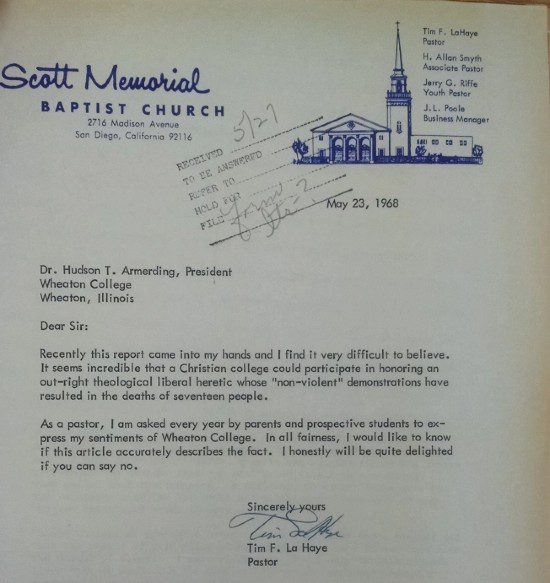
For those who can’t read that image, here is the text of LaHaye’s letter:
Recently this report came into my hands and I find it very difficult to believe. It seems incredible that a Christian college could participate in honoring an out-right theological liberal heretic whose “non-violent” demonstrations have resulted in the deaths of seventeen people.
As a pastor, I am asked every year by parents and prospective students to express my sentiments of Wheaton College. In all fairness, I would like to know if this article accurately describes the fact. I honestly will be quite delighted if you can say no.
Those two paragraphs consist of three parts: 1) The pious performance of sanctimonious dismay and lamentation, which is the standard form for the angriest expressions of white evangelical condemnation; 2) LaHaye’s evaluation of the life, work, and faith of Martin Luther King Jr., who serves here as a representative of the entire Civil Rights Movement, and LaHaye’s implication that this evaluation is and ought to be the mandatory response to MLK/CRM from every legitimate white evangelical; and 3) an explicit threat to punish Wheaton College if it does not repent of memorializing King and quickly get on board with LaHaye’s denunciation of him and of the entire Civil Rights agenda.
It’s an ugly, shameful piece of work.
The “report” LaHaye refers to was likely some newspaper mention of the “community-wide memorial service” held at Wheaton on April 7, 1968, three days after King’s assassination. It might have been the Chicago Tribune article mentioning that service that John Fea posted last year in discussing LaHaye’s letter. This was long before the internet, remember, so it would’ve taken a great deal of time and effort for the network of Citizens Councils concerned white evangelicals to have gotten this report all the way from Chicago to LaHaye’s church in San Diego. They took that time and effort because “this report” was, to them, too alarming to ignore.
It’s perhaps not entirely accurate to describe Tim LaHaye as an “evangelical” back in 1968. At that time he would still probably have preferred the term “fundamentalist,” perhaps even insisting on that distinction as a badge of honor. LaHaye was a Bob Jones University graduate, after all, and one who agreed with Jones’ assessment that “an evangelical is someone says to a liberal, ‘I’ll agree to call you a Christian if you agree to call me a scholar.'” The term “evangelical” was still regarded as a shortening of “Neo-Evangelical” — a category deliberately created by folks like Billy Graham and Carl Henry to carve out a distinction between them and fundamentalists like Bob Jones and Tim LaHaye. LaHaye didn’t disagree with that distinction in 1968, but he resented it.
That’s what makes the pious preamble of his letter so transparently disingenuous. He doesn’t find it “very difficult to believe” at all. Wheaton’s memorial service, in his mind, proved that those squishy intellectual Neo-evangelicals were guilty of just exactly the sort of pseudo-liberal, Christian-in-name-only sins that he’d always accused them of.
That’s what makes LaHaye’s unsubtle threat seem strange. “As a pastor,” he says, “I am asked every year by parents and prospective students to express my sentiments of Wheaton College.” But he knows that Dr. Amerdling already knows what those sentiments are, and that there’s no chance of improving them. Parents and prospective college students at Scott Memorial were already being warned to stay away from dangerously “liberal,” not-really-truly-Christian schools like Wheaton. Those kids were all being sent off to Bob Jones, never to Wheaton, so there was no Scott Memorial-to-Wheaton pipeline for him to threaten to cut off.
The threat here — in terms of “parents and prospective students” — is really that LaHaye might switch from implicit, passive disapproval to explicit, active condemnation, singling out Wheaton as a pariah and punching bag. He could use his influence to create negative connotations of “controversy” and “liberalism” that could shape the perceptions of parents and churches beyond his own Southern California white fundamentalist networks.
Wheaton’s memorial service and LaHaye’s response to it recall a conversation between John Fea and Adam Laats that we discussed here several years ago. Fea, a history professor at a Christian university, sees the faculty and the students of a school as the locus of that institution’s character and identity. Laats, who teaches at a public university but focuses his research on religious schools, sees the administration, trustees, and donors, as the main actors shaping that identity and character. We can see the tension between those two sources of identity in this 1968 example, with Wheaton’s students and faculty responding to the assassination of King by organizing a memorial service to grieve and to honor the slain prophet while Wheaton’s administrators wound up responding, instead, to angry letters like this one from LaHaye.
Laats’ description of the mindset of those administrators helps to illustrate the seriousness of the threat Tim LaHaye was making to Wheaton’s president:
However the boundaries of evangelicalism are defined, whether in 1935, 1963, or 2016, schools need to remain squarely within them. More relevant, they need to be seen by the evangelical public as remaining squarely within those boundaries. If school administrators fail, students and alumni will vote with their wallets, taking their tuition dollars and donations elsewhere. …
Every school has certain poorly defined lines that no one is allowed to cross. Or, to be more precise, it means that the evangelical public needs to feel confident that the school as a whole is not crossing those lines, even if some students and teachers are. Or are rumored to be. …
… In short, to thrive and survive, evangelical colleges need students. To attract students, leaders know their schools must be perceived as safe evangelical environments.
Honoring Martin Luther King Jr., LaHaye said, meant legitimizing the Civil Rights Movement as a whole. And if Wheaton were to suggest that the Civil Rights Movement was legitimate, then he would declare it anathema — outside “the boundaries of evangelicalism” and no longer to “be perceived as a safe evangelical environment.”
Laats mentions wallets and donations. LaHaye’s doesn’t explicitly refer to donors in his letter because he didn’t need to, but this was also a big part of the threat he was making.
The image of LaHaye’s letter above comes from a blog post by historian Jesse Curtis’ in 2017. Curtis lists a series of questions raised by this letter as an artifact from Wheaton’s archives. He asks, for example: “Did the blowback Wheaton received (this was only one of dozens of letters) affect its institutional behavior in subsequent years?”
That’s an interesting question, and I’d be interested in seeing it addressed by someone who’s familiar enough with that “institutional behavior in subsequent years” to answer it. I’m not that someone.
I am, alas, someone who is depressingly well-prepared to address the questions Curtis raises about Tim LaHaye:
What kinds of information did LaHaye rely on to understand the civil rights movement, and where did the “deaths of seventeen people” statistic come from? Was this a right-wing meme? How did it circulate in this pre-internet age? Did LaHaye blame Dr. King for all the violence that occurred at his protests?
Was LaHaye satisfied with the president’s reply? (There is no subsequent letter from LaHaye in the archive.) Did he continue to recommend Wheaton College to his congregation?
Did LaHaye change his views in later decades? As memory of the civil rights movement changed and it became impolitic to have such a negative view of Dr. King, did LaHaye adjust, or did he just become silent?
Did LaHaye ever write anything publicly about the civil rights movement, or about race more generally? …
What does this reveal about the theological and racial climate of white evangelicalism in the late 1960s? Were LaHaye’s attitudes exceptional, or normal?
The answer to the first four questions is that LaHaye was a member of, and an ambassador for, the John Birch Society. Which is why the answer to the next two questions is “No.”
No, he was not satisfied with the president’s reply — whatever that was — because the Bircher’s whole thing was to be perpetually aggrieved and thus never satisfied with any reply, response, or concession. And no, he did not “continue to recommend Wheaton” because he had never done so previously. A few years later he started his own school — Christian Heritage College.
And that right there — “Christian HERITAGE College” — answers Curtis’ next three questions about the non-evolution of LaHaye’s views about the Civil Rights Movement. (While there do exist scattered examples of usage in which the word “heritage” is not a winking euphemism for white hegemony, this is not one of those examples. Again: John. Birch. Society.)
Curtis’ final two questions there seem to require a book-length answer, but let’s focus just on that last one: “Were LaHaye’s attitudes exceptional, or normal?”
Tim LaHaye was asking that same question in 1968. He was fairly confident that his view was normal, and he was absolutely certain that it ought to be normal. But news of that Wheaton memorial service had him worried that some of his fellow white Christians weren’t holding the line. He fired off this letter to exceptionalize what he saw as Wheaton’s dangerous attitude, to ensure that any sympathy toward or respect for the Civil Rights Movement would be buried with that “liberal heretic.”
This is the key point about LaHaye’s letter. It wasn’t a one-off. On May 23, 1968, he wrote this letter aiming to delegitimize the Civil Rights Movement and to make opposition to the Civil Rights Movement a mandatory, necessary stance for all white evangelicals and fundamentalists — a defining boundary of evangelicalism. He went on to write more than 80 books, founded a university, and helped to launch the Moral Majority, Concerned Women for America, the Council for National Policy, the American Coalition for Traditional Values, the Coalition for Religious Freedom. And, of course, he teamed up with Jerry B. Jenkins to give us Left Behind.
All of that could be described as Tim LaHaye’s attempt to ensure that the attitudes he expressed in that 1968 letter would be and remain “normal” for white evangelicalism in the 1960s, ’70s, ’80s, ’90s, 2000s and 2010s. For the next 48 years of his life, right up until his unraptured demise in 2016, Tim LaHaye never stopped writing this letter.
Previous Post

January 24, 2023
Wherein I beg for money
Next Post
January 30, 2023 Slavery and 'the question of how to interpret the Bible'
Recent Comments
"IT wasn't that she was press secretary, it's that having a JD doesn't make you ..."
The purpose-driven labor priest
"Kotsko makes some good points, but still point is, Warren & his movement pulled a ..."
The purpose-driven labor priest
"I love that in Superman and Lois, Lois fell in love with Clark, and has ..."
‘A hermeneutical Pandora’s box’
"And vice versa."
The purpose-driven labor priest
Browse Our Archives
Select a Category class warfare evangelicals Iraq Left Behind Mammon music Uncategorized
Select a Month October 2026 September 2026 August 2026 July 2026 June 2026 May 2026 April 2026 March 2026 January 2026 December 2025 November 2025 October 2025 September 2025 August 2025 July 2025 June 2025 May 2025 April 2025 March 2025 February 2025 January 2025 December 2024 November 2024 October 2024 September 2024 August 2024 July 2024 June 2024 May 2024 April 2024 March 2024 February 2024 January 2024 December 2023 November 2023 October 2023 September 2023 August 2023 July 2023 June 2023 May 2023 April 2023 March 2023 February 2023 January 2023 December 2022 November 2022 October 2022 September 2022 August 2022 July 2022 June 2022 May 2022 April 2022 March 2022 February 2022 January 2022 December 2021 November 2021 October 2021 September 2021 August 2021 July 2021 June 2021 May 2021 April 2021 March 2021 February 2021 January 2021 December 2020 November 2020 October 2020 September 2020 August 2020 July 2020 June 2020 May 2020 April 2020 March 2020 February 2020 January 2020 December 2019 November 2019 October 2019 September 2019 August 2019 July 2019 June 2019 May 2019 April 2019 March 2019 February 2019 January 2019 December 2018 November 2018 October 2018 September 2018 August 2018 July 2018 June 2018 May 2018 April 2018 March 2018 February 2018 January 2018 December 2017 November 2017 October 2017 September 2017 August 2017 July 2017 June 2017 May 2017 April 2017 March 2017 February 2017 January 2017 December 2016 November 2016 October 2016 September 2016 August 2016 July 2016 June 2016 May 2016 April 2016 March 2016 February 2016 January 2016 December 2015 November 2015 October 2015 September 2015 August 2015 July 2015 June 2015 May 2015 April 2015 March 2015 February 2015 January 2015 December 2014 November 2014 October 2014 September 2014 August 2014 July 2014 June 2014 May 2014 April 2014 March 2014 February 2014 January 2014 December 2013 November 2013 October 2013 September 2013 August 2013 July 2013 June 2013 May 2013 April 2013 March 2013 February 2013 January 2013 December 2012 November 2012 October 2012 September 2012 August 2012 July 2012 June 2012 May 2012 April 2012 March 2012 February 2012 January 2012 December 2011 November 2011 October 2011 September 2011 August 2011 July 2011 June 2011 May 2011 April 2011 March 2011 February 2011 January 2011 December 2010 November 2010 October 2010 September 2010 August 2010 July 2010 June 2010 May 2010 April 2010 March 2010 February 2010 January 2010 December 2009 November 2009 October 2009 September 2009 August 2009 July 2009 June 2009 May 2009 April 2009 March 2009 February 2009 January 2009 December 2008 November 2008 October 2008 September 2008 August 2008 July 2008 June 2008 May 2008 April 2008 March 2008 February 2008 January 2008 December 2007 November 2007 October 2007 September 2007 August 2007 July 2007 June 2007 May 2007 April 2007 March 2007 February 2007 January 2007 December 2006 November 2006 October 2006 September 2006 August 2006 July 2006 June 2006 May 2006 April 2006 March 2006 February 2006 January 2006 December 2005 November 2005 October 2005 September 2005 August 2005 July 2005 June 2005 May 2005 April 2005 March 2005 February 2005 January 2005 December 2004 November 2004 October 2004 September 2004 August 2004 July 2004 June 2004 May 2004 April 2004 March 2004 February 2004 January 2004 December 2003 November 2003 October 2003 September 2003
Follow Us!
TAKE THE
Religious Wisdom Quiz
Which king was killed at the Battle of Megiddo?
Select your answer to see how you score.
Josiah Amaziah Asa Jehoash
Related posts from slacktivist

The purpose-driven labor priest

'A hermeneutical Pandora’s box'

No, most white evangelicals are not 'egalitarian'

TRENDING AT PATHEOS Progressive Christian

Nearly every morning, I make the drive to Detroit with my high-school-age...

The Real AI Story Is Adoption Without Trust
Artificial intelligence has crossed a political threshold. It is no longer a...

A new article, written by Jeff Lindsay and Gale L. Pooley,...

Swimfan: Forgotten Aughts Pleasures
This is a recovery effort. In 2002, My Big Fat Greek Wedding...

Top Three Anti-Catholic Lies About Catholicism
This is my initial transcript for the video, "THE 3 WORST...

Pope Leo Celebrates Mass for Nurses & Docs...
I don't have any idea how he did it, but Pope Leo...
view all Progressive Christian blogs
What Are Your Thoughts?leave a comment
Ad-Free & Subscriber Log-In Subscription Support
- About Us
- 2026 Calendar
- Videos
- Podcasts
- Library of World Religions
- Faith In Media Tracker
- Advertise With Us
- Write for Us
- Privacy Policy
- Terms of Service
- Do Not Sell My Data
- Contact Us
- Radiant Digital
- Manage Newsletter Subscriptions
- Unsubscribe From Notifications
- Sitemap
Copyright 2008-2026, Patheos. All rights reserved.
Subscription Support Ad-Free & Subscriber Log-In
Follow Patheos