
BuddhistCatholicContemplativeEvangelicalGeneral ChristianHinduJewishLatter-day SaintMuslimNew VisionsProgressive Christian
Beliefs
- Buddhist
- Catholic
- Contemplative
- Evangelical
- General Christian
- Hindu
- Jewish
- Latter-day Saint
- More Voices
- Muslim
- New Visions
- Pagan
- Progressive Christian
Topics
- Religion News
- Food and Religion
- Sports and Religion
- Religious Art
- Religious Music and Entertainment
- Religious Events
- History and Religion
- Style and Religion
- Politics and Religion
- Women in Religion
- Recreation Outdoors and Religion
- Business Finance and Religion
- Careers Workplace and Religion
- Education and Religion
- Family Parenting and Religion
- Health Fitness and Religion
- Home and Religion
- Relationships and Religion
- Technology and Religion
- Travel and Religion
Columnists
- Buddhist Columnists
- Business Finance and Religion Columnists
- Careers Workplace and Religion Columnists
- Catholic Columnists
- Contemplative Columnists
- Education and Religion Columnists
- Evangelists Columnists
- Family Parenting and Religion Columnists
- General Christian Columnists
- Health Fitness and Religion Columnists
- Hindu Columnists
- History and Religion Columnists
- Home and Religion Columnists
- Jewish Columnists
- More Voices Columnists
- Latter Day Columnists
- Muslim Columnists
- New Visions Columnists
- Nonreligious Columnists
- Pagan Columnists
- Politics and Religion Columnists
- Progressive Columnists
- Recreation Outdoors and Religion Columnists
- Relationships and Religion Columnists
- Religion News Columnists
- Religious Art Columnists
- Religious Events Columnists
- Religious Music and Entertainment Columnists
- Sports and Religion Columnists
- Style and Religion Columnists
- Technology and Religion Columnists
- Travel and Religion Columnists
- Women in Religion Columnists
Resource Library
- 2026 Calendar
- Library of World Religions
- The 100 Most Holy Places on Earth
- Patheos Answers
- Podcasts
- Videos
- Faith Leaders Database
- Anglican Episcopalian
- Bahai
- Baptist
- Buddhism
- Christianity
- Confucianism
- Eastern Orthodoxy
- Hinduism
- Holiness and Pentecostal
- ISKCON
- Islam
- Judaism
- Lutheran
- Methodist
- The Church of Jesus Christ of Latter-day Saints
- New Age
- Paganism
- Presbytarian and Reformed
- Protestantism
- Religion Behind the Scenes
- Roman Catholic
- Scientology
- Shia Islam
- Sikhism
- Sufism
- Sunni Islam
- Taoism
- Zen
- See all religions
Research Tools
 Ad-Free & Subscriber Log-In Subscription Support
Follow Patheos 

- Trending:
- Advent
- |
- Forgiveness
- |
- Thanksgiving
- |
- Election
- |
- Seasonal Holidays
- |
- Marriage

- Home
- Progressive Christian
- Where did these guys come from?
Where did these guys come from?
Last updated on: September 16, 2022 at 5:42 pm by Fred Clark
Where did these guys come from? 2022-09-16T17:42:17-04:00 Fred Clark
Patheos Explore the world's faith through different perspectives on religion and spirituality! Patheos has the views of the prevalent religions and spiritualities of the world.
I’ve never heard a sermon on Ezra 10:15. There should be sermons on this passage. Lots of them. It should be the stuff of altar calls and bonfire dedications reserved for the last night of Bible camp or youth-group retreats.
This should be one of those verses that appears on T-shirts and bumper stickers, inspirational posters and tattoos. It should’ve been one of the verses that Tim Tebow penciled into his eye-black. It should be the senior quote that devout young believers select for their yearbooks and a perennial Top-10 pick for anyone who decides to choose their “life verse.”
Because Ezra 10:15 is just an amazing, inspiring, confounding passage. Here’s what it says: “Only Jonathan son of Asahel and Jahzeiah son of Tikvah, supported by Meshullam and Shabbethai the Levite, opposed this.”
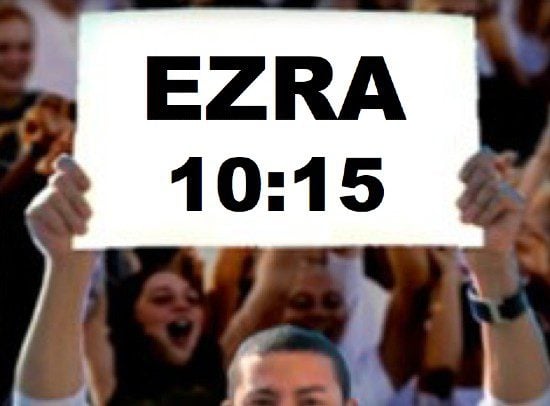
Snipped from context, that doesn’t seem like much. Just a pile of unfamiliar, hard-to-pronounce names.
They shouldn’t be unfamiliar names. These names ought to be every bit as familiar, at least, as Shadrach, Meshach, and Abednego (even if this list lacks the appealing rhythm of that one). Anybody raised in Sunday school and VBS ought to be able to recite these names easily due to the multiple recitations they’d heard of this beloved Bible story, perhaps singing them to the tune of a Bible-class children’s song about “Meshullam and Shabbethai and you and I.”
But most people, even most people raised in church and church culture, don’t know these names.
So who are these guys? And what was it that these four — and “only” these four — people “opposed” that everyone else in this story supported?
Well, this is from the story of Ezra. So this is about Ezra’s grand scheme of ethnic cleansing.
That’s the context here. Ezra is the leader of the Israelites who have returned from exile and are trying to rebuild their city and their culture from the ruins. This isn’t going well and so Ezra and his closest advisers ponder why and they decide it must be because of the women and children. Those women and children are Moabites — dirty foreigners, strangers, aliens. And clearly all the problems with the rebuilding of Jerusalem must be due to the presence of these evil, nasty Moabite women and their half-breed children.
Thousands of Israelite men had compromised themselves by marrying these Moabite women and then producing these tainted, foreign offspring. And so Ezra came up with a plan: Mass divorce. A mass divorce so huge it would take three days to carry out, even when doing these dozens at a time. Then all of these thousands of Moabite ex-wives would be sent away, along with all of their tainted children.
Sent away where? Doesn’t matter. Not our problem. Just away is all that matters. Cast them out like Hagar and Ishmael. And then the newly purified, untainted people will at last be able to succeed in rebuilding the city.
That was the plan and it had the near-unanimous support of every leader among the people:
Ezra rose up and put the leading priests and Levites and all Israel under oath to do what had been suggested. And they took the oath. …
Within the three days, all the men of Judah and Benjamin had gathered in Jerusalem. And on the twentieth day of the ninth month, all the people were sitting in the square before the house of God. … The whole assembly responded with a loud voice: “You are right! We must do as you say.”
Everybody was at the rally (well, every man, anyway). All the leaders, with no dissent, explained the plan. And the whole assembly loudly agreed.
Except for these four: “Only Jonathan son of Asahel and Jahzeiah son of Tikvah, supported by Meshullam and Shabbethai the Levite, opposed this.”
That’s Ezra 10:15, and how that verse ever got included in the rest of this passage is a puzzle. I haven’t researched the scholarship on this so I don’t know what the general consensus is about whether this verse is a later addition or part of the original version of the text.
The case that it was a later addition has a lot to recommend it. Condemnations of Ezra’s horrific scheme, after all, make up a considerable chunk of our scriptures, both in Hebrew (see, for example, the entire book of Ruth*) and in Greek (see the genealogies in the Gospels). Ezra’s plan for ethnic cleansing via mass-divorce and child-abandonment shapes and re-shapes scriptural discussions of divorce in both the “Old” and New Testaments.
So I can imagine some later redactor — someone like the author of Jonah or of Malachi — inserting this (depressingly short) list of opponents here as a way of deflating Ezra a bit or as a reminder that not quite “the whole assembly” was on board with this hideous crime. That’s possible.
But it’s also entirely possible that this list of detractors was original to the author of the surrounding text in Ezra, someone who seems to have thought ethnic cleansing and mass-divorce was a spiffy plan. If that’s the case, then these names must have been included, perversely, for the same reason that other scriptures record the names of people like Korah — the guy the book of Numbers says led a rebellion against Moses and was, consequently, swallowed up by the Earth. It may be, in other words, that the author of Ezra was so caught up in the hysteria of this “You are right! We must do as you say” rally for ethnic cleansing that he wanted to single out Jonathan, Jahzeiah, Meshullam, and Shabbethai as stubborn, rebellious fools who failed to appreciate the clarity and simplicity of righteously exiling and abandoning thousands of one’s own children.
So I can’t say for sure whether this verse is the product of someone intending us to see JJM&S as heroes or as villains. I’m not sure where this verse comes from.
Within the context of the story itself, it’s also difficult to say where these guys come from. We’re told they “opposed” Ezra’s plan, but we’re not told why. The story records the fact of their objection, but none of the reasons for it. All the story has to tell us is that “only” these four “opposed this.”
That’s not possible to believe, of course, even within the story as it is told. These four may have been the only men in the whole assembly who spoke out against this plan, but the “whole assembly” described in the story is only men. None of those thousands of Moabite wives and one-drop-too-Moabite children were a part of that assembly, but it’s impossible to believe that all of those mothers and their children were enthusiastic about Ezra’s plan to cast them all out into the wilderness empty-handed. None of those women was allowed a voice in that assembly, or in the story as told to us by the book of Ezra (which is, again, why we have the book of Ruth). The closest this story comes to allowing us to hear from any of them is the parenthetical mention, and hasty dismissal, of some unexplained “opposition” from four dissenters.
But while the story offers no explanation of or for their dissent, we as readers can’t help but wonder what it was that motivated Jonathan et. al. to speak up against “the whole assembly,” risking a great deal to take a stand on what they must surely have realized was the losing side.
Where did these guys come from? What enabled them to see clearly when the “whole assembly” was blind? What was it about them that enabled them to oppose the horrible crime that the rest of the assembly cheered for and participated in?
That, as I said up top, ought to be the stuff of sermons.
And right about now those sermons seem particularly urgent. These are, one might say, ruthless times.
Jonathan son of Asahel and Jahzeiah son of Tikvah, supported by Meshullam and Shabbethai the Levite may seem like obscure names from Bible trivia, but it would be immensely helpful if more American Christians learned those names between now and November.
– – – – – – – – – – – – –
* And the story of Ruth wherever it echoes up in any discussion of the line of David, which is a lot.
David is, of course, the son of Jesse. But who was Jesse’s wife and David’s mother? The Bible doesn’t say. (The Talmud gives us a name, Nitzevet, but she’s not named anywhere in the canonical stories or genealogies of David.)
David’s grandfather was Obed, but what was his grandmother’s name? Who was Obed’s wife? We don’t know. The Bible doesn’t say. The name of David’s mother and grandmother aren’t important. Heck, the names of his father and grandfather aren’t really that important. What matters in this story is the name of David’s great-grandmother.
The name of David’s great-grandmother is really, really important. That’s why you know it and why you may not even have noticed previously that you didn’t know the names of his mother and grandmother. Ruth is important because “Jonathan son of Asahel and Jahzeiah son of Tikvah, supported by Meshullam and Shabbethai the Levite” were right and Ezra and the whole assembly were wrong and nearly every biblical discussion of the line of David and the lineage of David has been written or rewritten to underscore that point.
Previous Post

September 16, 2022
9/16 Flashback: 0-for-3
Next Post
September 17, 2022 9/17 Flashback: Lazy
Browse Our Archives
Select a Category class warfare evangelicals Iraq Left Behind Mammon music Uncategorized
Select a Month November 2026 October 2026 September 2026 August 2026 July 2026 June 2026 May 2026 April 2026 March 2026 January 2026 December 2025 November 2025 October 2025 September 2025 August 2025 July 2025 June 2025 May 2025 April 2025 March 2025 February 2025 January 2025 December 2024 November 2024 October 2024 September 2024 August 2024 July 2024 June 2024 May 2024 April 2024 March 2024 February 2024 January 2024 December 2023 November 2023 October 2023 September 2023 August 2023 July 2023 June 2023 May 2023 April 2023 March 2023 February 2023 January 2023 December 2022 November 2022 October 2022 September 2022 August 2022 July 2022 June 2022 May 2022 April 2022 March 2022 February 2022 January 2022 December 2021 November 2021 October 2021 September 2021 August 2021 July 2021 June 2021 May 2021 April 2021 March 2021 February 2021 January 2021 December 2020 November 2020 October 2020 September 2020 August 2020 July 2020 June 2020 May 2020 April 2020 March 2020 February 2020 January 2020 December 2019 November 2019 October 2019 September 2019 August 2019 July 2019 June 2019 May 2019 April 2019 March 2019 February 2019 January 2019 December 2018 November 2018 October 2018 September 2018 August 2018 July 2018 June 2018 May 2018 April 2018 March 2018 February 2018 January 2018 December 2017 November 2017 October 2017 September 2017 August 2017 July 2017 June 2017 May 2017 April 2017 March 2017 February 2017 January 2017 December 2016 November 2016 October 2016 September 2016 August 2016 July 2016 June 2016 May 2016 April 2016 March 2016 February 2016 January 2016 December 2015 November 2015 October 2015 September 2015 August 2015 July 2015 June 2015 May 2015 April 2015 March 2015 February 2015 January 2015 December 2014 November 2014 October 2014 September 2014 August 2014 July 2014 June 2014 May 2014 April 2014 March 2014 February 2014 January 2014 December 2013 November 2013 October 2013 September 2013 August 2013 July 2013 June 2013 May 2013 April 2013 March 2013 February 2013 January 2013 December 2012 November 2012 October 2012 September 2012 August 2012 July 2012 June 2012 May 2012 April 2012 March 2012 February 2012 January 2012 December 2011 November 2011 October 2011 September 2011 August 2011 July 2011 June 2011 May 2011 April 2011 March 2011 February 2011 January 2011 December 2010 November 2010 October 2010 September 2010 August 2010 July 2010 June 2010 May 2010 April 2010 March 2010 February 2010 January 2010 December 2009 November 2009 October 2009 September 2009 August 2009 July 2009 June 2009 May 2009 April 2009 March 2009 February 2009 January 2009 December 2008 November 2008 October 2008 September 2008 August 2008 July 2008 June 2008 May 2008 April 2008 March 2008 February 2008 January 2008 December 2007 November 2007 October 2007 September 2007 August 2007 July 2007 June 2007 May 2007 April 2007 March 2007 February 2007 January 2007 December 2006 November 2006 October 2006 September 2006 August 2006 July 2006 June 2006 May 2006 April 2006 March 2006 February 2006 January 2006 December 2005 November 2005 October 2005 September 2005 August 2005 July 2005 June 2005 May 2005 April 2005 March 2005 February 2005 January 2005 December 2004 November 2004 October 2004 September 2004 August 2004 July 2004 June 2004 May 2004 April 2004 March 2004 February 2004 January 2004 December 2003 November 2003 October 2003 September 2003
Follow Us!
TAKE THE
Religious Wisdom Quiz
Who was the major prophet during King Hezekiah's reign in Judah?
Select your answer to see how you score.
Jeremiah Ezekiel Isaiah Daniel
Related posts from slacktivist

Smart people saying smart things (11.24.26)
'Statements of Faith' never get shorter

A rough month for the 'Jim Crow theobros'
TRENDING AT PATHEOS Progressive Christian

Rock N' Roll-- Morphing into/for a New Generation...
Well, should we be grateful, or is rock n' roll just dead? ...

Ansley Gordon Brings Faith and Fresh Stories to...
For screenwriter and actress Ansley Gordon, Christmas has always been about more...

Chris Pratt on Veterans, Faith, “The Way of...
For Chris Pratt, service is not something that ends when a person...

Chapter 5, Sarah: The Quest for Safety in...
Open and Relational Theology & Social Psychology About this series: This series...

When Worry Gets You Nowhere, How Can Faith...
Sometimes, we think that by worrying, we can somehow predict the future....

The Wasp And I: Meditations on Repentance
How can we enter the power and joy of the repentant self...
view all Progressive Christian blogs
Ad-Free & Subscriber Log-In Subscription Support
- About Us
- 2026 Calendar
- Videos
- Podcasts
- Library of World Religions
- Faith In Media Tracker
- Advertise With Us
- Write for Us
- Privacy Policy
- Terms of Service
- Do Not Sell My Data
- Contact Us
- Radiant Digital
- Manage Newsletter Subscriptions
- Unsubscribe From Notifications
- Sitemap
Copyright 2008-2026, Patheos, part of the Radiant Digital network of media brands. All rights reserved.
Subscription Support Ad-Free & Subscriber Log-In
Follow Patheos