
BuddhistCatholicContemplativeEvangelicalGeneral ChristianHinduJewishLatter-day SaintMuslimNew VisionsProgressive Christian
Beliefs
- Buddhist
- Catholic
- Contemplative
- Evangelical
- General Christian
- Hindu
- Jewish
- Latter-day Saint
- More Voices
- Muslim
- New Visions
- Pagan
- Progressive Christian
Topics
- Religion News
- Food and Religion
- Sports and Religion
- Religious Art
- Religious Music and Entertainment
- Religious Events
- History and Religion
- Style and Religion
- Politics and Religion
- Women in Religion
- Recreation Outdoors and Religion
- Business Finance and Religion
- Careers Workplace and Religion
- Education and Religion
- Family Parenting and Religion
- Health Fitness and Religion
- Home and Religion
- Relationships and Religion
- Technology and Religion
- Travel and Religion
Columnists
- Buddhist Columnists
- Business Finance and Religion Columnists
- Careers Workplace and Religion Columnists
- Catholic Columnists
- Contemplative Columnists
- Education and Religion Columnists
- Evangelists Columnists
- Family Parenting and Religion Columnists
- General Christian Columnists
- Health Fitness and Religion Columnists
- Hindu Columnists
- History and Religion Columnists
- Home and Religion Columnists
- Jewish Columnists
- More Voices Columnists
- Latter Day Columnists
- Muslim Columnists
- New Visions Columnists
- Nonreligious Columnists
- Pagan Columnists
- Politics and Religion Columnists
- Progressive Columnists
- Recreation Outdoors and Religion Columnists
- Relationships and Religion Columnists
- Religion News Columnists
- Religious Art Columnists
- Religious Events Columnists
- Religious Music and Entertainment Columnists
- Sports and Religion Columnists
- Style and Religion Columnists
- Technology and Religion Columnists
- Travel and Religion Columnists
- Women in Religion Columnists
Resource Library
- 2026 Calendar
- Library of World Religions
- The 100 Most Holy Places on Earth
- Patheos Answers
- Podcasts
- Videos
- Faith Leaders Database
- Anglican Episcopalian
- Bahai
- Baptist
- Buddhism
- Christianity
- Confucianism
- Eastern Orthodoxy
- Hinduism
- Holiness and Pentecostal
- ISKCON
- Islam
- Judaism
- Lutheran
- Methodist
- The Church of Jesus Christ of Latter-day Saints
- New Age
- Paganism
- Presbytarian and Reformed
- Protestantism
- Religion Behind the Scenes
- Roman Catholic
- Scientology
- Shia Islam
- Sikhism
- Sufism
- Sunni Islam
- Taoism
- Zen
- See all religions
Research Tools
 Ad-Free & Subscriber Log-In Subscription Support
Follow Patheos 

- Trending:
- Advent
- |
- Forgiveness
- |
- Thanksgiving
- |
- Election
- |
- Seasonal Holidays
- |
- Marriage

- Home
- Progressive Christian
- Living together in two separate worlds
Living together in two separate worlds
Last updated on: November 12, 2021 at 2:58 am by Fred Clark
Living together in two separate worlds 2021-11-12T02:58:48-05:00 Fred Clark
Patheos Explore the world's faith through different perspectives on religion and spirituality! Patheos has the views of the prevalent religions and spiritualities of the world.
“What Is ‘Progressive Christianity’?” Roger Olson asks. This is in a post on Patheos’ Evangelical Channel. If you’re at all familiar with the origins of Patheos, or with it’s more recent involvement in boosting and shaping the term “progressive Christianity,” then you’ll understand why that’s hilarious.
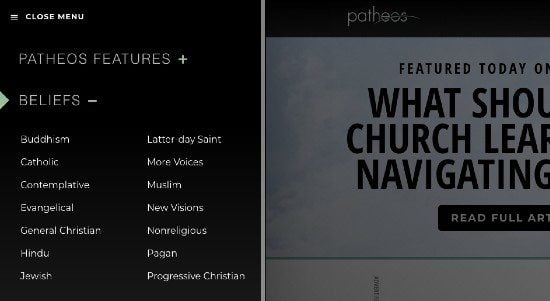
If Roger Olson wants to know what “progressive Christianity” means, he’s two clicks away from the answer on the homepage of his own website.
I offered an initial brief-ish response to Olson’s question in this Twitter thread. The short version is that “progressive Christian” isn’t a theological category, but a political one. It’s a squishy term because it has come to be used to refer to just about every Christian who doesn’t fit in with the polarized partisan identity and politicized culture of white evangelicalism. “Progressive Christianity,” in other words, is a political category because it’s used in contrast with white evangelicalism, and white evangelicalism is a political category, not a theological one.
Patheos adopted the label “Progressive Christian,” replacing the former “Mainline Protestant,” when it moved several blogs — including this one — off of the Evangelical Channel that hosts Roger Olson’s blog. They had to change that name because we were not “Mainline Protestants,” we were evangelicals. But having our voices there on the Evangelical Channel was perceived as off-putting to would-be evangelical readers who would be horrified by our non-Republican politics and our not-Hannity-friendly culture.
So “What Is Progressive Christianity?” according to the website that hosts Roger Olson’s blog? It’s not liberal theology, although it may include that. It’s simply any form of Protestant Christianity that does not expect and require the Republican politics expected and required within white evangelicalism. “Everything else” turns out to be a less-than-precise category, which is why the term “progressive Christian” gets applied not just to “Tree huggin’, love makin’, pro choicin’, gay weddin’, Widespread Panic diggin’ hippies like me” but also to people like Russell Moore and Beth Moore.
George Marsden, contending with the difficulty of defining a perpetually contended category like “evangelical,” once joked that an evangelical is anyone who likes Billy Graham. In the current usage, popularized by the website you’re reading right now, “progressive Christian” refers to anyone who does not like Franklin Graham.
The original idea of Patheos — back before it started adding blogs and columnists and such — was to be an online resource to help people understand and navigate religious pluralism. Say your new coworker is Buddhist, or your new neighbor is Lutheran, and you don’t know what that means. Patheos’ goal was to be a one-stop site where you could be introduced to the beliefs, practices, and customs of these new friends, with the descriptions of each tradition written by people from that tradition.
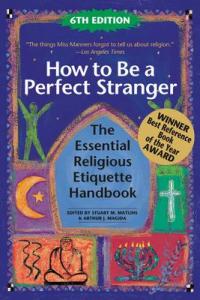 The idea was something like the book How to Be a Perfect Stranger, which is a terrific resource for explaining and demystifying the religious beliefs of your neighbors in a pluralistic society. Perfect Stranger is a kind of etiquette guide for the unfamiliar situations we can all face due to our robust variety of religions. What should you do if you’re invited to a wedding or a funeral in an unfamiliar tradition? What’s the appropriate holiday greeting for your coworkers’ religious occasions?
Both the original version of Patheos and How to Be a Perfect Stranger were lovely expressions of Krister Stendahl’s advice to cultivate “holy envy” — to seek out and to honor that which is admirable in our neighbors. Stendahl, the late Lutheran bishop of Stockholm, presented that advice in 1985 in response to the outcry over the proposed construction of an LDS temple in Sweden. He laid out three “Rules of Religious Understanding”: 1) When trying to understand a religious tradition, talk to people from that tradition, not to their enemies; 2) Don’t compare their worst to your best; and 3) “Leave room for holy envy.”
Stendahl’s rules, like Perfect Stranger and ca. 2002 Patheos, were based on — and contingent upon — two vital assumptions: A) You are not an asshole; and B) You do not want to be an asshole, even inadvertently. These are necessary premises for neighborliness, interfaith justice, legal equality, and religious liberty — which is why all of those things tend to be in short supply.
Stendahl regarded his three rules as an expression of the imperative to “love thy neighbor.” They were meant to help us to love our neighbors, and to be good neighbors, in a world shaped by religious pluralism.
But it’s not so simple for those of us from conversionist religious traditions. Sure, it’s nice to be polite and hospitable, and even to allow a modicum of legal religious liberty for false religions, but there’s nothing nice or polite about allowing those neighbors to burn in Hell for eternity. If we really love them, then we’ll need to confront them with the need to convert and to be saved and spared from eternal punishment. And if they interpret such confrontational concern for their eternal fate as rude or impolite, well, that’s a small price to pay when the stakes are so infinitely high.
When I first encountered How to Be a Perfect Stranger, I was struck by the familiarity of its structure. It reminded me of several books I had read growing up in a white fundamentalist church and private school. Those also presented themselves as guidebooks to religious pluralism, but their intended purpose was very different. Some of those books were written as evangelistic how-to guides: How to evangelize to Jews; how to witness to Catholics; how to present the gospel to Mormons, Jehovah’s Witnesses, Hare Krishnas, Episcopalians, atheists, Muslims, and Buddhists.
And those were the better books. The others presented themselves as “apologetics,” violating Stendahl’s first rule by describing the vast array of world religions in the terms of outsiders and of their enemies and critics. Some of these “apologetics” guidebooks seemed intended to prepare their Christian readers for debate with anyone they encountered from these other traditions. More often, though, the purpose of these “apologetic” guides to religious pluralism seemed to be inoculation. Here is a bestiary of false religions you must shun and condemn. Beware of your neighbors, they will lead you astray.
The authors of those books couldn’t hear what Stendahl was saying or understand what the founders of Patheos and the editors of Perfect Stranger were trying to do. For those authors, the goal of loving our non-Christian (i.e., non-the-right-kind-of-Christian) neighbors seemed indistinct from saying “Live and let live, it’s all the same, nothing is true and nothing is truer than anything else.” To them, interfaith neighborliness — or even simply ecumenical Christianity — was misguided at best and, at worst, an assault on “absolute truth” itself.
The problem is that any alternative to the kind of neighbor-love expressed in Stendahl’s three rules is bound to end up with the hateful suspicion, shunning, and condemnation of those “apologetics”-themed guides to world religion. The neighbor-love of those other evangelical guidebooks — the ones driven by a fiercely urgent need to convert those neighbors in order to spare them from Hell — turns out to be unsustainable. The genuine love of neighbor that compels this white-knuckle evangelism will eventually lead in one of two directions. It will either curdle into resentment and condemnation of the unsaved, or else it will blossom into grace.
Someone who is genuinely driven to evangelize based on a genuine love of neighbor is eventually going to recognize what that means. It means “I love my neighbor, and if one loves another person, then one is compelled to do everything in one’s power to ensure that they do not suffer torment for all of eternity.” And thus either I am claiming that I am capable of loving my neighbor more than God loves them, or else I am guilty of loving my neighbor more than God thinks I should. If I conclude the latter, then I must repent of this love for neighbor and align myself with God’s delight in the prospect of their eternal torment. But if I conclude the former, then I must come to realize that God’s love and mercy must vastly exceed my own, and therefore some of my assumptions about grace and torment and soteriology are in dire need of revision.
That requires some unlearning — or “deconstruction,” as the kids say these days — but it has nothing to do with reading Schliermacher and Bultmann or whatever it is that Olson worries those “progressive Christians” are secretly on about.
This suggests that we might have some theological grounds for distinguishing between the mostly political categories of “evangelical” and “progressive Christian.” A “progressive Christian” is someone that evangelicals believe is outloving God. “Progressive Christianity” holds that it’s impossible to do that.
Previous Post

November 10, 2021
All the hot new trends in biblical baby names
Next Post
November 13, 2021 Jeremiah in Ireland, CRT, and 'Who Wrote the Bible?'
Browse Our Archives
Select a Category class warfare evangelicals Iraq Left Behind Mammon music Uncategorized
Select a Month November 2026 October 2026 September 2026 August 2026 July 2026 June 2026 May 2026 April 2026 March 2026 January 2026 December 2025 November 2025 October 2025 September 2025 August 2025 July 2025 June 2025 May 2025 April 2025 March 2025 February 2025 January 2025 December 2024 November 2024 October 2024 September 2024 August 2024 July 2024 June 2024 May 2024 April 2024 March 2024 February 2024 January 2024 December 2023 November 2023 October 2023 September 2023 August 2023 July 2023 June 2023 May 2023 April 2023 March 2023 February 2023 January 2023 December 2022 November 2022 October 2022 September 2022 August 2022 July 2022 June 2022 May 2022 April 2022 March 2022 February 2022 January 2022 December 2021 November 2021 October 2021 September 2021 August 2021 July 2021 June 2021 May 2021 April 2021 March 2021 February 2021 January 2021 December 2020 November 2020 October 2020 September 2020 August 2020 July 2020 June 2020 May 2020 April 2020 March 2020 February 2020 January 2020 December 2019 November 2019 October 2019 September 2019 August 2019 July 2019 June 2019 May 2019 April 2019 March 2019 February 2019 January 2019 December 2018 November 2018 October 2018 September 2018 August 2018 July 2018 June 2018 May 2018 April 2018 March 2018 February 2018 January 2018 December 2017 November 2017 October 2017 September 2017 August 2017 July 2017 June 2017 May 2017 April 2017 March 2017 February 2017 January 2017 December 2016 November 2016 October 2016 September 2016 August 2016 July 2016 June 2016 May 2016 April 2016 March 2016 February 2016 January 2016 December 2015 November 2015 October 2015 September 2015 August 2015 July 2015 June 2015 May 2015 April 2015 March 2015 February 2015 January 2015 December 2014 November 2014 October 2014 September 2014 August 2014 July 2014 June 2014 May 2014 April 2014 March 2014 February 2014 January 2014 December 2013 November 2013 October 2013 September 2013 August 2013 July 2013 June 2013 May 2013 April 2013 March 2013 February 2013 January 2013 December 2012 November 2012 October 2012 September 2012 August 2012 July 2012 June 2012 May 2012 April 2012 March 2012 February 2012 January 2012 December 2011 November 2011 October 2011 September 2011 August 2011 July 2011 June 2011 May 2011 April 2011 March 2011 February 2011 January 2011 December 2010 November 2010 October 2010 September 2010 August 2010 July 2010 June 2010 May 2010 April 2010 March 2010 February 2010 January 2010 December 2009 November 2009 October 2009 September 2009 August 2009 July 2009 June 2009 May 2009 April 2009 March 2009 February 2009 January 2009 December 2008 November 2008 October 2008 September 2008 August 2008 July 2008 June 2008 May 2008 April 2008 March 2008 February 2008 January 2008 December 2007 November 2007 October 2007 September 2007 August 2007 July 2007 June 2007 May 2007 April 2007 March 2007 February 2007 January 2007 December 2006 November 2006 October 2006 September 2006 August 2006 July 2006 June 2006 May 2006 April 2006 March 2006 February 2006 January 2006 December 2005 November 2005 October 2005 September 2005 August 2005 July 2005 June 2005 May 2005 April 2005 March 2005 February 2005 January 2005 December 2004 November 2004 October 2004 September 2004 August 2004 July 2004 June 2004 May 2004 April 2004 March 2004 February 2004 January 2004 December 2003 November 2003 October 2003 September 2003
Follow Us!
TAKE THE
Religious Wisdom Quiz
Who said, "Silver and gold have I none, but what I have I give to you"?
Select your answer to see how you score.
Paul John James Peter
Related posts from slacktivist

Is this the right room for an argument?

The Amish are not 'Evangelicals.' They're Amish.

The lumpers, the splitters, and me

'Is it right on red or left on...
TRENDING AT PATHEOS Progressive Christian

Happy Thanksgiving! I published this Thanksgiving column back in 2017 in...

More Than a Meal: A Messianic Thanksgiving
A Messianic Thanksgiving What if Thanksgiving became more than a meal to...

The Darkening of the Sun, Moon, and Stars
The darkening of the sun and moon and the falling of stars...

Gratitude as the Parent of All Virtues
Giving thanks stems from gratitude. Cicero said that gratitude is the parent...

Make Thanksgiving Bring Family Closer
Written by Dr. David K. Ewen from Eternal Truth Bible College Start...

Ghosts, Spirits, and Wizards in Post-Puritan New England
As it is Thanksgiving, I have a seasonal post concerned with New...
view all Progressive Christian blogs
Ad-Free & Subscriber Log-In Subscription Support
- About Us
- 2026 Calendar
- Videos
- Podcasts
- Library of World Religions
- Faith In Media Tracker
- Advertise With Us
- Write for Us
- Privacy Policy
- Terms of Service
- Do Not Sell My Data
- Contact Us
- Radiant Digital
- Manage Newsletter Subscriptions
- Unsubscribe From Notifications
- Sitemap
Copyright 2008-2026, Patheos, part of the Radiant Digital network of media brands. All rights reserved.
Subscription Support Ad-Free & Subscriber Log-In
Follow Patheos