
BuddhistCatholicContemplativeEvangelicalGeneral ChristianHinduJewishLatter-day SaintMuslimNew VisionsProgressive Christian
Beliefs
- Buddhist
- Catholic
- Contemplative
- Evangelical
- General Christian
- Hindu
- Jewish
- Latter-day Saint
- More Voices
- Muslim
- New Visions
- Pagan
- Progressive Christian
Topics
- Religion News
- Food and Religion
- Sports and Religion
- Religious Art
- Religious Music and Entertainment
- Religious Events
- History and Religion
- Style and Religion
- Politics and Religion
- Women in Religion
- Recreation Outdoors and Religion
- Business Finance and Religion
- Careers Workplace and Religion
- Education and Religion
- Family Parenting and Religion
- Health Fitness and Religion
- Home and Religion
- Relationships and Religion
- Technology and Religion
- Travel and Religion
Columnists
- Buddhist Columnists
- Business Finance and Religion Columnists
- Careers Workplace and Religion Columnists
- Catholic Columnists
- Contemplative Columnists
- Education and Religion Columnists
- Evangelists Columnists
- Family Parenting and Religion Columnists
- General Christian Columnists
- Health Fitness and Religion Columnists
- Hindu Columnists
- History and Religion Columnists
- Home and Religion Columnists
- Jewish Columnists
- More Voices Columnists
- Latter Day Columnists
- Muslim Columnists
- New Visions Columnists
- Nonreligious Columnists
- Pagan Columnists
- Politics and Religion Columnists
- Progressive Columnists
- Recreation Outdoors and Religion Columnists
- Relationships and Religion Columnists
- Religion News Columnists
- Religious Art Columnists
- Religious Events Columnists
- Religious Music and Entertainment Columnists
- Sports and Religion Columnists
- Style and Religion Columnists
- Technology and Religion Columnists
- Travel and Religion Columnists
- Women in Religion Columnists
Resource Library
- 2026 Calendar
- Library of World Religions
- The 100 Most Holy Places on Earth
- Patheos Answers
- Podcasts
- Videos
- Faith Leaders Database
- Anglican Episcopalian
- Bahai
- Baptist
- Buddhism
- Christianity
- Confucianism
- Eastern Orthodoxy
- Hinduism
- Holiness and Pentecostal
- ISKCON
- Islam
- Judaism
- Lutheran
- Methodist
- The Church of Jesus Christ of Latter-day Saints
- New Age
- Paganism
- Presbytarian and Reformed
- Protestantism
- Religion Behind the Scenes
- Roman Catholic
- Scientology
- Shia Islam
- Sikhism
- Sufism
- Sunni Islam
- Taoism
- Zen
- See all religions
Research Tools
 Ad-Free & Subscriber Log-In Subscription Support
Ad-Free & Subscriber Log-In Subscription Support
Follow Patheos 

- Trending:
- Forgiveness
- |
- Marriage
- |
- Consciousness
- |
- Death Penalty
- |
- Election
- |
- Halloween

- Home
- Progressive Christian
- A cow eating grass
A cow eating grass
Last updated on: March 24, 2021 at 7:49 pm by Fred Clark
A cow eating grass 2021-03-24T19:49:43-04:00 Fred Clark
Patheos Explore the world's faith through different perspectives on religion and spirituality! Patheos has the views of the prevalent religions and spiritualities of the world.
Here’s Daniel K. Williams at the Anxious Bench: “Will Reformed Evangelicalism Divide Over Racial Politics? The 19th-Century Stone-Campbell Movement Offers a Clue.”
On the one hand, this is a terrific example of how studying history can provide insights about the present. Williams’ knowledge of the conflicts within the Stone-Campbell Restorationist stream of American evangelicalism back in the 1850s allows him to recognize some real similarities with the conflicts today within the “young, restless, and Reformed” strand of American evangelicalism. That helps him clarify the internal and external factors that are pushing for and against the unity of this branch of the church.
Williams doesn’t pretend that knowledge of history allows us to simply predict the future, but his discussion illustrates how it can help us better understand and navigate the present and the sort of future our present choices may be creating.
On the other hand, though, this is all whiter than a blank sheet of paper.* And that makes the whole exercise more than a little bit off.
The unspoken, implicit whiteness of both of these stories doesn’t undermine Williams’ historical parallel, it deepens and strengthens it. If presumed whiteness is an unacknowledged blind spot in his essay, it’s also the unacknowledged blind spot in the conflicts he describes among both groups. It’s the factor that makes the parallel particularly apt. Sure, a bunch of 19th-century Arminians not seem to have much in common with a bunch of Very Online 21st-century Calvinists, but those differences seem trivial — mere noisy gongs and clanging cymbals — once we recognize the overriding similarity of two white groups of white Christians seeking to preserve the whiteness of their white doctrines.
Here’s Williams on the similarities between the two groups:
Both movements were strongly biblicist, both favored rational and logical appeals over emotional displays, and both promised a textual and theological pathway to the restoration of the original Christian message. … But perhaps most significantly, Stone-Campbell Restorationism paralleled the “young, restless, and Reformed” movement in its view of the church’s relationship to politics; although interested in social and political reform causes, many members of the movement believed that the restoration of the New Testament church offered a pathway to social reform that was superior to what any political party could advocate. The only problem was that the members of the movement could not agree on what that pathway should be. Nowhere was this more evident than on the issue of slavery.
This is a pillar of white Christianity, what later white Southern Presbyterians called “the spirituality of the church.” It’s the idea that yestbutofcourse “social reform” is all very well and good, but it must come about through the church and through religious conversion and not through anything as secular and worldly as politics. White Christianity is thus a-political — except for all the ways in which it never is and never can be.
 In the 19th century, as Williams discusses, this meant that abolitionism was regarded as inappropriate meddling in politics, while maintaining the status quo of slavery or advocating a flaccid, theoretical gradualism was not. In the 20th century, white Christians regarded the struggle for integration as a violation of the bold line prohibiting church involvement in “politics,” while the defense and practice of segregation was not.** And in the 21st century, as Williams notes, this dispute among white Christians about what does and does not constitute “politics” involves Black Lives Matter and other contemporary white disagreements over the legitimacy of the Reconstruction Amendments and the legal equality of Black Americans. Inequality is always a-political and spiritual while every closer approximation of equality is “racial politics” (controversial, divisive, and un-spiritual).
The white Christians of the white Stone-Campbell Restorationist movement could not agree on what their white doctrines required of them regarding “the issue of slavery.” The white Christians of the white “young, restless, and Reformed” movement cannot agree on what their white doctrines require of them regarding slavery either. And in both cases, this disagreement — this confusion and lack of clarity — is a product of whiteness.
What should the white church’s “pathway to social reform” be with regard to “the issue of slavery”? White Christians couldn’t say because it never occurred to those white Christians to ask Black Christians for guidance. Because all of this talk about the glories of “Christian unity” has never extended to include non-white Christians or non-white Christianities. And all this talk about the horrors of “division” and “disfellowship” has never applied to the non-white Christians just down the road.
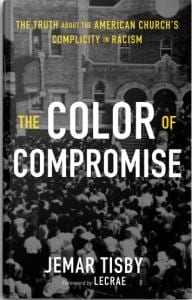
I happened to read Williams’ post just after listening to this podcast: “PTM: Leave LOUD- Jemar Tisby’s Story.” Tisby was, for several years, a rising star in that “young, restless, and Reformed” movement (one with a better claim to “young” than most of its leaders). And then he wasn’t.
What happened? That is, in part, the story of the subtle ways that whiteness works to exclude non-whiteness, the ways that whiteness gets enshrined into doctrines allowing the enforcement of whiteness to be exercised as a “spiritual” discipline of maintaining doctrinal orthodoxy.
But it’s also in part a not-at-all subtle story of explicit white power and unadulterated white-nationalist, Neo-Confederate racism indistinguishable from any of those 19th-century arguments among white groups of white Christians. Which is to say, it’s in part the story of how a movement that makes space for Doug Wilson cannot also be a movement that makes space for Jemar Tisby. Give it a listen. (It’s compelling, lively, sometimes heart-breaking/enraging and sometimes funny — and unlike many podcasts, it doesn’t include any awkward segues into trying to sell you a new mattress or to use Stamps.com.)
Having Tisby’s voice still echoing in my head let me see what’s missing in Williams’ discussion. It’s the same thing I addressed a while back as “The Hole in Noll“:
[Noll provides] an immensely helpful, perceptive and illuminating discussion of the way antebellum American Christians were wrestling with what the Bible had to say about slavery. I think it should be required reading for anyone trying to understand American Christianity. It captures the essential dynamic — the fact that how American Christians read the Bible shaped how they responded to slavery and that how American Christians responded to slavery shaped how they read the Bible. The influence of slavery remains just as true today as it was in the early 19th century.
But, also, not.
Because actually that’s an immensely helpful, perceptive and illuminating discussion of the way antebellum white American Christians were wrestling with what the Bible had to say about slavery. I think it should be required reading for anyone trying to understand white American Christianity. It captures the essential white dynamic — the fact that how white American Christians read the Bible shaped how they responded to slavery and that how white American Christians responded to slavery shaped how they read the Bible.
What about Black Christians — lay people and theologians? There were millions of Black Christians in America during the first half of the 19th century — where do they fit in Noll’s scheme?
They don’t.
Noll acknowledges this, almost parenthetically, in The Civil War as Theological Crisis. After laying out all these various views among the disputatious [white] Christians, he briefly turns to consider the voices and arguments made by Black Christians at the time. That discussion is brief partly because it provides no contentious debate that needs summarizing. Among Black Christians, there were no credible voices arguing the proslavery side.
But the important thing there is not the unanimity of Black Christians in their opposition to slavery. The important thing there — what should be, for all Christians, everywhere, the most astonishingly important thing — is that America’s Black Christians were right.
We can say this. Definitively. Without qualification.
When it comes to the single largest question in American history — the single largest theological question and hermeneutic question that has ever faced the church in North America — white Christians were squabbling and divided. White Christians were wavering and uncertain and all over the map. White Christians, for the most part, got it wrong.
Black Christians, almost without exception, got it right.
I’m less interested in whether any given group of white Christians will be able to maintain a tenuous white Christian white unity than I am in whether those white Christians might someday start wanting to get right what they have, up until now, always gotten wrong.
* The title of this post comes from a dumb joke from grade school. Kid holds up a blank piece of paper and says it’s a picture of a cow eating grass.
“Where’s the grass?”
“The cow ate it all.”
“Well, where’s the cow?”
“It went to look for more grass.”
And that’s kind of the level of sheer whiteness we’re talking about here.
** Hence the standard narrative of white evangelicalism which describes a retreat from “politics” post-Scopes Trial before an eventual re-engagement with politics in the late ’70s. So all those white evangelicals shouting in the background of all those pictures of Ruby Bridges or the Little Rock Nine? Totally a-political. That’s the “spirituality of the church.”
Previous Post

March 20, 2021
Born at the same time
Next Post
March 26, 2021 Smart people saying smart things (3.26.21)
Browse Our Archives
Select a Category class warfare evangelicals Iraq Left Behind Mammon music Uncategorized
Select a Month October 2026 September 2026 August 2026 July 2026 June 2026 May 2026 April 2026 March 2026 January 2026 December 2025 November 2025 October 2025 September 2025 August 2025 July 2025 June 2025 May 2025 April 2025 March 2025 February 2025 January 2025 December 2024 November 2024 October 2024 September 2024 August 2024 July 2024 June 2024 May 2024 April 2024 March 2024 February 2024 January 2024 December 2023 November 2023 October 2023 September 2023 August 2023 July 2023 June 2023 May 2023 April 2023 March 2023 February 2023 January 2023 December 2022 November 2022 October 2022 September 2022 August 2022 July 2022 June 2022 May 2022 April 2022 March 2022 February 2022 January 2022 December 2021 November 2021 October 2021 September 2021 August 2021 July 2021 June 2021 May 2021 April 2021 March 2021 February 2021 January 2021 December 2020 November 2020 October 2020 September 2020 August 2020 July 2020 June 2020 May 2020 April 2020 March 2020 February 2020 January 2020 December 2019 November 2019 October 2019 September 2019 August 2019 July 2019 June 2019 May 2019 April 2019 March 2019 February 2019 January 2019 December 2018 November 2018 October 2018 September 2018 August 2018 July 2018 June 2018 May 2018 April 2018 March 2018 February 2018 January 2018 December 2017 November 2017 October 2017 September 2017 August 2017 July 2017 June 2017 May 2017 April 2017 March 2017 February 2017 January 2017 December 2016 November 2016 October 2016 September 2016 August 2016 July 2016 June 2016 May 2016 April 2016 March 2016 February 2016 January 2016 December 2015 November 2015 October 2015 September 2015 August 2015 July 2015 June 2015 May 2015 April 2015 March 2015 February 2015 January 2015 December 2014 November 2014 October 2014 September 2014 August 2014 July 2014 June 2014 May 2014 April 2014 March 2014 February 2014 January 2014 December 2013 November 2013 October 2013 September 2013 August 2013 July 2013 June 2013 May 2013 April 2013 March 2013 February 2013 January 2013 December 2012 November 2012 October 2012 September 2012 August 2012 July 2012 June 2012 May 2012 April 2012 March 2012 February 2012 January 2012 December 2011 November 2011 October 2011 September 2011 August 2011 July 2011 June 2011 May 2011 April 2011 March 2011 February 2011 January 2011 December 2010 November 2010 October 2010 September 2010 August 2010 July 2010 June 2010 May 2010 April 2010 March 2010 February 2010 January 2010 December 2009 November 2009 October 2009 September 2009 August 2009 July 2009 June 2009 May 2009 April 2009 March 2009 February 2009 January 2009 December 2008 November 2008 October 2008 September 2008 August 2008 July 2008 June 2008 May 2008 April 2008 March 2008 February 2008 January 2008 December 2007 November 2007 October 2007 September 2007 August 2007 July 2007 June 2007 May 2007 April 2007 March 2007 February 2007 January 2007 December 2006 November 2006 October 2006 September 2006 August 2006 July 2006 June 2006 May 2006 April 2006 March 2006 February 2006 January 2006 December 2005 November 2005 October 2005 September 2005 August 2005 July 2005 June 2005 May 2005 April 2005 March 2005 February 2005 January 2005 December 2004 November 2004 October 2004 September 2004 August 2004 July 2004 June 2004 May 2004 April 2004 March 2004 February 2004 January 2004 December 2003 November 2003 October 2003 September 2003
Follow Us!
TAKE THE
Religious Wisdom Quiz
What food did Jesus say He is, symbolically?
Select your answer to see how you score.
Bread of Life Salt of the Earth Honey from the Rock Fruit of the Vine
Related posts from slacktivist

Is this the right room for an argument?

The Amish are not 'Evangelicals.' They're Amish.

The lumpers, the splitters, and me

'Is it right on red or left on...
TRENDING AT PATHEOS Progressive Christian

The First Eucharistic Controversy: Christ’s Real Presence
For Catholics, the Eucharist is the source and summit of the Christian...

How to Make a Decision When You Can't...
Main point: It’s much more valuable to stay close to God so...

Archdiocese Hosts Military Marriage Retreat in Germany
RASTATT, Germany — The transient military lifestyle, with its frequent deployments and...

Nearly every morning, I make the drive to Detroit with my high-school-age...

The Real AI Story Is Adoption Without Trust
Artificial intelligence has crossed a political threshold. It is no longer a...

A new article, written by Jeff Lindsay and Gale L. Pooley,...
view all Progressive Christian blogs
Ad-Free & Subscriber Log-In Subscription Support
- About Us
- 2026 Calendar
- Videos
- Podcasts
- Library of World Religions
- Faith In Media Tracker
- Advertise With Us
- Write for Us
- Privacy Policy
- Terms of Service
- Do Not Sell My Data
- Contact Us
- Radiant Digital
- Manage Newsletter Subscriptions
- Unsubscribe From Notifications
- Sitemap
Copyright 2008-2026, Patheos. All rights reserved.
Subscription Support Ad-Free & Subscriber Log-In
Follow Patheos