
BuddhistCatholicContemplativeEvangelicalGeneral ChristianHinduJewishLatter-day SaintMuslimNew VisionsProgressive Christian
Beliefs
- Buddhist
- Catholic
- Contemplative
- Evangelical
- General Christian
- Hindu
- Jewish
- Latter-day Saint
- More Voices
- Muslim
- New Visions
- Pagan
- Progressive Christian
Topics
- Religion News
- Food and Religion
- Sports and Religion
- Religious Art
- Religious Music and Entertainment
- Religious Events
- History and Religion
- Style and Religion
- Politics and Religion
- Women in Religion
- Recreation Outdoors and Religion
- Business Finance and Religion
- Careers Workplace and Religion
- Education and Religion
- Family Parenting and Religion
- Health Fitness and Religion
- Home and Religion
- Relationships and Religion
- Technology and Religion
- Travel and Religion
Columnists
- Buddhist Columnists
- Business Finance and Religion Columnists
- Careers Workplace and Religion Columnists
- Catholic Columnists
- Contemplative Columnists
- Education and Religion Columnists
- Evangelists Columnists
- Family Parenting and Religion Columnists
- General Christian Columnists
- Health Fitness and Religion Columnists
- Hindu Columnists
- History and Religion Columnists
- Home and Religion Columnists
- Jewish Columnists
- More Voices Columnists
- Latter Day Columnists
- Muslim Columnists
- New Visions Columnists
- Nonreligious Columnists
- Pagan Columnists
- Politics and Religion Columnists
- Progressive Columnists
- Recreation Outdoors and Religion Columnists
- Relationships and Religion Columnists
- Religion News Columnists
- Religious Art Columnists
- Religious Events Columnists
- Religious Music and Entertainment Columnists
- Sports and Religion Columnists
- Style and Religion Columnists
- Technology and Religion Columnists
- Travel and Religion Columnists
- Women in Religion Columnists
Resource Library
- 2026 Calendar
- Library of World Religions
- The 100 Most Holy Places on Earth
- Patheos Answers
- Podcasts
- Videos
- Faith Leaders Database
- Anglican Episcopalian
- Bahai
- Baptist
- Buddhism
- Christianity
- Confucianism
- Eastern Orthodoxy
- Hinduism
- Holiness and Pentecostal
- ISKCON
- Islam
- Judaism
- Lutheran
- Methodist
- The Church of Jesus Christ of Latter-day Saints
- New Age
- Paganism
- Presbytarian and Reformed
- Protestantism
- Religion Behind the Scenes
- Roman Catholic
- Scientology
- Shia Islam
- Sikhism
- Sufism
- Sunni Islam
- Taoism
- Zen
- See all religions
Research Tools
 Ad-Free & Subscriber Log-In Subscription Support
Ad-Free & Subscriber Log-In Subscription Support
Follow Patheos 

- Trending:
- Forgiveness
- |
- Marriage
- |
- Consciousness
- |
- Death Penalty
- |
- Election
- |
- Halloween

- Home
- Progressive Christian
- ‘A Call for Unity’
‘A Call for Unity’
Last updated on: November 18, 2020 at 8:39 pm by Fred Clark
‘A Call for Unity’ 2020-11-18T20:39:05-05:00 Fred Clark
Patheos Explore the world's faith through different perspectives on religion and spirituality! Patheos has the views of the prevalent religions and spiritualities of the world.
Religion reporter Emma Green sits down with Georgia white evangelical mega-church pastor Andy Stanley for a post-election interview in The Atlantic: “The Evangelical Reckoning Begins.”
Green and Stanley both work hard to set the stage by explaining that Stanley isn’t one of those white evangelicals — not a die-hard, Fox-addled Trump worshipper.
Andy Stanley’s evangelical megachurch was empty on Election Night, with only a few cars in the Disney World–style parking lot out front. North Point Community Church and its nine satellites in the Atlanta area have been mostly closed since the coronavirus pandemic began in March. When Stanley decided to cancel in-person worship until at least early 2021, dozens of families were so unhappy that they decided to quit his church. “Never once did I hear, ‘We’re upset because we miss coming to church,’” he told me, leaning back in a heather-gray wingback chair. The vibe of his church offices is tasteful and inoffensive, as if his decorator was trying to channel that magic Fixer Upper quality of looking distinctive while appealing to almost everyone. “What I heard was, ‘We’re upset because you bought into a political agenda. We’re upset because you believe the Democrats’ narrative.’”
Stanley has spent his career in ministry deliberately avoiding this kind of politicization in his church. The 62-year-old pastor is a child of the religious right: His father, Charles Stanley, is a televangelist and former president of the Southern Baptist Convention who wrote the devotional that President George W. Bush used to read each morning. “I grew up in a family that was very, very right-leaning,” Stanley said. “I saw the hypocrisy there.” He yearned to reach people beyond the conservative Christian world, to make the story of the resurrection irresistible to the unchurched. So he rejected his culture-war inheritance and struck out on his own, and now the son has arguably surpassed the father: Andy Stanley leads a congregation of more than 37,000 adults and children each Sunday, second in size in the U.S. only to Joel Osteen’s Houston empire, according to some estimates. He’s written roughly two dozen books, mostly Jesus-y self-help, including one that came out in October called Better Decisions, Fewer Regrets. North Point has a network of about 90 churches around the world, and young Christian leaders flock to the church for guidance on how to expand their influence. Sam Collier, a Black pastor and friend of Stanley’s who is about to open Atlanta’s first branch of Hillsong, the Australian mega-ministry network, told me North Point is like “the Christian Gap.”
That observation — “the Christian Gap” — seems to be intended as a compliment, comparing Stanley’s church to the inoffensive, generic mass-appeal of the clothing chain. This is due, Green and Stanley both tell us, to Stanley’s determination to avoid being “political.”
That’s the strange thing about this strange interview in which Stanley constantly insists that he is not political. That’s what he tells us. What he shows us, however, is that Andy Stanley is a thoroughly, pervasively political man who just doesn’t understand that that’s what he is.
But while Stanley and similar giants inside the evangelical world have largely stayed out of politics during the Trump years, other evangelicals have been busy telling the outside world that their faith is completely aligned with Trumpism. This has created a dilemma: Stanley and his allies are now saddled with an image of evangelicalism they don’t want and didn’t create. Before they can reach anyone with a message of faith over politics, they’ll have to contend with the political baggage their fellow Christian leaders created.
In the Gospels, Jesus calls on his followers to go out, teach his message, and baptize people. Stanley has organized his life around this imperative, called “the Great Commission.” The question for evangelicals, now, is whether the undeniable association between Trump and their version of Christianity will make that work harder. “Has this group of people who have somehow become ‘evangelical leaders’” aligned with Trump “hurt the Church’s ability to reach people outside the Church? Absolutely,” Stanley said. But he’s not overly worried: A year or two from now, he said, “all that goes away.” New leaders will rise up. The Trump era of evangelical history will fade. Stanley chuckled. “And this will just be, for a lot of people, a bad dream.”
The invocation of the Great Commission there is weirdly hollow. It includes three things — “go out, teach his message, and baptize people” — but there’s no indication of what the middle one means. What is “Jesus’ message” that we’re greatly commissioned to go out and teach? That’s an even bigger “Christian Gap.” Apparently the message we’re meant to go out and teach is to convince others to go out and teach it too. I sometimes call this contentless form of the Great Commission “Amway without the soap” because it’s like the ultimate, purest form of multi-level marketing — one in which the need for any actual product is dispensed with entirely.
When we finally get around to Stanley’s scrupulously implicit politics, it doesn’t sound like anything informed by any identifiable aspect of Jesus’ “message.” It just sounds like what you’d expect from a well-off white guy in suburban Georgia:
Stanley …wouldn’t say who he voted for in the past two elections, but he volunteered that he’s a conservative guy with conservative values. His wife, Sandra, watches The Five on Fox News, and their family flips back and forth between the various cable networks. He’s never met the president, but after he told a friend that his foster daughter is a die-hard Trump fan, he received a personalized video from Trump telling her to do her homework. North Point’s original campus in Alpharetta largely leans Republican, he said. He understands Trump’s appeal. …
And then there’s this:
“If you’re asking me, ‘Did Donald Trump inflame, or make worse, or stir up racial tension?’ — I don’t know the answer to that,” he said. “I don’t know that I would place that on the shoulders of Donald Trump.” Many Black Christians have expressed pain over Trump’s racism. But Stanley wants to tread carefully: “I’m always hesitant to assign or accept simple, broad-brush explanations for anything. Especially events I have no personal involvement in or firsthand knowledge of.” He firmly supports the sentiment “Black lives matter,” but like a number of other prominent pastors, he says he’s uncomfortable with the organization behind the slogan. In a time of such intense political anger, putting faith before politics seems to involve grasping uncertainly at the line between speaking prophetically and making everybody mad.
Stanley wants to endorse the “sentiment” of the Civil Rights Movement without endorsing its aims. He’s not the first to make such an attempt. Hence the title of this post: “A Call to Unity.”
That was the title chosen by eight white religious leaders from Birmingham, Alabama, for their open letter scolding Martin Luther King Jr. as an outside agitator and asking him to leave. One of them was the pastor of that city’s most prominent Southern Baptist church, a man named Earl Stallings.
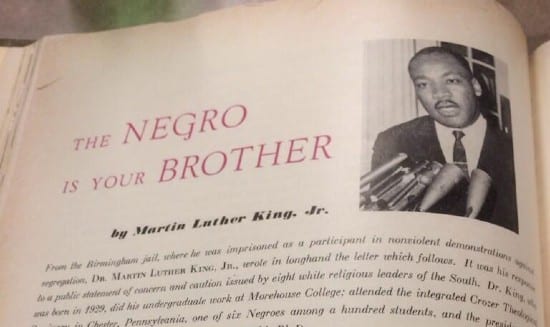
The Atlantic published King’s Letter From a Birmingham Jail in August, 1963, retitling it “The Negro Is Your Brother.” They could just as easily have retitled it “The Evangelical Reckoning Begins.”
Andy Stanley reminds me a lot of Earl Stallings. Stallings fretted about Bull Connor the same way that Stanley frets about Donald Trump. He wanted to make sure people understood that he did not approve of that sort of thing. Not that he actually condemned it, mind you, but that he did not approve of it at all. Like Stanley, Stallings lived “in a time of intense political anger” and so his attempts to “put faith before politics” involved “grasping uncertainly at the line between speaking prophetically and making everybody mad.”
Alas for Stallings, he failed at both speaking prophetically and not making everybody mad. He decided as a gesture of support for the “sentiment” of the Civil Rights Movement to allow Black Baptists to attend an Easter service at his church. That earned him a canonical note of thanks from King himself, who wrote: “I commend you, Reverend Stallings, for your Christian stand on this past Sunday, in welcoming Negroes to your worship service on a nonsegregated basis.” But it also freaked out much of his all-white congregation, leading to his departure from the church just a few years later and then to the church’s eventual split.
More to the point, Stallings was mentioned by name in King’s Letter From a Birmingham Jail because he was one of the “Dear Fellow Clergymen” to whom that letter was addressed. Stallings was specifically and personally one of the “white moderates” King roasts in that letter:
I have almost reached the regrettable conclusion that the Negro’s great stumbling block in his stride toward freedom is not the White Citizen’s Counciler or the Ku Klux Klanner, but the white moderate, who is more devoted to “order” than to justice; who prefers a negative peace which is the absence of tension to a positive peace which is the presence of justice; who constantly says: “I agree with you in the goal you seek, but I cannot agree with your methods of direct action”; who paternalistically believes he can set the timetable for another man’s freedom; who lives by a mythical concept of time and who constantly advises the Negro to wait for a “more convenient season.” Shallow understanding from people of good will is more frustrating than absolute misunderstanding from people of ill will. Lukewarm acceptance is much more bewildering than outright rejection.
I had hoped that the white moderate would understand that law and order exist for the purpose of establishing justice and that when they fail in this purpose they become the dangerously structured dams that block the flow of social progress. I had hoped that the white moderate would understand that the present tension in the South is a necessary phase of the transition from an obnoxious negative peace, in which the Negro passively accepted his unjust plight, to a substantive and positive peace, in which all men will respect the dignity and worth of human personality. Actually, we who engage in nonviolent direct action are not the creators of tension. We merely bring to the surface the hidden tension that is already alive. We bring it out in the open, where it can be seen and dealt with. Like a boil that can never be cured so long as it is covered up but must be opened with all its ugliness to the natural medicines of air and light, injustice must be exposed, with all the tension its exposure creates, to the light of human conscience and the air of national opinion before it can be cured.
That’s the context of King’s “commendation” of Stallings for his “lukewarm acceptance.” A context made more fierce by the entirety of the paragraph in which that sentence appears:
Perhaps I was too optimistic; perhaps I expected too much. I suppose I should have realized that few members of the oppressor race can understand the deep groans and passionate yearnings of the oppressed race, and still fewer have the vision to see that injustice must be rooted out by strong, persistent and determined action. I am thankful, however, that some of our white brothers in the South have grasped the meaning of this social revolution and committed themselves to it. They are still all too few in quantity, but they are big in quality. Some — such as Ralph McGill, Lillian Smith, Harry Golden, James McBride Dabbs, Ann Braden and Sarah Patton Boyle — have written about our struggle in eloquent and prophetic terms. Others have marched with us down nameless streets of the South. They have languished in filthy, roach infested jails, suffering the abuse and brutality of policemen who view them as “dirty nigger-lovers.” Unlike so many of their moderate brothers and sisters, they have recognized the urgency of the moment and sensed the need for powerful “action” antidotes to combat the disease of segregation. Let me take note of my other major disappointment. I have been so greatly disappointed with the white church and its leadership. Of course, there are some notable exceptions. I am not unmindful of the fact that each of you has taken some significant stands on this issue. I commend you, Reverend Stallings, for your Christian stand on this past Sunday, in welcoming Negroes to your worship service on a nonsegregated basis. I commend the Catholic leaders of this state for integrating Spring Hill College several years ago.
On behalf of justice, King says, some white Christians “have languished in filthy, roach infested jails, suffering the abuse and brutality of policemen.” But he adds that he is “not unmindful,” too, of the fact that after years of struggle, the Rev. Stallings also stepped up to allow Black Christians inside of his church building on Easter Sunday. The contrast is deliberate and unflattering.
One more nugget from Emma Green’s profile of white moderate Andy Stanley:
The secular world may believe “evangelicals” are nothing more than people who love Trump. Stanley happily uses the term Jesus follower instead. People within the Church, especially those who are Black or part of other minority groups, may be grieved over the way their brothers and sisters embraced Trumpism. Stanley has faith that they’ll stay in the fold. “This isn’t going to have long-term adverse effects on the Church, I’ll say that,” he told me.
Stanley is confident that the negative peace will soon be restored. Don’t worry, he says, reassuringly, in the long-term, nothing will ever change.
Previous Post

November 13, 2020
In the pines, in the pines
Next Post
November 20, 2020 If you don't know who the mark is ...
Browse Our Archives
Select a Category class warfare evangelicals Iraq Left Behind Mammon music Uncategorized
Select a Month October 2026 September 2026 August 2026 July 2026 June 2026 May 2026 April 2026 March 2026 January 2026 December 2025 November 2025 October 2025 September 2025 August 2025 July 2025 June 2025 May 2025 April 2025 March 2025 February 2025 January 2025 December 2024 November 2024 October 2024 September 2024 August 2024 July 2024 June 2024 May 2024 April 2024 March 2024 February 2024 January 2024 December 2023 November 2023 October 2023 September 2023 August 2023 July 2023 June 2023 May 2023 April 2023 March 2023 February 2023 January 2023 December 2022 November 2022 October 2022 September 2022 August 2022 July 2022 June 2022 May 2022 April 2022 March 2022 February 2022 January 2022 December 2021 November 2021 October 2021 September 2021 August 2021 July 2021 June 2021 May 2021 April 2021 March 2021 February 2021 January 2021 December 2020 November 2020 October 2020 September 2020 August 2020 July 2020 June 2020 May 2020 April 2020 March 2020 February 2020 January 2020 December 2019 November 2019 October 2019 September 2019 August 2019 July 2019 June 2019 May 2019 April 2019 March 2019 February 2019 January 2019 December 2018 November 2018 October 2018 September 2018 August 2018 July 2018 June 2018 May 2018 April 2018 March 2018 February 2018 January 2018 December 2017 November 2017 October 2017 September 2017 August 2017 July 2017 June 2017 May 2017 April 2017 March 2017 February 2017 January 2017 December 2016 November 2016 October 2016 September 2016 August 2016 July 2016 June 2016 May 2016 April 2016 March 2016 February 2016 January 2016 December 2015 November 2015 October 2015 September 2015 August 2015 July 2015 June 2015 May 2015 April 2015 March 2015 February 2015 January 2015 December 2014 November 2014 October 2014 September 2014 August 2014 July 2014 June 2014 May 2014 April 2014 March 2014 February 2014 January 2014 December 2013 November 2013 October 2013 September 2013 August 2013 July 2013 June 2013 May 2013 April 2013 March 2013 February 2013 January 2013 December 2012 November 2012 October 2012 September 2012 August 2012 July 2012 June 2012 May 2012 April 2012 March 2012 February 2012 January 2012 December 2011 November 2011 October 2011 September 2011 August 2011 July 2011 June 2011 May 2011 April 2011 March 2011 February 2011 January 2011 December 2010 November 2010 October 2010 September 2010 August 2010 July 2010 June 2010 May 2010 April 2010 March 2010 February 2010 January 2010 December 2009 November 2009 October 2009 September 2009 August 2009 July 2009 June 2009 May 2009 April 2009 March 2009 February 2009 January 2009 December 2008 November 2008 October 2008 September 2008 August 2008 July 2008 June 2008 May 2008 April 2008 March 2008 February 2008 January 2008 December 2007 November 2007 October 2007 September 2007 August 2007 July 2007 June 2007 May 2007 April 2007 March 2007 February 2007 January 2007 December 2006 November 2006 October 2006 September 2006 August 2006 July 2006 June 2006 May 2006 April 2006 March 2006 February 2006 January 2006 December 2005 November 2005 October 2005 September 2005 August 2005 July 2005 June 2005 May 2005 April 2005 March 2005 February 2005 January 2005 December 2004 November 2004 October 2004 September 2004 August 2004 July 2004 June 2004 May 2004 April 2004 March 2004 February 2004 January 2004 December 2003 November 2003 October 2003 September 2003
Follow Us!
TAKE THE
Religious Wisdom Quiz
What does "Ebenezer" mean in Hebrew?
Select your answer to see how you score.
Gift from God House of the Lord Stone of Help City of Refuge
Related posts from slacktivist

Is this the right room for an argument?

The Amish are not 'Evangelicals.' They're Amish.

The lumpers, the splitters, and me

'Is it right on red or left on...
TRENDING AT PATHEOS Progressive Christian

The Iron Gates and the Lion of the...
Yesterday, I didn't finish my report about, well, yesterday. So I'll...

Dolly Parton’s Last Song Wins Dove Award with...
Bluegrass band The Grascals, speaking on the red carpet at the 57th...

The Image: On the Horror of Capitalism and...
The Image Then went the Pharisees, and took counsel how they might...

We are approaching the date of our new American national holiday: October...

Letters on Living the Faith by C.S. Lewis
Most of us met C.S. Lewis as a public intellectual. Mere Christianity....

When Halloween Unmasks Married Hearts
Written by Dr. David K. Ewen from Eternal Truth Bible College Behind...
view all Progressive Christian blogs
Ad-Free & Subscriber Log-In Subscription Support
- About Us
- 2026 Calendar
- Videos
- Podcasts
- Library of World Religions
- Faith In Media Tracker
- Advertise With Us
- Write for Us
- Privacy Policy
- Terms of Service
- Do Not Sell My Data
- Contact Us
- Radiant Digital
- Manage Newsletter Subscriptions
- Unsubscribe From Notifications
- Sitemap
Copyright 2008-2026, Patheos. All rights reserved.
Subscription Support Ad-Free & Subscriber Log-In
Follow Patheos