
BuddhistCatholicContemplativeEvangelicalGeneral ChristianHinduJewishLatter-day SaintMuslimNew VisionsProgressive Christian
Beliefs
- Buddhist
- Catholic
- Contemplative
- Evangelical
- General Christian
- Hindu
- Jewish
- Latter-day Saint
- More Voices
- Muslim
- New Visions
- Pagan
- Progressive Christian
Topics
- Religion News
- Food and Religion
- Sports and Religion
- Religious Art
- Religious Music and Entertainment
- Religious Events
- History and Religion
- Style and Religion
- Politics and Religion
- Women in Religion
- Recreation Outdoors and Religion
- Business Finance and Religion
- Careers Workplace and Religion
- Education and Religion
- Family Parenting and Religion
- Health Fitness and Religion
- Home and Religion
- Relationships and Religion
- Technology and Religion
- Travel and Religion
Columnists
- Buddhist Columnists
- Business Finance and Religion Columnists
- Careers Workplace and Religion Columnists
- Catholic Columnists
- Contemplative Columnists
- Education and Religion Columnists
- Evangelists Columnists
- Family Parenting and Religion Columnists
- General Christian Columnists
- Health Fitness and Religion Columnists
- Hindu Columnists
- History and Religion Columnists
- Home and Religion Columnists
- Jewish Columnists
- More Voices Columnists
- Latter Day Columnists
- Muslim Columnists
- New Visions Columnists
- Nonreligious Columnists
- Pagan Columnists
- Politics and Religion Columnists
- Progressive Columnists
- Recreation Outdoors and Religion Columnists
- Relationships and Religion Columnists
- Religion News Columnists
- Religious Art Columnists
- Religious Events Columnists
- Religious Music and Entertainment Columnists
- Sports and Religion Columnists
- Style and Religion Columnists
- Technology and Religion Columnists
- Travel and Religion Columnists
- Women in Religion Columnists
Resource Library
- 2026 Calendar
- Library of World Religions
- The 100 Most Holy Places on Earth
- Patheos Answers
- Podcasts
- Videos
- Faith Leaders Database
- Anglican Episcopalian
- Bahai
- Baptist
- Buddhism
- Christianity
- Confucianism
- Eastern Orthodoxy
- Hinduism
- Holiness and Pentecostal
- ISKCON
- Islam
- Judaism
- Lutheran
- Methodist
- The Church of Jesus Christ of Latter-day Saints
- New Age
- Paganism
- Presbytarian and Reformed
- Protestantism
- Religion Behind the Scenes
- Roman Catholic
- Scientology
- Shia Islam
- Sikhism
- Sufism
- Sunni Islam
- Taoism
- Zen
- See all religions
Research Tools
 Ad-Free & Subscriber Log-In Subscription Support
Ad-Free & Subscriber Log-In Subscription Support
Follow Patheos 

- Trending:
- Forgiveness
- |
- Marriage
- |
- Consciousness
- |
- Death Penalty
- |
- Election
- |
- Halloween

- Home
- Progressive Christian
- ‘Mrs. Whiling’s Faith Cure’
‘Mrs. Whiling’s Faith Cure’
Last updated on: December 8, 2019 at 5:47 pm by Fred Clark
‘Mrs. Whiling’s Faith Cure’ 2019-12-08T17:47:01-05:00 Fred Clark
Patheos Explore the world's faith through different perspectives on religion and spirituality! Patheos has the views of the prevalent religions and spiritualities of the world.
“By 1891, Elizabeth grew disillusioned with faith healing, because she viewed it as hooey. She consequently wrote a book attacking it in 1891, called Mrs. Whilling’s Faith Cure.”
That tantalizing tidbit comes from a New England Historical Society article about a traditional Maine delicacy I’d never heard of before: “The Needham, a Potato Candy Sacred and Peculiar to Maine.” It seems there’s enough chocolate, coconut, and powdered sugar in a needham that one hardly notices the room-temperature mashed potatoes that make up the bulk of Maine’s official “state treat.”
I’ll have to try one of those the next time I find myself up Down East. It sounds like Maine’s potato-infused version of a regional delicacy around here, the “Irish potato,” which, as Wikipedia says “is a traditional Philadelphia confection that, despite its name, is not from Ireland, and does not usually contain any potato.” Those delightful chewy gobs of coconut and cinnamon appear on Wawa counters every March and we always end up buying a box of Oh Ryan’s each year because that is just something one does around here. (I like them better than “salt water taffy” — another obligatory traditional regional candy that one somehow always ends up with a box of after anybody goes down the shore.)
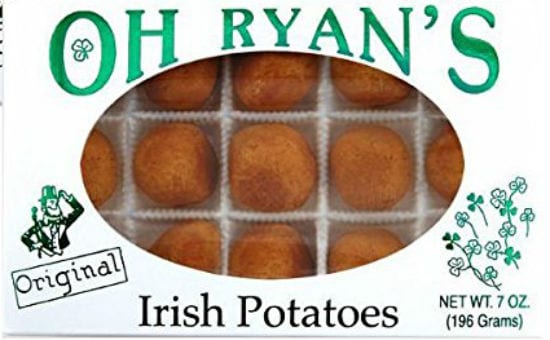
I was surprised by the word “usually” in that Wikipedia entry — “does not usually contain any potato.” It seems some people make a variation of these that sounds like a smaller, round cinnamon needham. OK, then.
The strangest thing about needhams isn’t the mashed potato. It’s the name. The NE Historical Society explains:
In 1986, Maine writer John Gould described the needham as ‘sacred and peculiar’ to Maine. He told the commonly accepted story of how the candy originated sometime around 1872.
A candymaker, Mr. Seavey, introduced a new item when one of his cooks brought forth a chocolate-covered coconut cream with a secret ingredient — potato. He passed it about to see what Mr. Seavey, and others, thought of it. Significantly, the new candy had a square shape.
Mr. Seavey and others immediately approved the candy, but they didn’t know what to call it. Mr. Seavey said, “Let’s call ’em needhams, after the popular preacher,” according to Gould.
And so the candy became the needham, for a century a native Maine delicacy except for a few areas where it crossed the line into New Hampshire.
The popular preacher was George C. Needham, an Irish-born Protestant evangelist who became a follower of Dwight L. Moody and was briefly a popular tent-meeting and rescue-mission revivalist. Needham may have been “popular” in New England in 1872, but he’s since fallen into obscurity. He apparently wrote more than a dozen hymns, but I’d never heard of any of those either. He wrote a handful of books — including a hagiography of Charles H. Spurgeon, a couple of “humorous” collections of stories about the “Street Arabs and gutter snipes” (yeesh) he encountered in rescue missions, and a few early (1870s) “Bible prophecy” books detailing his belief that biblical arcana about the tabernacle proved that the Second Coming of Jesus was imminent.
After coming up nearly empty on a Google search to learn more about Needham, I turned to my physical library. I have an embarrassing number of books about 19th-century revivalism and evangelicalism but can’t find any mention of Needham in any of them. He seems, today, to be remembered only as the arbitrary namesake of that Maine confection.
So almost all I can tell you about “the popular preacher” comes from two sources. One is an August 1901 announcement of his revival meetings in the long-defunct weekly Cambridge Tribune:
George C. Needham was born In the south of Ireland, In the region near the lake of Killarney. He is one of four brothers, all of whom have distinguished themselves in evangelistic work. Rev. Thomas Needham is known as the “sailor preacher.” Rev. William E. Needham is styled the “artist preacher,” because he gives blackboard illustrations of his sermons, and Rev. Benjamin C. Needham is called the “farmer preacher” from the fact that he both farms and preaches. Rev. George C. Needham has made his home in Philadelphia for a good many years. During the summer months he carries on a tent work in that city. The tent in which Mr. Needham holds his revival meetings is a large one, having a seating capacity of nearly 800. … Mr Needham is assisted in his evangelistic work by his wife. They have been extensive travelers in the cause of religion. … Mr. Needham assisted the late Rev. Mr. Moody in his work of evangelization for a good many years. He is now associated with Rev. William Moody, the son of the great evangelist.
The other source is from six months later — Needham’s 1902 obituary in The New York Times. That obituary recounts an anecdote that Needham likely told in his tent-meeting revivals. Emily Burnham of the Bangor Daily News summarizes the story with an appropriate dose of skepticism:
In his obituary in The New York Times in February 1902 — among the only sources of information on the man, aside from his voluminous writings on spiritual matters — it states that he was born in Ireland in 1846. His obituary claims that when he was 10 years old he was put on a ship bound for South America, and was tortured by the captain and tattooed against his will during the long journey. Eventually Needham was taken ashore in Patagonia, where he claimed he was taken captive by “cannibal Indians” who were going to “make a feast of him,” but they stopped when they saw his tattoos.
(Given that there is absolutely no historical record of the Tehuelche people of Patagonia and Tierra del Fuego ever practicing cannibalism in any form, this seems a particularly dubious and, unsurprisingly, racist claim.)
Needham was not the first evangelistic preacher to rely on dubious and racist anecdotes in his revivals. And he’s far from the last.
I’m frustrated that I was unable to learn more about George C. Needham because he seems like a fascinating transitional case-study in American white evangelicalism. His “Bible-prophecy” occultism predates the explosion of premillennial dispensationalist folklore that followed the publication of the Scofield Bible. And he was apparently working the “faith-healing” racket a full generation before the birth of Pentecostalism in the early 20th-century. I’m curious as to how Needham stitched together all of that — his proto-Rapture folklore, his 19th-century faith healing, his Spurgeonism and Moodyism. He seems like he may have been both an outdated relic and ahead of his time.
Needham apparently dropped the faith-healing stuff eventually, thanks to his wife, Elizabeth, who — as we saw way up at the top of this post — became convinced it was “hooey” and thus “wrote a book attacking it in 1891, called Mrs. Whilling’s Faith Cure.”
Googling to learn more about Elizabeth Needham can be tricky due to a far more (in)famous person with that same name, but I was able to find a nice online edition of Mrs. Whilling’s Faith Cure courtesy of the Ohio State Library.
It is, alas, quite awful. It’s a didactic tract more than a novel, and Mrs. Needham’s style of prose has not aged well. A taste:
Dr. Luther Large was a commanding character. His pleasing face arrested even a stranger’s attention. But his eyes were its chief feature. They were small, but of purest quality. As the opal gem under certain light emits fire, and at other angles of vision rays of mellow softness, so with those changing eyes. They flashed out one glance of sarcastic merriment on poor little Ruth Gentlee, and she wilted like a young June leaf under a sharp northeast wind. With lowered head, without another word, she turned and walked down the church aisle. The pastor’s eyes followed her, having instantly changed to their expression of yearning, fatherly tenderness.
All the names are like that: Large, Gentlee, Whilling, Sharpe, Noble, Middleman.* None of these are characters as much as spokespeople for varying points of view who all state their case, are corrected, and then admit the error of their thinking as each, in turn, bows before the superior biblical teaching of the opal-eyed Dr. Large.
If you’re wondering what the plot is, there isn’t much of one. Mrs. Whilling invites Dr. Large to conduct a series of weekly Bible studies addressing the craze for faith healing and the book provides a transcript of these meetings. The result is chapters that consist entirely of a late 19th-century white evangelical exegesis of James 5:14.
One gets the sense that Mrs. Needham felt that, as a woman, she lacked the spiritual authority to write a book of biblical interpretation, so instead she wrote a “novel” starring a male protagonist who could serve as her surrogate mouthpiece. I applaud the ingenuity of that, even if the execution turned out to be thuddingly dull.
Mrs. Whilling’s Faith Cure has been out of print for more than a century and deserves to stay that way. It’s not worth reviving in its original state.
But I think it could be rewritten and salvaged. We just need to kill off Dr. Large. He should be found dead in his locked study — the fire extinguished from his opal eyes — sometime just before the third meeting of his weekly Bible study. The various two-dimensional straw-man proponents of faith healing would thus be transformed into suspects to be interviewed — first separately, and then, ultimately, all at once in Mrs. Whilling’s spacious parlor — by (surprise twist!) amateur alienist Emma Reynolds Moody.
Not only would that be far more engaging and entertaining, but transforming this clumsily pedantic “novel” into a cozy whodunit would also allow us to explore motives behind the faith-healing hooey other than the only motive Mrs. Needham seems to recognize: insufficiently rigorous biblical exegesis.
Anyway, here is a recipe for Irish potato candy and here is a recipe for needhams.
– – – – – – – – – – – – –
* “Dr. Middleman” is the one character I wished we’d seen more of. Needham’s description of him is one of the very few places her book shows the kind of wit I was hoping for:
“He is a physician who practices medicine, but has sympathy with faith healing. His house is a kind of refuge for the professional healers when they get sick. They put themselves under his care till well.”
Previous Post

December 6, 2019
LBCF, No. 256: 'Menacing flowers'
Next Post
December 11, 2019 North Dakota conservatives seek to deny refuge to those in need
Browse Our Archives
Select a Category class warfare evangelicals Iraq Left Behind Mammon music Uncategorized
Select a Month October 2026 September 2026 August 2026 July 2026 June 2026 May 2026 April 2026 March 2026 January 2026 December 2025 November 2025 October 2025 September 2025 August 2025 July 2025 June 2025 May 2025 April 2025 March 2025 February 2025 January 2025 December 2024 November 2024 October 2024 September 2024 August 2024 July 2024 June 2024 May 2024 April 2024 March 2024 February 2024 January 2024 December 2023 November 2023 October 2023 September 2023 August 2023 July 2023 June 2023 May 2023 April 2023 March 2023 February 2023 January 2023 December 2022 November 2022 October 2022 September 2022 August 2022 July 2022 June 2022 May 2022 April 2022 March 2022 February 2022 January 2022 December 2021 November 2021 October 2021 September 2021 August 2021 July 2021 June 2021 May 2021 April 2021 March 2021 February 2021 January 2021 December 2020 November 2020 October 2020 September 2020 August 2020 July 2020 June 2020 May 2020 April 2020 March 2020 February 2020 January 2020 December 2019 November 2019 October 2019 September 2019 August 2019 July 2019 June 2019 May 2019 April 2019 March 2019 February 2019 January 2019 December 2018 November 2018 October 2018 September 2018 August 2018 July 2018 June 2018 May 2018 April 2018 March 2018 February 2018 January 2018 December 2017 November 2017 October 2017 September 2017 August 2017 July 2017 June 2017 May 2017 April 2017 March 2017 February 2017 January 2017 December 2016 November 2016 October 2016 September 2016 August 2016 July 2016 June 2016 May 2016 April 2016 March 2016 February 2016 January 2016 December 2015 November 2015 October 2015 September 2015 August 2015 July 2015 June 2015 May 2015 April 2015 March 2015 February 2015 January 2015 December 2014 November 2014 October 2014 September 2014 August 2014 July 2014 June 2014 May 2014 April 2014 March 2014 February 2014 January 2014 December 2013 November 2013 October 2013 September 2013 August 2013 July 2013 June 2013 May 2013 April 2013 March 2013 February 2013 January 2013 December 2012 November 2012 October 2012 September 2012 August 2012 July 2012 June 2012 May 2012 April 2012 March 2012 February 2012 January 2012 December 2011 November 2011 October 2011 September 2011 August 2011 July 2011 June 2011 May 2011 April 2011 March 2011 February 2011 January 2011 December 2010 November 2010 October 2010 September 2010 August 2010 July 2010 June 2010 May 2010 April 2010 March 2010 February 2010 January 2010 December 2009 November 2009 October 2009 September 2009 August 2009 July 2009 June 2009 May 2009 April 2009 March 2009 February 2009 January 2009 December 2008 November 2008 October 2008 September 2008 August 2008 July 2008 June 2008 May 2008 April 2008 March 2008 February 2008 January 2008 December 2007 November 2007 October 2007 September 2007 August 2007 July 2007 June 2007 May 2007 April 2007 March 2007 February 2007 January 2007 December 2006 November 2006 October 2006 September 2006 August 2006 July 2006 June 2006 May 2006 April 2006 March 2006 February 2006 January 2006 December 2005 November 2005 October 2005 September 2005 August 2005 July 2005 June 2005 May 2005 April 2005 March 2005 February 2005 January 2005 December 2004 November 2004 October 2004 September 2004 August 2004 July 2004 June 2004 May 2004 April 2004 March 2004 February 2004 January 2004 December 2003 November 2003 October 2003 September 2003
Follow Us!
TAKE THE
Religious Wisdom Quiz
Which Psalm contains "The Lord is my shepherd; I shall not want"?
Select your answer to see how you score.
Psalm 1 Psalm 119 Psalm 23 Psalm 51
Related posts from slacktivist

Is this the right room for an argument?

The Amish are not 'Evangelicals.' They're Amish.

The lumpers, the splitters, and me

'Is it right on red or left on...
TRENDING AT PATHEOS Progressive Christian

When Halloween Unmasks Married Hearts
Written by Dr. David K. Ewen from Eternal Truth Bible College Behind...

Aristotle. He’s been called the father of logic, the father of the...

Methodist Central Hall and Westminster Abbey
Situated on the same square is Methodist Central Hall and Westminster Abbey. ...

57th Dove Awards Honor Dolly Parton, Crown New...
On gospel music’s biggest night, the 57th annual GMA Dove Awards honored...

The First Eucharistic Controversy: Christ’s Real Presence
For Catholics, the Eucharist is the source and summit of the Christian...

What a Stop Sign Can Teach Us About...
How to Make a Decision When You Can't Hear God Main point:...
view all Progressive Christian blogs
Ad-Free & Subscriber Log-In Subscription Support
- About Us
- 2026 Calendar
- Videos
- Podcasts
- Library of World Religions
- Faith In Media Tracker
- Advertise With Us
- Write for Us
- Privacy Policy
- Terms of Service
- Do Not Sell My Data
- Contact Us
- Radiant Digital
- Manage Newsletter Subscriptions
- Unsubscribe From Notifications
- Sitemap
Copyright 2008-2026, Patheos. All rights reserved.
Subscription Support Ad-Free & Subscriber Log-In
Follow Patheos