
BuddhistCatholicContemplativeEvangelicalGeneral ChristianHinduJewishLatter-day SaintMuslimNew VisionsProgressive Christian
Beliefs
- Buddhist
- Catholic
- Contemplative
- Evangelical
- General Christian
- Hindu
- Jewish
- Latter-day Saint
- More Voices
- Muslim
- New Visions
- Pagan
- Progressive Christian
Topics
- Religion News
- Food and Religion
- Sports and Religion
- Religious Art
- Religious Music and Entertainment
- Religious Events
- History and Religion
- Style and Religion
- Politics and Religion
- Women in Religion
- Recreation Outdoors and Religion
- Business Finance and Religion
- Careers Workplace and Religion
- Education and Religion
- Family Parenting and Religion
- Health Fitness and Religion
- Home and Religion
- Relationships and Religion
- Technology and Religion
- Travel and Religion
Columnists
- Buddhist Columnists
- Business Finance and Religion Columnists
- Careers Workplace and Religion Columnists
- Catholic Columnists
- Contemplative Columnists
- Education and Religion Columnists
- Evangelists Columnists
- Family Parenting and Religion Columnists
- General Christian Columnists
- Health Fitness and Religion Columnists
- Hindu Columnists
- History and Religion Columnists
- Home and Religion Columnists
- Jewish Columnists
- More Voices Columnists
- Latter Day Columnists
- Muslim Columnists
- New Visions Columnists
- Nonreligious Columnists
- Pagan Columnists
- Politics and Religion Columnists
- Progressive Columnists
- Recreation Outdoors and Religion Columnists
- Relationships and Religion Columnists
- Religion News Columnists
- Religious Art Columnists
- Religious Events Columnists
- Religious Music and Entertainment Columnists
- Sports and Religion Columnists
- Style and Religion Columnists
- Technology and Religion Columnists
- Travel and Religion Columnists
- Women in Religion Columnists
Resource Library
- 2026 Calendar
- Library of World Religions
- The 100 Most Holy Places on Earth
- Patheos Answers
- Podcasts
- Videos
- Faith Leaders Database
- Anglican Episcopalian
- Bahai
- Baptist
- Buddhism
- Christianity
- Confucianism
- Eastern Orthodoxy
- Hinduism
- Holiness and Pentecostal
- ISKCON
- Islam
- Judaism
- Lutheran
- Methodist
- The Church of Jesus Christ of Latter-day Saints
- New Age
- Paganism
- Presbytarian and Reformed
- Protestantism
- Religion Behind the Scenes
- Roman Catholic
- Scientology
- Shia Islam
- Sikhism
- Sufism
- Sunni Islam
- Taoism
- Zen
- See all religions
Research Tools
 Ad-Free & Subscriber Log-In Subscription Support
Ad-Free & Subscriber Log-In Subscription Support
Follow Patheos 

- Trending:
- Forgiveness
- |
- Marriage
- |
- Consciousness
- |
- Death Penalty
- |
- Election
- |
- Halloween

- Home
- Progressive Christian
- But sometimes I hit London
But sometimes I hit London
Last updated on: November 12, 2019 at 7:55 pm by Fred Clark
But sometimes I hit London 2019-11-12T19:55:13-05:00 Fred Clark
Patheos Explore the world's faith through different perspectives on religion and spirituality! Patheos has the views of the prevalent religions and spiritualities of the world.
Erik Loomis visited the American grave of Wernher von Braun, thereby sending me down a Google hole.
Here’s the bit that prompted the searching:
After Sputnik, von Braun became a lot more important to the military. Now it was all about space. He might not have his slave laborers anymore, but he was once again catered to, getting most of what he demanded. He moved over to NASA in 1960 and stayed for the next decade. He was very cautious in his experiments, more so than the Soviets, and was blamed by the American military for delays that got a Soviet manned flight into space before the Americans. But von Braun was the lead developer for the famed Saturn rocket, which is what took Apollo 11 to the moon in 1969. He was the most important person behind the creation and development of the U.S. Space and Rocket Center in Huntsville. Throughout this whole period, he embraced one great form of American hypocrisy — he converted to evangelical Christianity while also sleeping with every woman he could find, including many of the women who worked for him.
Wernher von Braun “converted to evangelical Christianity”? How is it that I never heard about this before?
You have to understand that evangelicals love to celebrate famous people who are part of our gang. As a rule, we do not miss the chance to brag about any remotely prominent person whose born-again status allows us to piggy-back on their prominence and cultural influence. It’s almost unheard of for any noteworthy person who might plausibly be claimed as one of us to go unclaimed as such.
It’s kind of like the way my late great friend Dwight Ozard used to interject “Canadian!” before I could even finish any sentence mentioning someone from his home country.
“I just watched all three Back to the–”
“He’s Canadian!”
“Jane, you ignorant–”
“He’s Canadian!”
“I can’t believe a billion people watch Bayw–”
“She’s Canadian!”
The evangelical instinct to claim its celebrities is even more ferocious than that. I grew up about 30 miles from the Meadowlands, but most people at my white evangelical church and private Christian school weren’t Giants or Jets fans. They were Cowboys fans, because Roger Staubach and Tom Landry were evangelicals. (Somewhere I still have a copy of the Spire Christian comic book “Tom Landry and the Dallas Cowboys.”) We’d watch games all but chanting “One of us, one of us” like the extras in Freaks.
So it’s kind of remarkable that I don’t ever remember hearing someone as famous and historically significant as Wernher von Braun celebrated or praised as gabba gabba one of us.
I like to think that this was a matter of discretion — that despite von Braun’s vital role in the space program, his Time magazine covers, and his popular Disney specials — evangelicals still chose not to celebrate his conversion or to trumpet his membership in our tribe because he was also, you know, a big honkin’ Nazi.

Former Nazi, as NASA and Disney always hastened to point out. Former reluctant Nazi, they said, pointing to the very little and very doubtful evidence that his participation in the Nazi war machine was reluctant. (“OK, yes, there’s that one picture of him in his SS uniform, next to Himmler, but only that one picture” is an actual argument made with the intent of defending von Braun.)
Maybe even a religious subculture desperate for vicarious fame and respectability was hesitant to hitch its wagon to the man who designed the V-2 rocket for Hitler, thereby facilitating the murder of thousands of Allied civilians as well as the deaths of some 12,000 concentration camp prisoners forced to work as enslaved labor on the project. Maybe the purported conversion of the real-life inspiration for Dr. Strangelove should be viewed with a bit more cautious skepticism. This was, after all, a man whose entire life story was marked by an eagerness to radically shift his allegiance whenever expedient.
So even though we evangelicals love nothing more than a personal testimony with a redemption arc from the depths of sin, maybe it seemed a bit too much when those depths of sin involved years of being an SS officer using slave labor to build “vengeance weapons” for Hitler.
Except that’s not how this works. As a rule, the more depraved the sinner, the greater the triumph of that person’s conversion and redemption. “Repentant former SS officer begins a new life in Christ” would have made for a very compelling testimony and witness. The model for this kind of story, after all, is John Newton — the captain of a slave ship before the “Amazing Grace” of his repentance and conversion.* So Wernher von Braun’s conversion testimony should have been not just welcome, but immensely popular.
 For a while, I think it was. Back at the beginning of the space race, when von Braun was at the height of his fame as an all-American rocket man, he was featured in a cover story for Guideposts magazine.** (This was in 1960, before white evangelicals came to view Guideposts as too squishy to count as truly evangelical.) I doubt von Braun is the only former Nazi to ever have his story of faith and inspiration featured on the cover of that magazine, but he’s probably the least remorseful former Nazi to be featured there.
And that’s what makes Wernher von Braun’s “personal testimony” so tepid and unconvincing. There’s no element of repentance or remorse. Whatever von Braun meant by his conversion, it didn’t involve “I once was lost but now am found / was blind but now I see.” He always insisted, instead, that he was never genuinely lost, or truly blind — that he was somehow never really a Nazi — but that he was just playing along because he had no choice or because he only ever cared about building his rockets.
One gets the sense, rather, that von Braun eventually became a Christian for the same reason and in the same way that he became an American. “My country has lost two world wars,” he said, “This time I want to be on the winning side.”
So maybe the reason I never heard about the famous Christian Wernher von Braun was that most evangelicals weren’t entirely convinced by his conversion story. Maybe that’s why I never wound up with a Spire Christian comic with his name on the cover.
But thanks to going down that Google hole, I’ve learned that von Braun is enjoying a 21st-century revival among one strain of American white evangelicalism: Creationists love the guy.
Answers in Genesis includes a glowing profile of von Braun for its “Profiles of Creation Scientists” series. It rehashes all of the revisionist dismissals Operation Paperclip originally pushed to cover for the amnesty granted to von Braun and other Nazi scientists deemed to be useful to America’s Cold War interests. AiG’s celebration of von Braun’s Christian faith is as gushing as it is fraudulent:
He had full confidence in the truth of the Bible, describing it as ‘the revelation of God’s nature and love’. He acknowledged his dependence on God in prayer, not only in times of crisis such as during his escape from Nazi Germany, but also in his work—such as praying for the safety of the manned space flights.
Here’s another creationist site that offers a gushing, “inspirational” retelling of von Braun’s conversion. David Coppedge’s long hagiography of the former SS officer appends a few pop-essays written by von Braun himself, extolling a kind of generic, civil religious faith.
Coppedge also appends the text of a 1972 letter von Braun wrote to the California State Board of Education arguing for teaching something like intelligent-design creationism in public schools. That letter is the primary reason von Braun is such a hero to creationists today.***
The letter from von Braun doesn’t really read like the kind of culture-warrior creationist nonsense promoted by outfits like Answers in Genesis. It reads more like the kind of porridge produced by contemporary writers shooting for some of the sweet Templeton money that funds so many similarly gooey essays on “Science and Religion” nowadays.
It reads less like something written by a convert to evangelical Christianity than it does like something written by a pragmatic nominal Lutheran whose main concern regarding his Nazi past is how it will affect his reputation and respectability.
Overall, then, I’m not wholly convinced that von Braun really converted to evangelical Christianity as much as that he was a thoroughly unprincipled pragmatist who found himself living in Texas and Alabama. Kind of the same way I feel about Robert Jeffress.
– – – – – – – – – – – – – – –
* This folklore about Newton’s conversion and his writing of “Amazing Grace” is not true. And it’s not true in a rather important way.
Newton wasn’t the captain of a slave ship when he experienced his born-again conversion to evangelical Christianity. He was, at that time, only the first mate on a slave ship. He only became a captain years later, spending nearly another decade as both a slaver — a kidnapper, torturer, trafficker, thief and murderer — and an evangelical Christian.
Then he got married, left the sea, worked as a customs agent, eventually became an Anglican clergyman, later wrote “Amazing Grace, and then, many years later, became an outspoken abolitionist.
A timeline:
1748: Newton begins his career in the slave trade, has a conversion experience during a fierce storm at sea.
1748-1754: Devout Christian Newton works in the slave trade, advancing to become captain of his own slave ship.
1754: Devout Christian Newton gives up sailing for work as a customs officer/tax collector, continues investing in the slave trade.
1764: Newton is ordained an Anglican priest.
1772: Newton writes the words to “Amazing Grace.”
1788: At the age of 63 — 40 years after he became a born-again Christian and 16 years after writing his most famous hymn — Newton becomes an abolitionist.
The actual history of Newton’s four-decade long conversion is far more interesting, instructive, and inspirational than the folklore of his supposed instantaneous conversion during a storm at sea.
** If some enterprising American religious studies professor decided to research and analyze everyone who has ever appeared on the cover of Guideposts and what this tells us about American Christianity and civil religion, then I, for one, would be very eager to read that paper.
*** For Coppedge specifically, this affection is also personal — Coppedge worked on the Cassini project for NASA’s Jet Propulsion Laboratory and has since made his living promoting himself as someone unjustly fired for his Christian faith. He views Wernher von Braun as a kindred spirit — as a rocket engineer who regards faith and science as inextricably linked and who believes that legitimate science requires “belief in the certainty of a Creator.”
I think his search for a kindred spirit would be better directed to Jack Parsons — a rocketry pioneer and prodigy who helped to found the JPL before losing both his fortune and his girlfriend to L. Ron Hubbard, and then losing both the map and his marbles.
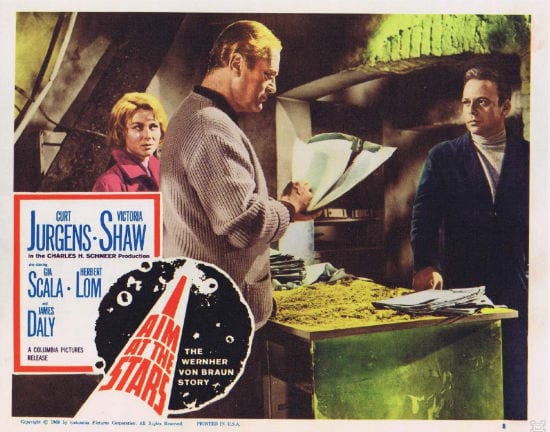
P.S. The title of this post comes from a Mort Sahl joke about the fawning Hollywood biopic — a box office flop — that von Braun himself pushed for. The movie was called I Aim at the Stars, and Sahl suggested “But Sometimes I Hit London” as a subtitle.
Wernher von Braun was a very strange man. Among other things, he wrote a book called Project Mars: A Technical Tale, which was part science fiction novel and part engineering schematic for an actual Mars mission. In the imagined distant future of 1980 in von Braun’s story, a grim peace reigns enforced by a nuclear-armed Death Star — a 440-crew-member space station he called “Lunetta.”
Learned that from Michael Mark Cohen’s long, fascinating discussion of von Braun’s life: “The Whitest Man Who Ever Lived.” Cohen mentions, but doesn’t spend a lot of time on, von Braun’s “evangelical Christian” conversion. That’s probably appropriate.
Anyway, here’s the Tom Lehrer video you’ve been patiently waiting for:
Previous Post

November 11, 2019
Bartender says 'Is this some kind of joke?'
Next Post
November 15, 2019 LBCF, No. 254: 'Last supper'
Browse Our Archives
Select a Category class warfare evangelicals Iraq Left Behind Mammon music Uncategorized
Select a Month October 2026 September 2026 August 2026 July 2026 June 2026 May 2026 April 2026 March 2026 January 2026 December 2025 November 2025 October 2025 September 2025 August 2025 July 2025 June 2025 May 2025 April 2025 March 2025 February 2025 January 2025 December 2024 November 2024 October 2024 September 2024 August 2024 July 2024 June 2024 May 2024 April 2024 March 2024 February 2024 January 2024 December 2023 November 2023 October 2023 September 2023 August 2023 July 2023 June 2023 May 2023 April 2023 March 2023 February 2023 January 2023 December 2022 November 2022 October 2022 September 2022 August 2022 July 2022 June 2022 May 2022 April 2022 March 2022 February 2022 January 2022 December 2021 November 2021 October 2021 September 2021 August 2021 July 2021 June 2021 May 2021 April 2021 March 2021 February 2021 January 2021 December 2020 November 2020 October 2020 September 2020 August 2020 July 2020 June 2020 May 2020 April 2020 March 2020 February 2020 January 2020 December 2019 November 2019 October 2019 September 2019 August 2019 July 2019 June 2019 May 2019 April 2019 March 2019 February 2019 January 2019 December 2018 November 2018 October 2018 September 2018 August 2018 July 2018 June 2018 May 2018 April 2018 March 2018 February 2018 January 2018 December 2017 November 2017 October 2017 September 2017 August 2017 July 2017 June 2017 May 2017 April 2017 March 2017 February 2017 January 2017 December 2016 November 2016 October 2016 September 2016 August 2016 July 2016 June 2016 May 2016 April 2016 March 2016 February 2016 January 2016 December 2015 November 2015 October 2015 September 2015 August 2015 July 2015 June 2015 May 2015 April 2015 March 2015 February 2015 January 2015 December 2014 November 2014 October 2014 September 2014 August 2014 July 2014 June 2014 May 2014 April 2014 March 2014 February 2014 January 2014 December 2013 November 2013 October 2013 September 2013 August 2013 July 2013 June 2013 May 2013 April 2013 March 2013 February 2013 January 2013 December 2012 November 2012 October 2012 September 2012 August 2012 July 2012 June 2012 May 2012 April 2012 March 2012 February 2012 January 2012 December 2011 November 2011 October 2011 September 2011 August 2011 July 2011 June 2011 May 2011 April 2011 March 2011 February 2011 January 2011 December 2010 November 2010 October 2010 September 2010 August 2010 July 2010 June 2010 May 2010 April 2010 March 2010 February 2010 January 2010 December 2009 November 2009 October 2009 September 2009 August 2009 July 2009 June 2009 May 2009 April 2009 March 2009 February 2009 January 2009 December 2008 November 2008 October 2008 September 2008 August 2008 July 2008 June 2008 May 2008 April 2008 March 2008 February 2008 January 2008 December 2007 November 2007 October 2007 September 2007 August 2007 July 2007 June 2007 May 2007 April 2007 March 2007 February 2007 January 2007 December 2006 November 2006 October 2006 September 2006 August 2006 July 2006 June 2006 May 2006 April 2006 March 2006 February 2006 January 2006 December 2005 November 2005 October 2005 September 2005 August 2005 July 2005 June 2005 May 2005 April 2005 March 2005 February 2005 January 2005 December 2004 November 2004 October 2004 September 2004 August 2004 July 2004 June 2004 May 2004 April 2004 March 2004 February 2004 January 2004 December 2003 November 2003 October 2003 September 2003
Follow Us!
TAKE THE
Religious Wisdom Quiz
True or False: James teaches that pure religion before God is to visit orphans and widows in their trouble.
Select your answer to see how you score.
TRUE FALSE
Related posts from slacktivist

Is this the right room for an argument?

The Amish are not 'Evangelicals.' They're Amish.

The lumpers, the splitters, and me

'Is it right on red or left on...
TRENDING AT PATHEOS Progressive Christian

I was strolling through the top floor of the brand new Parthenon...

What Does Gêvâh Mean For Kimberley Guifoyle &...
This week, a lot of the news is focused on Kimberly Guilfoyle....

INNER CIRCLE: Profound Mystery (Of Christ In All...
Ephesians 5:31-32 “For this reason, a man will leave his father and...

Do Not Rejoice When Your Enemy Falls: The...
Turning an execution into a public spectacle is a disturbing expression of...

'The Chosen' S6 Trailer: The Passion Gets Very...
Not many watching 'The Chosen' worry about spoilers, but just because they...

The purpose-driven labor priest
A labor activist reads Rick Warren and it gets me wondering about...
view all Progressive Christian blogs
Ad-Free & Subscriber Log-In Subscription Support
- About Us
- 2026 Calendar
- Videos
- Podcasts
- Library of World Religions
- Faith In Media Tracker
- Advertise With Us
- Write for Us
- Privacy Policy
- Terms of Service
- Do Not Sell My Data
- Contact Us
- Radiant Digital
- Manage Newsletter Subscriptions
- Unsubscribe From Notifications
- Sitemap
Copyright 2008-2026, Patheos. All rights reserved.
Subscription Support Ad-Free & Subscriber Log-In
Follow Patheos