
BuddhistCatholicContemplativeEvangelicalGeneral ChristianHinduJewishLatter-day SaintMuslimNew VisionsProgressive Christian
Beliefs
- Buddhist
- Catholic
- Contemplative
- Evangelical
- General Christian
- Hindu
- Jewish
- Latter-day Saint
- More Voices
- Muslim
- New Visions
- Pagan
- Progressive Christian
Topics
- Religion News
- Food and Religion
- Sports and Religion
- Religious Art
- Religious Music and Entertainment
- Religious Events
- History and Religion
- Style and Religion
- Politics and Religion
- Women in Religion
- Recreation Outdoors and Religion
- Business Finance and Religion
- Careers Workplace and Religion
- Education and Religion
- Family Parenting and Religion
- Health Fitness and Religion
- Home and Religion
- Relationships and Religion
- Technology and Religion
- Travel and Religion
Columnists
- Buddhist Columnists
- Business Finance and Religion Columnists
- Careers Workplace and Religion Columnists
- Catholic Columnists
- Contemplative Columnists
- Education and Religion Columnists
- Evangelists Columnists
- Family Parenting and Religion Columnists
- General Christian Columnists
- Health Fitness and Religion Columnists
- Hindu Columnists
- History and Religion Columnists
- Home and Religion Columnists
- Jewish Columnists
- More Voices Columnists
- Latter Day Columnists
- Muslim Columnists
- New Visions Columnists
- Nonreligious Columnists
- Pagan Columnists
- Politics and Religion Columnists
- Progressive Columnists
- Recreation Outdoors and Religion Columnists
- Relationships and Religion Columnists
- Religion News Columnists
- Religious Art Columnists
- Religious Events Columnists
- Religious Music and Entertainment Columnists
- Sports and Religion Columnists
- Style and Religion Columnists
- Technology and Religion Columnists
- Travel and Religion Columnists
- Women in Religion Columnists
Resource Library
- 2026 Calendar
- Library of World Religions
- The 100 Most Holy Places on Earth
- Patheos Answers
- Podcasts
- Videos
- Faith Leaders Database
- Anglican Episcopalian
- Bahai
- Baptist
- Buddhism
- Christianity
- Confucianism
- Eastern Orthodoxy
- Hinduism
- Holiness and Pentecostal
- ISKCON
- Islam
- Judaism
- Lutheran
- Methodist
- The Church of Jesus Christ of Latter-day Saints
- New Age
- Paganism
- Presbytarian and Reformed
- Protestantism
- Religion Behind the Scenes
- Roman Catholic
- Scientology
- Shia Islam
- Sikhism
- Sufism
- Sunni Islam
- Taoism
- Zen
- See all religions
Research Tools
 Ad-Free & Subscriber Log-In Subscription Support
Ad-Free & Subscriber Log-In Subscription Support
Follow Patheos 

- Trending:
- Forgiveness
- |
- Marriage
- |
- Consciousness
- |
- Death Penalty
- |
- Election
- |
- Halloween

- Home
- Progressive Christian
- LBCF, No. 237: ‘The Good King’
LBCF, No. 237: ‘The Good King’
Last updated on: June 14, 2019 at 6:30 am by Fred Clark
LBCF, No. 237: ‘The Good King’ 2019-06-14T00:46:55-04:00 Fred Clark
Patheos Explore the world's faith through different perspectives on religion and spirituality! Patheos has the views of the prevalent religions and spiritualities of the world.
Originally posted February 8, 2010.
You can read this entire series, for free, via the convenient Left Behind Index. The ebook collection The Anti-Christ Handbook: Volume 1, is available on Amazon for just $0.99. Pretending you don’t have a hermeneutic is the worst hermeneutic. Volume 2 of The Anti-Christ Handbook, completing all the posts on the first Left Behind book, is also now available. Volume 3 is coming someday.
Tribulation Force, pp. 147-151
A great deal of theology has to do not with God but with us — with humans and human nature and human choices.
God is still in the picture, of course, that’s what separates theology from other varieties of philosophy, psychology, history, or ethics. But you can’t do theology without also addressing all of those disciplines. You can’t talk about theology without talking about human nature as well as the nature of God.
One of the ways in which the World’s Worst Books are instructively awful is that they demonstrate, over and over, that these two aspects of theology are interrelated. In these books we see example after example of the way a distorted understanding of the nature of God can result in a distorted understanding of human nature. And vice versa.
That interrelated distortion is on full display here in these pages of Tribulation Force.
Nicolae Carpathia finally gets down to the specifics of his offer to hire Buck Williams. Buck rejects the terms of that offer. That’s pretty much all that happens here.
What’s interesting is Buck’s reason for rejecting Nicolae’s job offer.
“If you do not mind,” Carpathia said, “I would now like to ask your friends to join us.” …
Buck didn’t know if it was just his imagination, but it seemed both Steve Plank and Chaim Rosenzweig had bemused, knowing looks when they entered, trailed by Hattie. She set a chair from the conference table on the other side of Buck, and the men sat. Hattie left again.
The only other books I’ve read that paid this much attention to seating arrangements all involved Hercule Poirot saying, “You may wonder why I have called you all here this evening …” And yet for all of that, I still don’t have anything like a clear picture of what Nicolae’s office looks like.
“Mr. Williams has a prerequisite,” Carpathia announced, to the low murmur from Plank and Rosenzweig. “He must be headquartered in Chicago.”
“That just helps narrow it down,” Dr. Rosenzweig said. “Does it not?”
Jerry Jenkins’ odd practice of using formal titles even in dialogue — “Dr. Rosenzweig said,” “Captain Steele replied” — just made me realize something else that’s wrong with this story. Buck Williams shouldn’t be in love with Rayford’s daughter. He should be in love with Dr. Rosenzweig’s daughter.
As we know from everything from The Tempest to High Anxiety, any genius scientist in the unwitting or unwilling employ of an evil mastermind will also have a brilliant, beautiful and devoted daughter. The male protagonist will, by definition, fall in love with said daughter. It simply won’t do to have a character like Dr. Chaim Rosenzweig unless he also has a brilliant and beautiful daughter. And if won’t do for Buck to have a wise-but-befuddled old mentor like Dr. Rosenzweig without consequently falling in love with that same requisite daughter.
Hence another of my theories, otherwise unsupported by the text: Irene Steele’s religious devotion arose, in part, from the gnawing guilt she had felt ever since her brief-but-torrid affair with an Israeli botanist 21 years ago.
The secretary-general turned toward Buck. “Here is my offer: You become president and publisher of the Chicago Tribune, which I shall acquire from the Wrigley family within the next two months. I will rename it The Midwest Tribune and publish it under the auspices of Global Community Enterprises. The headquarters will remain Tribune Tower in Chicago. Along with your job comes a limousine with driver, a personal valet, whatever staff you deem necessary, a home on the North Shore with domestic help, and a retreat home on Lake Geneva in southern Wisconsin. Beyond naming the publication and the publishing company, I will not intrude on your decision making. You will have complete freedom to run the paper any way you wish.”
This list of perks, incidentally, was identical to Jenkins’ own list of demands to the Tribune company for his continued employment with them as the writer of Gil Thorp. The company agreed to the limo, valet and North Shore mansion with servants, but when they balked at the swanky Wisconsin retreat, Jenkins walked away from the strip.
Nicolae’s list of perks, tellingly, did not include a generous 401(k). Of course, if he’s really as smart and evil as the authors make him out to be, he wouldn’t offer a 401(k) retirement plan but, instead, would tempt the thousands of new “president and publishers” he’ll need to hire for his new Global Community media empire with an even more generous-sounding offer of a full pension for which they’d be eligible after just seven years of service.
Buck doesn’t pay any attention to all this talk of perks and benefits. He’s more interested in the question of editorial control. That’s the right thing to be worried about, since Nicolae makes it clear that his One World Media monopoly will be wholly owned and operated by his One World Government.
Buck is shocked by the audacity of this scheme. Nicolae, he thinks to himself, would “break every rule of journalistic ethics by owning a major media outlet while serving as secretary-general of the United Nations.”
Setting aside that Buck’s concern for journalistic ethics is, again, a bit out of place while he’s in the middle of a first-class junket under an assumed name, the larger problem here is that he fails to grasp the scope and scale of Nicolae’s project. The Romanian president and U.N. secretary-general isn’t merely proposing to own “a major media outlet,” but to own all media outlets, major and minor, in every city, region and nation on earth.
(And boy is Buck going to be disappointed when he learns that his “retreat home on Lake Geneva” is actually a time-share that he’ll be splitting with the president/publishers of Time magazine, the Sydney Morning Herald, Paramount studios, BBC World Service, Clear Channel, Le Monde, Cat Fancy and the newly renamed Highlights for Grieving Parents.*)
Buck heard Nicolae’s promise of “complete freedom to run the paper any way you wish,” but he doesn’t trust it. He cagily suspects the Antichrist may be up to no good. OWG-ownership of the Trib, he protests, would make it “impotent as an independent news voice.”
“That will be up to you.”
“Are you serious? You would allow your own publication to criticize you? To take issue with the United Nations?”
“I welcome the accountability. My motives are pure, my goals are peaceful, and my audience is global.”
Nicolae’s motives and their dubious purity turns out to be the key issue at stake here as Buck and the authors view the situation. Buck splutters his protest for a few more paragraphs until Nicolae brings it back to this central question of his motives:
“If my motives were anything but ideal, I would have a problem with it too. But what is wrong with controlling global news when we are headed toward peace and harmony and unity?”
“Where is the power to think for oneself?” Buck asked. “Where is the forum for diverse ideas? What happens to the court of public opinion?”
“The court of public opinion,” Steve said, “is calling for more of what the secretary-general has to offer.”
Buck was defeated, and he knew it.
He’s defeated here because he doesn’t fundamentally disagree with what Nicolae has just said. The Antichrist says that the concentration of unchecked, unbalanced, unaccountable power in one person’s hands is only problematic if that person’s motives are “anything but ideal.” Buck and the authors accept that wholeheartedly. All they object to is Nicolae’s claim that his motives are ideal.
Put another way, Buck is not, in principle, opposed to the idea of a benevolent dictatorship. He just doesn’t believe, in this particular case, that Nicolae happens to be truly benevolent.
In the moral universe of Left Behind, there is one and only one thing that is necessary and sufficient for keeping power in check: Virtue (which is to say, virtuous intent — or passionate sincerity). In such a universe, a Good Person can and ought to be trusted to wield unchecked and unlimited power. And a Bad Person, by contrast, must not be trusted with even limited, constrained, accountable power.
This idea reflects a dangerously naive understanding of human nature. It’s a radically different notion than the pessimistic, Madisonian perspective that shapes America’s Constitution. The idea at work there is that no one is virtuous enough to be trusted with unconstrained power.
But my point here isn’t that Buck’s understanding of human nature is incompatible with America’s constitutional democracy. My point is, rather, that LaHaye and Jenkins have given Buck an understanding of human nature that is incompatible with what Christians believe. Or, in other words, their understanding of human nature is incompatible with the world as Christians perceive it to be.**
Reinhold Niebuhr often joked that humanity’s inherent sinfulness was the only “empirically verifiable” Christian doctrine. Look around, he was saying, see anyone anywhere who you think is so perfectly virtuous that she or he could be trusted to wield unconstrained power over everyone else?
But this pessimistic appreciation for human corruptibility isn’t the only thing Christians perceive when they look at human nature. We also see creatures made in God’s image, creatures that God has deemed worthy of relentless love and affection, creatures destined for something better than corruption. Niebuhr argued that these two sides of human nature suggested that democracy — with power widely distributed and widely entrusted, but never unconstrained — was a commendable model. “[Humanity’s] capacity for justice makes democracy possible,” he said, “but [humanity’s] inclination to injustice makes democracy necessary.”
LaHaye & Jenkins, by contrast, don’t see these two sides of human nature as being present in every person. They view some people — the redeemed — as possessing a capacity for justice. And they view other people — the unregenerate unredeemed — as having an inclination to injustice. The redeemed bear the image of God. The unredeemed are totally depraved.
This view divides the world, to borrow one more phrase from Niebuhr, into the Children of Light and the Children of Darkness. The Children of Light are seen as trustworthy of wielding unlimited power without abusing it. While wielding such power the Children of Light might end up punishing, marginalizing, disenfranchising, imprisoning, enslaving or executing the Children of Darkness, but that doesn’t constitute an abuse of power — that’s just what the Children of Darkness deserve.
So here we are at that interrelated distortion I mentioned above and the unanswerable chicken-and-egg question at the heart of L&J’s theology. Did they arrive at this understanding of human nature because this is what they imagine God is like — a benevolent dictator whose fierce, cruel destruction of his enemies must be interpreted as a function of that benevolence? Or did they come to imagine that this is what God is like because of their (stunted) understanding of human nature, because they imagine that, if they were God, this is what they would do?
I’m guessing C. Both of the above.
– – – – – – – – – – – –
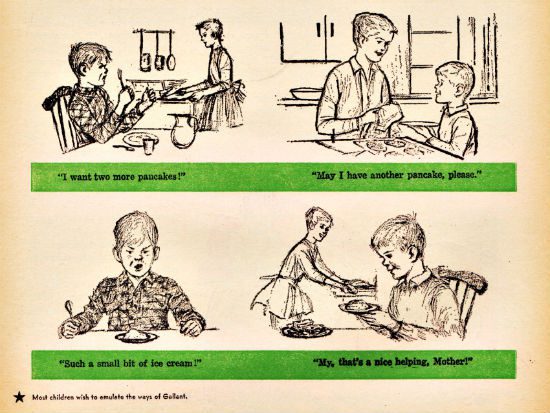
* The Rapturing of all children below the pubescent “age of accountability” would mean, ironically, that both Gallant and Goofus would be among the disappeared now in Heaven.
** I would say that the authors’ understanding of human nature is “unbiblical” — evangelicals’ favorite trump-card word — except that by now it’s abundantly clear that LaHaye & Jenkins’ idea of what is or isn’t actually to be found in the pages of the Bible is utterly unpredictable and indecipherable. A Romanian secretary-general of the global federation of nations who seeks to rebuild the ancient city of Babylon, for example, is something they would say is a “biblical” teaching. “Blessed are the peacemakers,” on the other hand, they would argue is not “biblical.” Given such bewildering use of the term, it’s probably best to avoid it when discussing the authors.
Next Post

June 17, 2019 Pack up all your dishes ...
Browse Our Archives
Select a Category class warfare evangelicals Iraq Left Behind Mammon music Uncategorized
Select a Month October 2026 September 2026 August 2026 July 2026 June 2026 May 2026 April 2026 March 2026 January 2026 December 2025 November 2025 October 2025 September 2025 August 2025 July 2025 June 2025 May 2025 April 2025 March 2025 February 2025 January 2025 December 2024 November 2024 October 2024 September 2024 August 2024 July 2024 June 2024 May 2024 April 2024 March 2024 February 2024 January 2024 December 2023 November 2023 October 2023 September 2023 August 2023 July 2023 June 2023 May 2023 April 2023 March 2023 February 2023 January 2023 December 2022 November 2022 October 2022 September 2022 August 2022 July 2022 June 2022 May 2022 April 2022 March 2022 February 2022 January 2022 December 2021 November 2021 October 2021 September 2021 August 2021 July 2021 June 2021 May 2021 April 2021 March 2021 February 2021 January 2021 December 2020 November 2020 October 2020 September 2020 August 2020 July 2020 June 2020 May 2020 April 2020 March 2020 February 2020 January 2020 December 2019 November 2019 October 2019 September 2019 August 2019 July 2019 June 2019 May 2019 April 2019 March 2019 February 2019 January 2019 December 2018 November 2018 October 2018 September 2018 August 2018 July 2018 June 2018 May 2018 April 2018 March 2018 February 2018 January 2018 December 2017 November 2017 October 2017 September 2017 August 2017 July 2017 June 2017 May 2017 April 2017 March 2017 February 2017 January 2017 December 2016 November 2016 October 2016 September 2016 August 2016 July 2016 June 2016 May 2016 April 2016 March 2016 February 2016 January 2016 December 2015 November 2015 October 2015 September 2015 August 2015 July 2015 June 2015 May 2015 April 2015 March 2015 February 2015 January 2015 December 2014 November 2014 October 2014 September 2014 August 2014 July 2014 June 2014 May 2014 April 2014 March 2014 February 2014 January 2014 December 2013 November 2013 October 2013 September 2013 August 2013 July 2013 June 2013 May 2013 April 2013 March 2013 February 2013 January 2013 December 2012 November 2012 October 2012 September 2012 August 2012 July 2012 June 2012 May 2012 April 2012 March 2012 February 2012 January 2012 December 2011 November 2011 October 2011 September 2011 August 2011 July 2011 June 2011 May 2011 April 2011 March 2011 February 2011 January 2011 December 2010 November 2010 October 2010 September 2010 August 2010 July 2010 June 2010 May 2010 April 2010 March 2010 February 2010 January 2010 December 2009 November 2009 October 2009 September 2009 August 2009 July 2009 June 2009 May 2009 April 2009 March 2009 February 2009 January 2009 December 2008 November 2008 October 2008 September 2008 August 2008 July 2008 June 2008 May 2008 April 2008 March 2008 February 2008 January 2008 December 2007 November 2007 October 2007 September 2007 August 2007 July 2007 June 2007 May 2007 April 2007 March 2007 February 2007 January 2007 December 2006 November 2006 October 2006 September 2006 August 2006 July 2006 June 2006 May 2006 April 2006 March 2006 February 2006 January 2006 December 2005 November 2005 October 2005 September 2005 August 2005 July 2005 June 2005 May 2005 April 2005 March 2005 February 2005 January 2005 December 2004 November 2004 October 2004 September 2004 August 2004 July 2004 June 2004 May 2004 April 2004 March 2004 February 2004 January 2004 December 2003 November 2003 October 2003 September 2003
Follow Us!
TAKE THE
Religious Wisdom Quiz
Who was the youngest king of Judah?
Select your answer to see how you score.
Josiah Asa Hezekiah Jehoshaphat
Related posts from slacktivist

Can't seem to get it through my head

For Buffy and Carl so loved the world


'To every generation': Child abuse at Cornerstone Church
TRENDING AT PATHEOS Progressive Christian

When Halloween Unmasks Married Hearts
Written by Dr. David K. Ewen from Eternal Truth Bible College Behind...

Aristotle. He’s been called the father of logic, the father of the...

Methodist Central Hall and Westminster Abbey
Situated on the same square is Methodist Central Hall and Westminster Abbey. ...

57th Dove Awards Honor Dolly Parton, Crown New...
On gospel music’s biggest night, the 57th annual GMA Dove Awards honored...

The First Eucharistic Controversy: Christ’s Real Presence
For Catholics, the Eucharist is the source and summit of the Christian...

What a Stop Sign Can Teach Us About...
How to Make a Decision When You Can't Hear God Main point:...
view all Progressive Christian blogs
Ad-Free & Subscriber Log-In Subscription Support
- About Us
- 2026 Calendar
- Videos
- Podcasts
- Library of World Religions
- Faith In Media Tracker
- Advertise With Us
- Write for Us
- Privacy Policy
- Terms of Service
- Do Not Sell My Data
- Contact Us
- Radiant Digital
- Manage Newsletter Subscriptions
- Unsubscribe From Notifications
- Sitemap
Copyright 2008-2026, Patheos. All rights reserved.
Subscription Support Ad-Free & Subscriber Log-In
Follow Patheos