
BuddhistCatholicContemplativeEvangelicalGeneral ChristianHinduJewishLatter-day SaintMuslimNew VisionsProgressive Christian
Beliefs
- Buddhist
- Catholic
- Contemplative
- Evangelical
- General Christian
- Hindu
- Jewish
- Latter-day Saint
- More Voices
- Muslim
- New Visions
- Pagan
- Progressive Christian
Topics
- Religion News
- Food and Religion
- Sports and Religion
- Religious Art
- Religious Music and Entertainment
- Religious Events
- History and Religion
- Style and Religion
- Politics and Religion
- Women in Religion
- Recreation Outdoors and Religion
- Business Finance and Religion
- Careers Workplace and Religion
- Education and Religion
- Family Parenting and Religion
- Health Fitness and Religion
- Home and Religion
- Relationships and Religion
- Technology and Religion
- Travel and Religion
Columnists
- Buddhist Columnists
- Business Finance and Religion Columnists
- Careers Workplace and Religion Columnists
- Catholic Columnists
- Contemplative Columnists
- Education and Religion Columnists
- Evangelists Columnists
- Family Parenting and Religion Columnists
- General Christian Columnists
- Health Fitness and Religion Columnists
- Hindu Columnists
- History and Religion Columnists
- Home and Religion Columnists
- Jewish Columnists
- More Voices Columnists
- Latter Day Columnists
- Muslim Columnists
- New Visions Columnists
- Nonreligious Columnists
- Pagan Columnists
- Politics and Religion Columnists
- Progressive Columnists
- Recreation Outdoors and Religion Columnists
- Relationships and Religion Columnists
- Religion News Columnists
- Religious Art Columnists
- Religious Events Columnists
- Religious Music and Entertainment Columnists
- Sports and Religion Columnists
- Style and Religion Columnists
- Technology and Religion Columnists
- Travel and Religion Columnists
- Women in Religion Columnists
Resource Library
- 2026 Calendar
- Library of World Religions
- The 100 Most Holy Places on Earth
- Patheos Answers
- Podcasts
- Videos
- Faith Leaders Database
- Anglican Episcopalian
- Bahai
- Baptist
- Buddhism
- Christianity
- Confucianism
- Eastern Orthodoxy
- Hinduism
- Holiness and Pentecostal
- ISKCON
- Islam
- Judaism
- Lutheran
- Methodist
- The Church of Jesus Christ of Latter-day Saints
- New Age
- Paganism
- Presbytarian and Reformed
- Protestantism
- Religion Behind the Scenes
- Roman Catholic
- Scientology
- Shia Islam
- Sikhism
- Sufism
- Sunni Islam
- Taoism
- Zen
- See all religions
Research Tools
 Ad-Free & Subscriber Log-In Subscription Support
Ad-Free & Subscriber Log-In Subscription Support
Follow Patheos 

- Trending:
- Forgiveness
- |
- Marriage
- |
- Consciousness
- |
- Death Penalty
- |
- Election
- |
- Halloween

- Home
- Progressive Christian
- Ignoring hateful extremists doesn’t make them go away
Ignoring hateful extremists doesn’t make them go away
Last updated on: March 26, 2022 at 12:42 pm by Fred Clark
Ignoring hateful extremists doesn’t make them go away 2022-03-26T12:42:09-04:00 Fred Clark
Patheos Explore the world's faith through different perspectives on religion and spirituality! Patheos has the views of the prevalent religions and spiritualities of the world.
“Will the Real Evangelical Please Stand Up?” Adam Laats is writing there about court evangelicals versus the slightly less-Trumpy old-guard of “mainstream” white evangelicalism, but his conclusion is pertinent to our discussion here of popular evangelical anti-Semite Rick Wiles.
Laats writes:
The Taylor/Pence story hits the same ugly notes. I sympathize entirely with Amy Peterson and her friends and allies at Taylor University. I wish evangelical institutions would embrace the best traditions of evangelical religion. I hope — though I don’t pray — that large numbers of white evangelicals reject Trump’s toxic Americanism at the polls in 2020.
In the end, however, we all need to face realities. The faculty and some students at Taylor might reel in dismay at the university’s decision to honor Mike Pence. But in the end, as Peterson recounts, lots of Taylor students and faculty loved it. And the school’s administrators, as always desperate to reassure students and families that they represent “real” evangelical values, decided that Pence embodied those values. When pollsters explore beyond the faculty lounge, they find that white evangelicals prefer Pence to Peterson.
And many of those same white evangelicals are also being taught — by Trump and Pence, and by their many court prophets in the so-called “Christian” media — to prefer the hateful propaganda of people like Rick Wiles.
One popular response to hateful demagogues like Trump or Wiles is not to respond at all. Ignore them and maybe they’ll just go away. Criticizing them or challenging their lies, this argument holds, just gives them more attention and more oxygen. Maybe if we never mention the growing influence of CBN and Trinity and EWTN and Charisma and TruNews et. al. then all of those fear- and hate-inducing outlets will stop having influence.
Maybe if we stop paying any attention to them, no one else will pay any attention to them either.
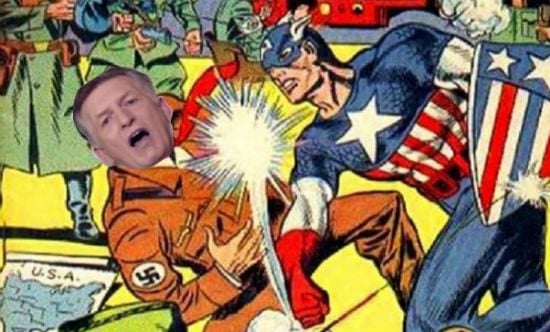
I suppose that it’s possible that such a response has sometimes succeeded in the past. Examples of such successes wouldn’t easily spring to mind because, after all, every such example would be someone who was first ignored and then went away.
But many, many counter-examples do spring to mind — examples that show this non-responsive response often fails catastrophically, essentially amounting to an unconditional surrender.
Risking such catastrophic failure does not seem prudent. Nor does it seem prudent to accept an argument that positions itself as prudence but that counsels the same timid course of inaction that would result from simple cowardice.
In its most extreme form, this idea of “ignore them and let’s hope they just go away” twists itself into a time-traveling logic that reverses cause and effect, blaming critics of hateful demagogues for those demagogues’ very existence. One of the weirdest and wildest examples of this argument for retroactive causation was something we discussed here several years ago — when now-CEO and president of Christianity Today Tim Dalrymple explained that the rise of the religious right and its influence was the product of, well, me.
Recalling that strange episode led me to revisit a couple of posts from early 2013. Seeing as they’ve aged pretty well, and they’re relevant to our conversation of What To Do About Rick Wiles, I’m reposting them here:
– – – – – – – – – – –
‘Mainstream’ evangelicals criticize critics of the religious right
Well, I told you this was coming.
Last month I wrote about a modest bit of push-back from “mainstream” evangelicals against the appalling things said by several religious right leaders following the massacre in Newtown, Conn.
Mike Huckabee, James Dobson, Bryan Fischer and Franklin Graham disgraced themselves by blaming the shootings on the separation of church and state, same-sex marriage and legal abortion, prompting widespread criticism from a wide variety of Christian leaders and just about anyone else who heard what they said.
But, as usual, mainstream evangelical leaders, magazines, bloggers and spokespeople were hesitant to condemn those remarks. Their constituency, after all, is the same white evangelical populace that watches Huckabee on Fox News, listens to Dobson and Fischer on the radio (on 7,000 and 200 stations, respectively), and that inexplicably regards Franklin Graham as the legitimate heir to his father’s legacy. They are thus, understandably, rather timid about criticizing those folks.
Yet a handful of “mainstream” evangelical types did clear their throats and respond to Huckabee and Dobson, including Out of Ur, which is the blog of Leadership Journal, the magazine for pastors put out by the folks at Christianity Today.
Out of Ur published a guest post by Michael Cheshire, an evangelical pastor from Colorado, who wrote, “They Think We’re a Hate Group, and They Might Be Right.” Cheshire compared the vocal and visible leaders of the evangelical religious right with a “crazy uncle”:
I feel like I’m with a crazy uncle who makes ignorant comments while you’re helping him shop. You have to stand behind him and mouth, “I’m so sorry. He’s old and bit crazy. He means well.” So to my gay friends, scientists, iPhone users, and others he blamed for the horrendous killing spree by that mentally ill young man, I stand here mouthing a few words of apology to you.
The rest of Cheshire’s piece was pretty forceful, so much so that I worried “… it might get him banished into the limbo of ‘controversial’ evangelical voices — Cizik-ed away to a seat beside folks like Tony Campolo and Jim Wallis, whose continued membership in the tribe is permitted mainly as a way of marking its boundary.”
And that didn’t take long. Less than two weeks later, Skye Jethani posted Out of Ur’s backpedaling semi-retraction of Cheshire’s comments: “No, We’re Not a Hate Group.”
Jethani explains that the religious right is not representative of the silent majority of American evangelicals. That’s a false impression, he says, created by sensationalistic journalists and, Jethani says — citing Timothy Dalrymple — created by wily progressive Christians. He links to Dalrymple’s unique explanation for the rise of the religious right. It’s due, he says, to:
… people like Fred Clark. I think Fred dramatically underestimates the extent to which he and his ilk shape the public and media perception of evangelicals when they shine a relentless light on every ridiculous and offensive thing an evangelical pastor or radio host does, and completely ignore the good and important work that the vast majority of evangelicals do on a regular basis.
Yes, it’s all true. I started this blog in 2002. At the time, James Dobson was an inconsequential figure broadcasting his radio message daily on a mere 7,000 stations (mostly AM). He’d only written a couple dozen books at that point, and only half of those had become national best-sellers. And only 500 or so of the thousands of newspapers and evangelical publications in America bothered to carry his weekly column.
But once I started shining my “relentless light on every ridiculous and offensive thing an evangelical pastor or radio host does,” that criticism — cleverly disguised as posts about the Iraq War, eschatology, Buffy, Niebuhr, subsidiarity and manufactured housing — catapulted James Dobson to national fame, leading Time magazine to dub him “the nation’s most influential evangelical leader.”
I’ve done the same thing for countless others — Franklin Graham, Rick Warren, Bryan Fischer, Tony Perkins and dozens of other such figures who I’ve managed to elevate without ever even mentioning them here.
My very first substantial post, on my original blogspot site, criticized Pat Robertson for selling “sentergistic” anti-aging milkshakes. The effect of that post was so powerful that it lifted Robertson to a second-place finish in the Iowa caucuses 14 years earlier.
My influence is vast, unstoppable and retroactive.
Or, alternatively, Dalrymple and Jethani might be talking out of their backsides. It’s one of those.
In any case, Jethani’s endorsement of Dalrymple’s weirdly anachronistic history of the religious right is not the biggest problem with his attempted rebuttal of Cheshire’s piece. The biggest problem with Jethani’s post is that it’s pastoral malpractice.
Skye Jethani gets one thing partly right in his push-back against the push-back against the appalling public theology of the religious right.
In his Out of Ur essay “No, We’re Not a Hate Group,” Jethani discusses the way the “sensationalism” of the spotlight-grabbing media stars of the religious right can make them seem disproportionately influential:
In the free market of the media it is not fair and accurate reporting that gets rewarded, but page views, clicks, and [Nielsen] ratings. With online and cable news outlets struggling for viewers (and revenue), there is constant pressure for these organization to not just report news but make it. Therefore, when a Christian leader is needed to comment on an event, they are more likely to invite a Crazy Uncle Christian known for shooting his mouth off and insulting minorities than the thoughtful, reflective Christian offering wisdom.
… If you’re behind the editorial desk at CNN and desperate for page views, which story are you going to publish: “Christian Leader Fasts and Prays for Victims of School Shooting” or “Christian Leader Blames Shooting on School Prayer Ban”[?]
Sadly, when sensationalism sells it’s going to be the crazy uncles in Christendom that get media attention.
Yes, “sensationalism sells.” But Jethani apparently didn’t watch CNN in the days and weeks following the Newtown shooting. The former story — “[Christians] … Pray for Victims” — was reported dozens of times covering numerous events. They reported — positively — on sermons at several area churches. They quoted from clergy who spoke at funerals. It wasn’t just CNN, either — one prayer vigil was broadcast on all the major networks — with NBC interrupting Sunday Night Football to show it live. Look through CNN’s Belief Blog over the past month and you’ll find many, many thoughtful, reflective, restrained and respectful articles commending the responsible reactions from numerous Christian leaders following the tragedy.
Sure, CNN also covered the statements by Huckabee, Dobson, Fischer and Graham, but they didn’t interrupt Sunday Night Football to do so. And they had to cover those statements because they are news.
It’s the man-bites-dog principle. The old saying is that “Dog Bites Man” is not news — that’s what dogs sometimes do, and it’s just a routine occurrence. But “Man Bites Dog” is news — it’s something unusual, unexpected and noteworthy.
Similarly “Pastor Provides Pastoral Care” is not news. Nor is “Shock-jock Says Something Shocking” newsworthy. But if the “Morning Zoo Crew” on the local radio station dispenses with its usual crude antics in the wake of a tragedy, organizing a vigil and rallying community support for the victims, that would be news — a reversal of the usual roles, something surprising and unexpected.
By the same token, when a religious leader, of all people, responds to tragedy by making the sort of shocking statements one usually expects to hear from Zoo-Crew shock-jocks, that’s news too. One could, in a sense, regard the newsworthiness of Huckabee and Dobson’s comments as a kind of slantwise affirmation of American Christianity. Despite a decades-long pattern of white evangelical spokespeople saying appalling things in the aftermath of tragedies, those comments are still regarded as news — meaning they are still perceived as surprisingly out-of-character, as unexpected, Man-Bites-Dog incidents.
The larger problem with Jethani’s lament about CNN supposedly ignoring that story they didn’t ignore — “Christians Pray for Victims” — is that he seems to want media coverage of the church to be like one of those children’s events where everybody gets a trophy just for showing up. His fine whine reminds me of Chris Rock’s most notorious routine — the one in which he outlines the difference between black people in general and a small sub-set of the black population with whom he is sorely disappointed (I’m paraphrasing). Of this latter sub-set, Rock says:
[They] always want credit for some [stuff] they’re supposed to do. … [He] will brag about some [stuff] a normal man just does. [He] will say some [stuff] like “I take care of my kids.” You’re supposed to, you dumb $@%#. … What are you bragging about? What kind of ignorant [stuff] is that?
“I ain’t never been to jail.” What you want, a cookie? You’re not supposed to go to jail, you low-expectation-having $@%#.
This seems to be the gist of Jethani’s complaint about Cheshire’s complaint, of his criticism of Cheshire’s criticism. He wants reporters to ignore religious leaders who behave badly. And when religious leaders do not behave badly — when they do [stuff] they’re simply supposed to do — he wants a cookie.
Cable news is certainly often guilty of “sensationalism.” CNN has an infamous tendency to go into histrionics over stories of missing white women. But the correction to that would be for CNN to cover such stories in a more restrained and proportionate manner. It would not be for CNN to ignore such stories completely while covering, instead, the stories of the many millions of white women who are not missing.
The news media may be suckers for sensational claims, and the Crazy Uncles of the religious right may be virtuosos at exploiting that weakness, but cable news did not create the religious right. Nor did the critics of the religious right create it.
The religious right arose from within white evangelical Christianity. And it continues to thrive and to be enormously popular within white evangelical Christianity. That’s not something that we can blame on CNN, or on me, or on Michael Cheshire.
Previous Post

April 16, 2019
We need to do something about Rick Wiles
Next Post
April 18, 2019 It's never wrong to hop a fence
Browse Our Archives
Select a Category class warfare evangelicals Iraq Left Behind Mammon music Uncategorized
Select a Month October 2026 September 2026 August 2026 July 2026 June 2026 May 2026 April 2026 March 2026 January 2026 December 2025 November 2025 October 2025 September 2025 August 2025 July 2025 June 2025 May 2025 April 2025 March 2025 February 2025 January 2025 December 2024 November 2024 October 2024 September 2024 August 2024 July 2024 June 2024 May 2024 April 2024 March 2024 February 2024 January 2024 December 2023 November 2023 October 2023 September 2023 August 2023 July 2023 June 2023 May 2023 April 2023 March 2023 February 2023 January 2023 December 2022 November 2022 October 2022 September 2022 August 2022 July 2022 June 2022 May 2022 April 2022 March 2022 February 2022 January 2022 December 2021 November 2021 October 2021 September 2021 August 2021 July 2021 June 2021 May 2021 April 2021 March 2021 February 2021 January 2021 December 2020 November 2020 October 2020 September 2020 August 2020 July 2020 June 2020 May 2020 April 2020 March 2020 February 2020 January 2020 December 2019 November 2019 October 2019 September 2019 August 2019 July 2019 June 2019 May 2019 April 2019 March 2019 February 2019 January 2019 December 2018 November 2018 October 2018 September 2018 August 2018 July 2018 June 2018 May 2018 April 2018 March 2018 February 2018 January 2018 December 2017 November 2017 October 2017 September 2017 August 2017 July 2017 June 2017 May 2017 April 2017 March 2017 February 2017 January 2017 December 2016 November 2016 October 2016 September 2016 August 2016 July 2016 June 2016 May 2016 April 2016 March 2016 February 2016 January 2016 December 2015 November 2015 October 2015 September 2015 August 2015 July 2015 June 2015 May 2015 April 2015 March 2015 February 2015 January 2015 December 2014 November 2014 October 2014 September 2014 August 2014 July 2014 June 2014 May 2014 April 2014 March 2014 February 2014 January 2014 December 2013 November 2013 October 2013 September 2013 August 2013 July 2013 June 2013 May 2013 April 2013 March 2013 February 2013 January 2013 December 2012 November 2012 October 2012 September 2012 August 2012 July 2012 June 2012 May 2012 April 2012 March 2012 February 2012 January 2012 December 2011 November 2011 October 2011 September 2011 August 2011 July 2011 June 2011 May 2011 April 2011 March 2011 February 2011 January 2011 December 2010 November 2010 October 2010 September 2010 August 2010 July 2010 June 2010 May 2010 April 2010 March 2010 February 2010 January 2010 December 2009 November 2009 October 2009 September 2009 August 2009 July 2009 June 2009 May 2009 April 2009 March 2009 February 2009 January 2009 December 2008 November 2008 October 2008 September 2008 August 2008 July 2008 June 2008 May 2008 April 2008 March 2008 February 2008 January 2008 December 2007 November 2007 October 2007 September 2007 August 2007 July 2007 June 2007 May 2007 April 2007 March 2007 February 2007 January 2007 December 2006 November 2006 October 2006 September 2006 August 2006 July 2006 June 2006 May 2006 April 2006 March 2006 February 2006 January 2006 December 2005 November 2005 October 2005 September 2005 August 2005 July 2005 June 2005 May 2005 April 2005 March 2005 February 2005 January 2005 December 2004 November 2004 October 2004 September 2004 August 2004 July 2004 June 2004 May 2004 April 2004 March 2004 February 2004 January 2004 December 2003 November 2003 October 2003 September 2003
Follow Us!
TAKE THE
Religious Wisdom Quiz
True or False: According to Hebrews, faith is the substance of things hoped for and the evidence of things not seen.
Select your answer to see how you score.
TRUE FALSE
Related posts from slacktivist

Is this the right room for an argument?

The Amish are not 'Evangelicals.' They're Amish.

The lumpers, the splitters, and me

'Is it right on red or left on...
TRENDING AT PATHEOS Progressive Christian

Methodist Central Hall and Westminster Abbey
Situated on the same square is Methodist Central Hall and Westminster Abbey. ...

57th Dove Awards Honor Dolly Parton, Crown New...
On gospel music’s biggest night, the 57th annual GMA Dove Awards honored...

The First Eucharistic Controversy: Christ’s Real Presence
For Catholics, the Eucharist is the source and summit of the Christian...

What a Stop Sign Can Teach Us About...
How to Make a Decision When You Can't Hear God Main point:...

Archdiocese Hosts Military Marriage Retreat in Germany
RASTATT, Germany — The transient military lifestyle, with its frequent deployments and...

Nearly every morning, I make the drive to Detroit with my high-school-age...
view all Progressive Christian blogs
Ad-Free & Subscriber Log-In Subscription Support
- About Us
- 2026 Calendar
- Videos
- Podcasts
- Library of World Religions
- Faith In Media Tracker
- Advertise With Us
- Write for Us
- Privacy Policy
- Terms of Service
- Do Not Sell My Data
- Contact Us
- Radiant Digital
- Manage Newsletter Subscriptions
- Unsubscribe From Notifications
- Sitemap
Copyright 2008-2026, Patheos. All rights reserved.
Subscription Support Ad-Free & Subscriber Log-In
Follow Patheos