
BuddhistCatholicContemplativeEvangelicalGeneral ChristianHinduJewishLatter-day SaintMuslimNew VisionsProgressive Christian
Beliefs
- Buddhist
- Catholic
- Contemplative
- Evangelical
- General Christian
- Hindu
- Jewish
- Latter-day Saint
- More Voices
- Muslim
- New Visions
- Pagan
- Progressive Christian
Topics
- Religion News
- Food and Religion
- Sports and Religion
- Religious Art
- Religious Music and Entertainment
- Religious Events
- History and Religion
- Style and Religion
- Politics and Religion
- Women in Religion
- Recreation Outdoors and Religion
- Business Finance and Religion
- Careers Workplace and Religion
- Education and Religion
- Family Parenting and Religion
- Health Fitness and Religion
- Home and Religion
- Relationships and Religion
- Technology and Religion
- Travel and Religion
Columnists
- Buddhist Columnists
- Business Finance and Religion Columnists
- Careers Workplace and Religion Columnists
- Catholic Columnists
- Contemplative Columnists
- Education and Religion Columnists
- Evangelists Columnists
- Family Parenting and Religion Columnists
- General Christian Columnists
- Health Fitness and Religion Columnists
- Hindu Columnists
- History and Religion Columnists
- Home and Religion Columnists
- Jewish Columnists
- More Voices Columnists
- Latter Day Columnists
- Muslim Columnists
- New Visions Columnists
- Nonreligious Columnists
- Pagan Columnists
- Politics and Religion Columnists
- Progressive Columnists
- Recreation Outdoors and Religion Columnists
- Relationships and Religion Columnists
- Religion News Columnists
- Religious Art Columnists
- Religious Events Columnists
- Religious Music and Entertainment Columnists
- Sports and Religion Columnists
- Style and Religion Columnists
- Technology and Religion Columnists
- Travel and Religion Columnists
- Women in Religion Columnists
Resource Library
- 2026 Calendar
- Library of World Religions
- The 100 Most Holy Places on Earth
- Patheos Answers
- Podcasts
- Videos
- Faith Leaders Database
- Anglican Episcopalian
- Bahai
- Baptist
- Buddhism
- Christianity
- Confucianism
- Eastern Orthodoxy
- Hinduism
- Holiness and Pentecostal
- ISKCON
- Islam
- Judaism
- Lutheran
- Methodist
- The Church of Jesus Christ of Latter-day Saints
- New Age
- Paganism
- Presbytarian and Reformed
- Protestantism
- Religion Behind the Scenes
- Roman Catholic
- Scientology
- Shia Islam
- Sikhism
- Sufism
- Sunni Islam
- Taoism
- Zen
- See all religions
Research Tools
 Ad-Free & Subscriber Log-In Subscription Support
Ad-Free & Subscriber Log-In Subscription Support
Follow Patheos 

- Trending:
- Forgiveness
- |
- Marriage
- |
- Consciousness
- |
- Death Penalty
- |
- Election
- |
- Halloween

- Home
- Progressive Christian
- Orwell on why Donald Trump isn’t quite a nationalist
Orwell on why Donald Trump isn’t quite a nationalist
Last updated on: November 7, 2018 at 8:21 pm by Fred Clark
Orwell on why Donald Trump isn’t quite a nationalist 2018-11-07T20:21:25-05:00 Fred Clark
Patheos Explore the world's faith through different perspectives on religion and spirituality! Patheos has the views of the prevalent religions and spiritualities of the world.
Donald Trump says, proudly, that he is a nationalist. As with most words Trump uses, it is not clear that he knows what he means by this, or if he means anything like what other people mean when they use that word. And as with everything Donald Trump says, it is unclear whether or not he meant this, or actually believes it, or whether he will say the same thing again or its opposite in the next sentence.
But given all of that, Trump said this:
You know, they have a word – it’s sort of became old-fashioned – it’s called a nationalist. And I say, really, we’re not supposed to use that word. You know what I am? I’m a nationalist, okay? I’m a nationalist. Nationalist. Nothing wrong. Use that word. Use that word.
The USA Today piece linked above goes on to quote from conservative writer Max Boot, who explains the associations that lead most American politicians to avoid that word:
In the 20th century, nationalism has come to be associated with far-right politics, with fascism, with leaders like Mussolini, Hitler, Pinochet, Franco and others. And that is perhaps part of the reason why previous American presidents did not describe themselves as nationalists. They called themselves patriots.
The distinction there between “nationalists” and “patriots” goes way back. “Nationalism is not to be confused with patriotism,” George Orwell wrote in his 1945 essay “Notes on Nationalism“:
Both words are normally used in so vague a way that any definition is liable to be challenged, but one must draw a distinction between them, since two different and even opposing ideas are involved. By “patriotism” I mean devotion to a particular place and a particular way of life, which one believes to be the best in the world but has no wish to force on other people. Patriotism is of its nature defensive, both militarily and culturally. Nationalism, on the other hand, is inseparable from the desire for power. The abiding purpose of every nationalist is to secure more power and more prestige, not for himself but for the nation or other unit in which he has chosen to sink his own individuality.
Re-reading Orwell’s essay, I’m convinced that Donald Trump is, in fact, not a nationalist. I say this for the same reason that Orwell italicized that same word — not — in the quote above. A “nationalist,” in Orwell’s taxonomy, is a person who has subsumed their self and their identity into that of “the nation or other unit.” Trump doesn’t do that. He’s trying, rather, to the opposite of that — to subsume the nation into his self and his identity.
Trump shares the nationalist’s overriding obsession with pursuing power and prestige, but he seeks these for himself, not for any larger nation or cause. He is certainly preaching nationalism and promoting a political message that appeals to nationalists, but he is not himself one of them. He is, rather, a demagogue who views actual nationalists as easy marks for his own personal pursuit of personal power and prestige.
Trump’s appeal for the nationalists who adore him is due, in part, to his close kinship to their monomaniacal outlook. Here’s more from Orwell. Notice how much of it applies perfectly to Donald Trump, and the one key place where he departs from the description:
A nationalist is one who thinks solely, or mainly, in terms of competitive prestige. He may be a positive or a negative nationalist — that is, he may use his mental energy either in boosting or in denigrating — but at any rate his thoughts always turn on victories, defeats, triumphs and humiliations. He sees history, especially contemporary history, as the endless rise and decline of great power units, and every event that happens seems to him a demonstration that his own side is on the upgrade and some hated rival is on the downgrade. But finally, it is important not to confuse nationalism with mere worship of success. The nationalist does not go on the principle of simply ganging up with the strongest side. On the contrary, having picked his side, he persuades himself that it is the strongest, and is able to stick to his belief even when the facts are overwhelmingly against him. Nationalism is power-hunger tempered by self-deception. Every nationalist is capable of the most flagrant dishonesty, but he is also — since he is conscious of serving something bigger than himself — unshakeably certain of being in the right.
Donald Trump wasn’t even born yet when Orwell wrote that paragraph, yet it describes Trump to a T. Except for one little bit there, that em-dash parenthetical in the final sentence:
Trump thinks solely, or mainly, in terms of competitive prestige. Trump may use his mental energy either in boosting or in denigrating — but his thoughts always turn on victories, defeats, triumphs and humiliations. Every event that happens seems to him a demonstration that his own side is on the upgrade and some hated rival is on the downgrade. Trump might appear, at first, to be merely a worshipper of success, but rather persuades himself that everything he does succeeds, and is able to stick to his belief even when the facts are overwhelmingly against him. Donald Trump is power-hunger tempered by self-deception. He is capable of the most flagrant dishonesty, but he is also unshakeably certain of being in the right.
But — and here is what separates him from nationalists — Donald Trump has never been conscious of serving something bigger than himself. Donald Trump does not believe or accept that there is anything bigger than himself.
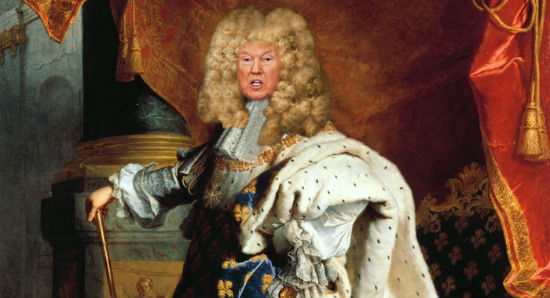
“L’etat c’est moi.” (image snurched from New York magazine, click pic for link to original)
Given that, I agree with Dave Roberts, who observes that Trump is simply a toxic narcissist:
Trump continues to be quite easy to understand, indeed virtually transparent: he’s a toxic narcissist. It explains everything from day one. We’re just so profoundly unfamiliar with that personality ending up in that role, it shocks people over and over and over again.
But, like, of course his only lens into the election is who supported him and who didn’t, or what the results say about him. Of course his only lens into media is who praises him and who doesn’t. Of course his only lens into politics and policymaking is whether they make him look good.
And the next thing? No matter how serious it is, whether a school shooting or a potential war, he will, I promise you, treat it exactly the same way. It will be about him: what it says about him, how it makes him look, who’s with him or against him.
The shock comes from our implicit belief (based on interacting with normal people) that there’s another level, that there’s some subject, some set of events, that could jolt Trump out of his myopia and cause him to grapple with the actual weight/significance of the moment. But there isn’t. Not disease, not war, nothing. The point is he’s incapable of another level. That’s what toxic narcissism means! There is nothing exogenous that can or will change that about him. What you see is what you get, and will get, as long as he’s in power.
Trump depends on nationalists for support because he and they share a similar epistemology.
Orwell is particularly sharp in describing the “indifference to reality” that shapes the way both nationalists and narcissists view the world:
In nationalist thought there are facts which are both true and untrue, known and unknown. A known fact may be so unbearable that it is habitually pushed aside and not allowed to enter into logical processes, or on the other hand it may enter into every calculation and yet never be admitted as a fact, even in one’s own mind.
Every nationalist is haunted by the belief that the past can be altered. He spends part of his time in a fantasy world in which things happen as they should — in which, for example, the Spanish Armada was a success or the Russian Revolution was crushed in 1918 — and he will transfer fragments of this world to the history books whenever possible. Much of the propagandist writing of our time amounts to plain forgery. Material facts are suppressed, dates altered, quotations removed from their context and doctored so as to change their meaning. Events which it is felt ought not to have happened are left unmentioned and ultimately denied. … The primary aim of propaganda is, of course, to influence contemporary opinion, but those who rewrite history do probably believe with part of their minds that they are actually thrusting facts into the past. When one considers the elaborate forgeries … it is difficult to feel that the people responsible are merely lying. More probably they feel that their own version was what happened in the sight of God, and that one is justified in rearranging the records accordingly.
Indifference to objective truth is encouraged by the sealing-off of one part of the world from another, which makes it harder and harder to discover what is actually happening. There can often be a genuine doubt about the most enormous events. For example, it is impossible to calculate within millions, perhaps even tens of millions, the number of deaths caused by the present war. The calamities that are constantly being reported — battles, massacres, famines, revolutions — tend to inspire in the average person a feeling of unreality. One has no way of verifying the facts, one is not even fully certain that they have happened, and one is always presented with totally different interpretations from different sources. … The general uncertainty as to what is really happening makes it easier to cling to lunatic beliefs. Since nothing is ever quite proved or disproved, the most unmistakable fact can be impudently denied. Moreover, although endlessly brooding on power, victory, defeat, revenge, the nationalist is often somewhat uninterested in what happens in the real world. What he wants is to feel that his own unit is getting the better of some other unit, and he can more easily do this by scoring off an adversary than by examining the facts to see whether they support him. All nationalist controversy is at the debating-society level. It is always entirely inconclusive, since each contestant invariably believes himself to have won the victory. Some nationalists are not far from schizophrenia, living quite happily amid dreams of power and conquest which have no connection with the physical world.
The question, I suppose, is whether the millions of defiantly indifferent-to-reality nationalists who now support Donald Trump will one day come to see that he does not share their obsessive concern for “serving something bigger.” Perhaps they will. Perhaps it will slowly dawn on them that Trump loves only Trump and serves only Trump, and that he in no way shares their weaponized devotion to an abstract notion of “the nation.”
But that seems less likely to me than the other possibility, which is that Trump will gradually win them over to his way of thinking — weaning them away from devotion to “the nation” and transferring that devotion to “some other unit,” i.e., to himself. This seems already to have begun, at least among the most fervent nominal “nationalists” who gather at Trump’s rallies. For these devoted followers, Trump is the nation and the nation is Trump.
This seems like the more dangerous outcome. Nationalism is bad. Trumpism is worse.
Previous Post

November 5, 2018
We try to control forgiveness because we know we need it
Next Post
November 8, 2018 Smart people saying smart things (11.8.18)
Browse Our Archives
Select a Category class warfare evangelicals Iraq Left Behind Mammon music Uncategorized
Select a Month October 2026 September 2026 August 2026 July 2026 June 2026 May 2026 April 2026 March 2026 January 2026 December 2025 November 2025 October 2025 September 2025 August 2025 July 2025 June 2025 May 2025 April 2025 March 2025 February 2025 January 2025 December 2024 November 2024 October 2024 September 2024 August 2024 July 2024 June 2024 May 2024 April 2024 March 2024 February 2024 January 2024 December 2023 November 2023 October 2023 September 2023 August 2023 July 2023 June 2023 May 2023 April 2023 March 2023 February 2023 January 2023 December 2022 November 2022 October 2022 September 2022 August 2022 July 2022 June 2022 May 2022 April 2022 March 2022 February 2022 January 2022 December 2021 November 2021 October 2021 September 2021 August 2021 July 2021 June 2021 May 2021 April 2021 March 2021 February 2021 January 2021 December 2020 November 2020 October 2020 September 2020 August 2020 July 2020 June 2020 May 2020 April 2020 March 2020 February 2020 January 2020 December 2019 November 2019 October 2019 September 2019 August 2019 July 2019 June 2019 May 2019 April 2019 March 2019 February 2019 January 2019 December 2018 November 2018 October 2018 September 2018 August 2018 July 2018 June 2018 May 2018 April 2018 March 2018 February 2018 January 2018 December 2017 November 2017 October 2017 September 2017 August 2017 July 2017 June 2017 May 2017 April 2017 March 2017 February 2017 January 2017 December 2016 November 2016 October 2016 September 2016 August 2016 July 2016 June 2016 May 2016 April 2016 March 2016 February 2016 January 2016 December 2015 November 2015 October 2015 September 2015 August 2015 July 2015 June 2015 May 2015 April 2015 March 2015 February 2015 January 2015 December 2014 November 2014 October 2014 September 2014 August 2014 July 2014 June 2014 May 2014 April 2014 March 2014 February 2014 January 2014 December 2013 November 2013 October 2013 September 2013 August 2013 July 2013 June 2013 May 2013 April 2013 March 2013 February 2013 January 2013 December 2012 November 2012 October 2012 September 2012 August 2012 July 2012 June 2012 May 2012 April 2012 March 2012 February 2012 January 2012 December 2011 November 2011 October 2011 September 2011 August 2011 July 2011 June 2011 May 2011 April 2011 March 2011 February 2011 January 2011 December 2010 November 2010 October 2010 September 2010 August 2010 July 2010 June 2010 May 2010 April 2010 March 2010 February 2010 January 2010 December 2009 November 2009 October 2009 September 2009 August 2009 July 2009 June 2009 May 2009 April 2009 March 2009 February 2009 January 2009 December 2008 November 2008 October 2008 September 2008 August 2008 July 2008 June 2008 May 2008 April 2008 March 2008 February 2008 January 2008 December 2007 November 2007 October 2007 September 2007 August 2007 July 2007 June 2007 May 2007 April 2007 March 2007 February 2007 January 2007 December 2006 November 2006 October 2006 September 2006 August 2006 July 2006 June 2006 May 2006 April 2006 March 2006 February 2006 January 2006 December 2005 November 2005 October 2005 September 2005 August 2005 July 2005 June 2005 May 2005 April 2005 March 2005 February 2005 January 2005 December 2004 November 2004 October 2004 September 2004 August 2004 July 2004 June 2004 May 2004 April 2004 March 2004 February 2004 January 2004 December 2003 November 2003 October 2003 September 2003
Follow Us!
TAKE THE
Religious Wisdom Quiz
Who saw a vision of wheels within wheels by the Kebar River?
Select your answer to see how you score.
Micah Ezekiel Jonah Daniel
Related posts from slacktivist

Innocence, identity, and blood libel (cont'd.)
Innocence, identity, and blood libel (part 2)
Innocence, identity, and blood libel (part 1)

'For there is nothing hidden that will not...
TRENDING AT PATHEOS Progressive Christian

Looking at the Largest Orthodox Cathedral on Earth
There is often a considerable amount of anger and, shall we...

The Problem with False Prophets
Miller’s Station UMC| 10/18/26| Anchor Verse: Jeremiah 23: 1, 9-23 I...

Emotion in Early Christianity by Andrew Crislip
Andrew Crislip’s Emotion in Early Christianity examines an often overlooked dimension of...

16 Spiritual Touchstones for a More Grounded Life
After decades of spiritual study, here are 16 principles I try...

Catholic Evangelization: Sharing Your Faith Every Day
Welcome back to the Graceful Awakening mini-series called, “From Faith to Mission.” ...

The Pillar of the Boatmen: the Ancient Monument...
The Pillar of the Boatmen is a Romano-Gaulish sculpture that dates from...
view all Progressive Christian blogs
Ad-Free & Subscriber Log-In Subscription Support
- About Us
- 2026 Calendar
- Videos
- Podcasts
- Library of World Religions
- Faith In Media Tracker
- Advertise With Us
- Write for Us
- Privacy Policy
- Terms of Service
- Do Not Sell My Data
- Contact Us
- Radiant Digital
- Manage Newsletter Subscriptions
- Unsubscribe From Notifications
- Sitemap
Copyright 2008-2026, Patheos. All rights reserved.
Subscription Support Ad-Free & Subscriber Log-In
Follow Patheos