
BuddhistCatholicContemplativeEvangelicalGeneral ChristianHinduJewishLatter-day SaintMuslimNew VisionsProgressive Christian
Beliefs
- Buddhist
- Catholic
- Contemplative
- Evangelical
- General Christian
- Hindu
- Jewish
- Latter-day Saint
- More Voices
- Muslim
- New Visions
- Pagan
- Progressive Christian
Topics
- Religion News
- Food and Religion
- Sports and Religion
- Religious Art
- Religious Music and Entertainment
- Religious Events
- History and Religion
- Style and Religion
- Politics and Religion
- Women in Religion
- Recreation Outdoors and Religion
- Business Finance and Religion
- Careers Workplace and Religion
- Education and Religion
- Family Parenting and Religion
- Health Fitness and Religion
- Home and Religion
- Relationships and Religion
- Technology and Religion
- Travel and Religion
Columnists
- Buddhist Columnists
- Business Finance and Religion Columnists
- Careers Workplace and Religion Columnists
- Catholic Columnists
- Contemplative Columnists
- Education and Religion Columnists
- Evangelists Columnists
- Family Parenting and Religion Columnists
- General Christian Columnists
- Health Fitness and Religion Columnists
- Hindu Columnists
- History and Religion Columnists
- Home and Religion Columnists
- Jewish Columnists
- More Voices Columnists
- Latter Day Columnists
- Muslim Columnists
- New Visions Columnists
- Nonreligious Columnists
- Pagan Columnists
- Politics and Religion Columnists
- Progressive Columnists
- Recreation Outdoors and Religion Columnists
- Relationships and Religion Columnists
- Religion News Columnists
- Religious Art Columnists
- Religious Events Columnists
- Religious Music and Entertainment Columnists
- Sports and Religion Columnists
- Style and Religion Columnists
- Technology and Religion Columnists
- Travel and Religion Columnists
- Women in Religion Columnists
Resource Library
- 2026 Calendar
- Library of World Religions
- The 100 Most Holy Places on Earth
- Patheos Answers
- Podcasts
- Videos
- Faith Leaders Database
- Anglican Episcopalian
- Bahai
- Baptist
- Buddhism
- Christianity
- Confucianism
- Eastern Orthodoxy
- Hinduism
- Holiness and Pentecostal
- ISKCON
- Islam
- Judaism
- Lutheran
- Methodist
- The Church of Jesus Christ of Latter-day Saints
- New Age
- Paganism
- Presbytarian and Reformed
- Protestantism
- Religion Behind the Scenes
- Roman Catholic
- Scientology
- Shia Islam
- Sikhism
- Sufism
- Sunni Islam
- Taoism
- Zen
- See all religions
Research Tools
 Ad-Free & Subscriber Log-In Subscription Support
Ad-Free & Subscriber Log-In Subscription Support
Follow Patheos 

- Trending:
- Forgiveness
- |
- Marriage
- |
- Consciousness
- |
- Death Penalty
- |
- Election
- |
- Halloween

- Home
- Progressive Christian
- LBCF, No. 192: ‘L&J vs. ORBP’
LBCF, No. 192: ‘L&J vs. ORBP’
Last updated on: July 6, 2018 at 8:12 am by Fred Clark
LBCF, No. 192: ‘L&J vs. ORBP’ 2018-07-06T08:12:04-04:00 Fred Clark
Patheos Explore the world's faith through different perspectives on religion and spirituality! Patheos has the views of the prevalent religions and spiritualities of the world.
Originally posted February 13, 2009.
You can read this entire series, for free, via the convenient Left Behind Index. The ebook collection The Anti-Christ Handbook: Volume 1, is available on Amazon for just $2.99. They’re not going to stop with immigrants. Volume 2 of The Anti-Christ Handbook, completing all the posts on the first Left Behind book, is also now available. Volume 3 is coming soon.
Shortly after starting to work our way through the first book in the Left Behind series, we noted that Tim LaHaye and Jerry B. Jenkins seemed to be “Recycling Sydney Watson.”
Watson was an early 20th-century novelist who produced a trilogy of End Times books — Scarlet and Purple, The Mark of the Beast and In the Twinkling of an Eye — from 1913 to 1916.
Writing in Books & Culture, Crawford Gribben noted L&J’s many instances of flagrant borrowing from Watson’s story, concluding that: “At best the novels are deeply intertextual; at worst, it might even be claimed, elements of their fictions are explicitly derivative.” (I think “deeply intertextual” would be a wonderful phrase to hide behind for any college student caught plagiarizing.)
What I want to highlight here are the dates of publication of Watson’s trilogy. These apocalyptic works were produced before the American involvement in World War I,* before the fundamentalist/modernist chasm erupted in the 1920s, and before Einstein and Heisenberg and the rest pulled the rug out from under modernity.
 Watson was thus ahead of his time. The gloomy, fatalistic pessimism of Darby’s premillennial dispensationalism was still more of a fringe phenomenon, the province of Seventh Day Adventists, but not yet of most American evangelicals. Cyrus Scofield had completed the first version of his PMD Reference Bible, but the influential final version wouldn’t appear until after Watson’s trilogy, in 1917.
When Sydney Watson was publishing his fictional prophecies of doom and gloom, the prevailing spirit in American Christianity — including among evangelicals — was an optimistic faith in inevitable progress. Glory, glory, hallelujah, God’s truth is marching on. The outlook was millennial.** Society was improving, and the idea was that it would continue to improve to a state of perfection. Slavery had been abolished and soon other social ills — the drinking of alcohol, for example — would be abolished too. Whether or not we succeeded in electing William Jennings Bryan, we were destined, manifestly, to continue the process that Baptist theologian Walter Rauschenbusch in his 1912 book called Christianizing the Social Order. Rauschenbusch today might be thought of as more of a “mainline Protestant” than an “evangelical,” but those dividing lines had not yet been drawn when he and Watson were writing. His theology drew upon the utopian outlook described in Charles Sheldon’s runaway best-seller In His Steps — the book that gave us the question, “What Would Jesus Do?”
Sheldon was unquestionably evangelical, but he was also, at the very least, sympathetic to the idea of what was then called “Christian socialism,” which tells you all you really need to know about the zeitgeist of American evangelicalism at the dawn of the 20th century. In His Steps was a juggernaut of a best-seller for years following its publication in 1896 (in part due to the failure of Sheldon’s original publisher to secure the copyright). It was a publishing phenomenon along the lines of Harry Potter or the Da Vinci Code or, yes, the Left Behind series. Watson’s trilogy, on the other hand, proved to be influential — creating the template copied by scores of later writers — but was nowhere near as widely read as Sheldon’s book.
I have not read Sydney Watson’s books, but I’m going to go out on a limb and guess that they were at least as well-written and engaging as L&J’s later, derivative series (ahem). So why, then, are L&J gazillionaires at the helm of a publishing empire while Watson’s books are obscure and out of print?
Two reasons, I think. Timing and marketing.
Watson was not just ahead of his time, but against it. He was peddling pessimism before it was all the rage. And he had the misfortune of publishing his series before the success of Scofield’s 1917 Reference Bible prepared the soil.
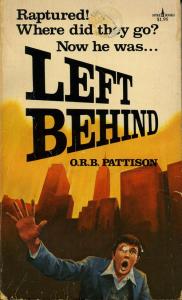
A similar misfortune befell the publication of Olive Ruth Brown Pattison’s apocalyptic thriller published by Fleming H. Revell/Spire Books. The paperback edition, as you’ve already seen from the picture above, was called Left Behind. (The hardcover edition was originally published, a few months earlier, as The Undelivered.)
Yep, same title. Same premise. Very similar End Times check list. But this book barely registered when it was published in 1969. Apart from the echo of its title in the current blockbuster series, O.R.B. Pattison’s book left little trace on the evangelical subculture. I’d never even heard of this book’s existence until Atrios sent me a copy (thank you again, kind sir) and I spent a chunk of my childhood helping my mother create card catalogs for the libraries of both a PMD church and private school.
I can’t really say that Pattison’s Left Behind is a good book, but it is far more engaging and better written than the World’s Worst Books are. (That sets the bar very low, but it clears it.) Here, for example, is how Pattison’s story begins:
The typically muggy heat of Washington’s midsummer had penetrated the basement garage, its oppressiveness exaggerated by contrast with the air-conditioned coolness of the government offices above. Evans peeled off his coat and tossed it atop his attache case before sliding behind the wheel of his two-seater Electro Town Car. With the windows rolled down, he edged into the line of similar small cars heading toward the exit ramp, wishing for the hundredth time that someone would devise a way to power the new battery driven cars for air conditioning. Beyond the jockeying congestion of Constitution Avenue, the traffic inched across Arlington bridge, accelerating slightly as it swept into the low rolling hills of Virginia. Heat mirages shimmered from the sun-baked paving.
Evans scrubbed his handkerchief over his forehead and blond brush-cut hair, irritably. Only Wednesday, he thought. Wednesday: two more days to go before the weekend. …
Ken Evans is already far more appealing than either Rayford Steele or Buck Williams ever manages to be. And unlike L&J — who have Manhattan stretching into central Connecticut while cruise ships sail in the Jordan River — she presents a recognizable geography of Washington and its suburbs. Pattison’s hints of sci-fi detail for her not-so-distant-future setting all seem, like that Electro Town Car, a bit quaintly dated, but not too bad for 1969.
So Pattison’s lack of success relative to L&J thus can’t be attributed to her book’s relative lack of appeal. Her problem was that she was writing in 1969 while their series began publication in 1995. The world of difference there is that L&J were writing post-Hal Lindsey while O.R.B.P. was writing pre-Hal Lindsey.**** Lindsey, you may recall, was the author of runaway best-sellers in the 1970s including The Late Great Planet Earth, There’s a New World Coming and Satan Is Alive and Well on Planet Earth. Like Scofield in 1917, Lindsey benefited from impeccable timing, popularizing a brand of apocalyptic pessimism just as the broader culture began to adopt a similarly pessimistic outlook. Lindsey caught the wave of the zeitgeist that Pattison just missed and he rode it for a decade, making a fortune while indoctrinating a whole generation of evangelicals. He blazed the trail that L&J would follow.
Spire Books tried to follow that trail, reissuing Pattison’s novel along with its own mass market editions of other apocalyptic PMD books throughout the 1970s, including Lindsey’s The Terminal Generation and titles like Frank Allnut’s The Antichrist After The Omen (“Learn the truth about the Satanic mission of the Antichrist, and how you can prepare for his coming”). But they never really had the marketing muscle that Tyndale was able to put behind L&J’s later novels.
In retrospect, Pattison should have agreed to be a “co-author” of the book she wrote, the way that Jerry B. Jenkins is listed (second) as the co-author of the books he wrote. Left Behind by Jerry B. Jenkins likely would have enjoyed the same lackluster marketing and sales that Left Behind by O.R.B. Pattison did. But Left Behind by Tim LaHaye and Jerry B. Jenkins had a Big Name on the cover, and that Big Name meant Big Marketing and Big Sales.
Unlike Jenkins, however, Pattison wasn’t a hired gun. LaHaye thought a book would sell so he slapped some notes on a napkin and hired Jerry Jenkins to write the thing. Jenkins didn’t have the pride of ownership that Pattison earned from choosing, on her own, to sit down and write a novel. Too bad for her. A 1980 re-release of her Left Behind repackaged as “by Hal Lindsay with O.R.B. Pattison,” or “by John Walvoord and O.R.B. Pattison,” might have made her a very wealthy woman.*****
After all this talk of zeitgeist it’s tempting to interpret (or impose) some kind of grand pattern, both within the evangelical subculture and the larger culture that hosts it, of an oscillation between millennialist optimism and fatalism, whether premillennial or otherwise. And it would be even more tempting, then, to use such a pattern as an argument for my own position of a Niebuhrian, chastened hopefulness as a kind of Golden Mean. But to be honest, I’m not really confident in my ability to interpret such things.
During the 1990s, as I was working for the group that launched what would eventually become the Evangelical Environmental Network, I used to riff about how I thought this effort would become easier at the beginning of the 21st century, after the fin de siecle alarmism of the late 20th century had worked itself out and been proven false. By then, I figured, two thousand zero zero would have come and gone and people would realize that it didn’t mean party’s over whoops out of time.
But while EEN’s message of “creation care” is proving to be more influential than I’d ever hoped it might be, apocalyptic alarmism is as perniciously popular among American evangelicals in 2009 as it was in 1999. So what do I know?
In any case, LaHaye and Jenkins are just the latest in a long line of salesmen pushing this nonsense and there will be others. But while I expect to see plenty more of their kind — more Watsons, Scofields, Lindseys, Pattisons and LaHayes — that’s not what I’m hoping for. I don’t want to see anyone else offering a “deeply intertextual” variation on Sydney Watson’s template. I want to see them start ripping off Charles Sheldon instead.
– – – – – – – – – – – –
* It may seem a bit overly tidy, but WWI really does serve as a watershed event for the death of millennial optimism. Or, to mix the metaphor, as the high-water mark of that millennial optimism — you can’t get much more millennial than the idea of a “war to end all wars.” This is why I don’t really understand the saying, “There are no atheists in foxholes.” The reality, as seen from the enduring cultural and theological repercussions of World War I, is rather that very few theists emerge from the trenches.
I actually somewhat agree with those post-theological theologians who say that God died in the trenches of World War I. “Inasmuch as ye have mustard gassed the least of these, my brethren, ye have done it unto me,” God says. It wasn’t the first time we’d killed him and it sure as Hell wouldn’t be the last. But that’s never the end of the story.
** The pre in premillennial comes from the idea that the world must end before Jesus returns to establish his millennial reign of perfect justice. Millennial here refers to the thousand-year reign of Christ mentioned in the Bible. This is, for most Christians, understood broadly as a statement of eschatological hope — in the end, there will be peace and justice, milk and honey, lions and lambs, etc. PMDs, as is their wont, interpret this in the style they call “literal,” as a period of not less than and not to exceed 365,242 days*** during which Jesus Christ will literally reign as a literal king on a literal throne with a literal crown on his literal head. PMDs long for this literal reign of Christ just as other Christians long for the messianic reign of perfect justice. But while those other Christians believe that the reign of God is both now and not yet, and thus believe that we can and ought to work toward a more perfect justice here on earth, PMDs are relieved of this responsibility and, in fact, view such efforts as not merely futile, but perverse. The millennial reign, they believe, will not come until after the end of the world, until after the widening gyre spirals down to its nadir of suffering, sin and injustice. This is why PMDs so often sound like the villains on Buffy the Vampire Slayer, awaiting the day that the Hellmouth is opened and the longed-for apocalypse at last arrives.
*** Every fourth year, of course, being a leap year, except for century years not divisible by 400. John of Patmos, PMDs believe, was writing for Christians of our dispensation of time (and only for Christians of our time) and thus must have been divinely informed of the particular quirks of our Gregorian calendar.
**** Also pre-Frank Peretti. Before the runaway success of his spiritual warfare as Mortal Kombat! horror novels, the evangelical Christian book market viewed fiction as a distracting sideshow, a way of padding out the shelf next to the Narnia books and the Grace Livingston Hill.
***** She did go on to publish 10 more novels under the name Ruth Abbey. I’m tempted to call her Ruth “Northanger” Abbey, due to the titles of some of those novels: Prisoner of the Manor, Evil at Nunnery Manor, Bridge of Tears, House by the Tarn, Dream of Terror, etc.
Previous Post

July 5, 2018
Out in the hall they were talking in a whisper
Next Post
July 6, 2018 Remembering the 'boat people' gives me a sinking feeling
Browse Our Archives
Select a Category class warfare evangelicals Iraq Left Behind Mammon music Uncategorized
Select a Month October 2026 September 2026 August 2026 July 2026 June 2026 May 2026 April 2026 March 2026 January 2026 December 2025 November 2025 October 2025 September 2025 August 2025 July 2025 June 2025 May 2025 April 2025 March 2025 February 2025 January 2025 December 2024 November 2024 October 2024 September 2024 August 2024 July 2024 June 2024 May 2024 April 2024 March 2024 February 2024 January 2024 December 2023 November 2023 October 2023 September 2023 August 2023 July 2023 June 2023 May 2023 April 2023 March 2023 February 2023 January 2023 December 2022 November 2022 October 2022 September 2022 August 2022 July 2022 June 2022 May 2022 April 2022 March 2022 February 2022 January 2022 December 2021 November 2021 October 2021 September 2021 August 2021 July 2021 June 2021 May 2021 April 2021 March 2021 February 2021 January 2021 December 2020 November 2020 October 2020 September 2020 August 2020 July 2020 June 2020 May 2020 April 2020 March 2020 February 2020 January 2020 December 2019 November 2019 October 2019 September 2019 August 2019 July 2019 June 2019 May 2019 April 2019 March 2019 February 2019 January 2019 December 2018 November 2018 October 2018 September 2018 August 2018 July 2018 June 2018 May 2018 April 2018 March 2018 February 2018 January 2018 December 2017 November 2017 October 2017 September 2017 August 2017 July 2017 June 2017 May 2017 April 2017 March 2017 February 2017 January 2017 December 2016 November 2016 October 2016 September 2016 August 2016 July 2016 June 2016 May 2016 April 2016 March 2016 February 2016 January 2016 December 2015 November 2015 October 2015 September 2015 August 2015 July 2015 June 2015 May 2015 April 2015 March 2015 February 2015 January 2015 December 2014 November 2014 October 2014 September 2014 August 2014 July 2014 June 2014 May 2014 April 2014 March 2014 February 2014 January 2014 December 2013 November 2013 October 2013 September 2013 August 2013 July 2013 June 2013 May 2013 April 2013 March 2013 February 2013 January 2013 December 2012 November 2012 October 2012 September 2012 August 2012 July 2012 June 2012 May 2012 April 2012 March 2012 February 2012 January 2012 December 2011 November 2011 October 2011 September 2011 August 2011 July 2011 June 2011 May 2011 April 2011 March 2011 February 2011 January 2011 December 2010 November 2010 October 2010 September 2010 August 2010 July 2010 June 2010 May 2010 April 2010 March 2010 February 2010 January 2010 December 2009 November 2009 October 2009 September 2009 August 2009 July 2009 June 2009 May 2009 April 2009 March 2009 February 2009 January 2009 December 2008 November 2008 October 2008 September 2008 August 2008 July 2008 June 2008 May 2008 April 2008 March 2008 February 2008 January 2008 December 2007 November 2007 October 2007 September 2007 August 2007 July 2007 June 2007 May 2007 April 2007 March 2007 February 2007 January 2007 December 2006 November 2006 October 2006 September 2006 August 2006 July 2006 June 2006 May 2006 April 2006 March 2006 February 2006 January 2006 December 2005 November 2005 October 2005 September 2005 August 2005 July 2005 June 2005 May 2005 April 2005 March 2005 February 2005 January 2005 December 2004 November 2004 October 2004 September 2004 August 2004 July 2004 June 2004 May 2004 April 2004 March 2004 February 2004 January 2004 December 2003 November 2003 October 2003 September 2003
Follow Us!
TAKE THE
Religious Wisdom Quiz
Who said, "Could not he who opened the eyes of the blind man have kept this man from dying?"
Select your answer to see how you score.
The centurion Mourners at Lazarus' tomb Mary Magdalene Peter
Related posts from slacktivist

Can't seem to get it through my head

For Buffy and Carl so loved the world


'To every generation': Child abuse at Cornerstone Church
TRENDING AT PATHEOS Progressive Christian

Nearly every morning, I make the drive to Detroit with my high-school-age...

The Real AI Story Is Adoption Without Trust
Artificial intelligence has crossed a political threshold. It is no longer a...

A new article, written by Jeff Lindsay and Gale L. Pooley,...

Swimfan: Forgotten Aughts Pleasures
This is a recovery effort. In 2002, My Big Fat Greek Wedding...

Top Three Anti-Catholic Lies About Catholicism
This is my initial transcript for the video, "THE 3 WORST...

Pope Leo Celebrates Mass for Nurses & Docs...
I don't have any idea how he did it, but Pope Leo...
view all Progressive Christian blogs
Ad-Free & Subscriber Log-In Subscription Support
- About Us
- 2026 Calendar
- Videos
- Podcasts
- Library of World Religions
- Faith In Media Tracker
- Advertise With Us
- Write for Us
- Privacy Policy
- Terms of Service
- Do Not Sell My Data
- Contact Us
- Radiant Digital
- Manage Newsletter Subscriptions
- Unsubscribe From Notifications
- Sitemap
Copyright 2008-2026, Patheos. All rights reserved.
Subscription Support Ad-Free & Subscriber Log-In
Follow Patheos