
BuddhistCatholicContemplativeEvangelicalGeneral ChristianHinduJewishLatter-day SaintMuslimNew VisionsProgressive Christian
Beliefs
- Buddhist
- Catholic
- Contemplative
- Evangelical
- General Christian
- Hindu
- Jewish
- Latter-day Saint
- More Voices
- Muslim
- New Visions
- Pagan
- Progressive Christian
Topics
- Religion News
- Food and Religion
- Sports and Religion
- Religious Art
- Religious Music and Entertainment
- Religious Events
- History and Religion
- Style and Religion
- Politics and Religion
- Women in Religion
- Recreation Outdoors and Religion
- Business Finance and Religion
- Careers Workplace and Religion
- Education and Religion
- Family Parenting and Religion
- Health Fitness and Religion
- Home and Religion
- Relationships and Religion
- Technology and Religion
- Travel and Religion
Columnists
- Buddhist Columnists
- Business Finance and Religion Columnists
- Careers Workplace and Religion Columnists
- Catholic Columnists
- Contemplative Columnists
- Education and Religion Columnists
- Evangelists Columnists
- Family Parenting and Religion Columnists
- General Christian Columnists
- Health Fitness and Religion Columnists
- Hindu Columnists
- History and Religion Columnists
- Home and Religion Columnists
- Jewish Columnists
- More Voices Columnists
- Latter Day Columnists
- Muslim Columnists
- New Visions Columnists
- Nonreligious Columnists
- Pagan Columnists
- Politics and Religion Columnists
- Progressive Columnists
- Recreation Outdoors and Religion Columnists
- Relationships and Religion Columnists
- Religion News Columnists
- Religious Art Columnists
- Religious Events Columnists
- Religious Music and Entertainment Columnists
- Sports and Religion Columnists
- Style and Religion Columnists
- Technology and Religion Columnists
- Travel and Religion Columnists
- Women in Religion Columnists
Resource Library
- 2026 Calendar
- Library of World Religions
- The 100 Most Holy Places on Earth
- Patheos Answers
- Podcasts
- Videos
- Faith Leaders Database
- Anglican Episcopalian
- Bahai
- Baptist
- Buddhism
- Christianity
- Confucianism
- Eastern Orthodoxy
- Hinduism
- Holiness and Pentecostal
- ISKCON
- Islam
- Judaism
- Lutheran
- Methodist
- The Church of Jesus Christ of Latter-day Saints
- New Age
- Paganism
- Presbytarian and Reformed
- Protestantism
- Religion Behind the Scenes
- Roman Catholic
- Scientology
- Shia Islam
- Sikhism
- Sufism
- Sunni Islam
- Taoism
- Zen
- See all religions
Research Tools
 Ad-Free & Subscriber Log-In Subscription Support
Ad-Free & Subscriber Log-In Subscription Support
Follow Patheos 

- Trending:
- Forgiveness
- |
- Marriage
- |
- Consciousness
- |
- Death Penalty
- |
- Election
- |
- Halloween

- Home
- Progressive Christian
- LBCF, No. 167: ‘Back to school’
LBCF, No. 167: ‘Back to school’
Last updated on: January 5, 2018 at 3:05 pm by Fred Clark
LBCF, No. 167: ‘Back to school’ 2018-01-05T15:05:23-05:00 Fred Clark
Patheos Explore the world's faith through different perspectives on religion and spirituality! Patheos has the views of the prevalent religions and spiritualities of the world.
Originally posted June 6, 2008.
Read this entire series, for free, via the convenient Left Behind Index. This post is also part of the ebook collection The Anti-Christ Handbook: Volume 1, available on Amazon for just $2.99. Subliminal advertisement. Volume 2 of The Anti-Christ Handbook, completing all the posts on the first Left Behind book, is also now available.
Left Behind, pp. 442-443
Chloe Steele told her father of her plans to finally look into local college classes that Monday.
That makes sense, right? Chloe was just beginning the winter quarter of her freshman year at Stanford when her studies were interrupted by a loss in her family. She returned home to be with her father but now, after two weeks of sitting around at home, she’s looking into resuming her studies closer to home. Makes perfect sense.
Or, rather, it would make perfect sense in a completely different novel — one where the Steeles’ family trauma was an isolated event and not part of a global apocalypse, a world-altering trauma heralding the end of the world. Here in Left Behind, the idea that Chloe would begin resuming classes — or that there would even be classes for her to resume — doesn’t make any sense at all.
Part of the reason that she can’t just pick up where she left off after her mother’s funeral is that there was no funeral. Not for Irene, not for Rayford Jr., not for any of the 2 billion or so people all over the world who are now gone.
Tim LaHaye and Jerry Jenkins could not allow funerals in this book. For them, everything depends on their ability to maintain an artificial distinction between “raptured” and “dead.” This isn’t just the alleged premise for this book, it’s the linchpin for their entire End Times check list and the thing that reshapes every aspect of their theology — not just eschatology but soteriology, ecclesiology, theodicy, the whole shebang. If they’d allowed funerals in Left Behind, then this artificial distinction would’ve been impossible to sustain and the wheels would have flown off their entire belief system.
In the early pages of the book, Rayford recalls his wife’s cheerful description of this indistinct distinction:
“Can you imagine, Rafe,” she exulted, “Jesus coming back to get us before we die?”
Her tone would have been a bit less exultant if she had avoided the euphemistic dodge of the “Rapture”: “Can you imagine, Rafe, Jesus coming back to grant us an instantaneous and painless death?”
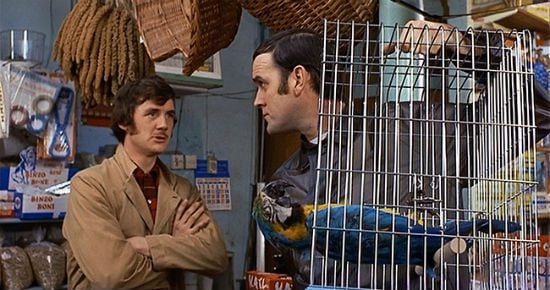
But the latter is just as accurate as the former. Irene and every other real, true Christian, and Raymie and every other innocent child on the planet have passed on. They are no more. They have ceased to be, gone to meet their maker. They’ve shuffled off their mortal coil, run down the curtain and joined the bleedin’ choir invisible. The plumage don’t enter into it.
This transition from earth to heaven, from life to afterlife, is in every way indistinguishable from the inevitable form that this transition usually takes. We have a word for that experience. It’s called “dying.” Irene Steele went to bed, fell asleep and died. Saying that she was raptured does not, in any meaningful way, change the experience for her. Her experience of this event would’ve been no different had there been a carbon monoxide leak, or a gas leak and explosion, or a Donnie Darko-style jet engine through the roof. And the experience for those she left behind — for her surviving husband and daughter — isn’t different in any meaningful way either.
The majority of the 2 billion or so “raptured” at the start of this book are children, those L&J believe are below some blurry “age of accountability” and who therefore would be regarded as innocents. (In interviews outside of the book L&J seem to underestimate the proportion of the earth’s populace that falls into this age range. They seem to have assumed that developing countries would have the same basic ratio of old and young as we have here in the U.S.) These innocent children are included in the Rapture, L&J say, because God is merciful, sparing them the suffering of the coming Great Tribulation.*
Viewing the rapturing of these children as an act of divine mercy is entirely dependent on the dubious distinction between raptured and dead. As long as we think of it as a worldwide “snatching away,” and not as a worldwide slaughter, then we can pretend that what has happened to all those children is somehow merciful. But that requires us to avoid anything that would allow or cause us to think more deeply about whether these things really are any different. Such deeper thoughts cast a disturbing light on Irene’s exultant longing for the coming Rapture — and on the longing of her real-world counterparts.
“To live is Christ, to die is gain,” St. Paul wrote, but this longing for and celebration of a global Rapture seems to have less to do with that than with something more like Jonestown, or Heaven’s Gate, or the Movement for the Restoration of the Ten Commandments.
Hence no funerals in Left Behind. Better to describe an impossible world in which humans do not act like humans — in which the universal human need to grieve and to ritualize mourning does not exist — than to allow readers to reflect on the similarities between the indistinguishable statements “Irene was raptured” and “Irene was dead.” Elephants mourn their dead. The alleged humans in Left Behind do not.
But even in the impossible, inhuman, no-funerals-allowed world of this book it seems unlikely that local colleges would or could so soon be resuming their normal routine.
A mere two weeks after The Event, these schools would still be struggling to figure out which of their students and faculty members were among the disappeared. I realize that L&J view intellectual, academic types as inherently ungodly, but surely some of them would have been taken, and surely some would have been killed in the hundreds of plane crashes and thousands of highway disasters that occurred the night of The Event. And even if those who remained/survived aren’t allowed to conduct funerals or memorial services, they would all, like Chloe, have been touched in some way by the disappearances and the concurrent carnage.
Consider also how The Event would forever alter most of the various academic disciplines. Physics and chemistry professors couldn’t very well continue teaching their students about the Conservation of Matter, what with 50 million or so tons of the stuff having just vanished from the universe. Professors teaching early childhood education or obstetrics probably wouldn’t see much sense in continuing with business as usual either. Those professors of religion and philosophy who remained would, of course, all be busy berating themselves because they were wrong, wrong, wrong not to have listened to Tim LaHaye.
It’s hard to imagine a course of study that wouldn’t have been shattered and turned upside down by The Event. But even if we assume that Chloe is studying subjects that might seem unaffected — say, I don’t know, Renaissance poetry — it seems impossible that classes could just go on as before without the professor breaking down, sobbing, mid-lecture. “Today we’re going to turn again to Petrarch’s sonnets, and … and … and …” (curls into fetal ball behind the podium) “My daughter. My beautiful daughter is gone and no one can tell me what has happened to her … et le piaghe che ‘nfin al cor mi vanno …”
Then there’s the question of where Chloe might be studying, of which local college she would be enrolling in.
This is trickier than it might seem. She’s a convert now, a member of New Hope Village Church’s prophecy-addled variant of the evangelical subculture. As such, somewhere like Northwestern or the University of Chicago just won’t do. But if such hotbeds of secular humanism would no longer be an option for Chloe neither would she have any remaining religious options of the sort viewed as acceptable by her newly adopted subculture. Pre-Event she’d have had multiple options within commuting distance — Wheaton College, Trinity Christian College, Judson University, even Christian Life College right there in town. But post-Event those campuses would be all-but deserted.** If the Christian alternatives are now closed and the secular schools are now unacceptable to her — devoid even of the shelter of a Campus Crusade chapter, like Sodom without even 10 righteous to be found — then where exactly is Chloe supposed to go?
Then again, the above difficulties all seem secondary to the larger question of why Chloe would even bother with college. The world is going to end in six years and 352 days. Spending three and a half of those years working toward her B.A. might not seem like a big priority at this point — even if she thinks that she’d be able to finish in that amount of time without things like Wormwood poisoning the seas or an army of monstrous dragon-locusts interrupting her studies. (On the other hand, it would be pretty sweet to take out all those college loans knowing that you’d never have to pay them back.)
Alas, all of this discussion about Chloe’s college plans turns out to be, well, academic. She soon ends up married to Buck and thus, in the authors’ view, no longer needs to worry her pretty little head about getting an education.
“And I was thinking,” she said, “about trying to get together with Hattie for lunch.”
“I thought you didn’t care for her,” Rayford said.
“I don’t, but that’s no excuse. She doesn’t even know what’s happened to me. She’s not answering her phone. Any idea what her schedule is?”
I appreciate the distinction Chloe makes there — the obligation to care about people even if you don’t care for them. That’s a rare thing here in Left Behind. Note the contrast here between Chloe’s willingness to go out of her way to meet with someone she doesn’t really like and Buck’s unwillingness, a few pages ago, to answer the direct questions of a friendly stranger. Even post-conversion Stepford Chloe seems like she could do better than Buck.
Her dad calls the airline to find out Hattie’s schedule:
Rayford was told that not only was Hattie not scheduled that day but also that she had requested a 30-day leave of absence. “That’s odd,” he told Chloe. “Maybe she’s got family troubles out West.”
Not that he’s going to bother checking in with her to find out if everything’s OK. Rayford doesn’t care for or about Hattie. He assuaged his guilt over their pseudo-affair by forcing her to sit silently through his evangelistic lecture, so as far as he’s concerned, he doesn’t need to give her another thought. And anyway, he’s busy:
“I promised Bruce I’d come over and watch that Carpathia press conference later this morning.”
It might seem easy to mock Rayford and Bruce’s idea of a good time here, but I’d be eager to see that press conference too. There’s a chance, after all, that Nicolae could announce what the new One World Language was going to be, and if that didn’t turn out to be English I might need to re-enroll in college myself.
– – – – – – – – – – – –
* This Great Tribulation, according to LaHaye and his prophecy-studies compatriots, is a calamitous time shaped by war, famine, disease and, stalking in the rear, gigantic, inevitable death within seven years. It’s worth noting that this is, right now, an apt description of what life is actually like for millions of children here in the real world. I would ask why God isn’t doing something to change that for these innocents but, as the saying goes, I’d be afraid that God would just ask me the same question.
** I’m picturing poor Mark Noll, shell-shocked and wandering through the empty halls of Wheaton’s campus, muttering to himself and ripping the pages one by one from Michael Williams’ This World Is Not My Home like Ophelia with her wildflowers.
Previous Post

January 4, 2018
They can't even sing to their shadows
Next Post
January 6, 2018 Epiphany: Jesus wept
Browse Our Archives
Select a Category class warfare evangelicals Iraq Left Behind Mammon music Uncategorized
Select a Month October 2026 September 2026 August 2026 July 2026 June 2026 May 2026 April 2026 March 2026 January 2026 December 2025 November 2025 October 2025 September 2025 August 2025 July 2025 June 2025 May 2025 April 2025 March 2025 February 2025 January 2025 December 2024 November 2024 October 2024 September 2024 August 2024 July 2024 June 2024 May 2024 April 2024 March 2024 February 2024 January 2024 December 2023 November 2023 October 2023 September 2023 August 2023 July 2023 June 2023 May 2023 April 2023 March 2023 February 2023 January 2023 December 2022 November 2022 October 2022 September 2022 August 2022 July 2022 June 2022 May 2022 April 2022 March 2022 February 2022 January 2022 December 2021 November 2021 October 2021 September 2021 August 2021 July 2021 June 2021 May 2021 April 2021 March 2021 February 2021 January 2021 December 2020 November 2020 October 2020 September 2020 August 2020 July 2020 June 2020 May 2020 April 2020 March 2020 February 2020 January 2020 December 2019 November 2019 October 2019 September 2019 August 2019 July 2019 June 2019 May 2019 April 2019 March 2019 February 2019 January 2019 December 2018 November 2018 October 2018 September 2018 August 2018 July 2018 June 2018 May 2018 April 2018 March 2018 February 2018 January 2018 December 2017 November 2017 October 2017 September 2017 August 2017 July 2017 June 2017 May 2017 April 2017 March 2017 February 2017 January 2017 December 2016 November 2016 October 2016 September 2016 August 2016 July 2016 June 2016 May 2016 April 2016 March 2016 February 2016 January 2016 December 2015 November 2015 October 2015 September 2015 August 2015 July 2015 June 2015 May 2015 April 2015 March 2015 February 2015 January 2015 December 2014 November 2014 October 2014 September 2014 August 2014 July 2014 June 2014 May 2014 April 2014 March 2014 February 2014 January 2014 December 2013 November 2013 October 2013 September 2013 August 2013 July 2013 June 2013 May 2013 April 2013 March 2013 February 2013 January 2013 December 2012 November 2012 October 2012 September 2012 August 2012 July 2012 June 2012 May 2012 April 2012 March 2012 February 2012 January 2012 December 2011 November 2011 October 2011 September 2011 August 2011 July 2011 June 2011 May 2011 April 2011 March 2011 February 2011 January 2011 December 2010 November 2010 October 2010 September 2010 August 2010 July 2010 June 2010 May 2010 April 2010 March 2010 February 2010 January 2010 December 2009 November 2009 October 2009 September 2009 August 2009 July 2009 June 2009 May 2009 April 2009 March 2009 February 2009 January 2009 December 2008 November 2008 October 2008 September 2008 August 2008 July 2008 June 2008 May 2008 April 2008 March 2008 February 2008 January 2008 December 2007 November 2007 October 2007 September 2007 August 2007 July 2007 June 2007 May 2007 April 2007 March 2007 February 2007 January 2007 December 2006 November 2006 October 2006 September 2006 August 2006 July 2006 June 2006 May 2006 April 2006 March 2006 February 2006 January 2006 December 2005 November 2005 October 2005 September 2005 August 2005 July 2005 June 2005 May 2005 April 2005 March 2005 February 2005 January 2005 December 2004 November 2004 October 2004 September 2004 August 2004 July 2004 June 2004 May 2004 April 2004 March 2004 February 2004 January 2004 December 2003 November 2003 October 2003 September 2003
Follow Us!
TAKE THE
Religious Wisdom Quiz
What attitude does Jesus teach toward children?
Select your answer to see how you score.
Send them away Teach them to fight Welcome them Ignore them
Related posts from slacktivist

Can't seem to get it through my head

For Buffy and Carl so loved the world


'To every generation': Child abuse at Cornerstone Church
TRENDING AT PATHEOS Progressive Christian

Methodist Central Hall and Westminster Abbey
Situated on the same square is Methodist Central Hall and Westminster Abbey. ...

57th Dove Awards Honor Dolly Parton, Crown New...
On gospel music’s biggest night, the 57th annual GMA Dove Awards honored...

The First Eucharistic Controversy: Christ’s Real Presence
For Catholics, the Eucharist is the source and summit of the Christian...

What a Stop Sign Can Teach Us About...
How to Make a Decision When You Can't Hear God Main point:...

Archdiocese Hosts Military Marriage Retreat in Germany
RASTATT, Germany — The transient military lifestyle, with its frequent deployments and...

Nearly every morning, I make the drive to Detroit with my high-school-age...
view all Progressive Christian blogs
Ad-Free & Subscriber Log-In Subscription Support
- About Us
- 2026 Calendar
- Videos
- Podcasts
- Library of World Religions
- Faith In Media Tracker
- Advertise With Us
- Write for Us
- Privacy Policy
- Terms of Service
- Do Not Sell My Data
- Contact Us
- Radiant Digital
- Manage Newsletter Subscriptions
- Unsubscribe From Notifications
- Sitemap
Copyright 2008-2026, Patheos. All rights reserved.
Subscription Support Ad-Free & Subscriber Log-In
Follow Patheos