
BuddhistCatholicContemplativeEvangelicalGeneral ChristianHinduJewishLatter-day SaintMuslimNew VisionsProgressive Christian
Beliefs
- Buddhist
- Catholic
- Contemplative
- Evangelical
- General Christian
- Hindu
- Jewish
- Latter-day Saint
- More Voices
- Muslim
- New Visions
- Pagan
- Progressive Christian
Topics
- Religion News
- Food and Religion
- Sports and Religion
- Religious Art
- Religious Music and Entertainment
- Religious Events
- History and Religion
- Style and Religion
- Politics and Religion
- Women in Religion
- Recreation Outdoors and Religion
- Business Finance and Religion
- Careers Workplace and Religion
- Education and Religion
- Family Parenting and Religion
- Health Fitness and Religion
- Home and Religion
- Relationships and Religion
- Technology and Religion
- Travel and Religion
Columnists
- Buddhist Columnists
- Business Finance and Religion Columnists
- Careers Workplace and Religion Columnists
- Catholic Columnists
- Contemplative Columnists
- Education and Religion Columnists
- Evangelists Columnists
- Family Parenting and Religion Columnists
- General Christian Columnists
- Health Fitness and Religion Columnists
- Hindu Columnists
- History and Religion Columnists
- Home and Religion Columnists
- Jewish Columnists
- More Voices Columnists
- Latter Day Columnists
- Muslim Columnists
- New Visions Columnists
- Nonreligious Columnists
- Pagan Columnists
- Politics and Religion Columnists
- Progressive Columnists
- Recreation Outdoors and Religion Columnists
- Relationships and Religion Columnists
- Religion News Columnists
- Religious Art Columnists
- Religious Events Columnists
- Religious Music and Entertainment Columnists
- Sports and Religion Columnists
- Style and Religion Columnists
- Technology and Religion Columnists
- Travel and Religion Columnists
- Women in Religion Columnists
Resource Library
- 2026 Calendar
- Library of World Religions
- The 100 Most Holy Places on Earth
- Patheos Answers
- Podcasts
- Videos
- Faith Leaders Database
- Anglican Episcopalian
- Bahai
- Baptist
- Buddhism
- Christianity
- Confucianism
- Eastern Orthodoxy
- Hinduism
- Holiness and Pentecostal
- ISKCON
- Islam
- Judaism
- Lutheran
- Methodist
- The Church of Jesus Christ of Latter-day Saints
- New Age
- Paganism
- Presbytarian and Reformed
- Protestantism
- Religion Behind the Scenes
- Roman Catholic
- Scientology
- Shia Islam
- Sikhism
- Sufism
- Sunni Islam
- Taoism
- Zen
- See all religions
Research Tools
 Ad-Free & Subscriber Log-In Subscription Support
Ad-Free & Subscriber Log-In Subscription Support
Follow Patheos 

- Trending:
- Forgiveness
- |
- Marriage
- |
- Consciousness
- |
- Death Penalty
- |
- Election
- |
- Halloween

- Home
- Progressive Christian
- ‘The WHY of this turn to the body’
‘The WHY of this turn to the body’
Last updated on: May 30, 2017 at 6:55 pm by Fred Clark
‘The WHY of this turn to the body’ 2017-05-30T18:55:17-04:00 Fred Clark
Patheos Explore the world's faith through different perspectives on religion and spirituality! Patheos has the views of the prevalent religions and spiritualities of the world.
Jeff Sharlet provides a history lesson of his own in his long, insightful review of Frances FitzGerald’s 700-page new history, The Evangelicals. Sharlet’s take is less critical than Randall Balmer’s (“Reading evangelical history with one eye closed”), but he offers some incisive thoughts on the gaps in FitzGerald’s account, which races through the early “Awakenings” to arrive at the rise of the religious right in the late 20th century.
Those gaps help to illustrate why the lockstep partisanship of the politicized religious right is not a new thing in white evangelicalism. Perhaps even, as Christopher Stroop recently remarked on Twitter, why “Sadly, Billy Graham people have always been Franklin Graham people.”
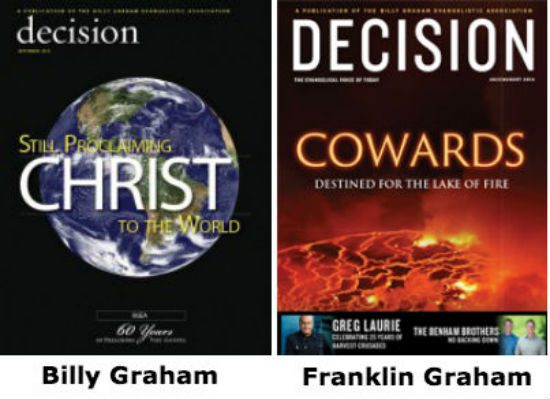
Filling in the gaps in that long history and long pedigree is important, because in tracing what hasn’t changed over the years, Sharlet is better able to focus on what has changed — on the one thing that’s new and unprecedented in the religious right:
Conservative evangelicalism has been an essential part of American politics going back much further than 1980. International Christian Leadership was the Christian Coalition of its day, less visible mainly because its aesthetic was establishmentarian. By contrast, Robertson and his peers, following the example of Reagan, emphasized the populist aesthetic of their tradition — even as they encouraged their followers to cling ever more fiercely to the corporate economics that had once been more of a concern of the men who paid for revivals than for the men and women who attended them.
What did change with the rise of the Christian Right was its emphasis on the politics of the body. Not so much actual bodies as imagined ones: particularly those destroyed by what some evangelicals came to call the “holocaust” of abortion. Towards the end of The Evangelicals, FitzGerald pays special attention to the case of Terri Schiavo, whose brain-dead body became a cause célèbre for evangelicals in the 2000s. The why of this turn toward the body — beyond the past interventions of fundamentalist intellectuals like Francis Schaeffer and Chuck Colson — remains an important question in evangelical history. FitzGerald would certainly be excused for failing to come to any strong conclusions. But she explores neither the significance of Schiavo’s fate in the lives of believers, nor the ways in which, for evangelical leaders, it was as much a stylistic change as a substantive one, a substitution of one jeremiad of cultural collapse for another.
This is key: “The why of this turn toward the body … remains an important question in evangelical history.” And thus it is an important question regarding the white evangelical present, and any white evangelical future.
And, because of the vital role that politicized white evangelicalism has come to play in American politics, it remains an important question for the entire nation.
Sharlet’s term for this New Thing strives to comprehend within it all the various peripheries of the religious right’s “emphasis on the politics of the body.” That term is spacious enough to include all the varieties of genital politics that have obsessed the culture warriors of the religious right — anti-feminism, homosexuality, its very recent shift to opposing birth control — while still also encompassing its longstanding fear of black bodies, of the lives it cannot bring itself to agree matter. But it’s also accurate to suggest, as he does, that this “turn toward the body” involves one thing above everything else in particular: “what some evangelicals came to call the ‘holocaust’ of abortion.”
That’s the New Thing. Today, it is the central and essential component of white evangelical identity — the paramount defining characteristic of the culture, doctrine, theology, piety and practice of this otherwise frustratingly amorphous branch of American Christianity. It is the one subject, above all others, on which no dissent is permitted. And that wasn’t the case 50 years ago. Or 40 years ago. It is an idea, as I have written before, that is younger than the Happy Meal. And this new idea was embraced so enthusiastically that we’ve re-written our English translations of the Bible just to accommodate it.
How did that happen? Why did that happen?
Those are not quite the same question. Sharlet acknowledges that by suggesting that the answers lie elsewhere than in “the past interventions of fundamentalist intellectuals like Francis Schaeffer.” I’m old enough to remember sitting in our darkened church sanctuary, watching Schaeffer walk through plastic dolls strewn along the shore of the Dead Sea as he explained to us that we could become the unambiguously virtuous heroes of an unambiguously virtuous holy war. I am old enough to remember the change, the before and after of it, and so I can remember the role that Schaeffer’s rhetoric played in that change — his role in the how of it.
But the why of it is not the same thing. The why of this turn toward the body involves far more than that. It’s not just about the causes of this change, but of its functions — not just how it was imparted, but of how and why it was received. And it is also, subsequently, about the consequences of those functions, which have been spiritually disastrous for evangelicalism and measurably disastrous for American society.
I don’t think we can begin to understand any of that without exploring the several functions that this transformation of evangelical religion plays. Those functions have become the emotional and spiritual cornerstones of evangelical identity, which makes this subject a matter of existential significance. They’re why it’s generally impossible to have a debate or an argument about the legality/criminality of abortion in America, why it’s nearly impossible even to achieve disagreement on the subject. Identity is at stake, which means, in a sense, that everything is at stake.
We can approach that head-on, with the ferocity of the Sermon on the Mount, saying “Every tree that does not bear good fruit is cut down and thrown into the fire.” Or we can approach it with delicacy and grace, taking care not to break a bruised reed or to quench a smoldering wick. But either way, we need to approach it. The why of this newfound, re-defining “emphasis on the politics of the body” — this pre-eminence of the politics of abortion — is too important to avoid. We need to identify and to understand the functions it plays, the needs it addresses, the spiritual and practical effects it produces.
Previous Post

May 29, 2017
'And I ask myself the same question'
Next Post
May 31, 2017 The not-so-secret secret of evangelicals and Planned Parenthood
Browse Our Archives
Select a Category class warfare evangelicals Iraq Left Behind Mammon music Uncategorized
Select a Month October 2026 September 2026 August 2026 July 2026 June 2026 May 2026 April 2026 March 2026 January 2026 December 2025 November 2025 October 2025 September 2025 August 2025 July 2025 June 2025 May 2025 April 2025 March 2025 February 2025 January 2025 December 2024 November 2024 October 2024 September 2024 August 2024 July 2024 June 2024 May 2024 April 2024 March 2024 February 2024 January 2024 December 2023 November 2023 October 2023 September 2023 August 2023 July 2023 June 2023 May 2023 April 2023 March 2023 February 2023 January 2023 December 2022 November 2022 October 2022 September 2022 August 2022 July 2022 June 2022 May 2022 April 2022 March 2022 February 2022 January 2022 December 2021 November 2021 October 2021 September 2021 August 2021 July 2021 June 2021 May 2021 April 2021 March 2021 February 2021 January 2021 December 2020 November 2020 October 2020 September 2020 August 2020 July 2020 June 2020 May 2020 April 2020 March 2020 February 2020 January 2020 December 2019 November 2019 October 2019 September 2019 August 2019 July 2019 June 2019 May 2019 April 2019 March 2019 February 2019 January 2019 December 2018 November 2018 October 2018 September 2018 August 2018 July 2018 June 2018 May 2018 April 2018 March 2018 February 2018 January 2018 December 2017 November 2017 October 2017 September 2017 August 2017 July 2017 June 2017 May 2017 April 2017 March 2017 February 2017 January 2017 December 2016 November 2016 October 2016 September 2016 August 2016 July 2016 June 2016 May 2016 April 2016 March 2016 February 2016 January 2016 December 2015 November 2015 October 2015 September 2015 August 2015 July 2015 June 2015 May 2015 April 2015 March 2015 February 2015 January 2015 December 2014 November 2014 October 2014 September 2014 August 2014 July 2014 June 2014 May 2014 April 2014 March 2014 February 2014 January 2014 December 2013 November 2013 October 2013 September 2013 August 2013 July 2013 June 2013 May 2013 April 2013 March 2013 February 2013 January 2013 December 2012 November 2012 October 2012 September 2012 August 2012 July 2012 June 2012 May 2012 April 2012 March 2012 February 2012 January 2012 December 2011 November 2011 October 2011 September 2011 August 2011 July 2011 June 2011 May 2011 April 2011 March 2011 February 2011 January 2011 December 2010 November 2010 October 2010 September 2010 August 2010 July 2010 June 2010 May 2010 April 2010 March 2010 February 2010 January 2010 December 2009 November 2009 October 2009 September 2009 August 2009 July 2009 June 2009 May 2009 April 2009 March 2009 February 2009 January 2009 December 2008 November 2008 October 2008 September 2008 August 2008 July 2008 June 2008 May 2008 April 2008 March 2008 February 2008 January 2008 December 2007 November 2007 October 2007 September 2007 August 2007 July 2007 June 2007 May 2007 April 2007 March 2007 February 2007 January 2007 December 2006 November 2006 October 2006 September 2006 August 2006 July 2006 June 2006 May 2006 April 2006 March 2006 February 2006 January 2006 December 2005 November 2005 October 2005 September 2005 August 2005 July 2005 June 2005 May 2005 April 2005 March 2005 February 2005 January 2005 December 2004 November 2004 October 2004 September 2004 August 2004 July 2004 June 2004 May 2004 April 2004 March 2004 February 2004 January 2004 December 2003 November 2003 October 2003 September 2003
Follow Us!
TAKE THE
Religious Wisdom Quiz
Who prophesied swords would be beaten into plowshares?
Select your answer to see how you score.
Hosea Micah Joel Daniel
Related posts from slacktivist

Is this the right room for an argument?

The Amish are not 'Evangelicals.' They're Amish.

The lumpers, the splitters, and me

'Is it right on red or left on...
TRENDING AT PATHEOS Progressive Christian

Nearly every morning, I make the drive to Detroit with my high-school-age...

The Real AI Story Is Adoption Without Trust
Artificial intelligence has crossed a political threshold. It is no longer a...

A new article, written by Jeff Lindsay and Gale L. Pooley,...

Swimfan: Forgotten Aughts Pleasures
This is a recovery effort. In 2002, My Big Fat Greek Wedding...

Top Three Anti-Catholic Lies About Catholicism
This is my initial transcript for the video, "THE 3 WORST...

Pope Leo Celebrates Mass for Nurses & Docs...
I don't have any idea how he did it, but Pope Leo...
view all Progressive Christian blogs
Ad-Free & Subscriber Log-In Subscription Support
- About Us
- 2026 Calendar
- Videos
- Podcasts
- Library of World Religions
- Faith In Media Tracker
- Advertise With Us
- Write for Us
- Privacy Policy
- Terms of Service
- Do Not Sell My Data
- Contact Us
- Radiant Digital
- Manage Newsletter Subscriptions
- Unsubscribe From Notifications
- Sitemap
Copyright 2008-2026, Patheos. All rights reserved.
Subscription Support Ad-Free & Subscriber Log-In
Follow Patheos