
BuddhistCatholicContemplativeEvangelicalGeneral ChristianHinduJewishLatter-day SaintMuslimNew VisionsProgressive Christian
Beliefs
- Buddhist
- Catholic
- Contemplative
- Evangelical
- General Christian
- Hindu
- Jewish
- Latter-day Saint
- More Voices
- Muslim
- New Visions
- Pagan
- Progressive Christian
Topics
- Religion News
- Food and Religion
- Sports and Religion
- Religious Art
- Religious Music and Entertainment
- Religious Events
- History and Religion
- Style and Religion
- Politics and Religion
- Women in Religion
- Recreation Outdoors and Religion
- Business Finance and Religion
- Careers Workplace and Religion
- Education and Religion
- Family Parenting and Religion
- Health Fitness and Religion
- Home and Religion
- Relationships and Religion
- Technology and Religion
- Travel and Religion
Columnists
- Buddhist Columnists
- Business Finance and Religion Columnists
- Careers Workplace and Religion Columnists
- Catholic Columnists
- Contemplative Columnists
- Education and Religion Columnists
- Evangelists Columnists
- Family Parenting and Religion Columnists
- General Christian Columnists
- Health Fitness and Religion Columnists
- Hindu Columnists
- History and Religion Columnists
- Home and Religion Columnists
- Jewish Columnists
- More Voices Columnists
- Latter Day Columnists
- Muslim Columnists
- New Visions Columnists
- Nonreligious Columnists
- Pagan Columnists
- Politics and Religion Columnists
- Progressive Columnists
- Recreation Outdoors and Religion Columnists
- Relationships and Religion Columnists
- Religion News Columnists
- Religious Art Columnists
- Religious Events Columnists
- Religious Music and Entertainment Columnists
- Sports and Religion Columnists
- Style and Religion Columnists
- Technology and Religion Columnists
- Travel and Religion Columnists
- Women in Religion Columnists
Resource Library
- 2026 Calendar
- Library of World Religions
- The 100 Most Holy Places on Earth
- Patheos Answers
- Podcasts
- Videos
- Faith Leaders Database
- Anglican Episcopalian
- Bahai
- Baptist
- Buddhism
- Christianity
- Confucianism
- Eastern Orthodoxy
- Hinduism
- Holiness and Pentecostal
- ISKCON
- Islam
- Judaism
- Lutheran
- Methodist
- The Church of Jesus Christ of Latter-day Saints
- New Age
- Paganism
- Presbytarian and Reformed
- Protestantism
- Religion Behind the Scenes
- Roman Catholic
- Scientology
- Shia Islam
- Sikhism
- Sufism
- Sunni Islam
- Taoism
- Zen
- See all religions
Research Tools
 Ad-Free & Subscriber Log-In Subscription Support
Ad-Free & Subscriber Log-In Subscription Support
Follow Patheos 

- Trending:
- Forgiveness
- |
- Marriage
- |
- Consciousness
- |
- Death Penalty
- |
- Election
- |
- Halloween

- Home
- Progressive Christian
- Why we can’t have Nice Things (cont’d.)
Why we can’t have Nice Things (cont’d.)
Last updated on: April 5, 2017 at 7:42 pm by Fred Clark
Why we can’t have Nice Things (cont’d.) 2017-04-05T19:42:09-04:00 Fred Clark
Patheos Explore the world's faith through different perspectives on religion and spirituality! Patheos has the views of the prevalent religions and spiritualities of the world.
I’m an evangelical Christian (albeit one who is now, I’m often told, unsanctioned, exiled/expelled). So I retain the evangelical belief that everybody can be saved — can be liberated and reborn and transformed. When I see someone expressing hateful ideas or living a life shaped by resentment of those who are worse off, I reflexively think, “That person needs Jesus.”
And let me be very clear: I believe that’s true. I believe they do. (I do. We do, etc.)
The problem, though, is that nine times out of 10 here in the US of A, it turns out that person already has Jesus. They know and believe in some version of Jesus, anyway, one they learned from their parents and their church and maybe even their Christian school or Bible college. And the Jesus they know and follow, worship and pray to, turns out to be a Jesus who shares their hateful ideas and blesses their punching-down resentment.
So it doesn’t seem like a big come-to-Jesus moment poses any threat to injustice, oppression or mass-plunder. Or even that a massive outpouring of some spiritual something that produced tens of millions of such come-to-Jesus moments would change much of anything.
I still retain my evangelical impulse to look at any massive social injustice and think: We need another Great Awakening. We need revival, repentance, and conversion to a new way of life. But when that thought comes to me now, I don’t invest much hope in it.
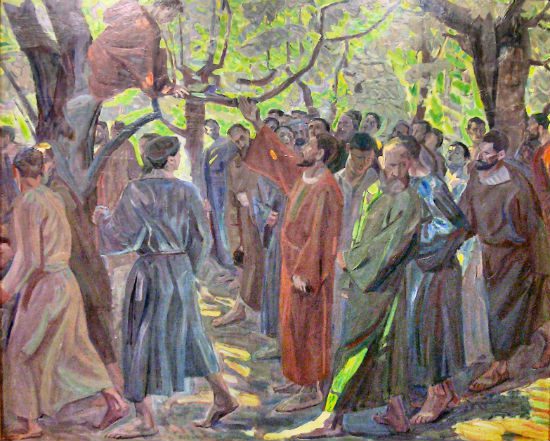
How to Recognise Jubilee From Quite A Long Way Away. No. 1: The sycamore. The. Sycamore. (“Christ and Zacchaeus” by Niels Larsen Stevns, 1913, via Wikimedia)
For one thing, I’ve studied enough about Great Awakenings to realize they’re really not that great. No matter how widespread the “awakening” seemed to be, it didn’t help most people get woke or stay so. Consider the First Great Awakening, led by figures like Jonathan Edwards and George Whitefield. Edwards was interested in eschatological justice for sinners, but not terribly interested in justice here in this life. Whitefield, on the other hand, proved to be an effective campaigner for political and social change — he helped to legalize slavery in the colony of Georgia so that he could run a more profitable plantation.
The Second Great Awakening is perhaps a bit more hopeful. It was led by folks like Charles G. Finney, who argued for abolition and women’s suffrage (and temperance, and anti-Masonry, and other causes of the day that haven’t aged quite as well). But the revivalism of this period didn’t always, or even usually, include such integral concern for justice. Confederate soldiers, too, saw Jesus in the watchfires of a hundred circling camps. And many of the revived and awakened took up arms again after the war, leading or joining the terrorist militias that repealed and replaced Reconstruction, imposing a century of Jim Crow in Jesus name, Amen.
Some religious historians talk of a third and even a fourth “Great Awakening,” but the evidence for any such thing is not terribly convincing, and the idea is depressing to contemplate. The claim that such events ever took place requires us to define Great Awakening down to something utterly inconsequential.* (If a Great Awakening falls in the forest and nobody hears it, does it still make a noise? What if they threw a Great Awakening and nobody came?)
I still appreciate the idea of such a thing. I see the resurgent ugliness of ethnic nationalism here in America and in Europe and I think that another Pentecost might be a very good thing right about now. But Pentecost is a church thing, and it’s no use looking to the church to provide the solution to a problem that seems most acute and most deeply rooted in our churches themselves. Frankly, it’s when I look at our churches that I most often think, “Those people need Jesus.”
Not that I’m giving up on our churches, mind you. Like I said, I still believe that everybody can be saved — even white American Christians. And our churches certainly have the resources and the stories that ought to enable them to rediscover the virtue and duty of solidarity, to repent from hatred and be liberated from resentment.
But such a rediscovery, should it occur within or without the church, suggests that our path forward lies in a “change of heart.”
George Orwell noted that “”A ‘change of heart’ is in fact the alibi of people who do not wish to endanger the status quo.” But he also conceded that the idea wasn’t necessarily pure humbug: “‘If [people] would behave decently the world would be decent’ is not such a platitude as it sounds.”
That’s from Orwell’s essay on Charles Dickens, whom Orwell loved, even though the great novelist seemed incapable of imagining any substantial, political, structural or institutional change:
It seems that in every attack Dickens makes upon society he is always pointing to a change of spirit rather than a change of structure. It is hopeless to try and pin him down to any definite remedy, still more to any political doctrine. His approach is always along the moral plane, and his attitude is sufficiently summed up in that remark about Strong’s school being as different from Creakle’s “as good is from evil” Two things can be very much alike and yet abysmally different. Heaven and Hell are in the same place. Useless to change institutions without a “change of heart” — that, essentially, is what he is always saying.
If that were all, he might be no more than a cheer-up writer, a reactionary humbug. A ‘change of heart’ is in fact the alibi of people who do not wish to endanger the status quo. But Dickens is not a humbug, except in minor matters, and the strongest single impression one carries away from his books is that of a hatred of tyranny. I said earlier that Dickens is not in the accepted sense a revolutionary writer. But it is not at all certain that a merely moral criticism of society may not be just as ‘revolutionary’ — and revolution, after all, means turning things upside down. … Progress is not an illusion, it happens, but it is slow and invariably disappointing. There is always a new tyrant waiting to take over from the old — generally not quite so bad, but still a tyrant. Consequently two viewpoints are always tenable. The one, how can you improve human nature until you have changed the system? The other, what is the use of changing the system before you have improved human nature? They appeal to different individuals, and they probably show a tendency to alternate in point of time. The moralist and the revolutionary are constantly undermining one another. … The central problem — how to prevent power from being abused — remains unsolved. Dickens, who had not the vision to see that private property is an obstructive nuisance, had the vision to see that. “If men would behave decently the world would be decent” is not such a platitude as it sounds.
In any case, though, the efficacy of a “change of heart” as a strategy relies on being able to answer a prior question: How can we bring about such a change? And how can we hope to do so on a large enough scale to change the big picture?
It’s one thing, after all, to smile at the happy ending for Tiny Tim thanks to Ebenezer Scrooge’s individual change of heart, but that doesn’t do anything to help any of the thousands of other poor and sick children in Dickens’ London. (We’re going to need more ghosts.)
The idea of Dickens’ Christmas Carol, I suppose, is that Scrooge is to serve as a model for social transformation based on individual transformation. The same could be argued for the story of Zacchaeus, on which Dickens’ story seems partly based. But Zacchaeus’ repentance involved his embrace of Jubilee — of a whole system and structure of economic justice, not just of his deciding to be a nicer person. Zacchaeus didn’t become a moralist, he joined a revolution. And he was only able to do that because there existed a revolution for him to join — one that consisted of something more substantial than just the maintenance of good cheer and Christmas spirit the whole year ’round.
A “change of heart,” I think, belongs more in the category of outcome. It’s a worthy goal, but not also the path to achieving itself. And it requires some idea of what it is that all these hearts are changing to.
– – – – – – – – – – – –
* The purported “Fourth Great Awakening,” if you’re interested, supposedly took place from ca. 1950-1980. I’d argue that this was, in fact, a period of religious revival, one in which prominent Christian leaders prophetically called for national repentance and rebirth. But the people who talk about a fourth Great Awakening ignore that. They’re not talking about the Civil Rights Movement, but about, like, Billy Graham and the explosive growth of Pentecostal churches.
Previous Post

April 4, 2017
Why we can't have Nice Things
Next Post
April 6, 2017 And I dreamed I was dying
Browse Our Archives
Select a Category class warfare evangelicals Iraq Left Behind Mammon music Uncategorized
Select a Month October 2026 September 2026 August 2026 July 2026 June 2026 May 2026 April 2026 March 2026 January 2026 December 2025 November 2025 October 2025 September 2025 August 2025 July 2025 June 2025 May 2025 April 2025 March 2025 February 2025 January 2025 December 2024 November 2024 October 2024 September 2024 August 2024 July 2024 June 2024 May 2024 April 2024 March 2024 February 2024 January 2024 December 2023 November 2023 October 2023 September 2023 August 2023 July 2023 June 2023 May 2023 April 2023 March 2023 February 2023 January 2023 December 2022 November 2022 October 2022 September 2022 August 2022 July 2022 June 2022 May 2022 April 2022 March 2022 February 2022 January 2022 December 2021 November 2021 October 2021 September 2021 August 2021 July 2021 June 2021 May 2021 April 2021 March 2021 February 2021 January 2021 December 2020 November 2020 October 2020 September 2020 August 2020 July 2020 June 2020 May 2020 April 2020 March 2020 February 2020 January 2020 December 2019 November 2019 October 2019 September 2019 August 2019 July 2019 June 2019 May 2019 April 2019 March 2019 February 2019 January 2019 December 2018 November 2018 October 2018 September 2018 August 2018 July 2018 June 2018 May 2018 April 2018 March 2018 February 2018 January 2018 December 2017 November 2017 October 2017 September 2017 August 2017 July 2017 June 2017 May 2017 April 2017 March 2017 February 2017 January 2017 December 2016 November 2016 October 2016 September 2016 August 2016 July 2016 June 2016 May 2016 April 2016 March 2016 February 2016 January 2016 December 2015 November 2015 October 2015 September 2015 August 2015 July 2015 June 2015 May 2015 April 2015 March 2015 February 2015 January 2015 December 2014 November 2014 October 2014 September 2014 August 2014 July 2014 June 2014 May 2014 April 2014 March 2014 February 2014 January 2014 December 2013 November 2013 October 2013 September 2013 August 2013 July 2013 June 2013 May 2013 April 2013 March 2013 February 2013 January 2013 December 2012 November 2012 October 2012 September 2012 August 2012 July 2012 June 2012 May 2012 April 2012 March 2012 February 2012 January 2012 December 2011 November 2011 October 2011 September 2011 August 2011 July 2011 June 2011 May 2011 April 2011 March 2011 February 2011 January 2011 December 2010 November 2010 October 2010 September 2010 August 2010 July 2010 June 2010 May 2010 April 2010 March 2010 February 2010 January 2010 December 2009 November 2009 October 2009 September 2009 August 2009 July 2009 June 2009 May 2009 April 2009 March 2009 February 2009 January 2009 December 2008 November 2008 October 2008 September 2008 August 2008 July 2008 June 2008 May 2008 April 2008 March 2008 February 2008 January 2008 December 2007 November 2007 October 2007 September 2007 August 2007 July 2007 June 2007 May 2007 April 2007 March 2007 February 2007 January 2007 December 2006 November 2006 October 2006 September 2006 August 2006 July 2006 June 2006 May 2006 April 2006 March 2006 February 2006 January 2006 December 2005 November 2005 October 2005 September 2005 August 2005 July 2005 June 2005 May 2005 April 2005 March 2005 February 2005 January 2005 December 2004 November 2004 October 2004 September 2004 August 2004 July 2004 June 2004 May 2004 April 2004 March 2004 February 2004 January 2004 December 2003 November 2003 October 2003 September 2003
Follow Us!
TAKE THE
Religious Wisdom Quiz
How old was David when he became king over Israel?
Select your answer to see how you score.
25 years old 40 years old 30 years old 20 years old
Related posts from slacktivist




Postcards from America (02.05.25)
TRENDING AT PATHEOS Progressive Christian

When Halloween Unmasks Married Hearts
Written by Dr. David K. Ewen from Eternal Truth Bible College Behind...

Aristotle. He’s been called the father of logic, the father of the...

Methodist Central Hall and Westminster Abbey
Situated on the same square is Methodist Central Hall and Westminster Abbey. ...

57th Dove Awards Honor Dolly Parton, Crown New...
On gospel music’s biggest night, the 57th annual GMA Dove Awards honored...

The First Eucharistic Controversy: Christ’s Real Presence
For Catholics, the Eucharist is the source and summit of the Christian...

What a Stop Sign Can Teach Us About...
How to Make a Decision When You Can't Hear God Main point:...
view all Progressive Christian blogs
Ad-Free & Subscriber Log-In Subscription Support
- About Us
- 2026 Calendar
- Videos
- Podcasts
- Library of World Religions
- Faith In Media Tracker
- Advertise With Us
- Write for Us
- Privacy Policy
- Terms of Service
- Do Not Sell My Data
- Contact Us
- Radiant Digital
- Manage Newsletter Subscriptions
- Unsubscribe From Notifications
- Sitemap
Copyright 2008-2026, Patheos. All rights reserved.
Subscription Support Ad-Free & Subscriber Log-In
Follow Patheos