
BuddhistCatholicContemplativeEvangelicalGeneral ChristianHinduJewishLatter-day SaintMuslimNew VisionsProgressive Christian
Beliefs
- Buddhist
- Catholic
- Contemplative
- Evangelical
- General Christian
- Hindu
- Jewish
- Latter-day Saint
- More Voices
- Muslim
- New Visions
- Pagan
- Progressive Christian
Topics
- Religion News
- Food and Religion
- Sports and Religion
- Religious Art
- Religious Music and Entertainment
- Religious Events
- History and Religion
- Style and Religion
- Politics and Religion
- Women in Religion
- Recreation Outdoors and Religion
- Business Finance and Religion
- Careers Workplace and Religion
- Education and Religion
- Family Parenting and Religion
- Health Fitness and Religion
- Home and Religion
- Relationships and Religion
- Technology and Religion
- Travel and Religion
Columnists
- Buddhist Columnists
- Business Finance and Religion Columnists
- Careers Workplace and Religion Columnists
- Catholic Columnists
- Contemplative Columnists
- Education and Religion Columnists
- Evangelists Columnists
- Family Parenting and Religion Columnists
- General Christian Columnists
- Health Fitness and Religion Columnists
- Hindu Columnists
- History and Religion Columnists
- Home and Religion Columnists
- Jewish Columnists
- More Voices Columnists
- Latter Day Columnists
- Muslim Columnists
- New Visions Columnists
- Nonreligious Columnists
- Pagan Columnists
- Politics and Religion Columnists
- Progressive Columnists
- Recreation Outdoors and Religion Columnists
- Relationships and Religion Columnists
- Religion News Columnists
- Religious Art Columnists
- Religious Events Columnists
- Religious Music and Entertainment Columnists
- Sports and Religion Columnists
- Style and Religion Columnists
- Technology and Religion Columnists
- Travel and Religion Columnists
- Women in Religion Columnists
Resource Library
- 2026 Calendar
- Library of World Religions
- The 100 Most Holy Places on Earth
- Patheos Answers
- Podcasts
- Videos
- Faith Leaders Database
- Anglican Episcopalian
- Bahai
- Baptist
- Buddhism
- Christianity
- Confucianism
- Eastern Orthodoxy
- Hinduism
- Holiness and Pentecostal
- ISKCON
- Islam
- Judaism
- Lutheran
- Methodist
- The Church of Jesus Christ of Latter-day Saints
- New Age
- Paganism
- Presbytarian and Reformed
- Protestantism
- Religion Behind the Scenes
- Roman Catholic
- Scientology
- Shia Islam
- Sikhism
- Sufism
- Sunni Islam
- Taoism
- Zen
- See all religions
Research Tools
 Ad-Free & Subscriber Log-In Subscription Support
Ad-Free & Subscriber Log-In Subscription Support
Follow Patheos 

- Trending:
- Forgiveness
- |
- Marriage
- |
- Consciousness
- |
- Death Penalty
- |
- Election
- |
- Halloween

- Home
- Progressive Christian
- Sanctuary and ‘civil disobedience’ (part 2)
Sanctuary and ‘civil disobedience’ (part 2)
Last updated on: March 28, 2017 at 7:35 pm by Fred Clark
Sanctuary and ‘civil disobedience’ (part 2) 2017-03-28T19:35:22-04:00 Fred Clark
Patheos Explore the world's faith through different perspectives on religion and spirituality! Patheos has the views of the prevalent religions and spiritualities of the world.
Civil disobedience is a form of protest that involves breaking the law. But most forms of protest that involve breaking the law are not civil disobedience. Tearing down the propaganda posters of a tyrant, for example, is illegal, but it’s not civil disobedience. Nor are any of the time-honored forms of protest involving spray paint. A brick through a window isn’t civil disobedience either — even when it may be the right thing to do.
And, as I’ve written here many times, “getting arrested” during a protest isn’t civil disobedience either. That’s a courageous, sometimes useful tactic for drawing attention to a cause, which makes it similar to the conscience-troubling and consciousness-raising effect of civil disobedience, but it’s still a different category. Such protesters usually get arrested for trespassing, but the laws forbidding trespassing are not the laws they’re protesting, nor are they laws those protesters consider unjust.
That’s the identifying characteristic of civil disobedience, which protests an unjust law by breaking that law, specifically, and thereafter submitting to the legal consequences of that unjust law.
Consider the 2014 case of Arnold Abbott of Fort Lauderdale, Florida. That city passed an ordinance restricting the public distribution of food to the homeless. Abbott, a World War II veteran who was then 90 years old, had been sharing meals with the homeless in a city park near the beach for decades and he wasn’t going to stop doing so just because the city had decided to make that illegal.
So Abbott was arrested and charged with breaking the law, after which he returned to the park and resumed his criminal enterprise. City police officers had been able to convince themselves to stop him once (“Just doing our job” and all that), but they couldn’t quite bring themselves to do it a second time. And the sight of this elderly veteran getting handcuffed for feeding the hungry had a dramatic effect on the people of Fort Lauderdale. They agreed with Abbott that the law he was breaking was “unfair” and “repressive.” Seeing such a law enforced didn’t make them want to see the lawbreaker punished, it made them want to see the law changed.
That is what civil disobedience looks like.
It’s a powerful tool. We can see that power in the effectiveness of the civil disobedience that changed American law during the Civil Rights Movement. The young people arrested and abused for lunch-counter sit-ins were breaking the law. By breaking that law, they demonstrated its injustice, and that led to the unjust law being changed.
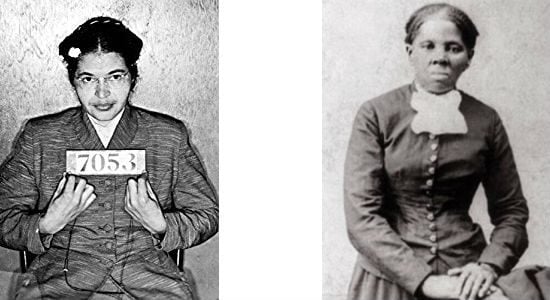
Rosa Parks (left) challenged an unjust law through civil disobedience. Harriet Tubman (right) challenged an unjust law by breaking it and getting away with it.
Civil disobedience is a form of law-breaking, but it is not lawless. We might think of it in D&D terms as a lawful good response to lawful evil.
Earlier this decade, the state of Alabama and the city of Hazleton, Pennsylvania, passed similar sets of unjust laws making it illegal for anyone to act as a neighbor toward anyone suspected of being an “illegal” immigrant. Those laws made it illegal to provide food or shelter to the undocumented — illegal to sell them food or to rent them an apartment. It was even illegal just to offer someone a ride if that person was suspected of being an immigrant.
Such unfair and repressive laws seem ripe for the opposition of civil disobedience. Such laws need to be broken — breaking them is a moral obligation, a moral imperative. And to their great credit, many people in Alabama and Hazleton refused to comply with them, never granting them moral legitimacy even if they were otherwise “lawful.” But this principled law-breaking wasn’t precisely a form of civil disobedience. That wasn’t an appropriate or available tool for that situation.
The problem in those cases had to do with the disproportionate consequences of civil disobedience, and where those consequences would fall. It was right and proper that, for example, church groups vocally announced their intention to continue acting as neighbors despite laws forbidding them from doing so. But those church groups couldn’t take the stand of civil disobedience because doing so wouldn’t have resulted only in their own arrest and prosecution, but also in the arrest, indefinite detention and/or deportation of the immigrant neighbors they were assisting. Those immigrant neighbors would not have the same legally recognized rights and protections, or the same visibility as the documented church folk helping them. Those neighbors might be, essentially, disappeared into the system, their lives forever affected without any of the public visibility and public debate that civil disobedience seeks to compel.
So in the case of unjust laws like that, citizens have not only a moral obligation to violate and reject the unjust laws, but also a moral obligation to get away with it. That’s not civil disobedience. It’s not even, primarily, a form of protest. It’s a necessary measure for protecting the would-be victims from the intolerable consequences of unjust laws.
This is the difference between Rosa Parks and Harriet Tubman. Parks effectively and strategically practiced civil disobedience. She broke an unjust law, submitting to her arrest and prosecution, and thereby helped to spark a public debate and a mass movement that ultimately changed and corrected that unjust law. Harriet Tubman broke an unjust law — many unjust laws — but she was compelled not to get caught doing so, for her own sake and for the sake of those she rescued. Her actions were illegal and unconstitutional but also, without question, the right thing to do. Her context denied her access to the lawful good, law-respecting law-breaking protest of civil disobedience, so she was forced to resort to something more akin to a chaotic good approach.
This Rosa Parks/Harriet Tubman distinction has a parallel in the various forms of what we sometimes describe as “sanctuary.” In most times and most places, the sanctity of sanctuary is respected, even if the legal framework is otherwise unjust. The sanctuary provided by ancient Greek temples, Israelite cities of refuge, and medieval cathedrals was recognized as legitimate, sometimes upheld by tradition and divine right and superstition as much as by formal law. Exercising their prerogative of sanctuary might put them at odds with those seeking to enforce unjust laws, but that was regarded as a legitimate prerogative and one that was in some sense legally inviolable.
But in many times and many places, the idea of such legally recognized legitimate sanctuary is rejected by the lawless enforcers of unjust laws. In those situations, Rosa Parks is not an option. In those situations, anyone seeking to provide sanctuary must act like Harriet Tubman. The first priority in such a context is not protest, but resistance and protection of the victims of injustice.
Context matters. It determines the appropriate form of protest or resistance and what may or may not be the right thing to do when confronted with unjust laws. Sometimes an unjust law can be challenged and changed through wholly legal channels without any recourse to any form of law-breaking. Other times, civil disobedience may be a necessary measure to force the issue and to rouse sufficient opposition to compel that change to take place. And still other times, one may be obliged to break an unjust law and attempt to get away with it as the only available means of protecting the victims of its injustice.
Correctly evaluating what kind of context one faces is essential to deciding what course of action will be most effective and what will be the right thing to do.
Previous Post

March 27, 2017
Or driven to its knees
Next Post
March 30, 2017 I guess we'll have to wait and see
Browse Our Archives
Select a Category class warfare evangelicals Iraq Left Behind Mammon music Uncategorized
Select a Month October 2026 September 2026 August 2026 July 2026 June 2026 May 2026 April 2026 March 2026 January 2026 December 2025 November 2025 October 2025 September 2025 August 2025 July 2025 June 2025 May 2025 April 2025 March 2025 February 2025 January 2025 December 2024 November 2024 October 2024 September 2024 August 2024 July 2024 June 2024 May 2024 April 2024 March 2024 February 2024 January 2024 December 2023 November 2023 October 2023 September 2023 August 2023 July 2023 June 2023 May 2023 April 2023 March 2023 February 2023 January 2023 December 2022 November 2022 October 2022 September 2022 August 2022 July 2022 June 2022 May 2022 April 2022 March 2022 February 2022 January 2022 December 2021 November 2021 October 2021 September 2021 August 2021 July 2021 June 2021 May 2021 April 2021 March 2021 February 2021 January 2021 December 2020 November 2020 October 2020 September 2020 August 2020 July 2020 June 2020 May 2020 April 2020 March 2020 February 2020 January 2020 December 2019 November 2019 October 2019 September 2019 August 2019 July 2019 June 2019 May 2019 April 2019 March 2019 February 2019 January 2019 December 2018 November 2018 October 2018 September 2018 August 2018 July 2018 June 2018 May 2018 April 2018 March 2018 February 2018 January 2018 December 2017 November 2017 October 2017 September 2017 August 2017 July 2017 June 2017 May 2017 April 2017 March 2017 February 2017 January 2017 December 2016 November 2016 October 2016 September 2016 August 2016 July 2016 June 2016 May 2016 April 2016 March 2016 February 2016 January 2016 December 2015 November 2015 October 2015 September 2015 August 2015 July 2015 June 2015 May 2015 April 2015 March 2015 February 2015 January 2015 December 2014 November 2014 October 2014 September 2014 August 2014 July 2014 June 2014 May 2014 April 2014 March 2014 February 2014 January 2014 December 2013 November 2013 October 2013 September 2013 August 2013 July 2013 June 2013 May 2013 April 2013 March 2013 February 2013 January 2013 December 2012 November 2012 October 2012 September 2012 August 2012 July 2012 June 2012 May 2012 April 2012 March 2012 February 2012 January 2012 December 2011 November 2011 October 2011 September 2011 August 2011 July 2011 June 2011 May 2011 April 2011 March 2011 February 2011 January 2011 December 2010 November 2010 October 2010 September 2010 August 2010 July 2010 June 2010 May 2010 April 2010 March 2010 February 2010 January 2010 December 2009 November 2009 October 2009 September 2009 August 2009 July 2009 June 2009 May 2009 April 2009 March 2009 February 2009 January 2009 December 2008 November 2008 October 2008 September 2008 August 2008 July 2008 June 2008 May 2008 April 2008 March 2008 February 2008 January 2008 December 2007 November 2007 October 2007 September 2007 August 2007 July 2007 June 2007 May 2007 April 2007 March 2007 February 2007 January 2007 December 2006 November 2006 October 2006 September 2006 August 2006 July 2006 June 2006 May 2006 April 2006 March 2006 February 2006 January 2006 December 2005 November 2005 October 2005 September 2005 August 2005 July 2005 June 2005 May 2005 April 2005 March 2005 February 2005 January 2005 December 2004 November 2004 October 2004 September 2004 August 2004 July 2004 June 2004 May 2004 April 2004 March 2004 February 2004 January 2004 December 2003 November 2003 October 2003 September 2003
Follow Us!
TAKE THE
Religious Wisdom Quiz
Who was cast into a pit by his brothers?
Select your answer to see how you score.
Joseph Daniel Moses Jacob
Related posts from slacktivist




Postcards from America (02.05.25)
TRENDING AT PATHEOS Progressive Christian

Nearly every morning, I make the drive to Detroit with my high-school-age...

The Real AI Story Is Adoption Without Trust
Artificial intelligence has crossed a political threshold. It is no longer a...

A new article, written by Jeff Lindsay and Gale L. Pooley,...

Swimfan: Forgotten Aughts Pleasures
This is a recovery effort. In 2002, My Big Fat Greek Wedding...

Top Three Anti-Catholic Lies About Catholicism
This is my initial transcript for the video, "THE 3 WORST...

Pope Leo Celebrates Mass for Nurses & Docs...
I don't have any idea how he did it, but Pope Leo...
view all Progressive Christian blogs
Ad-Free & Subscriber Log-In Subscription Support
- About Us
- 2026 Calendar
- Videos
- Podcasts
- Library of World Religions
- Faith In Media Tracker
- Advertise With Us
- Write for Us
- Privacy Policy
- Terms of Service
- Do Not Sell My Data
- Contact Us
- Radiant Digital
- Manage Newsletter Subscriptions
- Unsubscribe From Notifications
- Sitemap
Copyright 2008-2026, Patheos. All rights reserved.
Subscription Support Ad-Free & Subscriber Log-In
Follow Patheos