
BuddhistCatholicContemplativeEvangelicalGeneral ChristianHinduJewishLatter-day SaintMuslimNew VisionsProgressive Christian
Beliefs
- Buddhist
- Catholic
- Contemplative
- Evangelical
- General Christian
- Hindu
- Jewish
- Latter-day Saint
- More Voices
- Muslim
- New Visions
- Pagan
- Progressive Christian
Topics
- Religion News
- Food and Religion
- Sports and Religion
- Religious Art
- Religious Music and Entertainment
- Religious Events
- History and Religion
- Style and Religion
- Politics and Religion
- Women in Religion
- Recreation Outdoors and Religion
- Business Finance and Religion
- Careers Workplace and Religion
- Education and Religion
- Family Parenting and Religion
- Health Fitness and Religion
- Home and Religion
- Relationships and Religion
- Technology and Religion
- Travel and Religion
Columnists
- Buddhist Columnists
- Business Finance and Religion Columnists
- Careers Workplace and Religion Columnists
- Catholic Columnists
- Contemplative Columnists
- Education and Religion Columnists
- Evangelists Columnists
- Family Parenting and Religion Columnists
- General Christian Columnists
- Health Fitness and Religion Columnists
- Hindu Columnists
- History and Religion Columnists
- Home and Religion Columnists
- Jewish Columnists
- More Voices Columnists
- Latter Day Columnists
- Muslim Columnists
- New Visions Columnists
- Nonreligious Columnists
- Pagan Columnists
- Politics and Religion Columnists
- Progressive Columnists
- Recreation Outdoors and Religion Columnists
- Relationships and Religion Columnists
- Religion News Columnists
- Religious Art Columnists
- Religious Events Columnists
- Religious Music and Entertainment Columnists
- Sports and Religion Columnists
- Style and Religion Columnists
- Technology and Religion Columnists
- Travel and Religion Columnists
- Women in Religion Columnists
Resource Library
- 2026 Calendar
- Library of World Religions
- The 100 Most Holy Places on Earth
- Patheos Answers
- Podcasts
- Videos
- Faith Leaders Database
- Anglican Episcopalian
- Bahai
- Baptist
- Buddhism
- Christianity
- Confucianism
- Eastern Orthodoxy
- Hinduism
- Holiness and Pentecostal
- ISKCON
- Islam
- Judaism
- Lutheran
- Methodist
- The Church of Jesus Christ of Latter-day Saints
- New Age
- Paganism
- Presbytarian and Reformed
- Protestantism
- Religion Behind the Scenes
- Roman Catholic
- Scientology
- Shia Islam
- Sikhism
- Sufism
- Sunni Islam
- Taoism
- Zen
- See all religions
Research Tools
 Ad-Free & Subscriber Log-In Subscription Support
Ad-Free & Subscriber Log-In Subscription Support
Follow Patheos 

- Trending:
- Forgiveness
- |
- Marriage
- |
- Consciousness
- |
- Death Penalty
- |
- Election
- |
- Halloween

- Home
- Progressive Christian
- Left Behind Classic Fridays, No. 89: ‘Mostly dead’
Left Behind Classic Fridays, No. 89: ‘Mostly dead’
Last updated on: July 8, 2016 at 9:33 am by Fred Clark
Left Behind Classic Fridays, No. 89: ‘Mostly dead’ 2016-07-08T09:33:21-04:00 Fred Clark
Patheos Explore the world's faith through different perspectives on religion and spirituality! Patheos has the views of the prevalent religions and spiritualities of the world.
Originally posted October 20, 2006.
Read this entire series, for free, via the convenient Left Behind Index. This post is also part of the ebook collection The Anti-Christ Handbook: Volume 1, available on Amazon for just $2.99. Volume 2 of The Anti-Christ Handbook, completing all the posts on the first Left Behind book, is also now available.
Left Behind, pp. 227-228
Buck Williams sat near an exit at JFK Airport reading his own obituary.
As first sentences of chapters go, that’s not bad.
It’d be better, of course, if Buck had done even a half-convincing job of faking his own death — if he hadn’t immediately called his closest relatives to assure them that he wasn’t really dead, and if he weren’t sitting there, in public, out in the open, waiting for his closest friend and work colleague to pick him up at a busy airport.
And it would be better if the article in question really was his obituary, and not an incoherent jumble that reads half like a hastily cobbled obit and half like a news report on the car bombing in which he was supposedly killed. We’re not told what the byline on the article was (or even what the publication is), but it reads like something that would be credited to “Staff and wire reports” — since it combines both domestic and international reporting, some of which must’ve been pulled from international wires and some of which was apparently pulled from some newsweekly trade journal.
Newspaper copy editing is a craft, so if Aristotle was right about the relationship of craftsmanship and virtue, it’s possible that all the copy editors are among the disappeared. But even so, someone at whatever paper Buck is reading should have prevented this wretched article from getting onto the page.
Here’s the first sentence:
Cameron Williams, 30, the youngest senior writer on the staff of any weekly newsmagazine, is feared dead after a mysterious car bombing outside a London pub Saturday night that took the life of a Scotland Yard investigator.
To paraphrase Miracle Max, there’s a big difference between feared dead and all dead. You don’t publish obituaries for people who are only “feared dead” — which means this isn’t an obituary and paragraphs 2, 3 and 4 of this article, summarizing Buck’s life and career, should really be paragraphs 17, 18 and 19, if they’re going to run at all.
But if you think you’re writing an obituary, you need to write it as an obituary, meaning you begin with the most significant facts about the (confirmed) deceased. In the case of Pulitzer Prize-winning journalists like the GIRAT, this means you start out by mentioning that he is a Pulitzer Prize winner. It’s one of the prizes that becomes the first line of any winner’s obituary, as is true for Emmys, Tonys, Grammys, Nobels and Academy Awards, as George Clooney noted earlier this year:
The funny thing about winning an Academy Award, it will always be synonymous with your name from here on in. It will be, “Oscar-winner George Clooney, Sexiest Man Alive, 1997, Batman, died today in a freak accident at a …”
Clooney’s joke worked because he, and his audience, were at least passingly familiar with having read newspaper obituaries (which sometimes refer to “freak accidents,” but do not usually characterize car bombings as “mysterious”). LaHaye and Jenkins, on the other hand, seem never to have read one before.
L&J begin their pseudobituary with a statement about Buck — “the youngest senior writer on the staff of any weekly newsmagazine” — that is A) almost completely meaningless, and B) almost certainly not true (at least not without serious qualifications, “major, national weekly newsmagazine”).
What distinguishes a senior writer from his or her colleagues varies from publication to publication, but it has a lot more to do with the politics of internal staffing assignments than with anything that anyone outside of the staff needs to know or care about. Often such titles are more like what David Mamet wrote of an associate producer’s credit: “It’s what you give to your secretary instead of a raise.”
The title-instead-of-a-raise ploy works best with a certain kind of emotionally needy, thin-skinned employee. These are the kind of people who, once given a title like “senior writer,” will insist that others use it and will correct anyone who fails to do so. (“So you’re a writer for …” “Senior writer. Senior writer!”) L&J’s obsession with Buck’s ceremonial title reminds me of such people. L&J remind me of such people.
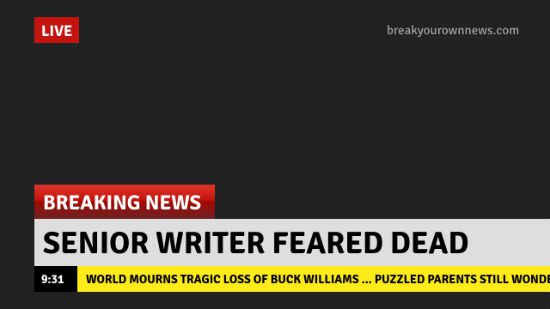
The pseudobit gives us two more paragraphs summarizing Buck’s career, neither of which offers the reader much sense of why they should care about this man’s feared passing. There’s little specific reference to Buck’s specific writing, no quotes from other prominent journalists to offer a sense of how he was regarded by his peers. It reads, instead, like something Buck himself would have written if he was feeling particularly petulant, slighted and underappreciated:
Williams, a five-year employee of Global Weekly, had won a Pulitzer [sic] as a reporter for the Boston Globe before joining the magazine as a staff reporter at 25. He quickly rose to the position of senior writer and has since written more than three dozen cover stories, four times assigned the Weekly’s Newsmaker of the Year story.
Pop-quiz: Do you know who wrote any of Time’s “Man of the Year” stories? Do you care? Have you ever heard anyone remark on such an assignment as a particularly notable and prestigious example of top-tier journalism? Me neither.
This odd preoccupation with inside baseball and corporate milestones reads more like something from a “staff bios” Web page than like an obituary. I’d guess that was where the pseudobit writer lifted it from, except that wouldn’t account for the errors, such as the first-reference use of “Pulitzer” without “Prize” and the failure to mention what category the prize was for (there are more than a dozen for journalists, and others for drama, fiction, music, history, poetry …) or what article or articles the prize recognized.
The journalist won the prestigious Ernest Hemingway Prize for war correspondence when he chronicled the destruction of the Russian air force over Israel 14 months ago. According to Steve Plank, executive editor of Global Weekly, the administration of the magazine is refusing to confirm the report of Williams’s death “until we see hard evidence.”
That second sentence, the one that really ought to be a new paragraph since it represents a jarringly new thought, is particularly strange. It tells us that the writer got on the phone to attempt to confirm Buck’s death. The writer managed to get in touch with Plank, getting only an evasive partial quote that offered a non-denial non-confirmation as to whether or not the subject of this obituary is even really dead to begin with. Then, deciding to go ahead with the obit anyway, the writer doesn’t bother to ask Plank anything about the character or accomplishments of his possibly deceased colleague.
This also tells us a thing or two about Steve Plank. The reporter may not have asked, but he still could have offered some praise of his friend — seizing the chance to say something like that eulogy in Waking Ned Devine. But maybe he was just too pressed for time, since while he was talking with this reporter he was also apparently on the other line, talking with Buck and arranging to pick him up at the airport the next day. That raises an ethical question about Plank’s comment. He either already knew, or at least suspected, that Buck wasn’t dead, yet when asked a direct question, he gives a deceptive answer. Joe Klein — a senior writer for a weekly newsmagazine — got in hot water a few years back for that very thing. If you can’t give an honest answer to such a direct question, then you avoid having to answer it. You don’t answer the phone and remain “unavailable for comment.” It’s been less than 24-hours since the first reports of Buck’s demise and Steve’s inability to stall and stonewall for even one news cycle suggests that he’s utterly unqualified for the position he later accepts as Antichrist press secretary.
Williams’s father and a married brother reside in Tucson, where Williams lost his sister-in-law, niece and nephew in last week’s* disappearances.
Oh, right. The disappearances.
It’s easy to forget, as our authors frequently do, that all this is happening in the context of those disappearances — which happened just six days ago. It’s not just Buck who is missing and “feared dead,” then, it’s Buck and 2 billion other people, including every child on the now-childless planet. Not to mention the thousands of still-untallied dead in the following days from the hundreds of plane crashes and other related disasters.
If the newspaper has decided to run obituaries for all those “feared dead,” then I can imagine there’d be a bit of a backlog. But with the line between “confirmed” and “feared” dead for the missing so utterly, indecipherably blurred, I’d also imagine newspapers would have to take a different approach.
Post-event there would be a new special section listing the prominent people suspected to be among the disappeared. I’d highlight a different segment of the population each day — locals, political leaders, entertainers, athletes, academics and authors, etc. — with brief capsule bios as space allowed. This special section wouldn’t only include the names of the famous and prominent, of course, there would also be the lists — long alphabetical lists in agate type, phonebook-style rolls of the missing. (After a few days’ worth of such special sections, I’d expect the editors, and their readers, to begin discerning some patterns — “Hmm, this list of evangelical types is really long …” — but that’s another issue.)
It would take days, maybe even weeks, before all the names in these listings could be confirmed as among the disappeared or the dead, and I rather doubt any New York paper would be able to report with confidence, five days after the event, on the disposition of all of Buck’s in-laws, nieces and nephews.
There’d be another new special section in newspapers, one with the photographs and phone numbers submitted by readers. The desperate, heart-breaking “Have you seen …?” section.
Charging for the placement of such photos would be very lucrative, but probably too sleazy even for the godless left behinders now in charge. For PR reasons, I’d guess they would run short, name-and-number, classified-ad type listings for free, with the option of adding a photo for an additional fee. Such fees would pay for all those extra pages. As would the ad revenue from all the new businesses springing up post-event to cash in: the private investigators, grief-counselors, quasi-religious gurus and other snake-oil salesmen pitching ways to get your children back or to protect yourself from the coming second wave of disappearances, which might strike at any time.
With all that extra work to do, it seems unlikely that anybody at the paper would be fine-toothing the international wires and clipping stories about car bombings that may have killed journalists and police officers on another continent.
Jenkins wrote a syndicated daily comic strip for several years (“Gil Thorp” — not funny), so he ought to have been around the newspaper business enough to realize all of the above. Not that you’d have to have such experience to realize such things — they are obvious to anyone who’s ever read a newspaper.
Maybe Jenkins and LaHaye never have. That would explain a great deal.
– – – – – – – – – – – –
* Oops. The one good thing about Rayford’s going to church on Sunday was that it allows us to finally figure out what day it is. And this being Sunday, the disappearances that occurred six days (or is it five?) earlier did, indeed, occur “last week.” And even though — as best as I can decipher from the book’s muddled chronology — the bombing in which Buck was suspected killed occurred in the same week as those disappearances, the report is written to appear in Sunday’s paper, so again L&J’s use of “last week’s disappearances” was the one thing they got right in this pseudobituary and shouldn’t have had the “[sic]” — “last week’s [sic] disappearances” — I initially put there. My bad.
Previous Post

July 8, 2016
American Horror Show open thread
Next Post
July 11, 2016 The Psalms and the word of God
Browse Our Archives
Select a Category class warfare evangelicals Iraq Left Behind Mammon music Uncategorized
Select a Month October 2026 September 2026 August 2026 July 2026 June 2026 May 2026 April 2026 March 2026 January 2026 December 2025 November 2025 October 2025 September 2025 August 2025 July 2025 June 2025 May 2025 April 2025 March 2025 February 2025 January 2025 December 2024 November 2024 October 2024 September 2024 August 2024 July 2024 June 2024 May 2024 April 2024 March 2024 February 2024 January 2024 December 2023 November 2023 October 2023 September 2023 August 2023 July 2023 June 2023 May 2023 April 2023 March 2023 February 2023 January 2023 December 2022 November 2022 October 2022 September 2022 August 2022 July 2022 June 2022 May 2022 April 2022 March 2022 February 2022 January 2022 December 2021 November 2021 October 2021 September 2021 August 2021 July 2021 June 2021 May 2021 April 2021 March 2021 February 2021 January 2021 December 2020 November 2020 October 2020 September 2020 August 2020 July 2020 June 2020 May 2020 April 2020 March 2020 February 2020 January 2020 December 2019 November 2019 October 2019 September 2019 August 2019 July 2019 June 2019 May 2019 April 2019 March 2019 February 2019 January 2019 December 2018 November 2018 October 2018 September 2018 August 2018 July 2018 June 2018 May 2018 April 2018 March 2018 February 2018 January 2018 December 2017 November 2017 October 2017 September 2017 August 2017 July 2017 June 2017 May 2017 April 2017 March 2017 February 2017 January 2017 December 2016 November 2016 October 2016 September 2016 August 2016 July 2016 June 2016 May 2016 April 2016 March 2016 February 2016 January 2016 December 2015 November 2015 October 2015 September 2015 August 2015 July 2015 June 2015 May 2015 April 2015 March 2015 February 2015 January 2015 December 2014 November 2014 October 2014 September 2014 August 2014 July 2014 June 2014 May 2014 April 2014 March 2014 February 2014 January 2014 December 2013 November 2013 October 2013 September 2013 August 2013 July 2013 June 2013 May 2013 April 2013 March 2013 February 2013 January 2013 December 2012 November 2012 October 2012 September 2012 August 2012 July 2012 June 2012 May 2012 April 2012 March 2012 February 2012 January 2012 December 2011 November 2011 October 2011 September 2011 August 2011 July 2011 June 2011 May 2011 April 2011 March 2011 February 2011 January 2011 December 2010 November 2010 October 2010 September 2010 August 2010 July 2010 June 2010 May 2010 April 2010 March 2010 February 2010 January 2010 December 2009 November 2009 October 2009 September 2009 August 2009 July 2009 June 2009 May 2009 April 2009 March 2009 February 2009 January 2009 December 2008 November 2008 October 2008 September 2008 August 2008 July 2008 June 2008 May 2008 April 2008 March 2008 February 2008 January 2008 December 2007 November 2007 October 2007 September 2007 August 2007 July 2007 June 2007 May 2007 April 2007 March 2007 February 2007 January 2007 December 2006 November 2006 October 2006 September 2006 August 2006 July 2006 June 2006 May 2006 April 2006 March 2006 February 2006 January 2006 December 2005 November 2005 October 2005 September 2005 August 2005 July 2005 June 2005 May 2005 April 2005 March 2005 February 2005 January 2005 December 2004 November 2004 October 2004 September 2004 August 2004 July 2004 June 2004 May 2004 April 2004 March 2004 February 2004 January 2004 December 2003 November 2003 October 2003 September 2003
Follow Us!
TAKE THE
Religious Wisdom Quiz
What is the official state church of Denmark, Norway, and Sweden?
Select your answer to see how you score.
Pentecostal Lutheran Catholic Orthodox
Related posts from slacktivist

Can't seem to get it through my head

For Buffy and Carl so loved the world


'To every generation': Child abuse at Cornerstone Church
TRENDING AT PATHEOS Progressive Christian

Emotion in Early Christianity by Andrew Crislip
Andrew Crislip’s Emotion in Early Christianity examines an often overlooked dimension of...

16 Spiritual Touchstones for a More Grounded Life
After decades of spiritual study, here are 16 principles I try...

Catholic Evangelization: Sharing Your Faith Every Day
Welcome back to the Graceful Awakening mini-series called, “From Faith to Mission.” ...

The Pillar of the Boatmen: the Ancient Monument...
The Pillar of the Boatmen is a Romano-Gaulish sculpture that dates from...

In one sense walking into Westminster Abbey is like walking down the...

'Super Scam Me' Exposes AI Jon Bon Jovi...
Leslie Pickett believed she was in a relationship with Jon Bon Jovi....
view all Progressive Christian blogs
Ad-Free & Subscriber Log-In Subscription Support
- About Us
- 2026 Calendar
- Videos
- Podcasts
- Library of World Religions
- Faith In Media Tracker
- Advertise With Us
- Write for Us
- Privacy Policy
- Terms of Service
- Do Not Sell My Data
- Contact Us
- Radiant Digital
- Manage Newsletter Subscriptions
- Unsubscribe From Notifications
- Sitemap
Copyright 2008-2026, Patheos. All rights reserved.
Subscription Support Ad-Free & Subscriber Log-In
Follow Patheos