
BuddhistCatholicContemplativeEvangelicalGeneral ChristianHinduJewishLatter-day SaintMuslimNew VisionsProgressive Christian
Beliefs
- Buddhist
- Catholic
- Contemplative
- Evangelical
- General Christian
- Hindu
- Jewish
- Latter-day Saint
- More Voices
- Muslim
- New Visions
- Pagan
- Progressive Christian
Topics
- Religion News
- Food and Religion
- Sports and Religion
- Religious Art
- Religious Music and Entertainment
- Religious Events
- History and Religion
- Style and Religion
- Politics and Religion
- Women in Religion
- Recreation Outdoors and Religion
- Business Finance and Religion
- Careers Workplace and Religion
- Education and Religion
- Family Parenting and Religion
- Health Fitness and Religion
- Home and Religion
- Relationships and Religion
- Technology and Religion
- Travel and Religion
Columnists
- Buddhist Columnists
- Business Finance and Religion Columnists
- Careers Workplace and Religion Columnists
- Catholic Columnists
- Contemplative Columnists
- Education and Religion Columnists
- Evangelists Columnists
- Family Parenting and Religion Columnists
- General Christian Columnists
- Health Fitness and Religion Columnists
- Hindu Columnists
- History and Religion Columnists
- Home and Religion Columnists
- Jewish Columnists
- More Voices Columnists
- Latter Day Columnists
- Muslim Columnists
- New Visions Columnists
- Nonreligious Columnists
- Pagan Columnists
- Politics and Religion Columnists
- Progressive Columnists
- Recreation Outdoors and Religion Columnists
- Relationships and Religion Columnists
- Religion News Columnists
- Religious Art Columnists
- Religious Events Columnists
- Religious Music and Entertainment Columnists
- Sports and Religion Columnists
- Style and Religion Columnists
- Technology and Religion Columnists
- Travel and Religion Columnists
- Women in Religion Columnists
Resource Library
- 2026 Calendar
- Library of World Religions
- The 100 Most Holy Places on Earth
- Patheos Answers
- Podcasts
- Videos
- Faith Leaders Database
- Anglican Episcopalian
- Bahai
- Baptist
- Buddhism
- Christianity
- Confucianism
- Eastern Orthodoxy
- Hinduism
- Holiness and Pentecostal
- ISKCON
- Islam
- Judaism
- Lutheran
- Methodist
- The Church of Jesus Christ of Latter-day Saints
- New Age
- Paganism
- Presbytarian and Reformed
- Protestantism
- Religion Behind the Scenes
- Roman Catholic
- Scientology
- Shia Islam
- Sikhism
- Sufism
- Sunni Islam
- Taoism
- Zen
- See all religions
Research Tools
 Ad-Free & Subscriber Log-In Subscription Support
Follow Patheos 

- Trending:
- Advent
- |
- Forgiveness
- |
- Thanksgiving
- |
- Election
- |
- Seasonal Holidays
- |
- Marriage

- Home
- Progressive Christian
- That time I was the evil opposite of Neoliberalism
That time I was the evil opposite of Neoliberalism
Last updated on: May 24, 2016 at 7:44 pm by Fred Clark
That time I was the evil opposite of Neoliberalism 2016-05-24T19:44:11-04:00 Fred Clark
Patheos Explore the world's faith through different perspectives on religion and spirituality! Patheos has the views of the prevalent religions and spiritualities of the world.
I was supposed to learn what Neoliberalism means back in the early 1990s, in seminary. We were studying various Christian economic perspectives and talk of “Neoliberalism” was very trendy in certain church circles at the time, so one of the texts we were supposed to read was Amy L. Sherman’s 1992 book Preferential Option: A Christian and Neoliberal Strategy for Latin America’s Poor.
Alas, I didn’t finish that book. I stopped reading on page 51.
I can cite that page number so precisely because page 51 is where Sherman denounces the epitome of everything that Neoliberalism is against. And, surprisingly, that epitome turned out to be me.
Me personally. Very specifically me.
“Similar logic was evident in a poem that circulated in the urban ministry office where I volunteer. The poem begins by noting that if there are seven cookies and eight people, the Christian is the one who goes without a cookie. Similarly, if there are five seats on the bus and six people, the Christian stands. …”
My first reaction was simply the angry thought: Poem? That wasn’t anything like a poem! Why is Sherman calling it that?
My second reaction was: Wait … how did something I wrote in the library comment book at my college wind up “circulating in [an] urban ministry office” several states away?
But eventually I got over that initial bewilderment and focused on the book’s weird argument, which was that my youthfully earnest sectarian expression of supererogatory altruism was somehow the apotheosis of the faulty logic of some kind of moribund Big Government Liberalism. Such thinking, she said, was the first step on the road to serfdom. It was the logic of “live simply that others may simply live,” she said — which was infernally dangerous because it “makes many Christians receptive to a statist model of development.”
Assigned reading or not, the book thereby forfeited any of the logical or factual credibility that might have allowed me to turn to page 52 and keep reading. As a college student, I had the temerity to suggest that we shouldn’t treat life as a game of musical chairs. Years later, a proponent of “Neoliberalism” had come across that suggestion, mistaken it for a “poem,” and then attacked it as an example of some crypto-Stalinist sentiment that embodied everything wrong in the world. OK, then.
So it wasn’t until a few years later, working on a new edition of my boss’s biggest book, that I reluctantly had to revisit this elastic ideology of “Neoliberalism” and learn what its proponents actually believed. This was a tricky thing to do in the 1990s, as the label was being claimed by and applied to a host of different and incompatible things. Bill Clinton was a Neoliberal. No, no, no — Bill Clinton was a betrayal of Neoliberalism. Or neither. Or both.
For some the “Neo” just meant “I’m a liberal who wants our agenda to carry more states than Mondale and Dukakis” — it was just a semantic way of avoiding the negative associations the right had worked so hard to affix to the word liberal (the same dynamic that leads many of the anti-Neoliberal progressives these days to prefer the term “progressive”). For others, the term “Neo-liberal” was a way of avoiding the ethical and economic baggage of their own anti-liberal legacy. Some who claimed the label as a badge of honor seemed to be simultaneously hurling it at others as an epithet and an accusation.
The word was contested, with competing meanings by competing claimants for ownership of it. Neoliberalism was large, it encompassed multitudes.
And it still does, which is why George Monbiot can write this: “Neoliberalism: The ideology at the root of all our problems.” That’s a fascinating, but muddling essay. He sometimes focuses the meaning of this word, “Neoliberalism,” to mean basically what we used to call laissez-faire capitalism — unfettered free markets, Voodoo economics, the 1980s writ large, etc. But he also uses the term to refer to something more vast and expansive. That headline is really his definition of “Neoliberalism” — it is the word he uses to refer to “the ideology at the root of all our problems,” a general name for Everything Bad.*
The vague generality of that fuzzes up the diagnostic usefulness of Monbiot’s essay. It’s like a doctor saying, “You’re unwell.” That may be true enough, but it’s not particularly helpful.
Back in the ’90s, ownership of the term “Neoliberal” was in many ways a tug of war between proponents of laissez-faire capitalism and, well, just plain liberals. Liberals embraced the term as a way of avoiding the negative connotations of being called liberals. And laissez-faire capitalists sought to claim the term as a way of avoiding the negative connotations of admitting that they were laissez-faire capitalists. My sense is the LFCs probably won that battle. (That’s bad news for many of the liberals who tried to claim the term “Neoliberal” in the late 20th century, because they’re now stuck with a label retroactively defined by their primary opponents and critics.)
The odd thing now is that the word is contested in pretty much the opposite way that it was contested back then. It used to be laissez-faire capitalist “Neoliberals” attacking liberals because, in their view, anything short of pure free-market ideology was indistinguishable from a “statist model.” Now those same liberals are accused of being “Neoliberals” by those who say that anything short of statist models is indistinguishable from laissez-faire capitalism. Neither of those accusations strikes me as helpful.
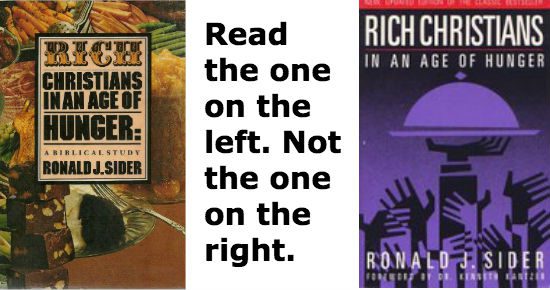
And but so, my point here actually is this: You should read the 1977 original edition of Rich Christians in an Age of Hunger and not the later editions in which the publisher sought to appease that book’s “Neoliberal” critics by revising the policy discussions in its final section.
And also too: Share your cookies.
– – – – – – – – – – – – – –
* Apart from racism, patriarchy, homophobia, xenophobia, religious animosity, and all the other such things that are, in this framing, irrelevant or, at most, tangential to “the root of all our problems.”
Previous Post

May 23, 2016
NRA: A grief ignored
Next Post
May 25, 2016 Scenes from the class war (5.25)
Browse Our Archives
Select a Category class warfare evangelicals Iraq Left Behind Mammon music Uncategorized
Select a Month November 2026 October 2026 September 2026 August 2026 July 2026 June 2026 May 2026 April 2026 March 2026 January 2026 December 2025 November 2025 October 2025 September 2025 August 2025 July 2025 June 2025 May 2025 April 2025 March 2025 February 2025 January 2025 December 2024 November 2024 October 2024 September 2024 August 2024 July 2024 June 2024 May 2024 April 2024 March 2024 February 2024 January 2024 December 2023 November 2023 October 2023 September 2023 August 2023 July 2023 June 2023 May 2023 April 2023 March 2023 February 2023 January 2023 December 2022 November 2022 October 2022 September 2022 August 2022 July 2022 June 2022 May 2022 April 2022 March 2022 February 2022 January 2022 December 2021 November 2021 October 2021 September 2021 August 2021 July 2021 June 2021 May 2021 April 2021 March 2021 February 2021 January 2021 December 2020 November 2020 October 2020 September 2020 August 2020 July 2020 June 2020 May 2020 April 2020 March 2020 February 2020 January 2020 December 2019 November 2019 October 2019 September 2019 August 2019 July 2019 June 2019 May 2019 April 2019 March 2019 February 2019 January 2019 December 2018 November 2018 October 2018 September 2018 August 2018 July 2018 June 2018 May 2018 April 2018 March 2018 February 2018 January 2018 December 2017 November 2017 October 2017 September 2017 August 2017 July 2017 June 2017 May 2017 April 2017 March 2017 February 2017 January 2017 December 2016 November 2016 October 2016 September 2016 August 2016 July 2016 June 2016 May 2016 April 2016 March 2016 February 2016 January 2016 December 2015 November 2015 October 2015 September 2015 August 2015 July 2015 June 2015 May 2015 April 2015 March 2015 February 2015 January 2015 December 2014 November 2014 October 2014 September 2014 August 2014 July 2014 June 2014 May 2014 April 2014 March 2014 February 2014 January 2014 December 2013 November 2013 October 2013 September 2013 August 2013 July 2013 June 2013 May 2013 April 2013 March 2013 February 2013 January 2013 December 2012 November 2012 October 2012 September 2012 August 2012 July 2012 June 2012 May 2012 April 2012 March 2012 February 2012 January 2012 December 2011 November 2011 October 2011 September 2011 August 2011 July 2011 June 2011 May 2011 April 2011 March 2011 February 2011 January 2011 December 2010 November 2010 October 2010 September 2010 August 2010 July 2010 June 2010 May 2010 April 2010 March 2010 February 2010 January 2010 December 2009 November 2009 October 2009 September 2009 August 2009 July 2009 June 2009 May 2009 April 2009 March 2009 February 2009 January 2009 December 2008 November 2008 October 2008 September 2008 August 2008 July 2008 June 2008 May 2008 April 2008 March 2008 February 2008 January 2008 December 2007 November 2007 October 2007 September 2007 August 2007 July 2007 June 2007 May 2007 April 2007 March 2007 February 2007 January 2007 December 2006 November 2006 October 2006 September 2006 August 2006 July 2006 June 2006 May 2006 April 2006 March 2006 February 2006 January 2006 December 2005 November 2005 October 2005 September 2005 August 2005 July 2005 June 2005 May 2005 April 2005 March 2005 February 2005 January 2005 December 2004 November 2004 October 2004 September 2004 August 2004 July 2004 June 2004 May 2004 April 2004 March 2004 February 2004 January 2004 December 2003 November 2003 October 2003 September 2003
Follow Us!
TAKE THE
Religious Wisdom Quiz
What was primary method of land transfer?
Select your answer to see how you score.
Witness testimony Verbal agreement Oath Written deed
Related posts from slacktivist


Postcards from America (02.05.25)
TRENDING AT PATHEOS Progressive Christian

Stop Making Thanksgiving Problematic And Just Give Thanks
“What if, today, we were grateful for everything?” –Charlie Brown I...

Sunday Readings: Stay Awake and Hope
The First Sunday of Advent begins a new liturgical year, and the...

Are You a Scrooge or an Ebenezer?
A Call to Remember As the Christmas season begins, will we remember...

Noah’s Ark Archaeologists: Gopher Wood or Should We...
Ancient wood, a boat-shaped formation and dates that invite a second look:...

Smart people saying smart things (11.24.26)
Please take time to listen to Perry Bacon, Sarah Posner, Adam Serwer,...

The Contingency of Our Technology
Last week we were hit with a raft of massive technology outages....
view all Progressive Christian blogs
Ad-Free & Subscriber Log-In Subscription Support
- About Us
- 2026 Calendar
- Videos
- Podcasts
- Library of World Religions
- Faith In Media Tracker
- Advertise With Us
- Write for Us
- Privacy Policy
- Terms of Service
- Do Not Sell My Data
- Contact Us
- Radiant Digital
- Manage Newsletter Subscriptions
- Unsubscribe From Notifications
- Sitemap
Copyright 2008-2026, Patheos, part of the Radiant Digital network of media brands. All rights reserved.
Subscription Support Ad-Free & Subscriber Log-In
Follow Patheos