
BuddhistCatholicContemplativeEvangelicalGeneral ChristianHinduJewishLatter-day SaintMuslimNew VisionsProgressive Christian
Beliefs
- Buddhist
- Catholic
- Contemplative
- Evangelical
- General Christian
- Hindu
- Jewish
- Latter-day Saint
- More Voices
- Muslim
- New Visions
- Pagan
- Progressive Christian
Topics
- Religion News
- Food and Religion
- Sports and Religion
- Religious Art
- Religious Music and Entertainment
- Religious Events
- History and Religion
- Style and Religion
- Politics and Religion
- Women in Religion
- Recreation Outdoors and Religion
- Business Finance and Religion
- Careers Workplace and Religion
- Education and Religion
- Family Parenting and Religion
- Health Fitness and Religion
- Home and Religion
- Relationships and Religion
- Technology and Religion
- Travel and Religion
Columnists
- Buddhist Columnists
- Business Finance and Religion Columnists
- Careers Workplace and Religion Columnists
- Catholic Columnists
- Contemplative Columnists
- Education and Religion Columnists
- Evangelists Columnists
- Family Parenting and Religion Columnists
- General Christian Columnists
- Health Fitness and Religion Columnists
- Hindu Columnists
- History and Religion Columnists
- Home and Religion Columnists
- Jewish Columnists
- More Voices Columnists
- Latter Day Columnists
- Muslim Columnists
- New Visions Columnists
- Nonreligious Columnists
- Pagan Columnists
- Politics and Religion Columnists
- Progressive Columnists
- Recreation Outdoors and Religion Columnists
- Relationships and Religion Columnists
- Religion News Columnists
- Religious Art Columnists
- Religious Events Columnists
- Religious Music and Entertainment Columnists
- Sports and Religion Columnists
- Style and Religion Columnists
- Technology and Religion Columnists
- Travel and Religion Columnists
- Women in Religion Columnists
Resource Library
- 2026 Calendar
- Library of World Religions
- The 100 Most Holy Places on Earth
- Patheos Answers
- Podcasts
- Videos
- Faith Leaders Database
- Anglican Episcopalian
- Bahai
- Baptist
- Buddhism
- Christianity
- Confucianism
- Eastern Orthodoxy
- Hinduism
- Holiness and Pentecostal
- ISKCON
- Islam
- Judaism
- Lutheran
- Methodist
- The Church of Jesus Christ of Latter-day Saints
- New Age
- Paganism
- Presbytarian and Reformed
- Protestantism
- Religion Behind the Scenes
- Roman Catholic
- Scientology
- Shia Islam
- Sikhism
- Sufism
- Sunni Islam
- Taoism
- Zen
- See all religions
Research Tools
 Ad-Free & Subscriber Log-In Subscription Support
Ad-Free & Subscriber Log-In Subscription Support
Follow Patheos 

- Trending:
- Forgiveness
- |
- Marriage
- |
- Consciousness
- |
- Death Penalty
- |
- Election
- |
- Halloween

- Home
- Progressive Christian
- Left Behind Classic Fridays, No. 67: ‘Selective literalism’
Left Behind Classic Fridays, No. 67: ‘Selective literalism’
Last updated on: February 5, 2016 at 8:25 am by Fred Clark
Left Behind Classic Fridays, No. 67: ‘Selective literalism’ 2016-02-04T19:37:30-05:00 Fred Clark
Patheos Explore the world's faith through different perspectives on religion and spirituality! Patheos has the views of the prevalent religions and spiritualities of the world.
Originally posted October 21, 2005.
You can read this entire series, for free, via the convenient Left Behind Index. This post is also part of the ebook collection The Anti-Christ Handbook: Volume 1, available on Amazon for just $2.99. Volume 2 of The Anti-Christ Handbook, completing all the posts on the first Left Behind book, is also now available.
Left Behind, pg. 165
Rayford Steele has not yet, himself, converted to what Tim LaHaye and Jerry Jenkins call “true” Christianity, but he’s already started trying to convert his daughter Chloe.
“I always called myself a Christian, mostly because I was raised that way and I wasn’t Jewish.”
“Now you’re saying you’re not a Christian?”
“Chloe, I think the Christians are gone.”
“So I’m not a Christian either?”
“You’re my daughter and the only other member of my family still left; I love you more than anything on earth. But if the Christians are gone and everyone else is left, I don’t think anyone is a Christian.”
“Some kind of a super Christian, you mean.”
“Yeah, a true Christian. Apparently those who were taken were recognized by God as truly his.”
This idea of true versus false Christianity, genuine versus inadequate faith, is at the heart of Left Behind. It’s built into the fabric of the book, as the title itself suggests. Some will be “recognized by God as truly his.” Everyone else will be “left behind.” Explaining and describing who falls into which group, and how to distinguish between the two, is an essential part of the story’s structure. This distinction — shibboleth, litmus test — is one of the book’s primary themes.
The problem is that such a distinction, the Bible makes very clear, is none of our business. It is, in fact, something Jesus explicitly commanded his followers not to do:
Jesus told them another parable: “The kingdom of heaven is like a man who sowed good seed in his field. But while everyone was sleeping, his enemy came and sowed weeds among the wheat, and went away. When the wheat sprouted and formed heads, then the weeds also appeared.
“The owner’s servants came to him and said, ‘Sir, didn’t you sow good seed in your field? Where then did the weeds come from?’
“‘An enemy did this,’ he replied.
“The servants asked him, ‘Do you want us to go and pull them up?’
“‘No,’ he answered, ‘because while you are pulling the weeds, you may root up the wheat with them. Let both grow together until the harvest. At that time I will tell the harvesters: First collect the weeds and tie them in bundles to be burned; then gather the wheat and bring it into my barn.'”
When this little allegory was met with blank stares from his disciples, Jesus took the unusual step of spelling out explicitly what he meant:
“The harvest is the end of the age, and the harvesters are angels. As the weeds are pulled up and burned in the fire, so it will be at the end of the age. The Son of Man will send out his angels, and they will weed out of his kingdom everything that causes sin and all who do evil. They will throw them into the fiery furnace, where there will be weeping and gnashing of teeth. Then the righteous will shine like the sun in the kingdom of their Father.”
This is some fairly trippy eschatology — harvester angels and fiery furnaces and the like. If you insist, as L&J do, on reading everything in the Bible “literally,” at face value, then you’re going to have a very difficult time reconciling the figures of speech in this passage (Matthew 13) with the equally vivid, but very different, literary details of this same end-of-the-age sorting that Jesus provides in the parable of the Sheep and the Goats (Matt. 25) or that of Lazarus and the Rich Man (in Luke 16).
The point of all three stories, of course, is that the kingdom of God is made up of those who do good, not those who do evil — and particularly not those evildoers (weeds, goats, Dives) who ignore the needs of the poor. To read such stories and ignore this point is perverse. To interpret them as primarily about the specific mechanics of the End Times — the role of Abraham and angels, the heat-setting of the fiery furnace — is even more perverse.
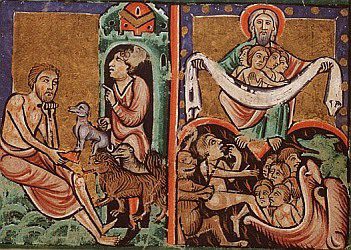 Such a reading makes a good defense mechanism, however, if you’re the rich man or the goats or the bad seed. If you’ve been ignoring the beggar at the gate, giving him only crumbs from your table — if you’ve been neglecting to feed the hungry, tend the sick, clothe the naked and comfort those in prison — then stories like these can be very disconcerting unless you’re able to distract yourself with some contorted “literal” reading of all the tangential details.
The criteria for the sorting that Jesus describes in all three of these parables is nothing like the criteria Rayford, LaHaye and Jenkins have in mind for distinguishing between true Christians “recognized by God as truly his” and those who will be left behind. L&J’s criteria involves a magical prayer of conversion and a “personal relationship with Jesus Christ” that has nothing to do with feeding Jesus when we encounter him in the hungry, or clothing Jesus when we encounter him naked, or visiting Jesus when he has, yet again, been thrown into prison.
L&J, like many American evangelicals, insist on what they call a “literal” Hell. Most of their literal idea of this literal Hell comes from a fuzzy cultural memory of a literal reading of Dante, but it is supported by hints from these various Day of Judgment stories told by Jesus. In the parable of the Sheep and the Goats, Jesus says that those who neglect the needy will be cast “outside, into the darkness, where there will be weeping and gnashing of teeth.” In the parable of the Wheat and Weeds, the mature weeds will be “pulled up and burned in the fire.” The Rich Man who neglected poor Lazarus is sent to “Hades, where he was in torment.” (I would love to read an explanation of a “literal” interpretation of Jesus’ reference here to the Greek god of the dead.)
The most vivid account of this “literal Hell” is from L&J’s favorite book of the Bible, Revelation, in another tale of end-of-the-age sorting:
And I saw the dead, great and small, standing before the throne, and books were opened. Another book was opened, which is the book of life. The dead were judged according to what they had done as recorded in the books. The sea gave up the dead that were in it, and death and Hades gave up the dead that were in them, and each person was judged according to what he had done. Then death and Hades were thrown into the lake of fire. The lake of fire is the second death. If anyone’s name was not found written in the book of life, he was thrown into the lake of fire.
I don’t want to get into a debate about the theology of Hell. What interests me in all of this is the glaring contradiction and inconsistency in L&J’s and other evangelicals’ supposedly “literal” reading of the Bible.
Every one of the passages above is cited in defense of a “literal Hell” by people who insist on a “literal” reading of scripture. Yet every one of these passages also explicitly states that people will be judged “according to what they had done.” This is true of every passage they might cite in defense of their literal reading of a literal Hell. And in every case, these literal readers will insist that the passage’s emphasis on deeds, works and actions should not be read literally.
That’s rather interesting, isn’t it?
I don’t believe that such passages are irreconcilable with the idea of justification by faith, but what’s interesting here is the selective literalism employed by L&J and others like them to dismiss such “strawy” passages. This selective literalism allows them to disregard explicit teachings about the poor and the needy while still insisting that they have the wisdom, the authority and the right to judge who is and is not a “true” Christian, who will and who won’t be left behind. That arrogant and contrabiblical assumption pervades Left Behind, beginning with the cover of the book and saturating every page.
By the way, the parable of the Wheat and Weeds, cited above, raises another difficulty for L&J and the other selective literalists of the premillennial dispensationalist persuasion. The premise of LB is that all the true Christians, all the good and the innocent, will be “raptured.” They will, as Irene Steele put it, be rescued by “Jesus coming back to get us before we die.” After that happens, L&J believe, the wicked and the guilty and the false Christians and the Jews will all be destroyed in an outpouring of God’s wrath. A “literal” reading of Jesus’ parable, however, would suggest they’ve got things in the wrong order. The parable has the weeds harvested first, then the wheat.
This is a contradiction only if one accepts L&J’s alleged insistence on a “literal interpretation.” I find this to be a foolish and illiterate hermeneutic, but these are the rules they claim to be following. When these rules become inconvenient, however, L&J casually toss them aside.
Previous Post

February 4, 2016
Could you be my little movie star?
Next Post
February 5, 2016 Pray that you will be among those 'left behind'
Browse Our Archives
Select a Category class warfare evangelicals Iraq Left Behind Mammon music Uncategorized
Select a Month October 2026 September 2026 August 2026 July 2026 June 2026 May 2026 April 2026 March 2026 January 2026 December 2025 November 2025 October 2025 September 2025 August 2025 July 2025 June 2025 May 2025 April 2025 March 2025 February 2025 January 2025 December 2024 November 2024 October 2024 September 2024 August 2024 July 2024 June 2024 May 2024 April 2024 March 2024 February 2024 January 2024 December 2023 November 2023 October 2023 September 2023 August 2023 July 2023 June 2023 May 2023 April 2023 March 2023 February 2023 January 2023 December 2022 November 2022 October 2022 September 2022 August 2022 July 2022 June 2022 May 2022 April 2022 March 2022 February 2022 January 2022 December 2021 November 2021 October 2021 September 2021 August 2021 July 2021 June 2021 May 2021 April 2021 March 2021 February 2021 January 2021 December 2020 November 2020 October 2020 September 2020 August 2020 July 2020 June 2020 May 2020 April 2020 March 2020 February 2020 January 2020 December 2019 November 2019 October 2019 September 2019 August 2019 July 2019 June 2019 May 2019 April 2019 March 2019 February 2019 January 2019 December 2018 November 2018 October 2018 September 2018 August 2018 July 2018 June 2018 May 2018 April 2018 March 2018 February 2018 January 2018 December 2017 November 2017 October 2017 September 2017 August 2017 July 2017 June 2017 May 2017 April 2017 March 2017 February 2017 January 2017 December 2016 November 2016 October 2016 September 2016 August 2016 July 2016 June 2016 May 2016 April 2016 March 2016 February 2016 January 2016 December 2015 November 2015 October 2015 September 2015 August 2015 July 2015 June 2015 May 2015 April 2015 March 2015 February 2015 January 2015 December 2014 November 2014 October 2014 September 2014 August 2014 July 2014 June 2014 May 2014 April 2014 March 2014 February 2014 January 2014 December 2013 November 2013 October 2013 September 2013 August 2013 July 2013 June 2013 May 2013 April 2013 March 2013 February 2013 January 2013 December 2012 November 2012 October 2012 September 2012 August 2012 July 2012 June 2012 May 2012 April 2012 March 2012 February 2012 January 2012 December 2011 November 2011 October 2011 September 2011 August 2011 July 2011 June 2011 May 2011 April 2011 March 2011 February 2011 January 2011 December 2010 November 2010 October 2010 September 2010 August 2010 July 2010 June 2010 May 2010 April 2010 March 2010 February 2010 January 2010 December 2009 November 2009 October 2009 September 2009 August 2009 July 2009 June 2009 May 2009 April 2009 March 2009 February 2009 January 2009 December 2008 November 2008 October 2008 September 2008 August 2008 July 2008 June 2008 May 2008 April 2008 March 2008 February 2008 January 2008 December 2007 November 2007 October 2007 September 2007 August 2007 July 2007 June 2007 May 2007 April 2007 March 2007 February 2007 January 2007 December 2006 November 2006 October 2006 September 2006 August 2006 July 2006 June 2006 May 2006 April 2006 March 2006 February 2006 January 2006 December 2005 November 2005 October 2005 September 2005 August 2005 July 2005 June 2005 May 2005 April 2005 March 2005 February 2005 January 2005 December 2004 November 2004 October 2004 September 2004 August 2004 July 2004 June 2004 May 2004 April 2004 March 2004 February 2004 January 2004 December 2003 November 2003 October 2003 September 2003
Follow Us!
TAKE THE
Religious Wisdom Quiz
Who said, "You intended to harm me, but God intended it for good"?
Select your answer to see how you score.
David Job Solomon Joseph
Related posts from slacktivist

Can't seem to get it through my head

For Buffy and Carl so loved the world


'To every generation': Child abuse at Cornerstone Church
TRENDING AT PATHEOS Progressive Christian

The Iron Gates and the Lion of the...
Yesterday, I didn't finish my report about, well, yesterday. So I'll...

Dolly Parton’s Last Song Wins Dove Award with...
Bluegrass band The Grascals, speaking on the red carpet at the 57th...

The Image: On the Horror of Capitalism and...
The Image Then went the Pharisees, and took counsel how they might...

We are approaching the date of our new American national holiday: October...

Letters on Living the Faith by C.S. Lewis
Most of us met C.S. Lewis as a public intellectual. Mere Christianity....

When Halloween Unmasks Married Hearts
Written by Dr. David K. Ewen from Eternal Truth Bible College Behind...
view all Progressive Christian blogs
Ad-Free & Subscriber Log-In Subscription Support
- About Us
- 2026 Calendar
- Videos
- Podcasts
- Library of World Religions
- Faith In Media Tracker
- Advertise With Us
- Write for Us
- Privacy Policy
- Terms of Service
- Do Not Sell My Data
- Contact Us
- Radiant Digital
- Manage Newsletter Subscriptions
- Unsubscribe From Notifications
- Sitemap
Copyright 2008-2026, Patheos. All rights reserved.
Subscription Support Ad-Free & Subscriber Log-In
Follow Patheos